
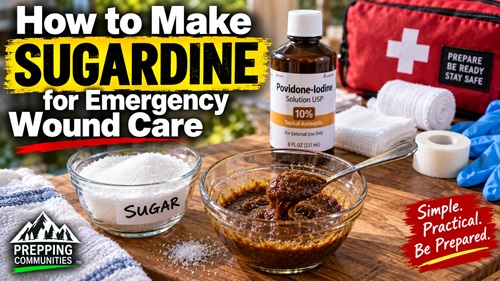
Sugar and povidone-iodine probably aren’t two things most people would think about combining for wound care, but the mixture commonly called sugardine has been used for years, particularly in veterinary wound care. It’s simple to make, inexpensive and requires ingredients that are relatively easy to store.
For preparedness purposes, though, knowing the recipe isn’t the most important part. If you’re going to keep something like sugardine in your emergency medical knowledge, you should understand what it is, why sugar has been used in wound care, how the mixture is made, why proper wound cleaning comes first and when an injury has gone beyond something that should be treated at home.
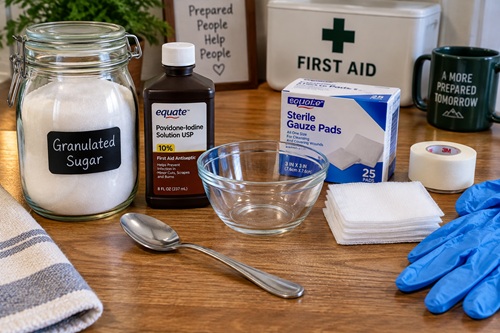
There is also an important distinction to make from the beginning. Sugardine is a traditional and improvised wound-care preparation, not a replacement for modern wound-care products or professional medical treatment. Sugar and sugar-based materials have been studied in wound care, but that doesn’t mean every homemade sugar preparation is proven effective for every type of wound. For a prepper, sugardine is better understood as contingency knowledge – another option to understand if normal resources become limited.
What Is Sugardine?
Sugardine is a thick paste made by combining ordinary granulated sugar with povidone-iodine solution. Sugar has some interesting properties when it is present at very high concentrations. One reason sugar-based materials have been used and studied in wound care is their effect on the wound environment, including osmotic effects and reduced water availability for microorganisms.
Povidone-iodine serves a different purpose. It is a broad-spectrum topical antiseptic with activity against many microorganisms. Combining it with sugar produces the thick paste commonly known as sugardine. The mixture is particularly familiar in veterinary and livestock circles, but that history shouldn’t be confused with proof that homemade sugardine is the best treatment for ordinary human wounds.
From a preparedness perspective, what makes the idea worth understanding is its simplicity. Sugar is inexpensive and stores extremely well when protected from moisture and pests. Povidone-iodine is also commonly kept with first-aid supplies. Instead of learning only about specialized products, you’re learning how basic materials may provide another option when normal wound-care resources aren’t readily available.
What You Need to Make Sugardine
The basic ingredients are ordinary granulated white sugar and a povidone-iodine solution intended for topical antiseptic use. You’ll also need a clean container and a clean spoon or other utensil for mixing.
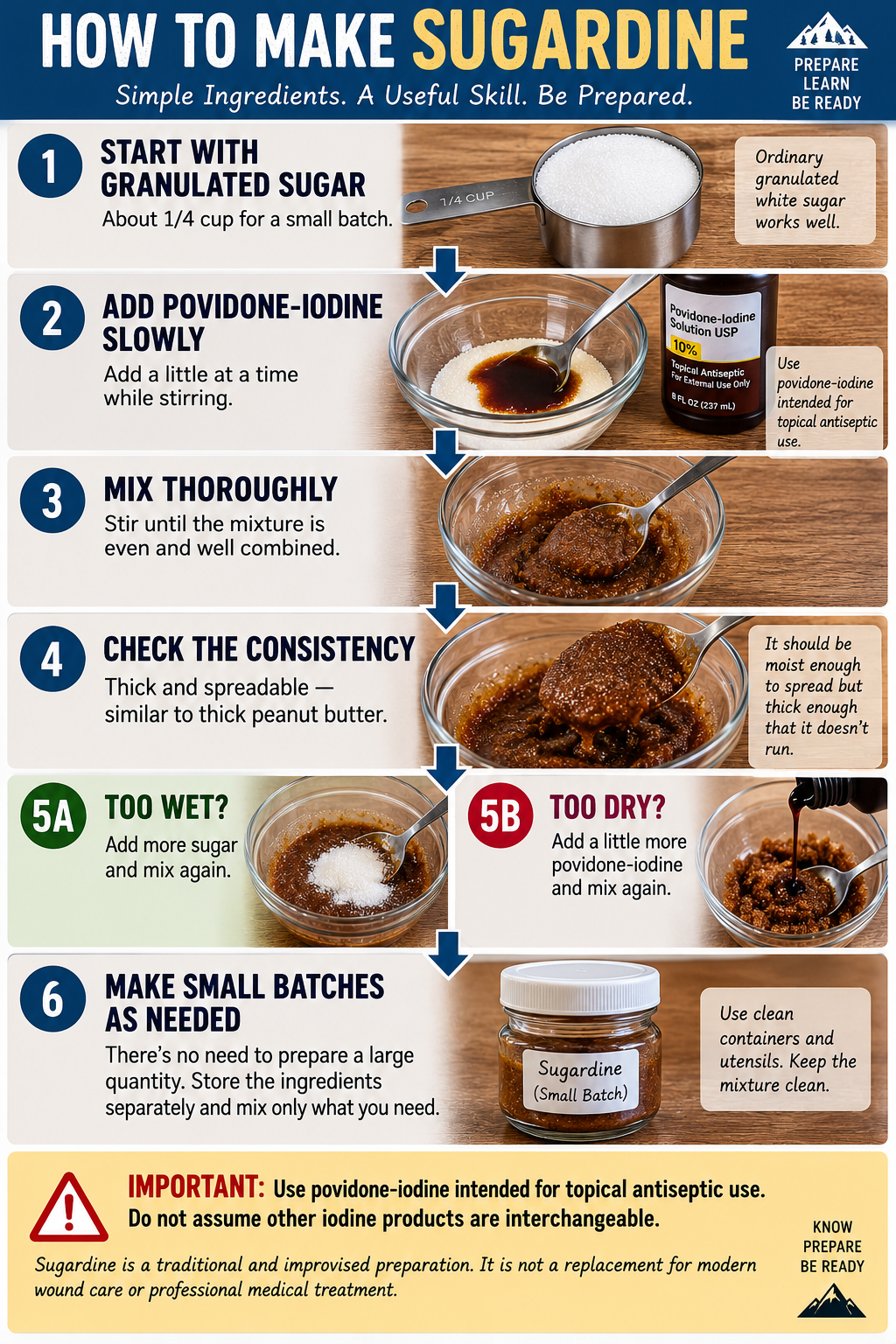
A practical small batch can begin with about 1/4 cup of granulated sugar. Add the povidone-iodine gradually while stirring rather than trying to hit a rigid ratio. You’re looking for a thick paste, so only a relatively small amount of liquid may be necessary. Starting small also prevents wasting supplies while you learn what the finished consistency should look like.
The type of iodine matters. Povidone-iodine, tincture of iodine and Lugol’s iodine are different preparations and shouldn’t automatically be treated as interchangeable. If you’re keeping povidone-iodine in your medical supplies, leave it in its original labeled container and follow the manufacturer’s directions and precautions.
Keeping medical products properly labeled is a small preparedness habit that can prevent a much bigger problem later. Months or years from now, somebody else may be the person reaching into that medical kit. They should be able to identify exactly what a product is, how it should be used and what precautions apply without having to guess.
How to Make Sugardine
Place about 1/4 cup of granulated sugar into a clean container and add a small amount of povidone-iodine. Stir the mixture thoroughly, then add a little more povidone-iodine only if it is needed.
The goal is a thick, spreadable paste rather than a liquid. Think of the consistency of thick peanut butter. It should be moist enough to spread but thick enough that it doesn’t immediately run away from where it is placed.
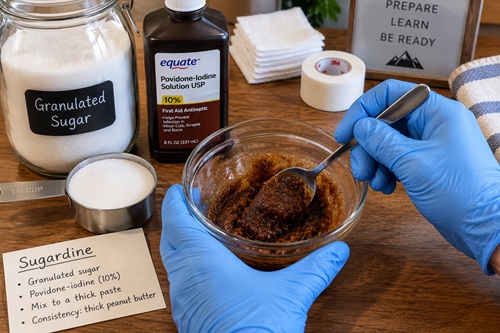
If you’ve added too much liquid, mix in additional sugar. If the mixture remains dry and crumbly, add a little more povidone-iodine and stir again. Adding the liquid gradually makes it much easier to control the consistency.
You’ll find different sugardine recipes giving different ratios. For preparedness purposes, understanding the desired consistency is more useful than memorizing a single formula. Sugar grain size, the particular product you’re using and environmental conditions can all affect how the mixture comes together.
There is also little reason to prepare a huge quantity. If you choose to keep this option available, storing the ingredients separately and mixing a small amount when needed makes more sense than depending on a large homemade batch that has been sitting in a medical cabinet for years.
Wound Cleaning Comes First
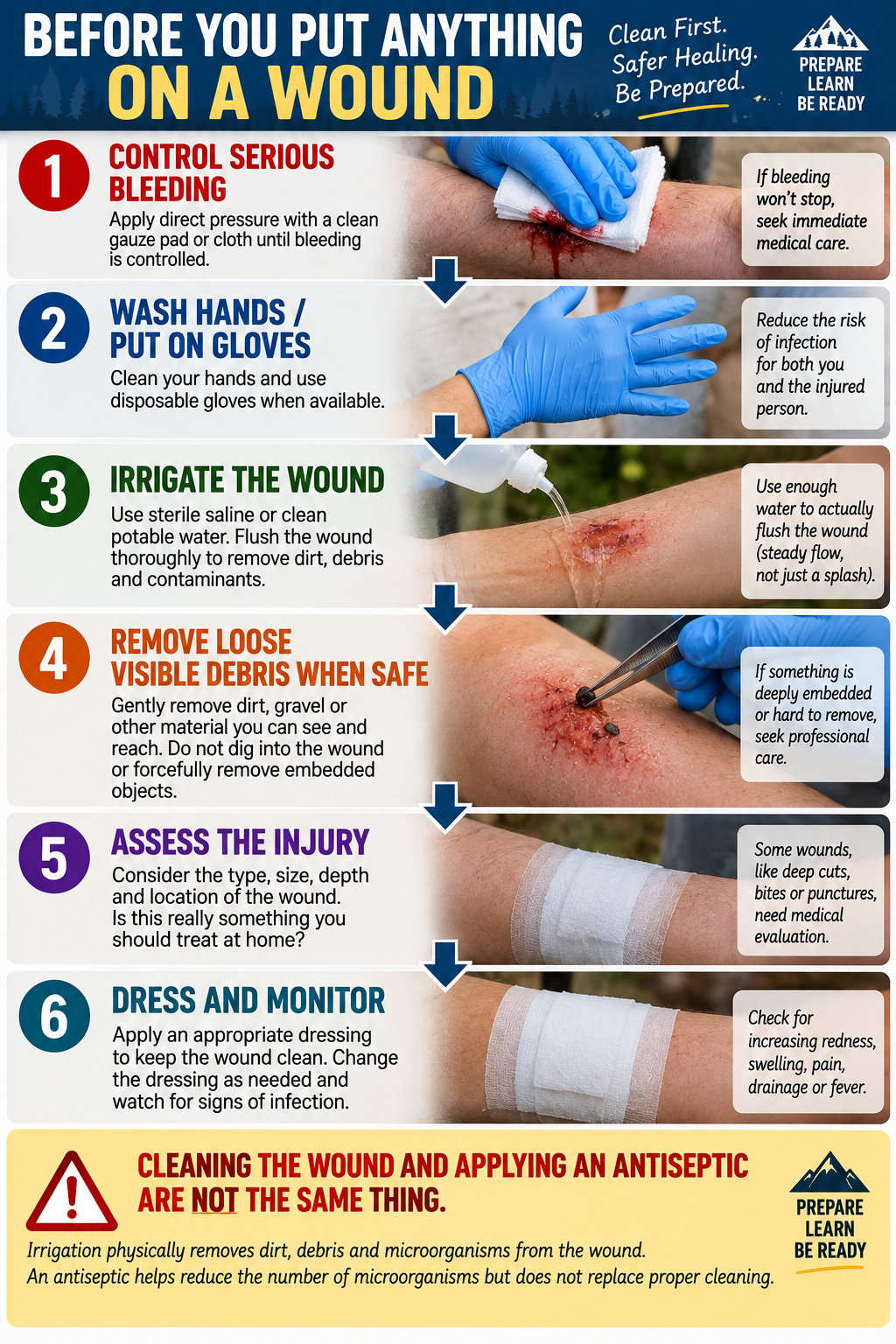
This may be the most useful lesson in the entire posting. Before worrying about sugardine – or almost anything else you’re planning to put on a wound – deal with the wound itself.
Dirt, gravel, plant material and other contamination don’t disappear because an antiseptic was applied afterward. Proper irrigation physically removes contamination, which is why having a reliable way to flush wounds is an important part of a first-aid kit.
Wash your hands and use medical gloves when available. Significant bleeding needs to be controlled first. Once bleeding is under control and you’re dealing with an injury appropriate for basic wound care, irrigate the wound thoroughly with sterile saline or clean potable water.
Use enough water to actually flush the injury. A tiny splash over the surface isn’t the same thing as irrigation. Visible loose debris can be carefully removed when it can be done safely, but deeply embedded material is another matter and may require professional treatment.
Povidone-iodine also shouldn’t simply be treated as a replacement for irrigation water. Cleaning a wound and applying an antiseptic are not the same thing. Saline or clean potable water is generally the better choice for physically flushing contamination from a wound.
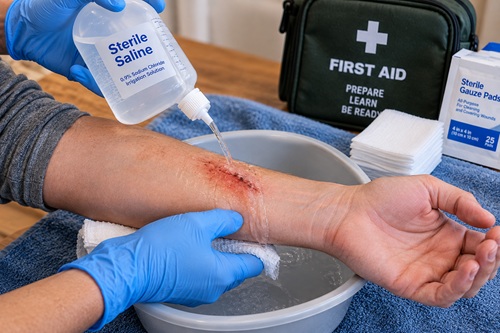
This is worth considering when you build emergency water supplies because clean water isn’t needed only for drinking and cooking. If several people are injured during an emergency, properly flushing wounds can consume considerably more water than expected.
Where Sugardine Fits Into Preparedness
If you have appropriate modern wound-care products available, use them according to their instructions rather than automatically replacing them with something homemade. Sugardine makes more sense as contingency knowledge for situations where normal resources are limited and appropriate medical care isn’t immediately available.
The type of injury matters much more than the recipe. A small superficial injury is very different from a deep puncture, animal or human bite, serious burn, heavily contaminated wound or injury involving deeper structures.
If an improvised preparation is being used, cleanliness matters. Don’t repeatedly dip dirty fingers or used utensils into your mixture. Keep the dressing clean and inspect the injury whenever the dressing is changed.
That inspection is important because changing a bandage isn’t just about putting another covering on the wound. It’s your chance to see whether the injury is actually improving. Pay attention to redness, swelling, warmth, drainage and pain. Look at what has changed since the previous dressing rather than simply asking whether the wound still looks bad.
Know When a Wound Is More Serious Than It Looks
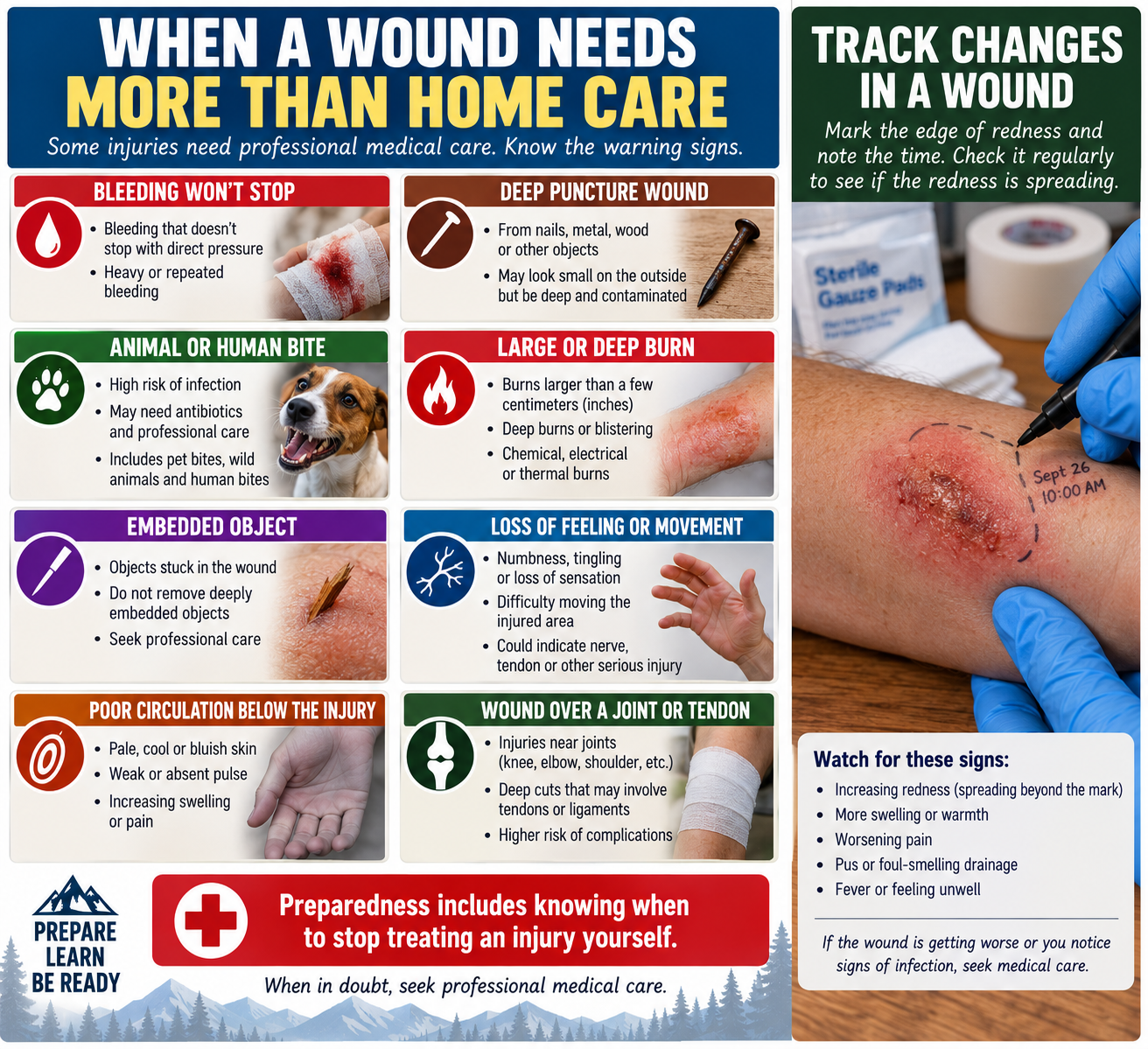
Some injuries deserve caution even when they don’t initially appear dramatic. Puncture wounds are a good example because the opening can be small while contamination or damage extends much farther below the surface.
Animal and human bites also deserve professional assessment because of their infection risks. Large or deep burns, heavily contaminated wounds, injuries containing embedded objects and wounds involving joints, tendons, nerves or other important structures can require care that simply can’t be provided by a homemade dressing.
Bleeding that can’t be controlled with appropriate direct pressure is an emergency. Loss of normal sensation, movement or circulation below an injury is another reason to seek urgent medical attention.
Being prepared doesn’t mean trying to prove that every medical problem can be handled at home. Good preparedness includes knowing when you’ve reached the limits of what you can safely do and getting the injured person to higher-level care while that option is still available.
Learn What a Worsening Wound Looks Like
One of the most useful medical preparedness skills is recognizing when a wound isn’t progressing normally. Some tenderness, redness and swelling can occur as part of healing, so what matters is how those symptoms change over time.
Redness that continues expanding, increasing warmth or swelling, worsening pain, pus or foul-smelling drainage should get your attention. Fever, chills, red streaks moving away from the wound, confusion, severe weakness or rapidly worsening symptoms are much more concerning and require prompt medical evaluation.
One simple technique can help you track spreading redness. Mark the outside edge of the red area with a pen and write down the time. When you look again later, you’ll have a visible reference showing whether the redness has remained within that boundary or continued moving outward.
That doesn’t diagnose an infection, but it gives you a simple way to track change instead of relying entirely on memory.
Some People Need Extra Caution
People with diabetes, poor circulation, reduced sensation or compromised immune systems can develop serious complications from wounds that might appear relatively minor. A small foot injury is a good example. Someone with reduced sensation may not fully appreciate how much damage has occurred, while impaired circulation can make healing more difficult.
Sugar and sugar-based treatments have been studied in different wound-care settings, but that shouldn’t be interpreted as a reason to self-treat diabetic foot wounds with homemade sugardine. These wounds can become serious and deserve appropriate medical assessment.
Povidone-iodine should also be treated like the medical product it is. Follow the product label, including its warnings and directions. Large treatment areas, repeated use and special medical circumstances aren’t the same as occasional use on a small area. When there is uncertainty because of an underlying medical condition, pregnancy, infancy or a previous reaction, professional guidance is the safer approach.
Store the Ingredients Instead of Depending on an Old Jar
For long-term preparedness, keeping the ingredients separately makes a lot of sense. Granulated white sugar stores extremely well when kept dry and protected from contamination and pests, and it has plenty of other uses.
Keep povidone-iodine in its original container and store it according to the manufacturer’s instructions. When you periodically inspect your first-aid supplies, check the bottle, label and expiration date just as you would your other medical products.
If you ever decide that sugardine is appropriate for a particular situation, you can prepare a small amount at that time. This keeps both ingredients available for other uses and means you aren’t relying on an old homemade preparation that has been sitting forgotten in the back of a cabinet.
Turn Your First-Aid Kit Into an Actual Capability
Sugardine raises a bigger preparedness issue that is worth thinking about. It’s easy to buy first-aid supplies. Knowing how to use them correctly is another matter. Someone can have an expensive trauma kit and still have trouble properly cleaning and dressing an ordinary wound.
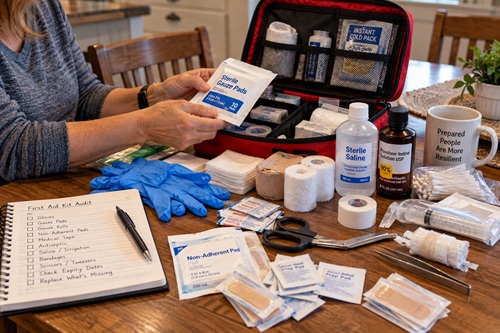
Take your first-aid supplies out sometime when there isn’t an emergency and work through a simple scenario. Imagine someone has fallen outside and badly scraped or cut an arm. Find the gloves. Decide what you would use to control the bleeding. Look at how you would irrigate the wound and how much irrigation water you actually have. Then find the gauze, dressings and tape you would use afterward.
Now imagine two or three people are injured instead of one. A handful of gauze pads suddenly doesn’t look like very much. Neither does one pair of gloves or one small bottle of saline. Working through the situation this way exposes weaknesses that aren’t obvious when everything is neatly packed into a first-aid bag.
It also makes you think about redundancy. If your preferred wound-care product is unavailable, what’s your second option? If the saline is gone, do you have clean water available? If adhesive bandages run out, can you make and secure a clean dressing with gauze and tape? Those are the kinds of questions that turn supplies into an actual preparedness capability.
Have a Backup Plan for Medical Care
Your medical plan shouldn’t end with your first-aid kit. Think about where you would actually go if someone needed professional treatment and your usual option wasn’t available.
Wildfires, floods, winter storms, power failures and road closures can all interfere with access to medical care without anything resembling a complete societal collapse. A relatively ordinary emergency can be enough to turn a short trip to the hospital into a much more complicated problem.
Know what alternatives exist in your area and think about more than one route for reaching them. Keep important medical and emergency contact information somewhere that doesn’t depend completely on a cellphone or internet connection. Make sure other people in the household know where the medical supplies are and understand the basic plan.
The purpose isn’t to assume that professional medical care will disappear. It’s to make sure a temporary disruption doesn’t leave you without options.
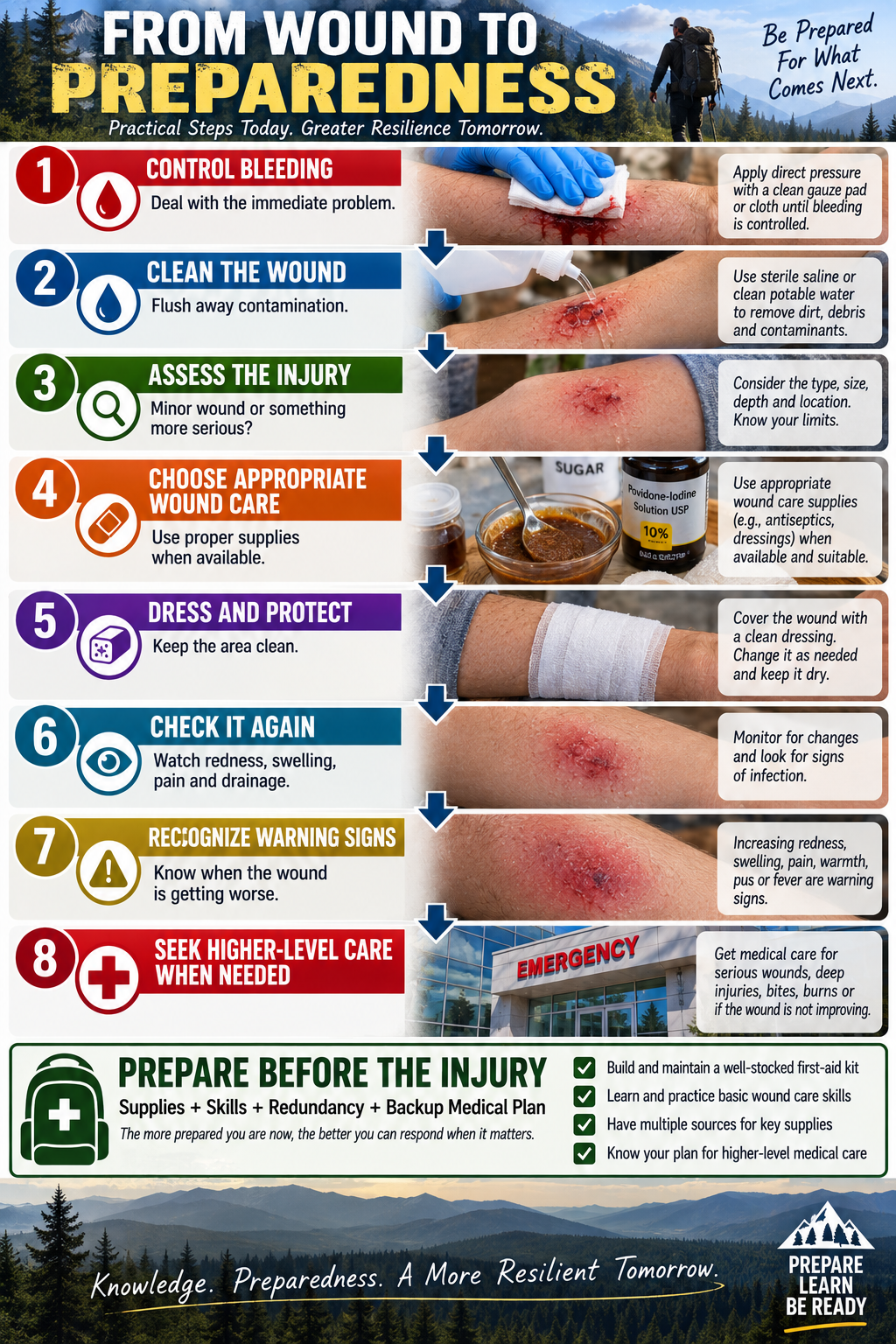
Preparedness Action Plan
Go through your first-aid supplies with wound care specifically in mind. Instead of simply counting bandages, think through the whole process from the moment someone is injured until the wound is cleaned, dressed and monitored. Make sure you have gloves, a realistic way to irrigate wounds, enough gauze and dressings, tape or wraps and appropriate first-aid products. Check expiration dates and inspect packaging for damage or contamination.
If you want sugardine available as part of your contingency knowledge, keep granulated white sugar properly stored and keep povidone-iodine in its original labeled container. You don’t necessarily need a premixed jar sitting on the shelf. The useful capability is having suitable supplies, understanding their limitations and knowing how to prepare a small amount if circumstances make it appropriate.
Spend some time learning basic wound care as well. Practise controlling bleeding, irrigating a simulated wound and securing a dressing. Learn the warning signs that an injury may be getting worse and decide ahead of time when your household would stop trying to manage a wound at home and seek professional medical help.
Finally, look beyond the first-aid kit. Know where you would go if your usual clinic or hospital wasn’t accessible, how you could reach an alternative and where important medical information is stored if your phone or internet connection isn’t working.
Key Takeaways
Sugardine is a simple mixture of granulated sugar and povidone-iodine made into a thick paste. Sugar and sugar-based compounds have a history in wound care and have been studied for their effects on the wound environment, but the evidence varies depending on the preparation and type of wound. Homemade sugardine should therefore be understood as contingency knowledge rather than a proven replacement for standard wound treatment.
The recipe itself is easy. The more valuable skills are knowing how to control bleeding, thoroughly irrigate a wound, prevent additional contamination, maintain a clean dressing, recognize when an injury is getting worse and understand when professional medical care is needed.
Keep useful supplies, build redundancy and practise the basic skills before an emergency happens. When medical help is delayed, knowing what you’re doing can be just as important as what you have in the first-aid kit.
Sources and Further Reading
For readers who want to explore the medical evidence behind this posting, research reviews indexed by the U.S. National Library of Medicine have examined the historical and modern use of sugar and sugar-based materials in wound care, including their proposed osmotic effects and potential applications in wound management.
Clinical wound-care guidance from the American Academy of Family Physicians also provides useful information on wound irrigation, including the use of sterile saline or potable tap water and considerations surrounding antiseptic solutions in open wounds.
Additional medical literature has examined sugar-based wound treatments in difficult-to-heal wounds, including diabetic wounds. These studies are useful for understanding the science and history behind sugar-based wound care, but they should not be interpreted as evidence that a homemade sugardine preparation is appropriate for every wound or every patient.
Further reading: U.S. National Library of Medicine/PubMed research on sugar and sugar-based wound treatments, American Academy of Family Physicians guidance on wound irrigation and wound-care research concerning diabetic and chronic wounds.
This posting is for preparedness education and general information only. It is not medical advice and is not a substitute for evaluation or treatment by a qualified healthcare professional. Serious, deep, contaminated, infected or otherwise concerning wounds should receive appropriate medical care as soon as possible.
© Prepping Communities. This content is for informational purposes only and not professional advice. Use at your own risk.
Terms | Privacy | Guidelines