
Preparedness can get complicated surprisingly fast. Start looking into emergency preparedness and pretty soon there are lists for everything: how much food to store, how much water you need, which batteries to buy, what belongs in a bug-out bag, whether you need a generator, solar panels, radios, water filters or months of supplies.
Before buying more stuff, there is a simpler place to start. Look at your own household and figure out what would stop working if some of the systems you normally depend on weren’t available.
That approach works whether you live in an apartment in Toronto, a subdivision outside Denver, a rural property in British Columbia or a farmhouse in Saskatchewan. The risks aren’t identical, but most households across North America depend on many of the same things. We expect electricity when we flip a switch, water when we open a tap, fuel when we reach a gas station and food when we walk into a grocery store. We also depend on pharmacies, roads, cellular networks, internet service and emergency services without thinking very much about the systems behind them.
Good preparedness isn’t about eliminating every one of those dependencies. That’s probably impossible. It’s about knowing which dependencies matter most to your household and making sure the loss of one doesn’t immediately leave you without another option.
Start With What Could Actually Happen Where You Live
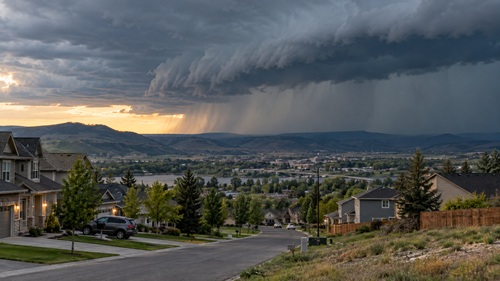
You don’t need to begin by preparing for every disaster imaginable. Start with your own area. Hurricanes matter along parts of the Atlantic and Gulf coasts. Wildfire is a serious concern across large areas of western Canada and the United States. Earthquakes matter along parts of the West Coast. Tornadoes, floods, ice storms, blizzards, extreme cold and extreme heat affect different regions in different ways. There are also emergencies that can happen almost anywhere. The power can go out, a water main can break, a boil-water advisory can be issued, cellular service can fail or a storm can prevent trucks from reaching your community for several days.
Write down a few situations that could genuinely affect where you live, but don’t stop at naming the hazard. Think about what would happen because of it. A winter storm isn’t necessarily the real problem. The problem may be that the storm knocks out electricity for three days while the temperature outside is well below freezing. A wildfire twenty miles away may never come close to your property, but it could close the highway you normally use to leave town. A major storm may cause little damage to your house but prevent fuel and grocery deliveries from reaching your community.
That shift in thinking is important. Instead of trying to predict exactly which disaster will happen, you’re looking at what your household depends upon and asking what happens when one of those things disappears.
Walk Through an Ordinary Day
Think about what happens from the time you wake up. The lights work. The toilet flushes. Someone makes coffee. The refrigerator is cold. Phones are charged. Maybe the furnace is running. If you’re on a well, an electric pump may be quietly providing water without anybody thinking about it.
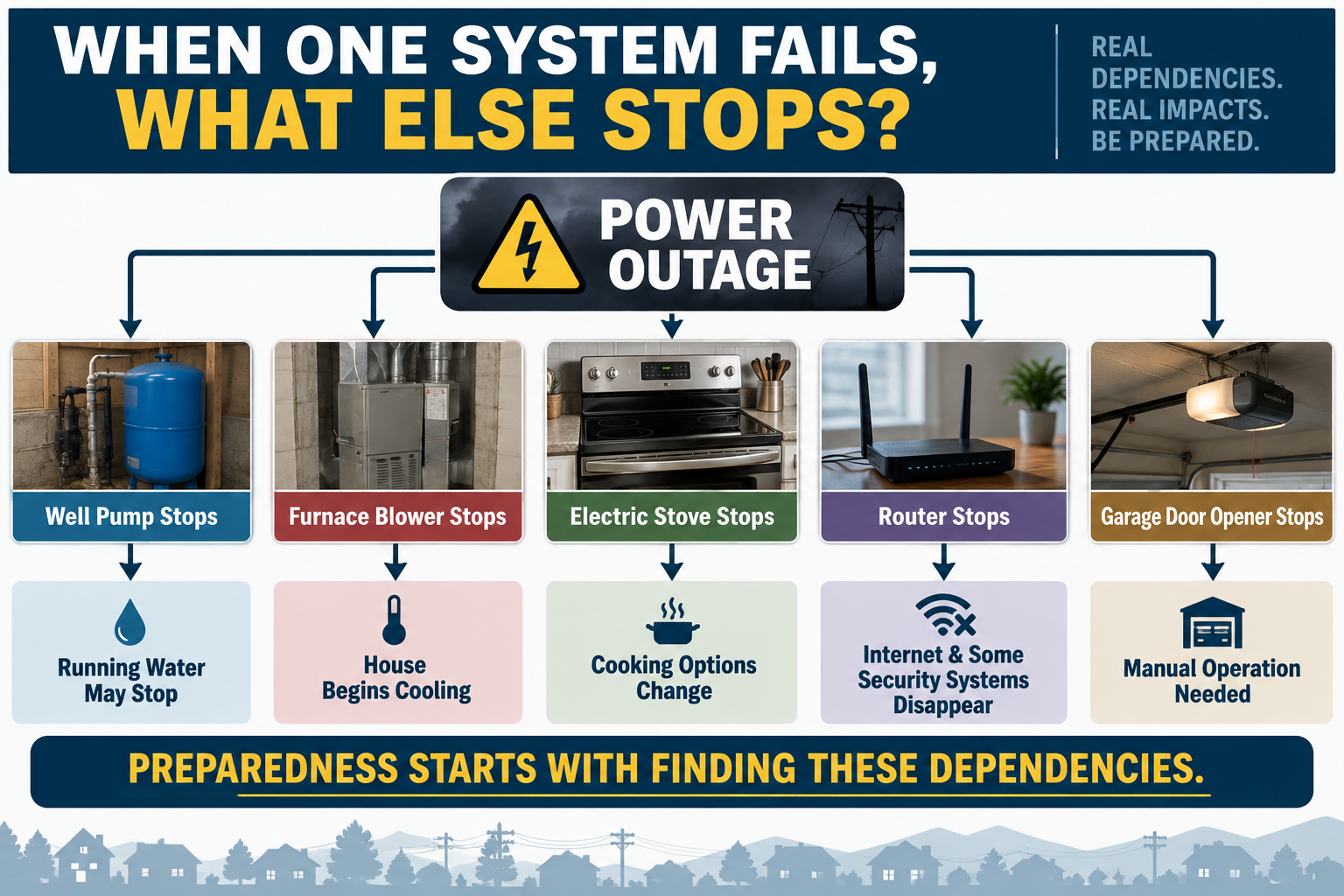
Now imagine it’s 6:30 in the morning after an overnight winter outage. The house is getting colder. You turn on the kitchen tap and nothing happens because the well pump doesn’t have power. You have plenty of coffee, but the coffee maker doesn’t work and your stove is electric.
Nothing catastrophic has happened, but in a few minutes you’ve already discovered three dependencies.
Try the same exercise with water, cellular service or access to town. Imagine the highway is closed for three days. Maybe the grocery store is still open but deliveries aren’t arriving. Perhaps the gas station has fuel but its electronic payment system isn’t operating normally. Emergency services may still be available but response times could be longer because roads are blocked or call volumes are high.
Write down what you discover. Those weaknesses are much more useful to you than somebody else’s generic preparedness checklist because they belong to your household.
Build a Pantry You Can Actually Use
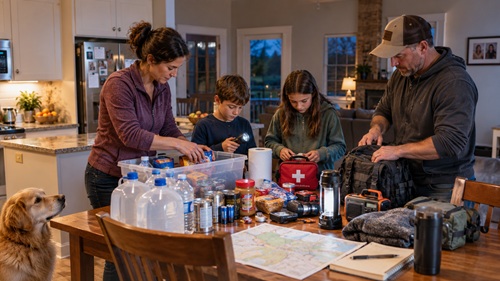
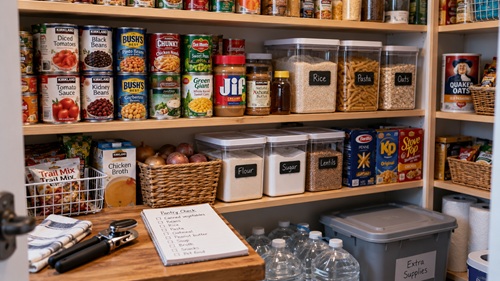
Emergency food doesn’t have to begin with expensive survival meals or buckets that sit untouched for twenty years. Look at what your household already eats. Rice, pasta, oatmeal, soup, beans, canned vegetables, canned meat, peanut butter and other shelf-stable foods can become part of an emergency pantry without completely changing the way your family eats.
Build that supply gradually and rotate it through normal meals. If you regularly use a particular canned food, keep several more on hand and replace what you use. This gives you an emergency reserve without creating a second pantry filled with food nobody normally wants.
The amount of food isn’t the only thing that matters. Look at how you would prepare it. Someone can have several weeks of rice, pasta and canned goods stored and discover during a blackout that most of their meals require water and an electric stove. Keep some foods that require little or no preparation and have a safe backup cooking method appropriate for your home.
A manual can opener is worth keeping around too. It sounds almost too obvious to mention until the electricity is off and somebody is staring at canned food with an electric opener sitting uselessly on the counter.
Build the pantry around the people who actually live in the house. Allergies, special diets, infants, elderly family members and pets all change what an appropriate emergency food supply looks like. The best emergency pantry isn’t necessarily the largest one. It’s the one your household can actually use.
Water Needs Its Own Plan
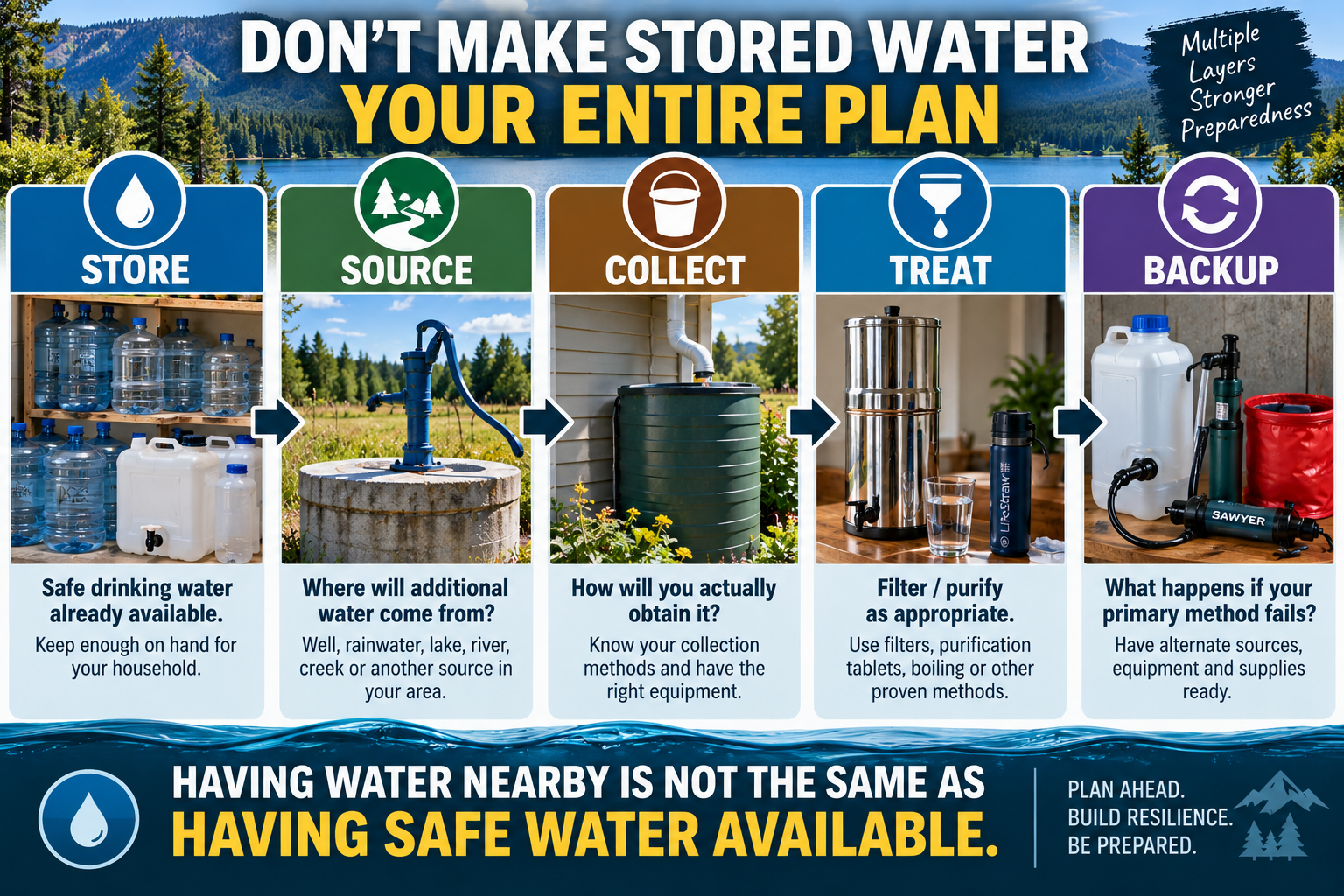
Water problems become serious quickly because we use far more water than we normally notice. Drinking is the obvious need, but water is also used for cooking, washing hands, brushing teeth, cleaning, pets and sanitation. Start by storing potable water, but don’t make stored water your entire plan because eventually those containers will be empty.
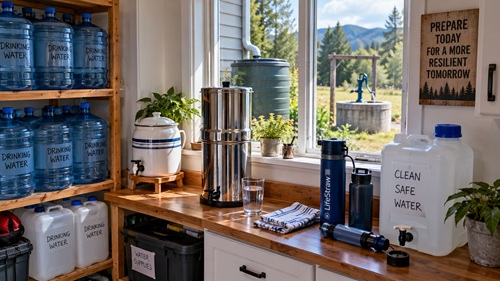
Think about where additional water could come from. If you have a well, that’s an important resource, but only if you can still get water from it. An electric well pump without backup power can leave a household with plenty of groundwater beneath the property and no practical way to bring it into the house.
If you’re considering rainwater, a lake, river, creek or another source, understand how you would collect and treat that water before drinking it. Learn how your filtration and purification equipment works while clean tap water is still available. Know what your filter removes, what it doesn’t remove, approximately how much water it can process and what you would do if it failed.
Don’t wait until the taps stop working to open the instructions for the first time. Water is important enough that having more than one way to deal with it makes sense.
Find Out What Really Happens When the Power Goes Out
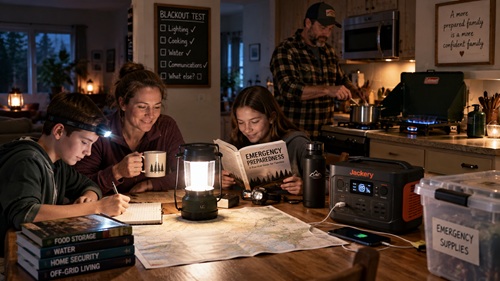
One of the best ways to understand your electrical preparedness is to stop assuming and actually test it. Pick an evening and pretend the electricity has gone out. Don’t use the electric stove. Leave the normal lights off. Don’t charge phones from wall outlets. Use the backup equipment you expect to depend upon and see how well it actually works.
You may discover that you don’t need to power the entire house. Keeping several lights operating, charging phones, maintaining communications, running essential medical equipment or occasionally powering another important device may matter much more than trying to reproduce normal electrical consumption.
Whatever backup system you use, learn its limitations. A battery eventually needs recharging. A generator eventually needs fuel. Solar depends on available sunlight and enough generating capacity to meet the load. There isn’t one perfect solution for every household or climate.
The important question isn’t simply whether you own backup power. It’s whether you know what it can run, how long it can run it and what you’ll do when that backup needs to be recharged or refueled.
Think About Heat and Cold Before You Lose Them
Temperature can become dangerous surprisingly quickly. Losing heat during a Canadian winter or a northern U.S. cold snap creates a very different problem from losing air conditioning during extreme summer heat in Arizona or Texas, but both deserve planning before the normal system fails.
During cold weather, it may make more sense to concentrate everyone into a smaller part of the house instead of trying to keep every room comfortable. Blankets, sleeping bags and layered clothing can reduce the amount of supplemental heat you need. During extreme heat, shade, ventilation, hydration and eventually moving somewhere cooler may become more important than trying to keep an entire house at its normal temperature.
Be particularly careful with alternative heating and cooking equipment. Anything that burns fuel can create carbon-monoxide and fire hazards when used incorrectly or in an inappropriate space. Working smoke alarms, carbon-monoxide detectors and fire extinguishers are preparedness equipment too. A backup solution shouldn’t create a more immediate danger than the emergency you’re trying to solve.
Learn the Boring Things About Your House
Find your main water shutoff and make sure more than one person knows where it is. Locate the electrical panel. Learn how the garage door releases when the opener doesn’t have electricity. If your home uses natural gas or propane, understand the system and follow the emergency procedures recommended by your utility or a qualified professional. Know where fire extinguishers are kept and check them periodically.
None of this sounds particularly exciting, but it’s useful during normal life as well as emergencies. A pipe can burst on an ordinary Tuesday. Knowing how to shut off the water quickly may be the difference between a small repair and major damage.
A lot of useful preparedness is like that. It isn’t dramatic. It simply makes the people living in the house more capable of dealing with problems themselves.
Open Your First-Aid Kit and Look Inside
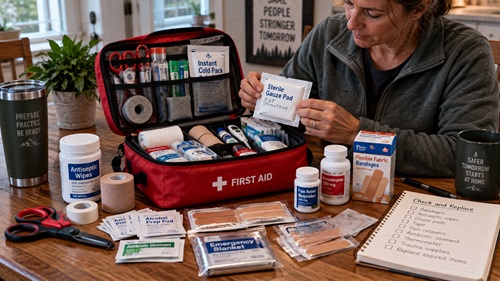
Owning a first-aid kit and being medically prepared aren’t necessarily the same thing. Open the kit and see what’s actually inside. A preassembled kit bought years ago may contain supplies you don’t know how to use while missing things your household is likely to need. Replace depleted or outdated items and keep an up-to-date list of important medications and medical information.
Skills matter just as much as supplies. A modest first-aid kit in the hands of somebody with useful training may be far more valuable than an enormous medical bag nobody understands. First-aid and CPR training are useful during disasters, but they’re equally useful when somebody gets injured during an ordinary day and professional help hasn’t arrived yet.
Think about medications as well. Know which prescriptions people in the household depend upon and maintain reasonable continuity where permitted and practical. If someone requires medication every day, discovering that the last dose was taken on the same morning a blizzard closes the highway is a preventable problem.
Have a Sanitation Plan
Imagine the water has been off since yesterday and someone needs to use the bathroom. What happens next?
Sanitation tends to receive less attention because generators, radios and water filters are more interesting, but garbage, human waste and poor hygiene don’t become less important during an emergency. Keep ordinary supplies such as soap, toilet paper, heavy-duty garbage bags and cleaning products available, but also understand what you would actually do if your normal toilet or sewer system couldn’t be used.
The solution will depend on your home and the type of failure. The important part is having thought through the problem before you’re standing in a bathroom without running water.
Know Where You Would Go If You Couldn’t Stay Home
Staying home often makes sense because that’s where your supplies, equipment and familiar surroundings are, but sometimes the house itself becomes the problem. Wildfire, flooding, chemical releases, structural damage or another local hazard can make leaving much safer than staying.
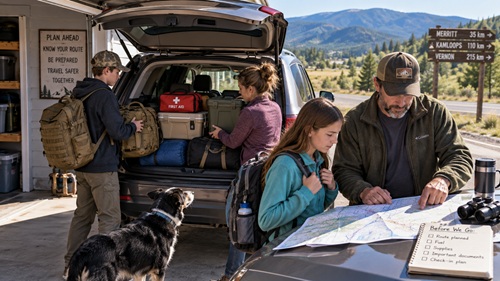
Decide where you could realistically go. It might be a relative’s house, another community, an evacuation centre or a hotel well outside the affected area. Then look at how you would get there. If everyone normally uses the same highway, identify another route. Bridges, mountain passes and major roads can become bottlenecks or close completely during emergencies.
Try not to let the vehicle routinely reach nearly empty. An evacuation is a bad time to discover that hundreds of other people also need fuel. Keep identification, medications, chargers, some clothing and other essentials organized enough that leaving doesn’t require an hour-long scavenger hunt through the house.
Protect the Information You May Need Later
Not every emergency ends when the immediate danger passes. Sometimes the difficult part is recovering afterwards. Insurance information, identification, medical information, property records and other documents may suddenly become important.
Keep important information organized and protected. Paper copies have the advantage of not requiring electricity, batteries or a working device. Secure digital copies provide another layer of redundancy. The idea isn’t to choose between paper and digital but to avoid having the only copy of something important disappear with one damaged phone or computer.
Write down important telephone numbers too. Many people can remember numbers from decades ago but couldn’t tell you a close family member’s current number because their phone has always remembered it for them. If the phone is lost, damaged or dead, that small dependency suddenly becomes obvious.
Decide How Your Family Will Find Each Other
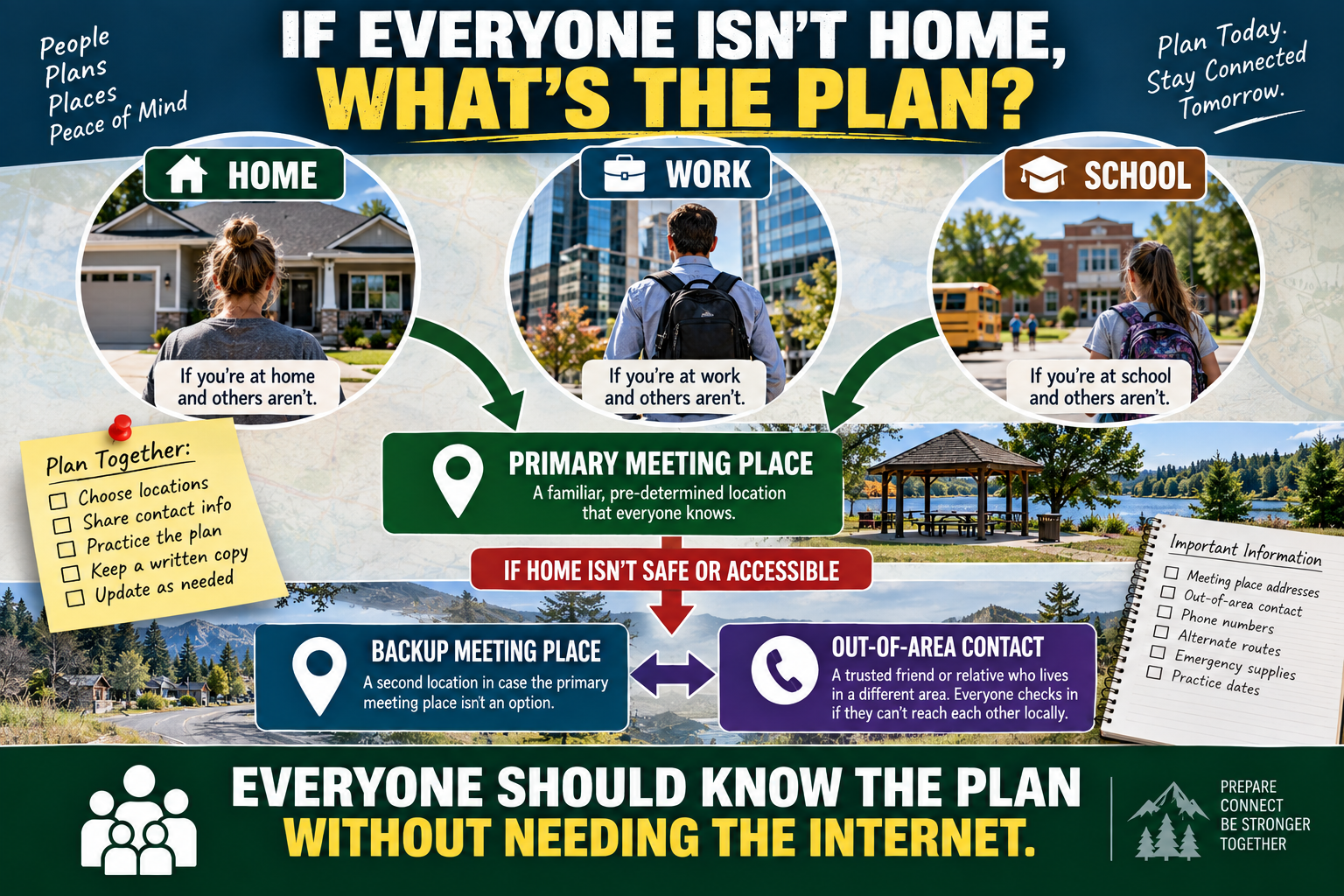
Emergencies don’t usually wait until everyone is conveniently sitting at home. Someone may be working, children may be at school and another family member could be shopping or travelling.
Imagine a wildfire evacuation alert arrives while one adult is at work and another is picking up the kids. Cell service is overloaded and calls aren’t getting through. Everyone’s plan was simply to meet at home, except the neighborhood containing the house is now under an evacuation order.
That’s why a family plan needs another meeting location. Consider an out-of-area family contact as well. In some disruptions it may be possible to reach somebody outside the affected region even when local communication is unreliable.
Keep the plan simple enough that people actually remember it. Everyone should understand where they’re trying to go and who they’re trying to contact without needing to retrieve instructions from the internet.
Most importantly, talk about it. A family emergency plan that exists only in one person’s head isn’t really a family plan.
Know a Few People Around You
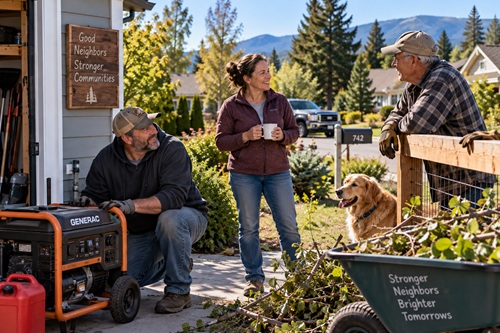
Preparedness becomes stronger when it doesn’t stop at the property line. You don’t need to organize a formal survival group. Start by knowing a few neighbors and exchanging phone numbers with people you trust.
Different households naturally have different skills and equipment. One neighbor may have medical training. Another understands generators. Someone owns a chainsaw and knows how to use it safely. Another person may have lived in the area for thirty years and know every road and trail around the community. You probably have something useful to offer them as well.
Neighbors also become an information network during longer disruptions. Someone may know why the highway is closed, whether the fuel station reopened or when utility crews were last seen. No household can reasonably own every tool, learn every skill or anticipate every problem. Knowing capable people is another form of preparedness.
Have More Than One Way to Get Information
Phones are excellent emergency tools while the systems behind them are operating. Have another way to receive information if those systems aren’t available. A battery-powered or hand-crank radio can still receive broadcasts when internet or cellular service is unavailable. Depending on where you live, weather radio, local radio stations and community emergency alerts may also be important.
Find out how emergency information is distributed where you live. Then take the radio or other backup equipment out and use it. Turn it on, find useful stations and learn the controls.
That’s a five-minute job today and one less thing to figure out during an emergency.
Look at Security Without Turning Your Home Into a Fortress
Most emergencies don’t instantly turn ordinary neighborhoods into chaos. Most people will be doing exactly what you’re doing—looking after themselves and their families. An extended disruption can still change the environment around your home. Streetlights may be out, alarm systems can lose connectivity, emergency services may be handling more calls and generators, fuel or other supplies may become more difficult to replace.
Walk around your property and look at doors, windows, lighting and places someone could approach without being noticed. Find out which cameras, alarms and electronic locks continue operating without electricity or internet. Look at what equipment or supplies are visible from the road and decide whether they really need to be.
Talk through what everyone in the household should do if something genuinely concerning happens. You don’t need an elaborate tactical plan. People need to know where to go, how to contact help if that’s possible and what they’re expected to do instead of everybody making different decisions at the same time.
Test Your Preparedness Instead of Assuming It Works
This is where the whole exercise becomes useful. Pick an evening and pretend the power is out. Make dinner without the normal stove. Use emergency lighting. Don’t use the home internet. Charge phones from backup power. Find the radio and listen to it. If you’re on a well, work through exactly how you would obtain water if the pump couldn’t run.
Then imagine the outage didn’t end overnight. What starts becoming difficult on the second day? Stretch the scenario to three days. Then think about a week. Food that seemed plentiful may become difficult to prepare. Batteries need charging. Stored water disappears faster than expected. Garbage accumulates. Fuel matters more. People get tired of living under emergency conditions.
You will probably discover a handful of small problems. Good. That’s the point. Finding a problem during a practice run gives you the opportunity to fix it while stores are open, the lights are on and nothing is actually wrong.
Improve One Weak Spot at a Time
Once you identify the gaps, don’t feel as though you need to fix everything in one weekend. Pick the weakness that concerns you most and deal with that one first. Maybe you don’t have enough water. Maybe you have plenty of food but no practical way to cook it without electricity. Perhaps your well stops when the power does. Maybe nobody in the family knows where the water shutoff is. Maybe all of your emergency contact information exists on one phone.
Fix one of those problems and then move to the next. A household that corrects one genuine weakness every month will be considerably more resilient a year from now. More importantly, those improvements will be based on things you actually need rather than somebody else’s shopping list.
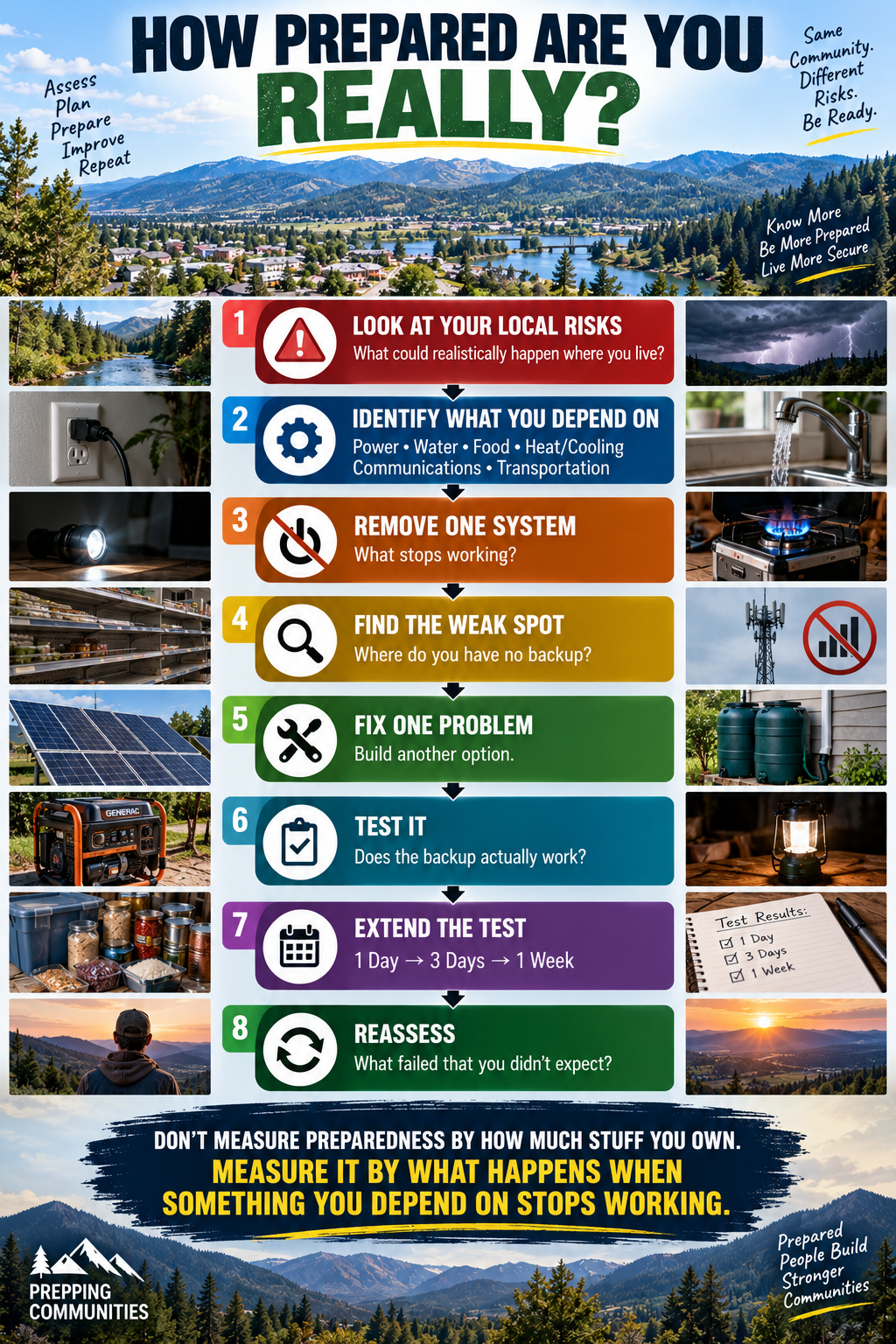
Preparedness Action Plan
Take a notebook and walk through your home. Look at the things you depend upon every day: electricity, water, food, heating or cooling, medications, sanitation, transportation, communications and security. For each one, think about what happens when the normal system isn’t available and write down where you have no practical alternative.
Choose the weakness that would create the biggest problem the fastest and start there. Once you’ve improved it, test what you’ve done. Cook using your backup method. Use your emergency lighting. Find out how quickly your household goes through stored water. Turn on the radio. Make sure everyone understands where they would meet if home wasn’t accessible.
Don’t worry about making the household perfectly prepared. Find one weak spot and make it better. Then find another.
Key Takeaways
You may finish this exercise and discover you’re in better shape than you thought. You may also find something surprisingly simple that you’ve overlooked. Perhaps you have weeks of food but can’t cook most of it without electricity. Maybe you have a productive well but no way to run the pump during an outage. Maybe everyone assumes they’ll meet at home during an emergency, but nobody has decided where to go if home isn’t accessible.
Those are useful things to discover now because they’re problems you can still solve without any pressure. Fix one and then test things again.
Preparedness isn’t really about owning everything you might possibly need. It’s about understanding where your household is vulnerable and gradually making sure that when one system stops working, you still have another option.
That’s how a household becomes more resilient.
© Prepping Communities. This content is for informational purposes only and not professional advice. Use at your own risk.
Terms | Privacy | Guidelines