
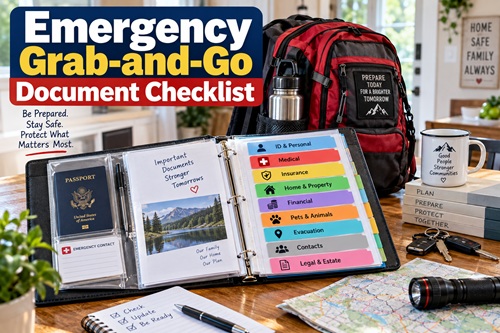
If you had 10 minutes to leave your home, would you have the documents and information needed to prove who you are, access your money, contact your insurance company, fill prescriptions, care for your pets, and begin recovering afterward?
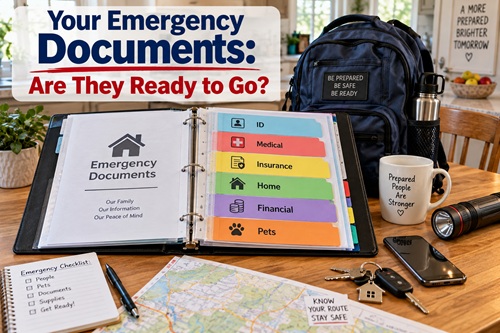
An emergency document binder is meant to solve that problem. It creates one organized location for the records and information that could become difficult to find after a fire, flood, evacuation, extended power outage, or other emergency.
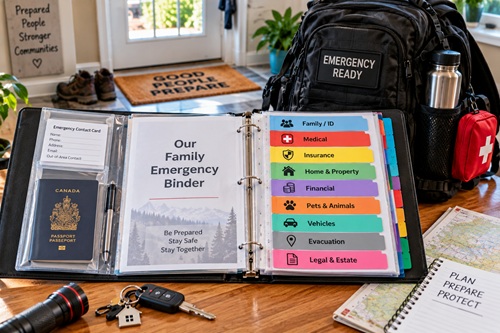
Personal Identification
For each household member:
☐ Birth certificate
☐ Passport
☐ Driver’s licence or government-issued ID
☐ Citizenship or immigration documents, if applicable
☐ Marriage certificate
☐ Adoption or guardianship records
☐ Recent photograph
☐ Important identification numbers
☐ Copies of any other difficult-to-replace identification
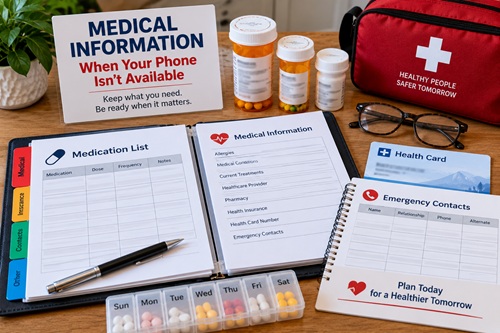
Medical Information
☐ Current medication list
☐ Medication dosages and instructions
☐ Prescription information
☐ Allergies
☐ Important medical information
☐ Health insurance information
☐ Provincial/state health information
☐ Doctor and specialist contact information
☐ Pharmacy contact information
☐ Eyeglass/contact-lens prescription
☐ Immunization records when relevant
☐ Emergency medical contacts
The goal isn’t to reproduce an entire medical history. Keep enough information available that another person could help manage essential care if normal systems weren’t accessible.
Emergency Contacts
Don’t assume everyone’s contacts will remain available through a phone.
☐ Immediate family
☐ Out-of-area family contact
☐ Close friends/neighbors
☐ Doctors
☐ Pharmacy
☐ Veterinarian
☐ Insurance companies
☐ Employer
☐ Children’s school/daycare
☐ Lawyer
☐ Accountant
☐ Financial institutions
☐ Utility providers
☐ Local emergency-management contacts
Include phone numbers, addresses and other information that would still be useful if your phone were lost, damaged or dead.
Home and Property
☐ Property deed/title information
☐ Mortgage information
☐ Property insurance policy
☐ Property tax information
☐ Rental agreement, if applicable
☐ Landlord contact information
☐ Utility account information
☐ Vehicle ownership/registration
☐ Vehicle insurance
☐ Spare keys stored appropriately
☐ Important equipment serial numbers
Financial Recovery Information
The objective isn’t to put every financial secret into an easily stolen binder. It’s to preserve enough information to identify and recover your accounts.
☐ List of banks and financial institutions
☐ Account reference information
☐ Credit-card issuer contact numbers
☐ Investment/retirement account information
☐ Recent tax records or important tax information
☐ Pension information
☐ Loan information
☐ Insurance policies
☐ Instructions for contacting financial institutions if cards or devices are lost
Avoid leaving passwords, PINs and complete account credentials openly accessible in the binder.
Insurance
☐ Homeowners/renters insurance
☐ Vehicle insurance
☐ Life insurance
☐ Health insurance
☐ Additional property insurance
☐ Policy numbers
☐ Claims telephone numbers
☐ Agent/broker information
☐ Instructions for beginning a claim
Household Inventory
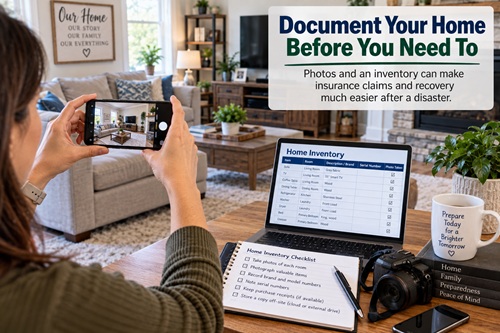
This section can become extremely valuable after a fire, flood or other major loss.
☐ Photos of every room
☐ Photos of valuable possessions
☐ Appliance information
☐ Electronics and serial numbers
☐ Tools and equipment
☐ Jewelry and collectibles
☐ Receipts for major purchases
☐ Vehicle information
☐ Photos of the exterior of the property
Keep another copy of this inventory somewhere other than your home.
Pets and Animals
☐ Recent photo of each animal
☐ Veterinarian information
☐ Vaccination records
☐ Medication information
☐ Microchip number
☐ Registration/licence information
☐ Feeding instructions
☐ Medical conditions
☐ Emergency boarding contacts
☐ Pet-friendly evacuation destinations
For livestock, expand this section to include identification, feed requirements, veterinary information and evacuation arrangements.
Evacuation Information
Your binder should help you leave, not merely identify yourself afterward.
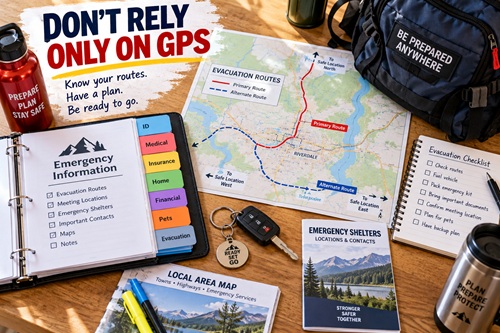
☐ Primary evacuation route
☐ Alternate evacuation routes
☐ Paper maps
☐ Family meeting locations
☐ Out-of-area meeting location
☐ Emergency shelter information
☐ Hotel/motel alternatives
☐ Pet-friendly destinations
☐ Important addresses written on paper
☐ Contact information for people you could stay with
Don’t depend entirely on GPS.
Children and Dependents
☐ Recent photographs
☐ School/daycare information
☐ Emergency contacts
☐ Medical information
☐ Medication requirements
☐ Custody/guardianship documentation where applicable
☐ Special-care instructions
☐ Reunification information
Legal and Estate Information
☐ Will information
☐ Power of attorney
☐ Healthcare directive
☐ Executor contact information
☐ Lawyer contact information
☐ Guardianship documents
☐ Relevant estate information
☐ Instructions for locating originals
Digital Recovery
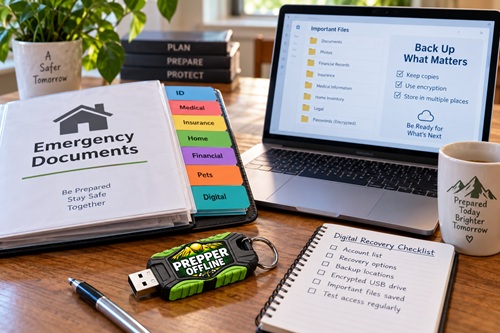
Modern preparedness also means being able to recover your digital life.
☐ Important account recovery information
☐ Backup authentication methods
☐ Device recovery information
☐ Important software/service account list
☐ Location of encrypted password backups
☐ Location of digital document backups
Passwords and authentication secrets should be protected appropriately rather than printed openly in an ordinary binder.
Cash and Immediate Essentials
Consider keeping a separate secure grab-and-go pouch with:
☐ Emergency cash in useful denominations
☐ Spare keys
☐ Backup payment method
☐ Emergency contact card
☐ Copies of essential identification
Don’t Keep Your Only Copy in the Binder
A grab-and-go binder should be one layer of redundancy, not the only place important information exists.
A stronger system might include:
Original documents → protected storage
Grab-and-go copies → emergency binder
Encrypted digital copies → secure storage
Off-site backup → trusted secondary location
That way, losing your home, binder, computer or cloud access doesn’t necessarily mean losing the information itself.
Review the Binder Regularly
☐ Replace expired identification copies
☐ Update medications
☐ Update photographs
☐ Check insurance policies
☐ Update financial institutions
☐ Update emergency contacts
☐ Review evacuation destinations
☐ Replace outdated maps
☐ Update pet information
☐ Verify digital backups
☐ Remove information you no longer need
A good schedule is to review it at least once a year and after any major life change.
Preparedness Action Plan
Start with the documents that would be hardest to replace.
Don’t try to build the perfect emergency binder in one sitting. Create the basic sections, collect what you already have, and then fill the gaps.
Once it’s assembled, perform a simple test:
Imagine your home is inaccessible and your phone is gone.
Using only what you’ve prepared, could you identify everyone in your household, contact family, access medical information, contact your insurer, identify your financial institutions, care for your animals, navigate out of the area and begin recovering?
Whatever you cannot do identifies the next gap to fix.
Key Takeaways
An emergency document binder isn’t really about paperwork. It’s about maintaining access to the information that proves who you are, what you own, who to contact, what care your family needs and how to begin recovering when normal access disappears.
The binder is most useful when it’s current, portable, protected and backed up somewhere else.
And like every preparedness system, don’t assume it works simply because you’ve created it.
Test it.
© Prepping Communities. This content is for informational purposes only and not professional advice. Use at your own risk.
Terms | Privacy | Guidelines