
Introduction
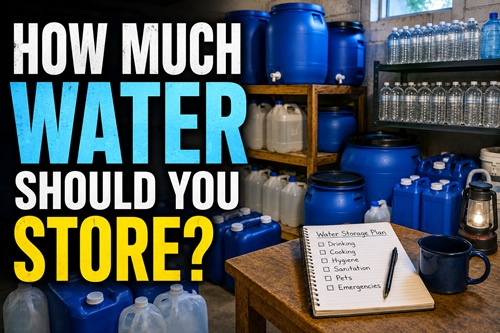
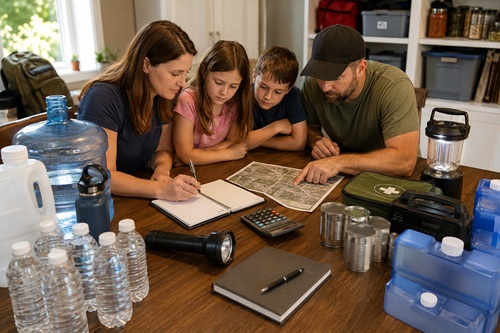
One of the first questions people ask when preparing for emergencies is, “How much water should be stored?” Although the question appears straightforward, the answer depends upon many factors, including the number of people in the household, the length of the emergency, climate, available storage space, medical requirements, pets, livestock, and the ability to obtain additional water once stored supplies begin to run low. A realistic storage goal should be based on the unique needs of the household rather than relying solely on generalized recommendations.
Water is unlike most emergency supplies because it is consumed continuously. Food can often be rationed or supplemented from existing pantry items, but the human body depends on a steady supply of clean drinking water every day. Water is also required for cooking, hygiene, sanitation, medical care, cleaning, and many other routine activities. As a result, households often discover that their total water requirements are substantially greater than expected once every daily use has been considered.
Many preparedness guides recommend storing enough water for at least seventy-two hours. While this provides an excellent starting point, it should be viewed as the beginning of a long-term preparedness plan rather than the final objective. Short disruptions caused by storms, power failures, or temporary water outages may be resolved within a few days, but larger emergencies can interrupt water service for weeks or even months. Understanding how storage goals increase over time allows households to build their reserves gradually while avoiding unrealistic expectations.
Water storage should also be viewed as one part of a complete water preparedness strategy rather than the entire solution. Even a household with several hundred gallons of stored water will eventually need a reliable method for replacing what has been consumed. As storage capacity increases, renewable water sources, purification methods, conservation practices, and efficient transportation become increasingly important. The strongest preparedness plans combine all of these elements into one integrated system.
The purpose of this handbook is to help you determine realistic water storage goals based on your own household rather than generic recommendations. You will learn how different emergency durations affect storage requirements, how to calculate your own water needs, how to choose practical storage targets, and how to expand your reserves over time without becoming overwhelmed. By the end of this guide, you should understand not only how much water to store, but also why those storage goals support a practical long-term preparedness strategy.
Understanding Water Storage Goals
Before deciding how many gallons or litres of water to store, it is important to understand what stored water is intended to accomplish. Water storage provides an immediate supply of safe drinking water that is available the moment normal service is interrupted. Unlike collecting water from natural sources, stored water requires no travel, no treatment, and no additional preparation before use. This immediate availability is its greatest advantage during the early hours of an emergency.
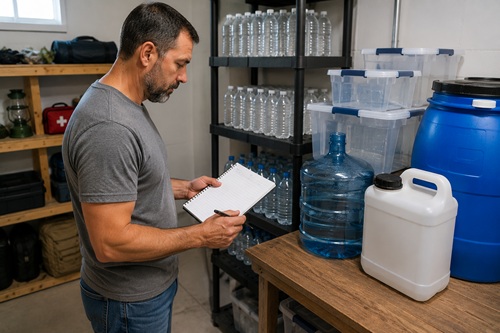
Stored water also buys valuable time. During the initial stages of an emergency, conditions are often uncertain. Utility companies may still be assessing damage, roads may be blocked, and official information may be limited. Having an adequate reserve allows households to remain safely at home while gathering reliable information and evaluating whether additional actions are necessary. Instead of rushing to purchase supplies or searching for water during the most chaotic period of an emergency, stored water allows thoughtful decisions to be made under far less pressure.
Another important purpose of water storage is reducing dependence on outside assistance. Municipal emergency distribution points, bottled water deliveries, and relief organizations often require time to become fully operational, particularly after large disasters affecting wide geographic areas. A household that already possesses an adequate water reserve can remain self-sufficient while emergency resources are directed toward individuals with more immediate needs.
Water storage should also be viewed as a bridge rather than a permanent solution. Every gallon stored today will eventually be consumed if an emergency continues long enough. For this reason, storage goals should be selected with the understanding that renewable water sources, purification equipment, and conservation measures will eventually become necessary if normal service is not restored. The longer the expected emergency, the more important these supporting systems become.
Many people attempt to answer the question, “How much water should I store?” with a single number. In reality, preparedness works better when storage goals are approached as progressive milestones. A household may first build enough water for seventy-two hours, then expand to one week, two weeks, one month, and eventually several months as experience, storage space, and budget allow. This gradual approach makes preparedness more manageable while allowing every improvement to provide immediate benefits.
Water storage goals should also remain flexible. Families change over time. Children grow older, pets are added, medical conditions develop, and living arrangements evolve. Periodically reviewing storage goals ensures that they continue to reflect the current needs of the household rather than assumptions made years earlier.
The remainder of this handbook examines each major storage milestone individually, explaining the advantages, limitations, and practical considerations associated with each stage. Rather than encouraging every household to pursue the same objective, the goal is to help you determine which storage targets best support your own preparedness plan.
Table 1 — Water Storage Goal Overview
| Storage Goal | Typical Purpose | Practical Benefit |
|---|---|---|
| 72 Hours | Immediate emergencies | Provides safe water during the initial disruption |
| One Week | Short-term outages | Allows additional time for recovery and assessment |
| Two Weeks | Extended utility interruptions | Supports longer disruptions with minimal outside assistance |
| One Month | Intermediate preparedness | Reduces dependence on emergency distribution systems |
| Three Months | Seasonal disruptions | Provides significant resilience while renewable systems are established |
| Six Months | Long-term preparedness | Supports prolonged emergencies when combined with renewable sources |
| One Year | Advanced preparedness | Requires integrated storage, conservation, and renewable water systems |
This progression demonstrates that water preparedness is not a single destination but an ongoing process of improving resilience over time. Each milestone builds upon the previous one, creating a stronger and more flexible household water strategy.
Beginning with the First Seventy-Two Hours
For decades, emergency preparedness organizations around the world have encouraged households to maintain enough supplies to remain self-sufficient for at least seventy-two hours. This recommendation is based on the observation that emergency services often require several days to fully respond after widespread disasters. During this period, roads may be blocked, power outages may continue, stores may be closed, and municipal water systems may still be under repair or subject to boil water advisories.
A seventy-two-hour water supply is intended to provide immediate security rather than long-term independence. It allows every member of the household to continue drinking, preparing meals, taking medications, and maintaining basic hygiene without leaving the safety of home. Even if additional water becomes available sooner, having these supplies already stored removes uncertainty during the most stressful stage of the emergency.
The amount of water required during this period depends entirely upon the household. A single adult requires substantially less water than a family with several children, pets, or elderly relatives. Climate also plays an important role. Hot temperatures and physically demanding cleanup activities often increase daily water consumption beyond normal levels. For this reason, the seventy-two-hour goal should always be calculated using your own household water budget rather than relying exclusively on generalized estimates.
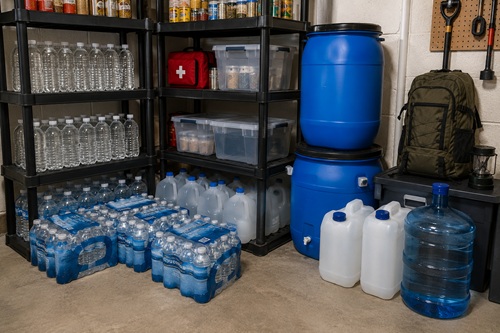
Many households find that a seventy-two-hour reserve is surprisingly achievable. Commercially bottled water, food-grade storage containers, stackable water bricks, and reusable jerry cans all make it possible to store this quantity without requiring large amounts of space. Beginning with this milestone also allows families to develop storage routines, rotation schedules, and inventory practices before expanding to larger reserves.
Although seventy-two hours is often described as the minimum preparedness recommendation, it should not be viewed as the finish line. Once this initial goal has been achieved, households are in an excellent position to begin working toward longer storage periods that provide greater flexibility during more prolonged emergencies.
Table 2 — Seventy-Two-Hour Water Storage Calculator
| Household Member | Daily Requirement | 72-Hour Requirement |
| Adult 1 | ||
| Adult 2 | ||
| Child 1 | ||
| Child 2 | ||
| Pets | ||
| Other Household Needs | ||
| Total Household Requirement |
Expanding to One Week of Water Storage
Once a seventy-two-hour water reserve has been established, the next logical milestone is building enough storage to support the household for one full week. This increase may appear modest, but it provides a significant improvement in preparedness because many emergencies continue well beyond the first three days. Utility repairs often take longer than expected, transportation networks may remain disrupted, and emergency distribution centers may still be experiencing delays. A one-week reserve allows households to remain patient while these systems recover rather than being forced to search for additional water immediately.
A one-week storage goal also provides greater flexibility when dealing with uncertainty. During the first several days of an emergency, it is often difficult to determine how long normal services will remain unavailable. Having additional stored water allows you to observe changing conditions, gather reliable information, and make informed decisions without the pressure of rapidly diminishing supplies.
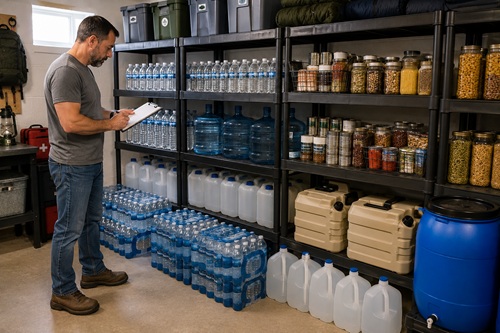
Building from seventy-two hours to one week is usually accomplished by expanding existing storage rather than purchasing entirely new systems. Additional bottled water, stackable water containers, food-grade jerry cans, or water bricks can often double household storage without requiring major changes to available space. Because the household has already established labeling, rotation, and inspection routines, expanding the reserve becomes much easier than creating it from the beginning.
A one-week reserve also introduces the importance of inventory management. As storage capacity grows, it becomes increasingly important to maintain written records showing how much water is available, where it is stored, and when it should be inspected or rotated. Good record keeping prevents forgotten supplies, expired containers, and uneven rotation schedules that may reduce the quality of stored water over time.
One week of stored water also provides an excellent opportunity to begin evaluating renewable water sources. Although the household may never need to use them during a short emergency, identifying nearby wells, springs, streams, rainwater collection opportunities, or other dependable sources before they are needed strengthens overall preparedness while laying the foundation for longer-term planning.
Table 3 — One-Week Water Storage Planner
| Water Use | Daily Requirement | Seven-Day Requirement |
|---|---|---|
| Drinking | ||
| Cooking | ||
| Hygiene | ||
| Medical Needs | ||
| Pets | ||
| Other Essential Uses | ||
| Total One-Week Requirement |
Completing this calculation allows you to compare your existing storage against your one-week objective and determine how much additional capacity is required to reach this milestone.
Planning for Two Weeks of Water Storage
A two-week water reserve represents another significant step toward household self-sufficiency. Many emergency management organizations recommend preparing for at least fourteen days because numerous disasters require considerably more than one week for full recovery. Severe storms, flooding, wildfires, earthquakes, prolonged power failures, and water system contamination can all interrupt normal services for extended periods.
Unlike a seventy-two-hour reserve, a two-week supply often requires households to think more carefully about storage methods, available space, and water rotation. Commercially bottled water remains useful, but many families begin incorporating larger food-grade containers because they provide greater storage capacity while reducing the number of individual containers that must be managed.
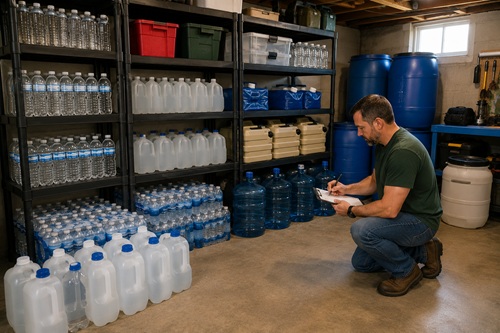
At this stage, water storage also becomes a balance between quantity and practicality. Storing more water is beneficial only if it can be maintained properly. Containers should remain accessible for inspection, protected from excessive heat and sunlight, and positioned where they do not create safety hazards or exceed structural weight limits. Careful organization becomes increasingly important as storage volumes increase.
Households should also begin considering contingency planning. If an emergency lasts longer than two weeks, how will additional water be obtained? What nearby sources have already been evaluated? Is appropriate purification equipment available? Have collection containers and transportation methods been prepared? Thinking about these questions while expanding storage helps transition preparedness from simply storing water toward managing an integrated water system.
A two-week reserve also provides an excellent opportunity to practice emergency water management. Operating the household for a day or two using only stored water often reveals unexpected challenges involving conservation, cooking, hygiene, and daily routines. These practice exercises improve confidence while identifying opportunities for further improvement.
Table 4 — Two-Week Storage Expansion Calculator
| Current Storage | Additional Storage Needed | Total Goal |
| Bottled Water | ||
| Water Bricks | ||
| Jerry Cans | ||
| Water Barrels | ||
| Other Containers | ||
| Total Capacity |
This worksheet helps determine how much additional storage must be added to achieve a complete fourteen-day reserve.
Building a One-Month Water Reserve
For many preparedness-minded households, one month represents the first major long-term water storage objective. A thirty-day reserve provides a substantial margin of safety for a wide variety of emergencies while allowing the household to remain largely independent of outside assistance during the initial recovery period.
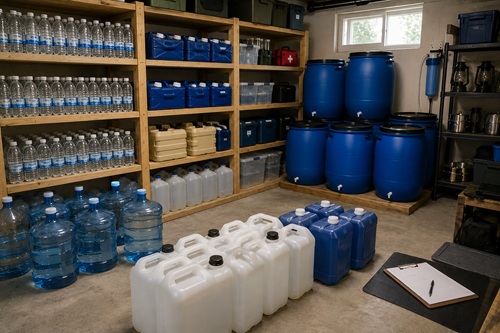
Reaching this milestone requires more than simply purchasing additional containers. Water storage now becomes a permanent component of household preparedness rather than a temporary emergency supply. Storage areas should be carefully selected to protect containers from sunlight, freezing temperatures, excessive heat, chemicals, and physical damage. Containers should be arranged to allow routine inspection and convenient rotation without moving large quantities of water unnecessarily.
One month of water also highlights the importance of household organization. Labeling containers with storage dates, maintaining inventory records, and rotating supplies on a regular schedule become increasingly valuable as the number of containers grows. A well-organized storage system reduces waste while ensuring that every container remains ready for use.
Many households also begin diversifying container sizes at this stage. Large barrels provide efficient long-term storage, while smaller jerry cans, stackable containers, and bottled water remain useful for transportation and everyday use. Combining several container sizes creates a more flexible storage system that adapts to a variety of situations.
Although a one-month reserve provides impressive preparedness, it also demonstrates why renewable water sources eventually become necessary. Depending upon household size, storing an entire month’s supply may require considerable space and careful planning. Recognizing these practical limitations encourages households to continue improving rainwater collection, purification equipment, wells, springs, and other renewable sources while maintaining their stored reserves.
Table 5 — One-Month Water Storage Worksheet
| Storage Category | Quantity | Capacity | Total Water Stored |
| Bottled Water | |||
| Water Bricks | |||
| Jerry Cans | |||
| Water Barrels | |||
| Emergency Containers | |||
| Total One-Month Storage |
Completing this worksheet provides a detailed inventory of your one-month reserve while identifying areas where additional storage or better organization may still be beneficial.
Planning for Three Months and Beyond
As water storage goals extend beyond one month, preparedness planning begins to change significantly. While additional stored water remains valuable, simply increasing the number of containers becomes progressively less practical. Storage space, container costs, rotation schedules, structural loading, and maintenance requirements all increase as reserves grow larger.
For this reason, three-month preparedness planning should be viewed as the point where stored water and renewable water systems begin working together. Rather than attempting to store every litre that may eventually be required, households should focus on maintaining a dependable reserve while developing reliable methods for collecting, purifying, transporting, and conserving additional water.
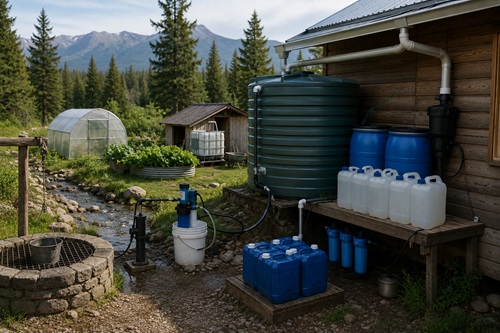
Rainwater harvesting systems, private wells, nearby springs, flowing streams, and other renewable sources become increasingly important at this stage. Stored water continues serving as the immediate supply available during the early stages of an emergency, while renewable sources gradually replace the water that has been consumed. This layered approach greatly improves long-term resilience without requiring unrealistic storage capacity.
Conservation also becomes a major factor. Every litre of water that is saved reduces the amount that must be collected and purified later. Efficient cooking methods, thoughtful hygiene practices, water-saving gardening techniques, and careful household management all contribute to extending available supplies while reducing the workload associated with long-term water production.
Perhaps the greatest advantage of planning beyond one month is the confidence it provides. Households that understand both their storage capacity and their renewable water capabilities are far better prepared to adapt to changing conditions than those relying exclusively on one approach. Long-term preparedness is achieved not through larger storage alone, but through the combination of stored reserves, renewable water sources, effective purification, practical conservation, and thoughtful planning.
Planning for Six Months of Water Security
A six-month water plan represents a significant level of preparedness and requires a different way of thinking than shorter-term storage goals. While it is technically possible to store enough water for many households to survive for six months, doing so often requires considerable space, substantial financial investment, and ongoing maintenance. As a result, long-term preparedness should focus on balancing stored reserves with dependable renewable water systems rather than relying exclusively on storage.
At this stage, stored water should be viewed as your emergency reserve rather than your only source of supply. Its primary purpose is to provide immediate access to safe drinking water while renewable systems are placed into operation or while temporary disruptions affecting those systems are resolved. Instead of attempting to store every litre required for six months, many experienced preparedness-minded households maintain a practical reserve while ensuring they can consistently replace consumed water from dependable local sources.
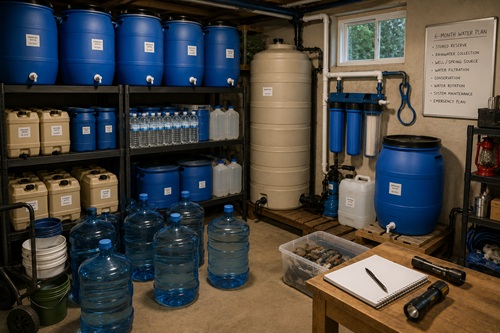
Storage organization also becomes increasingly important as reserves grow larger. Water should be divided among several storage locations whenever practical. This reduces the impact of accidental leaks, damaged containers, contamination, or localized flooding. Smaller containers remain useful for transportation and everyday access, while larger barrels or tanks provide efficient long-term storage. Diversifying storage methods improves flexibility and reduces dependence on any single container or location.
Routine maintenance should also become part of your preparedness schedule. Large water reserves require periodic inspections for leaks, damaged seals, container deterioration, algae growth, labeling accuracy, and proper rotation. Establishing an annual or semi-annual inspection routine helps ensure your stored water remains ready whenever it is needed.
One of the greatest benefits of six-month planning is that it encourages households to evaluate preparedness as an ongoing system rather than a collection of individual supplies. Water storage, rainwater harvesting, wells, purification equipment, transportation methods, conservation practices, and household planning all begin working together as one integrated strategy capable of supporting long-term resilience.
Should You Store One Year’s Worth of Water?
Many people eventually ask whether they should attempt to store enough water for an entire year. While the idea is understandable, storing a full year’s supply is not practical for most households. Depending on family size, the amount of water required may reach thousands of litres or gallons, creating significant challenges involving storage space, container costs, structural loading, maintenance, and water rotation.
Rather than attempting to store every drop that might eventually be needed, a more practical approach is to establish a layered water strategy. Stored water provides immediate access during the early stages of an emergency, while renewable water sources gradually assume the responsibility of replacing consumed supplies. This approach dramatically reduces the amount of water that must be physically stored while still providing long-term security.
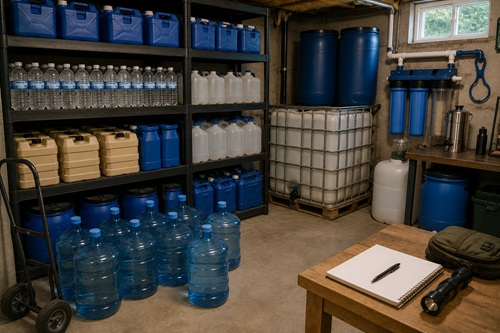
Households with private wells, productive springs, rainwater harvesting systems, nearby streams, or other dependable renewable sources often possess greater long-term resilience than households relying exclusively on very large stored reserves. Renewable systems can continue producing water indefinitely when properly maintained, whereas stored water always represents a finite supply that will eventually be exhausted.
This does not diminish the importance of water storage. Quite the opposite. Every household should maintain sufficient stored water to bridge the gap between normal municipal service and the successful operation of renewable systems. The appropriate amount varies from one household to another, but the principle remains the same. Stored water buys valuable time while longer-term solutions become operational.
The most resilient preparedness plans combine multiple independent systems rather than depending upon one approach alone. Storage, collection, purification, transportation, conservation, and renewable water production each contribute strengths that compensate for the limitations of the others.
Factors That Increase Water Storage Requirements
No two households require exactly the same amount of stored water. Although general recommendations provide useful starting points, actual storage goals should always be adjusted to reflect the specific circumstances of the household. Understanding these factors helps create a storage plan that is both practical and realistic.
Household size is usually the most obvious consideration. Every additional person increases daily drinking, cooking, hygiene, sanitation, and cleaning requirements. Even temporary household members such as visiting relatives or neighbors seeking shelter during an emergency should be considered if they are likely to remain for extended periods.
Climate has a substantial influence on water consumption. Hot temperatures increase drinking water requirements while also affecting cooking, hygiene, gardening, and livestock care. Households located in warm climates often require larger reserves than those living in cooler regions.
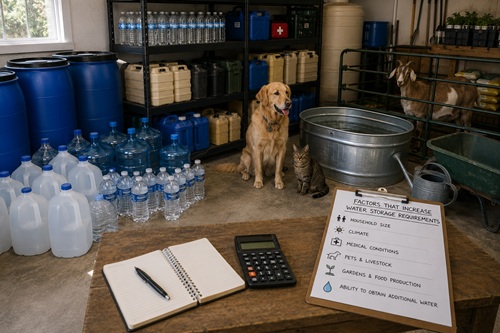
Medical conditions may also increase water needs. Certain illnesses, medications, pregnancy, breastfeeding, fever, and recovery from injury frequently require increased hydration or additional water for treatment and hygiene. These specialized needs should be incorporated into storage planning before an emergency occurs.
Pets and livestock represent another significant factor. A single large dog consumes considerably more water than a small companion animal, while horses, cattle, goats, and other livestock require dependable daily water regardless of emergency conditions. Households relying on animals for food production or transportation should ensure their requirements are fully reflected in storage calculations.
Gardens and food production systems also influence storage goals. Although emergency gardening often relies heavily on rainwater or renewable sources, newly planted gardens or periods of drought may temporarily require stored water until natural supplies become available.
Finally, consider your ability to obtain additional water. A household with a reliable private well and backup pumping system may choose different storage goals than one relying entirely on municipal water with no nearby renewable sources. Storage requirements should always be evaluated alongside the household’s overall water strategy rather than considered in isolation.
Table 6 — Household Storage Adjustment Worksheet
| Household Factor | Does It Increase Storage Needs? | Additional Planning Required |
|---|---|---|
| Children | ☐ | |
| Infants | ☐ | |
| Seniors | ☐ | |
| Medical Conditions | ☐ | |
| Pregnancy or Nursing | ☐ | |
| Dogs or Cats | ☐ | |
| Livestock | ☐ | |
| Vegetable Garden | ☐ | |
| Hot Climate | ☐ | |
| Physically Demanding Work | ☐ | |
| Limited Renewable Water | ☐ | |
| Other Household Factors | ☐ |
Completing this worksheet helps tailor your water storage goals to the specific demands of your household rather than relying solely on generalized preparedness recommendations.
Choosing the Right Water Storage Containers
Once realistic storage goals have been established, selecting appropriate containers becomes one of the most important decisions in your preparedness plan. The ideal storage system should protect water quality, maximize available space, simplify rotation, and allow convenient access during an emergency.
Commercially bottled water remains one of the simplest storage options because it arrives already packaged, sealed, and ready for immediate use. It is easy to rotate, transport, and distribute throughout the home. However, storing large quantities using only bottled water can become expensive and requires considerable shelf space.
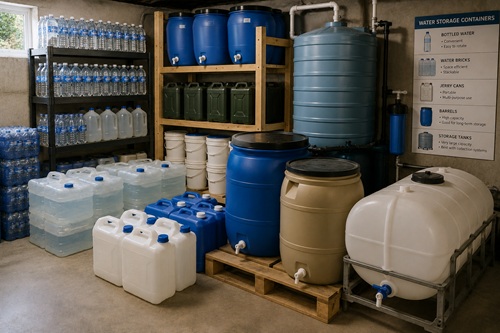
Food-grade water bricks provide another excellent option, particularly for households with limited storage space. Their stackable design allows efficient use of closets, basements, and storage rooms while making individual containers easy to carry when full.
Food-grade jerry cans are widely used because they combine portability with relatively large capacity. They are well suited for both storage and transportation, making them particularly useful when collecting water from renewable sources after stored supplies begin to decline.
Large food-grade barrels provide efficient long-term storage for households with sufficient space. Although difficult to move once filled, they offer substantial capacity while reducing the number of individual containers requiring maintenance and rotation.
Some advanced preparedness systems include large stationary storage tanks or cisterns capable of storing hundreds or even thousands of gallons. While these systems provide impressive capacity, they require careful planning, proper installation, structural support, and ongoing maintenance. They are most effective when integrated with renewable water collection systems such as rainwater harvesting or private wells.
Regardless of the container selected, every storage system should use food-grade materials intended for potable water. Containers previously used for chemicals, fuels, pesticides, or cleaning products should never be repurposed for drinking water, even if they appear clean. Choosing appropriate containers from the beginning protects water quality while reducing long-term maintenance problems.
Table 7 — Water Storage Container Comparison
| Container Type | Capacity | Portability | Long-Term Storage | Best Use |
| Bottled Water | Small | Excellent | Good | Immediate use and rotation |
| Water Bricks | Medium | Good | Excellent | Organized household storage |
| Jerry Cans | Medium | Excellent | Excellent | Storage and transportation |
| Water Barrels | Large | Poor When Full | Excellent | Long-term stationary storage |
| Large Storage Tanks | Very Large | Stationary | Excellent | Advanced long-term systems |
Selecting several container types rather than relying upon only one often produces the most flexible storage system. Each container serves a different purpose, and together they create a more resilient approach to long-term water preparedness.
Choosing Safe Locations for Water Storage
Selecting the right storage containers is only part of the planning process. Where water is stored has a direct impact on its long-term quality, accessibility, and usefulness during an emergency. Even high-quality food-grade containers can become damaged or contaminated if they are stored in unsuitable locations.
Whenever possible, store water in cool, dry areas away from direct sunlight. Heat accelerates the deterioration of many plastics, while prolonged exposure to sunlight encourages algae growth in translucent containers and may reduce the overall quality of stored water. Basements, interior storage rooms, climate-controlled garages, and dedicated preparedness areas often provide excellent long-term storage environments.
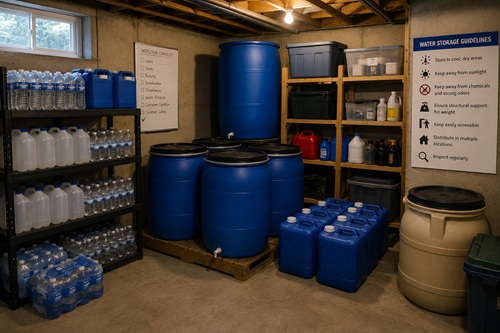
Water should also be protected from chemicals and strong odors. Fuels, paints, solvents, pesticides, fertilizers, gasoline, and household cleaning products should never be stored beside potable water. Although food-grade containers are designed to protect their contents, keeping water separated from hazardous materials reduces the risk of accidental contamination and simplifies household organization.
Structural considerations become increasingly important as storage capacity grows. Water is extremely heavy. A single litre weighs approximately one kilogram, while a single U.S. gallon weighs about 8.34 pounds (3.78 kilograms). Several large barrels positioned together can place thousands of pounds of weight on a floor. Before storing significant quantities of water, ensure the supporting structure is capable of safely carrying the load. Ground-level concrete floors generally provide the best support for larger storage systems.
Accessibility should never be overlooked. Water that cannot be reached quickly during an emergency offers little practical value. Storage containers should remain accessible without moving heavy equipment or climbing over other supplies. Likewise, every member of the household should know where emergency water is stored and how to access it safely.
Many preparedness-minded households distribute water throughout the home rather than storing everything in one location. This approach provides redundancy. If one storage area becomes damaged by flooding, fire, structural failure, or contamination, additional water remains available elsewhere. Multiple storage locations also reduce the risk associated with accidental leaks affecting the entire reserve.
Finally, every storage location should become part of your regular inspection routine. Periodically examine containers for leaks, damaged seals, bulging, discoloration, or other signs of deterioration. Correcting small problems early helps prevent the loss of valuable emergency water supplies.
Building Your Water Storage Gradually
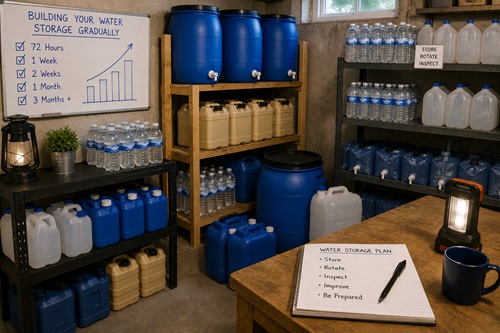
One of the most common reasons people postpone water preparedness is the belief that they must purchase an entire emergency water supply all at once. In reality, the strongest water storage systems are often built gradually over months or years. Incremental improvements make preparedness affordable, manageable, and easier to maintain.
Begin by establishing a realistic first milestone, such as a seventy-two-hour supply. Once this objective has been achieved, gradually expand toward one week, two weeks, one month, and beyond. Each milestone improves preparedness immediately while providing a sense of progress that encourages continued improvement.
Adding only a small amount of storage at regular intervals often produces remarkable results over time. Purchasing one additional case of bottled water each shopping trip, adding another food-grade container every month, or installing one additional rain barrel each season allows preparedness to grow steadily without creating significant financial pressure.
As storage capacity increases, continue improving organization rather than simply increasing volume. Label containers clearly, maintain an inventory, establish a rotation schedule, and record inspection dates. These simple habits prevent confusion while making long-term maintenance much easier.
Gradual expansion also allows experience to guide future decisions. You may discover that certain container sizes are more convenient than others, that some storage locations are easier to access, or that additional purification equipment would improve your overall water system. Building slowly provides opportunities to refine your approach rather than committing to one large purchase that may not fully meet your needs.
Preparedness should be viewed as a continuous improvement process rather than a project with a final completion date. Every additional container, improved storage location, or upgraded purification method strengthens your household’s resilience while spreading costs over a much longer period.
Common Water Storage Mistakes
Even households with substantial water reserves sometimes make mistakes that reduce the effectiveness of their preparedness efforts. Understanding these common problems helps avoid unnecessary expense while improving long-term reliability.
One of the most frequent mistakes is storing too little water because only drinking requirements are considered. Cooking, hygiene, sanitation, cleaning, medical care, pets, and food production all consume water. Failing to account for these activities often leads to unrealistic storage goals that fall short during actual emergencies.
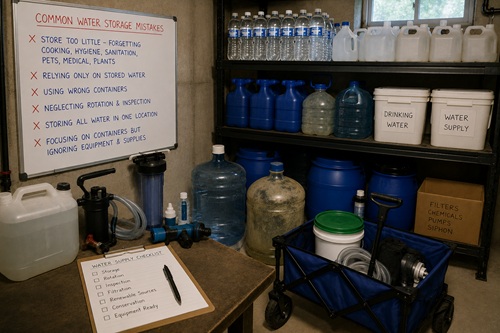
Another common mistake is assuming stored water alone will solve every long-term water problem. While storage provides an excellent beginning, every stored supply is eventually exhausted. Households should simultaneously develop renewable water sources, purification capabilities, transportation methods, and conservation practices to support long-duration emergencies.
Poor container selection also causes problems. Containers that are not food-grade, are difficult to move, leak easily, or are unsuitable for long-term potable water storage often require replacement sooner than expected. Investing in quality storage containers generally reduces maintenance while improving reliability.
Some households neglect water rotation. Although properly stored water often remains usable for extended periods, regular inspection and scheduled rotation help maintain quality while ensuring every container remains in good condition. Rotation also provides opportunities to inspect storage areas and verify inventory records.
Another mistake involves storing all water in a single location. A burst pipe, localized flooding, contamination, or structural damage can affect every container if the entire supply is concentrated in one area. Dividing storage among several locations increases redundancy and reduces the consequences of localized problems.
Finally, many people focus heavily on purchasing storage containers while overlooking the equipment needed to use them effectively. Collection containers, siphons, transfer pumps, water filters, purification chemicals, carts, wagons, and backup treatment methods all contribute to a practical long-term water system. Water preparedness involves much more than simply filling containers.
Integrating Water Storage with Renewable Water Sources
As water storage goals increase, renewable water becomes an increasingly important part of household preparedness. Rather than viewing storage and collection as separate activities, they should be considered complementary components of one integrated water strategy.
Stored water provides immediate security. It allows the household to continue functioning while evaluating the emergency and determining whether additional water collection will become necessary. Because it has already been purified and safely stored, it is immediately available without further treatment.
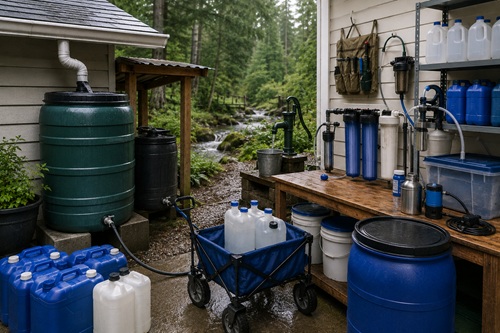
Renewable water sources then assume responsibility for replacing the water that has been consumed. Rainwater harvesting systems, private wells, productive springs, flowing streams, rivers, and lakes all provide opportunities to replenish household supplies. Depending on local conditions, one or more of these sources may become the primary supplier during a prolonged emergency.
Purification forms the critical link between renewable water and safe household use. Even the cleanest natural water should be evaluated carefully and treated appropriately before consumption. Portable filters, boiling, chemical disinfectants, ultraviolet treatment, or combinations of these methods ensure that collected water can safely replace stored reserves.
Transportation and storage complete the system. Water collected from renewable sources must be transported efficiently, transferred into clean containers, and protected from contamination while awaiting use. Each stage supports the others. Without clean storage, purified water may become contaminated again. Without transportation equipment, collection becomes unnecessarily difficult.
Conservation strengthens every part of the system. Every litre that is saved reduces the amount of water that must be collected, transported, purified, and stored. The combination of storage, collection, purification, transportation, and conservation creates a resilient household water system capable of adapting to changing conditions far more effectively than any single method alone.
Reviewing and Maintaining Your Water Storage Plan
Preparedness is not a one-time activity. Household water storage should be reviewed regularly to ensure it continues meeting the needs of everyone who depends upon it. Family size changes, medical requirements evolve, pets are added, storage containers age, and equipment eventually requires replacement.
At least once each year, inspect every water storage container for leaks, cracks, damaged lids, deteriorated seals, or other signs of wear. Verify that labels remain readable and that rotation dates are current. Replace damaged containers immediately rather than waiting until an emergency reveals the problem.
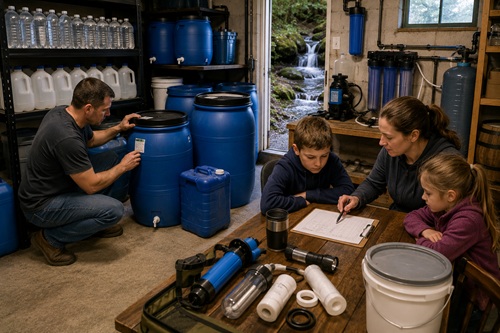
Review your household water budget during the same inspection. Confirm that your storage goals still reflect current household needs. If additional family members, pets, or medical requirements have increased water demand, adjust your storage objectives accordingly.
Renewable water sources should also be evaluated regularly. Visit nearby springs, streams, ponds, wells, or rainwater systems to verify that conditions have not changed significantly. Seasonal observations improve your understanding of how these sources perform throughout the year and strengthen long-term planning.
Finally, practice using your equipment. Test water filters, inspect transfer pumps, clean collection containers, and review emergency procedures with everyone in the household. Equipment that has never been used before an emergency often reveals unexpected problems when it is finally needed.
Table 8 — Annual Water Storage Inspection Checklist
| Inspection Item | Complete |
|---|---|
| Stored water inventory updated | ☐ |
| Containers inspected for damage | ☐ |
| Water rotated if required | ☐ |
| Labels verified | ☐ |
| Storage locations inspected | ☐ |
| Purification equipment tested | ☐ |
| Collection containers cleaned | ☐ |
| Renewable water sources reviewed | ☐ |
| Household water budget updated | ☐ |
| Emergency water plan practiced | ☐ |
A regular review schedule keeps your water storage system reliable while ensuring it continues supporting your household as circumstances change over time.
In Summary
Determining how much water to store is one of the most important decisions in emergency preparedness because every other aspect of a household’s water plan depends upon it. Rather than selecting an arbitrary number of containers or following a generalized recommendation without question, a well-developed storage plan begins with understanding your household’s actual daily water requirements. Once those needs are known, realistic storage goals can be established and expanded over time.
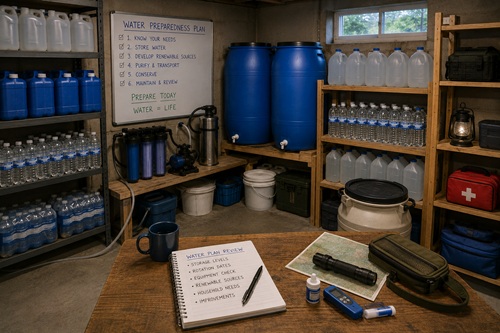
Water storage should always be viewed as a progression rather than a single destination. A seventy-two-hour reserve provides immediate security during short-term disruptions, while one-week, two-week, and one-month supplies offer increasing levels of independence as emergencies continue. Beyond these milestones, preparedness gradually shifts from simply storing larger quantities of water toward developing renewable water sources capable of replacing what has been consumed.
The most resilient households recognize that storage alone is not enough. Long-term preparedness depends upon combining stored water with dependable collection methods, effective purification, efficient transportation, thoughtful conservation, and regular maintenance. These systems complement one another, ensuring that the limitations of one approach are supported by the strengths of another.
Just as importantly, water preparedness is not static. Families grow, storage systems expand, equipment ages, and local conditions change over time. Reviewing your water storage plan regularly ensures that it continues meeting the needs of your household while providing opportunities for ongoing improvement.
By approaching water storage as part of an integrated preparedness strategy rather than an isolated task, households gain both confidence and flexibility. Instead of wondering whether enough water has been stored, they possess a practical system capable of adapting to emergencies of varying duration while supporting the health and well-being of everyone who depends upon it.
Preparedness Action Plan
Begin by calculating your household’s actual daily water requirements using a written household water budget. Include drinking water, cooking, hygiene, sanitation, medical needs, pets, livestock, and other recurring activities that require clean water. Use these calculations to establish realistic storage goals rather than relying solely on generalized recommendations.
If you have not yet established a seventy-two-hour reserve, make that your first objective. Once it has been achieved, develop a written plan for expanding your storage to one week, two weeks, one month, and beyond. Add storage gradually as space, budget, and experience allow while maintaining organized inventory records and regular rotation schedules.
Inspect your current storage locations and verify that all containers are food-grade, protected from sunlight, chemicals, excessive temperatures, and physical damage. Divide larger reserves among multiple storage areas whenever practical to improve redundancy and reduce the impact of accidental damage or contamination.
Evaluate the renewable water sources available near your home and determine how they would support your household if stored supplies became depleted. Ensure that appropriate collection containers, purification equipment, transportation methods, and conservation practices are available before they are needed.
Finally, schedule an annual review of your entire water storage system. Update your household water budget, inspect storage containers, test purification equipment, review renewable water sources, and revise your preparedness plan whenever household circumstances change.
Skills Learned
After completing this handbook, you should understand how to determine realistic household water storage goals based on emergency duration, household size, and expected daily water consumption. You should be able to distinguish between short-term emergency storage and long-term water preparedness while recognizing the role each plays within an integrated water strategy.
You should also be able to evaluate the advantages and limitations of different storage milestones, compare various container types, identify safe storage locations, recognize common water storage mistakes, and develop a gradual expansion plan that strengthens preparedness over time.
Most importantly, you should now understand that effective water preparedness extends beyond simply storing larger quantities of water. It requires balancing stored reserves with renewable water sources, purification methods, transportation equipment, conservation practices, and routine maintenance to create a resilient household water system capable of adapting to changing conditions.
Appendices
The following worksheets and reference materials are intended to become practical planning tools that can be reused as your household and preparedness program continue to evolve.
Appendix A — Household Water Storage Goal Calculator
Use this worksheet to establish progressive water storage milestones based on your household’s daily water requirements.
| Storage Goal | Daily Requirement | Total Water Required |
|---|---|---|
| 72 Hours | ||
| One Week | ||
| Two Weeks | ||
| One Month | ||
| Three Months | ||
| Six Months | ||
| One Year |
Appendix B — Water Storage Inventory
Maintain a complete inventory of every emergency water container in your household.
| Storage Container | Quantity | Capacity | Storage Location | Rotation Date |
| Bottled Water | ||||
| Water Bricks | ||||
| Jerry Cans | ||||
| Water Barrels | ||||
| Storage Tanks | ||||
| Other Containers |
Appendix C — Water Rotation Schedule
Regular rotation helps maintain water quality while ensuring storage containers remain in good condition.
| Storage Location | Last Rotation | Next Rotation | Completed |
| ☐ | |||
| ☐ | |||
| ☐ | |||
| ☐ | |||
| ☐ |
Appendix D — Water Storage Expansion Planner
Plan future improvements to your household water storage system.
| Improvement | Priority | Target Date | Completed |
| Increase 72-Hour Reserve | High | ☐ | |
| Expand to One Week | High | ☐ | |
| Expand to Two Weeks | Medium | ☐ | |
| Expand to One Month | Medium | ☐ | |
| Improve Container Organization | Medium | ☐ | |
| Add Renewable Water Source | High | ☐ | |
| Upgrade Purification Equipment | High | ☐ | |
| Improve Transportation Equipment | Medium | ☐ |
Appendix E — Household Water Storage Inspection Log
Record each inspection to help identify maintenance trends over time.
| Inspection Date | Containers Checked | Problems Found | Corrective Action |
Appendix F — Renewable Water Source Assessment
Identify the renewable water sources available to your household.
| Water Source | Distance | Seasonal Reliability | Treatment Required | Backup Source |
| Well | ||||
| Spring | ||||
| Creek | ||||
| River | ||||
| Lake | ||||
| Rainwater Collection | ||||
| Other |
Appendix G — Annual Water Preparedness Review
Complete this checklist at least once each year.
| Annual Review Item | Complete |
| Household water budget updated | ☐ |
| Storage goals reviewed | ☐ |
| Containers inspected | ☐ |
| Water rotated | ☐ |
| Labels verified | ☐ |
| Purification equipment tested | ☐ |
| Collection equipment inspected | ☐ |
| Renewable water sources reviewed | ☐ |
| Household emergency exercise completed | ☐ |
| Preparedness plan updated | ☐ |
Appendix H — Quick Reference Tables
Water Storage Progression
| Goal | Purpose |
| 72 Hours | Immediate emergency response |
| One Week | Short-term utility outages |
| Two Weeks | Extended emergency recovery |
| One Month | Intermediate preparedness |
| Three Months | Long-term resilience |
| Six Months | Extended emergency planning |
| One Year | Advanced integrated preparedness |
Water Preparedness Priorities
| Highest Priority | Supporting Priority | Long-Term Priority |
| Stored Drinking Water | Water Purification | Renewable Water Sources |
| Household Water Budget | Collection Equipment | Conservation Practices |
| Safe Storage | Transportation | Annual Maintenance |
Water Storage Formula
| Formula | Purpose |
| Daily Requirement × Number of Days | Total Storage Goal |
| Total Stored Water ÷ Daily Requirement | Estimated Days of Supply |
| Daily Requirement − Daily Conservation Savings | Reduced Emergency Requirement |
Appendix I — Household Water Storage Quick Reference
Recommended Storage Milestones
| Preparedness Goal | Typical Purpose |
|---|---|
| 72 Hours | Immediate emergency response |
| 1 Week | Utility outages |
| 2 Weeks | Extended disruptions |
| 1 Month | Long-term preparedness |
| 3 Months | Seasonal emergencies |
| 6 Months | Advanced preparedness |
Final Notes
There is no single “correct” amount of water that every household should store. The appropriate storage goal depends on your household’s size, climate, medical needs, available space, budget, and access to renewable water sources. The purpose of these appendices is to help transform general recommendations into a personalized water storage plan based on measurable information rather than assumptions.
As your preparedness evolves, continue updating these worksheets to reflect changes in your household, equipment, and long-term goals. Over time, they will become a practical record of your progress and an essential part of your overall emergency water preparedness plan.
© Prepping Communities. This content is for informational purposes only and not professional advice. Use at your own risk.
Terms | Privacy | Guidelines