
Introduction
Selecting the right water storage container is one of the most important decisions in any long-term preparedness plan. Even the cleanest water can become contaminated if it is stored in unsuitable containers, exposed to excessive heat, or handled improperly. The container itself becomes part of the water system, protecting the water from contamination while allowing it to be transported, inspected, rotated, and used safely over time.
Many people assume that any clean container will safely store drinking water. In reality, different containers are designed for different purposes. Some plastics are intended for long-term food storage, while others slowly break down or leach chemicals when used incorrectly. Certain containers are excellent for portability but inefficient for large-scale storage, while others provide tremendous capacity but are difficult to move once filled. Understanding these differences allows households to choose storage solutions that fit their preparedness goals rather than simply purchasing the largest or least expensive option available.
Storage containers should also be viewed as part of a complete preparedness system rather than isolated pieces of equipment. Water must eventually be collected, transported, purified, stored, rotated, and consumed. Every container influences how efficiently these tasks can be completed. A family relying only on very large barrels may struggle to transport water from nearby sources, while a household relying exclusively on small bottles may require excessive storage space and unnecessary maintenance. The strongest systems combine several container types, allowing each to perform the tasks for which it is best suited.
Another important consideration is the expected duration of the emergency. Containers suitable for short-term emergency supplies are not always the best choice for long-term preparedness. Likewise, a container that performs exceptionally well in a basement storage room may be poorly suited for vehicle evacuation, camping, or collecting water from natural sources. Choosing containers according to their intended purpose creates a more flexible and resilient water storage strategy.
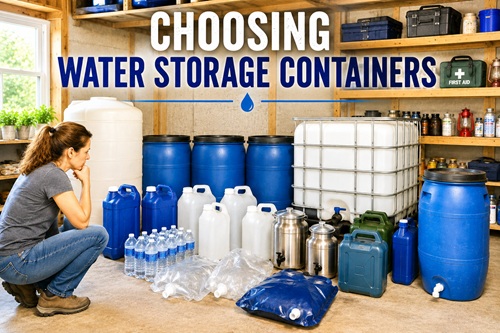
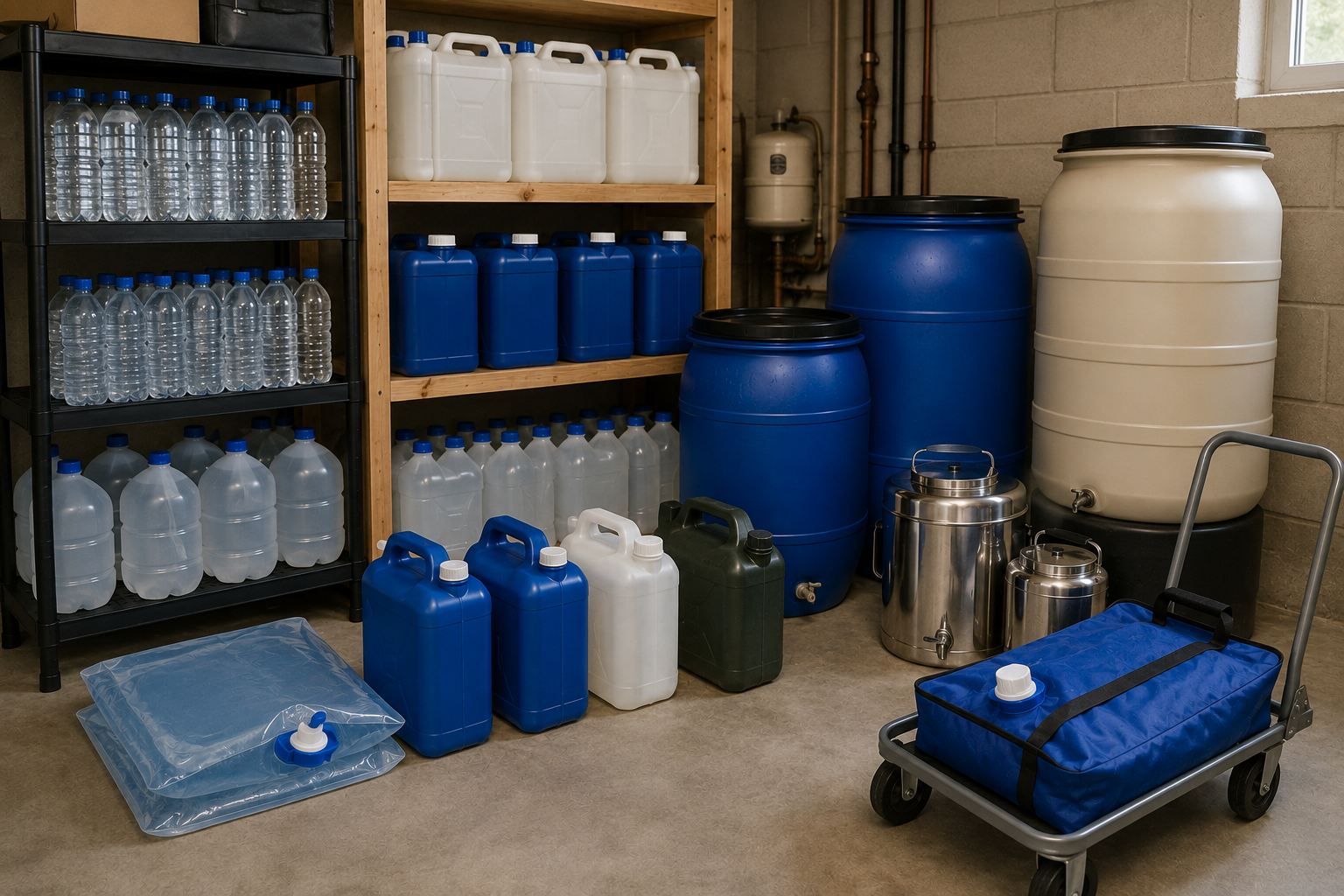
This handbook examines the most common water storage containers used by preparedness-minded households, including commercially bottled water, stackable containers, food-grade jerry cans, large storage barrels, cisterns, collapsible containers, stainless steel containers, and other specialized storage systems. You will learn the advantages and limitations of each, how to select containers for different situations, and how to build a layered storage system that remains practical, organized, and dependable for many years.
Why Container Selection Matters
Water storage begins long before the first container is filled. The type of container selected influences water quality, storage efficiency, portability, maintenance requirements, replacement costs, and the overall reliability of your preparedness plan. A poor container choice can shorten the usable life of stored water or make it unnecessarily difficult to manage during an emergency. Choosing appropriate containers from the beginning prevents many of these problems while simplifying long-term maintenance.
Every storage container performs several important functions simultaneously. It protects water from contamination, blocks physical damage, limits exposure to air and sunlight, allows transportation, and provides a practical method of dispensing water when needed. If any one of these functions is compromised, the usefulness of the stored water may be reduced. A cracked lid, damaged seal, contaminated interior, or poorly designed spout can introduce unnecessary complications when clean drinking water becomes most important.
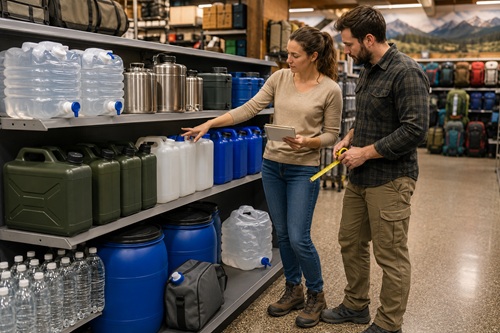
Container selection also affects how efficiently available storage space is used. Round barrels maximize storage volume while minimizing the number of containers that must be maintained, but they require considerable floor space. Rectangular stackable containers often use available shelving much more efficiently, allowing greater storage capacity inside closets, utility rooms, garages, or basements. Understanding these differences allows households to make better use of limited storage areas.
Portability is another major consideration. Water is heavy. A single U.S. gallon weighs approximately 8.34 pounds (3.78 kilograms), while a 55-gallon barrel weighs well over 450 pounds (204 kilograms) when full. Large stationary containers provide excellent storage efficiency but are nearly impossible to move without specialized equipment. Smaller containers sacrifice capacity but allow one person to transport water safely when collection or evacuation becomes necessary.
Container durability also deserves careful attention. Long-term preparedness often requires water to remain safely stored for months or even years. Containers must resist cracking, ultraviolet light, temperature changes, repeated handling, and normal aging. Investing in durable food-grade containers generally reduces replacement costs while improving confidence that emergency supplies will remain usable when needed.
Perhaps most importantly, container selection should support your overall preparedness strategy rather than dictate it. Instead of asking which single container is best, it is usually more helpful to ask which combination of containers will best support storage, transportation, collection, purification, and everyday household use. A layered approach nearly always provides greater flexibility than relying on only one type of container.
Table 1 — Factors to Consider When Choosing Water Storage Containers
| Selection Factor | Why It Matters |
|---|---|
| Food-grade construction | Protects drinking water quality |
| Storage capacity | Determines total water volume |
| Portability | Affects transportation and collection |
| Stackability | Improves storage efficiency |
| Durability | Supports long-term preparedness |
| Ease of cleaning | Simplifies maintenance |
| Dispensing method | Improves daily usability |
| Cost | Influences expansion over time |
| Replacement availability | Supports long-term sustainability |
| Intended use | Matches container to preparedness needs |
Selecting containers with these factors in mind creates a stronger, more adaptable water storage system than focusing on capacity alone.
Understanding Food-Grade Water Containers
Before comparing different container styles, it is important to understand what makes a container suitable for storing drinking water. The term food-grade refers to materials specifically manufactured to safely contact food and beverages without introducing harmful substances. Food-grade plastics, stainless steel, and certain other approved materials are designed to protect water quality while resisting chemical breakdown during long-term use.
Many common household containers are not intended for potable water storage, even if they appear clean. Buckets, storage totes, chemical containers, fuel cans, paint buckets, detergent bottles, and many recycled plastic containers may contain residues or materials unsuitable for drinking water. Washing these containers does not necessarily make them safe for potable water storage because some chemicals permanently penetrate the plastic or remain trapped within microscopic surface imperfections.
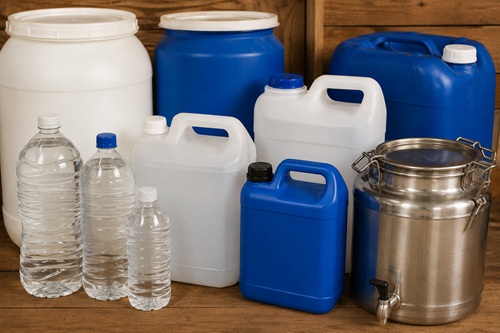
Most food-grade plastic water containers are manufactured using high-density polyethylene (HDPE), identified by the recycling symbol number 2. HDPE has become one of the most widely used materials for emergency water storage because it is durable, relatively lightweight, resistant to impact, and performs well over a wide range of temperatures. Properly manufactured HDPE containers also resist many forms of chemical degradation while remaining affordable for households building large water reserves.
Polyethylene terephthalate (PET), identified by recycling symbol 1, is commonly used for commercially bottled water. PET bottles are lightweight, inexpensive, and ideal for factory-sealed drinking water. However, they are generally designed for shorter-term use than heavier HDPE storage containers and may not tolerate repeated refilling or rough handling as well.
Food-grade stainless steel provides another excellent storage option. Stainless steel does not leach chemicals, resists corrosion, blocks sunlight completely, and offers exceptional durability. Although more expensive than plastic containers, stainless steel can provide decades of reliable service when properly maintained. Its primary disadvantages are higher initial cost and greater weight.
Regardless of the material selected, containers should always be purchased from reputable manufacturers specifically producing products intended for potable water storage. This simple decision eliminates many unnecessary risks while providing confidence that your emergency water remains protected throughout long-term storage.
Table 2 — Common Water Storage Materials
| Material | Advantages | Limitations | Typical Uses |
|---|---|---|---|
| HDPE Plastic | Durable, affordable, food-grade | Sensitive to UV over long periods | Barrels, jerry cans, water bricks |
| PET Plastic | Lightweight, inexpensive | Less durable for repeated use | Bottled water |
| Stainless Steel | Extremely durable, no chemical leaching | Expensive, heavier | Premium long-term storage |
| Glass | Chemically stable | Fragile, heavy | Small specialty storage |
| Silicone/Flexible Materials | Lightweight, collapsible | Shorter lifespan | Portable emergency containers |
Understanding these materials provides the foundation for selecting the right storage containers as your preparedness system continues to grow.
Commercially Bottled Water
Commercially bottled water is one of the simplest and most widely used methods of storing emergency drinking water. Because it is filled, sealed, and packaged under controlled conditions, bottled water requires very little preparation before it is placed into storage. For households just beginning their preparedness journey, it provides an immediate way to establish a reliable emergency reserve without purchasing specialized equipment or learning water treatment procedures.
One of the greatest advantages of bottled water is convenience. Individual bottles are lightweight, easy to transport, and immediately ready for use. They can be distributed throughout the home, stored inside vehicles, packed into evacuation kits, or carried by individual family members. If one container becomes damaged, only a small portion of the overall supply is affected rather than an entire barrel or storage tank.
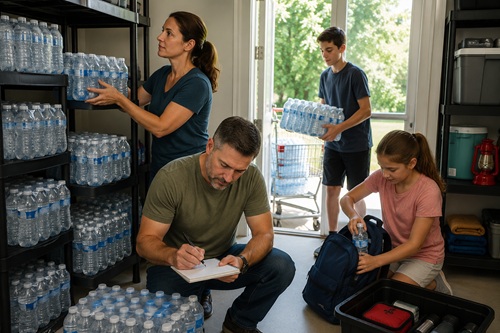
Commercial packaging also simplifies inventory management. Cases can be counted quickly, rotated easily, and replaced during normal shopping trips. This gradual replacement process allows households to expand their emergency water reserve over time without making large purchases all at once. Many families simply purchase one or two additional cases each month until their desired storage goal has been reached.
Despite these advantages, bottled water also has important limitations. Storing large quantities requires considerable shelf space because much of each case consists of empty air between bottles. A month’s supply for a family may require dozens of cases occupying significant floor area. Plastic bottles are also more susceptible to punctures, crushing, and damage than heavier-duty storage containers designed specifically for long-term preparedness.
Environmental conditions also affect bottled water. Cases should be protected from prolonged exposure to direct sunlight, freezing temperatures, excessive heat, and chemicals. While commercially bottled water often remains safe well beyond its printed date when properly stored, manufacturers typically recommend periodic rotation to maintain the highest quality and to inspect containers for damage.
Commercially bottled water works exceptionally well as the first layer of a household water storage system. It provides immediate access to safe drinking water while larger storage systems, renewable water sources, and purification equipment are gradually developed.
Table 3 — Advantages and Limitations of Commercially Bottled Water
| Advantages | Limitations |
|---|---|
| Ready to drink immediately | Requires considerable storage space |
| Factory sealed | Higher cost per litre than bulk storage |
| Lightweight and portable | Plastic bottles can be punctured or crushed |
| Excellent for evacuation kits | Generates more packaging waste |
| Easy to rotate | Less efficient for large household reserves |
| No preparation required | Shorter container life than heavy-duty storage containers |
Stackable Water Bricks and Modular Containers
Stackable water containers, often referred to as water bricks or modular storage containers, have become increasingly popular because they make exceptionally efficient use of household storage space. Unlike round containers, their rectangular shape allows them to fit neatly inside closets, storage rooms, shelves, and under workbenches while minimizing wasted space.
Most modular containers hold between three and four gallons (approximately eleven to fifteen litres), making them large enough to provide useful storage while remaining manageable for most adults to carry. This balance between capacity and portability is one of their greatest strengths. Unlike large barrels, a single container can be moved easily without specialized equipment, allowing water to be transported wherever it is needed.
Another advantage is flexibility. Individual containers can be added gradually as storage goals increase. Households do not need to purchase an entire storage system at once. Instead, they can expand one container at a time while maintaining a consistent storage layout. Because every container is identical, inventory management and rotation become much simpler.
Stackable containers also improve redundancy. If one container becomes damaged or contaminated, only a small portion of the overall reserve is affected. This reduces risk compared to relying on only one or two very large storage barrels.
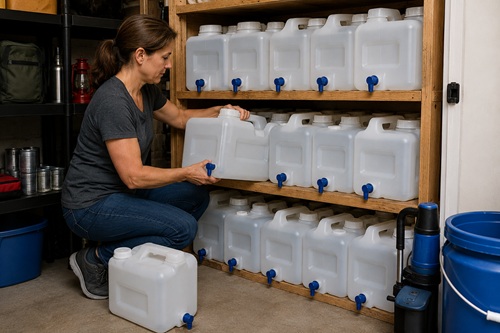
Most modular water containers are manufactured from food-grade HDPE plastic and include wide openings that simplify cleaning and sanitizing. Many models also feature interchangeable dispensing spigots, making them convenient for everyday use during emergencies.
Their rectangular design also makes them particularly useful in homes where storage space is limited. They stack securely on shelves, inside closets, beneath staircases, and in utility rooms without leaving the wasted space commonly found around cylindrical containers. As a result, households often store significantly more water within the same footprint.
The primary limitation is cost. Water bricks generally cost considerably more per gallon of storage capacity than large barrels. Households requiring hundreds of gallons of storage may find modular containers prohibitively expensive if used exclusively. Nevertheless, many preparedness-minded households consider them an excellent investment because of their convenience, organization, portability, and efficient use of space.
Another advantage is ease of maintenance. Because individual containers are relatively small, they can be emptied, cleaned, sanitized, rotated, and inspected by one person without assistance. If one container requires replacement, only a small portion of the overall reserve is temporarily unavailable.
For many preparedness-minded households, modular containers form the second layer of a comprehensive water storage system. Bottled water provides immediate access during the first hours of an emergency, while stackable containers provide larger reserves that remain organized, portable, and easy to maintain.
Food-Grade Jerry Cans
Food-grade jerry cans have become one of the most versatile water storage containers available because they combine substantial capacity with excellent portability. Most hold between five and seven gallons (nineteen to twenty-six litres), providing enough water to justify each trip while remaining manageable for one adult to carry under normal circumstances.
Unlike permanently installed storage systems, jerry cans are designed to serve multiple purposes. They function equally well as stationary household storage containers, transportation containers, and renewable water collection containers. This versatility makes them one of the most valuable components of a layered preparedness system.
Their integrated handles make transportation considerably easier than carrying multiple smaller bottles. When additional water must be collected from a nearby spring, creek, community distribution point, or rainwater collection system, jerry cans allow large amounts of water to be transported with fewer trips. Many households also use garden wagons or utility carts to increase carrying capacity even further.
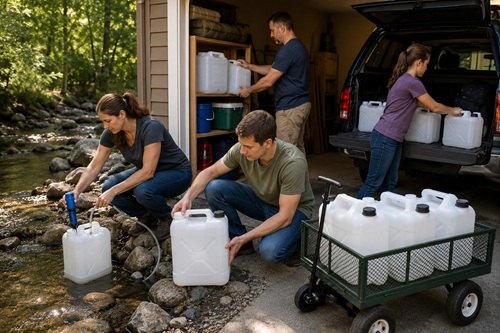
Food-grade jerry cans are also well suited for vehicle use. During evacuations they can be loaded into trucks, SUVs, trailers, or recreational vehicles without requiring specialized equipment. Their durable construction resists normal handling while their secure lids reduce the likelihood of spills during transportation.
Many preparedness-minded households also appreciate their flexibility inside the home. Jerry cans can remain filled as part of the permanent emergency reserve, yet they are immediately available whenever portable water is required elsewhere on the property. Few other container types provide this combination of storage, transportation, and collection capability.
Because jerry cans are frequently opened and refilled, regular cleaning and sanitizing become particularly important. Wide-mouth designs simplify inspection and cleaning, while food-grade materials ensure that stored drinking water remains protected throughout repeated use. Households should establish routine maintenance schedules so every container remains ready for immediate deployment.
Not every jerry can is intended for potable water. Fuel containers may appear similar but are manufactured for completely different purposes. Water containers should always be purchased from reputable manufacturers specifically producing food-grade products intended for drinking water. Using fuel containers for potable water should always be avoided regardless of how thoroughly they appear to have been cleaned.
For households expecting to collect renewable water during prolonged emergencies, food-grade jerry cans often become the primary working container. They bridge the gap between natural water sources and permanent household storage while remaining portable enough for one person to manage safely.
Table 4 — Comparing Common Portable Water Containers
| Container Type | Typical Capacity | Portability | Best Application |
|---|---|---|---|
| Commercial Bottled Water | Individual bottles | Excellent | Immediate drinking |
| Stackable Water Bricks | 3–4 gal (11–15 L) | Very Good | Organized household storage |
| Food-Grade Jerry Cans | 5–7 gal (19–26 L) | Excellent | Storage, transportation, and water collection |
| Collapsible Containers | 2–5 gal (8–20 L) | Good | Temporary collection and evacuation |
| Stainless Steel Containers | Various | Good | Premium long-term storage and everyday use |
These three container types—commercial bottled water, modular water bricks, and food-grade jerry cans—provide an excellent foundation for most household preparedness plans. Together they offer immediate access, organized storage, and portable water transportation, creating a flexible system capable of supporting both short-term emergencies and the transition to renewable water collection.
Large Water Barrels
Large food-grade water barrels provide one of the most economical methods of storing significant quantities of emergency water. The most common size holds approximately fifty-five gallons (208 litres), although smaller and larger barrels are also available. For households building one-month or longer water reserves, barrels often become the foundation of the overall storage system because they offer excellent storage capacity while minimizing cost per gallon.
One of the greatest advantages of large barrels is efficiency. A single fifty-five-gallon barrel stores the equivalent of well over two hundred individual 500 mL water bottles while requiring only one container to inspect, rotate, and maintain. This dramatically simplifies inventory management as household storage goals continue expanding.
Food-grade barrels are most commonly manufactured from high-density polyethylene (HDPE), making them resistant to impact, corrosion, and normal household temperature changes. Properly maintained barrels can provide many years of dependable service while protecting stored drinking water from contamination.
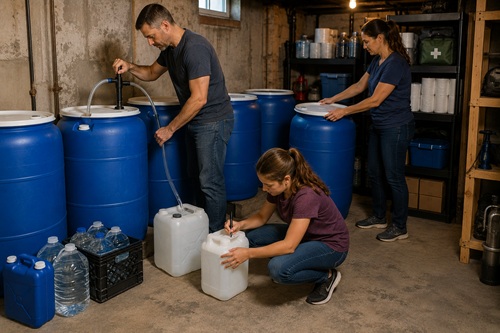
Although barrels provide outstanding storage efficiency, they introduce new planning considerations. Water is extremely heavy. A completely filled fifty-five-gallon barrel weighs approximately 460 pounds (209 kilograms). Once filled, it is effectively a permanent fixture unless pumps, dollies, or other lifting equipment are available. For this reason, barrels should always be positioned in their permanent storage location before filling.
Storage location deserves careful planning. Ground-level concrete floors generally provide the best support because they safely carry the tremendous weight of filled barrels. Placing several full barrels on elevated wooden floors without evaluating structural capacity may create unnecessary safety concerns. Whenever possible, distribute larger storage systems across several suitable locations rather than concentrating all weight in one area.
Dispensing water from barrels also requires planning. Unlike bottled water, barrels cannot simply be lifted and poured. Most households install siphons, hand pumps, electric transfer pumps, or gravity-fed dispensing systems that allow water to be removed without moving the barrel itself. Practicing with this equipment before an emergency ensures the system can be used confidently when needed.
Cleaning and sanitizing large barrels requires more effort than maintaining smaller containers. Their size makes it more difficult to reach interior surfaces, particularly if narrow openings are used. Selecting barrels with removable lids or wide openings greatly simplifies routine maintenance and inspections.
Despite these limitations, large barrels remain one of the most cost-effective ways to build substantial emergency water reserves. When combined with smaller portable containers, they provide an excellent balance between storage capacity and practical usability.
Table 5 — Advantages and Limitations of Water Barrels
| Advantages | Limitations |
|---|---|
| Very low cost per gallon | Extremely heavy when filled |
| Excellent long-term storage | Difficult to move |
| Fewer containers to inspect | Requires pumps or siphons |
| Durable HDPE construction | Needs suitable floor support |
| Efficient use of storage volume | More difficult to clean |
Water Storage Tanks and Cisterns
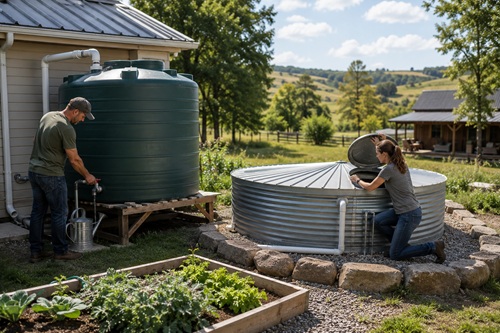
For households seeking long-term water independence, large storage tanks and cisterns provide capacities far beyond conventional barrels. These permanent systems typically range from several hundred gallons to several thousand gallons and are frequently used by rural homes, farms, off-grid properties, and homesteads.
Unlike portable containers, tanks become permanent infrastructure. Rather than simply storing emergency water, they often serve as part of the household’s everyday water system by working alongside rainwater harvesting systems, private wells, or other renewable water sources.
Large storage tanks provide exceptional storage efficiency. Instead of managing dozens of smaller containers, households maintain one integrated storage system. This simplifies inventory management while allowing tremendous quantities of water to be stored within a relatively compact footprint.
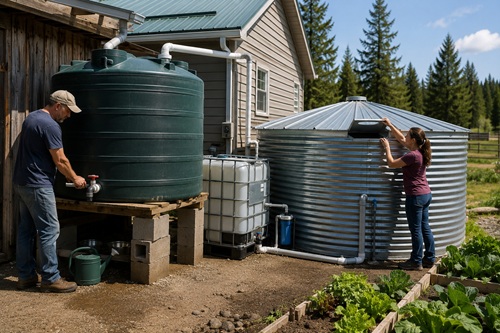
Many tanks are manufactured from food-grade polyethylene similar to smaller barrels, although fiberglass, concrete, and stainless steel systems are also available. Material selection depends upon climate, installation location, expected lifespan, and budget.
Above-ground tanks are generally easier to install and inspect. Their condition can be monitored visually, leaks are more easily detected, and maintenance usually requires less excavation or specialized equipment.
Underground cisterns offer different advantages. Because they remain below ground, they are naturally protected from sunlight, freezing temperatures, physical damage, and vandalism. Underground installations also preserve valuable yard space while maintaining more stable water temperatures throughout the year.
Installation planning becomes much more important as system size increases. Overflow systems, foundation preparation, plumbing connections, freeze protection, venting, access hatches, and drainage all influence long-term reliability. Large tanks should always be installed according to manufacturer recommendations while complying with local building regulations whenever applicable.
Most preparedness-minded households use storage tanks together with renewable water sources rather than relying exclusively on stored municipal water. Rainwater harvesting, private wells, or seasonal spring collection can continually replenish large tanks while purification systems ensure the water remains suitable for household use.
Table 6 — Typical Water Storage Tank Sizes
| Storage System | Approximate Capacity | Typical Application |
|---|---|---|
| Small Tank | 100–300 gallons | Supplemental storage |
| Medium Tank | 500–1,000 gallons | Household reserve |
| Large Tank | 1,500–5,000 gallons | Rural properties |
| Underground Cistern | 2,000–10,000+ gallons | Long-term integrated systems |
Collapsible Water Containers
Collapsible water containers serve a very different role from permanent storage systems. Rather than storing water continuously, they are designed to remain folded until additional carrying capacity is needed. This makes them particularly valuable for evacuation, water collection, and temporary transportation.
Their greatest advantage is space efficiency. When empty, most collapsible containers fold nearly flat, occupying very little storage space inside emergency kits, vehicles, or preparedness closets. During an emergency they can quickly be deployed to collect water from community distribution points, rainwater systems, nearby streams, or other renewable sources.
Because they are lightweight, collapsible containers are easy to transport even before they are filled. Several folded containers can be carried inside a backpack or vehicle without significantly increasing weight or reducing cargo space.
Many preparedness households keep several collapsible containers inside evacuation kits specifically because they allow additional water to be collected after leaving home. This flexibility is difficult to achieve using rigid containers alone.
Despite these advantages, collapsible containers are generally not intended for permanent long-term water storage. Flexible materials are more susceptible to punctures, abrasion, ultraviolet degradation, and general wear than rigid HDPE containers. They should therefore be viewed primarily as transportation equipment rather than primary storage vessels.
Most models include integrated carrying handles, pouring spouts, or dispensing valves that simplify household use after collection. Selecting durable food-grade materials and inspecting them regularly helps ensure they remain ready whenever additional water transport becomes necessary.
Stainless Steel Water Containers
Stainless steel water containers represent one of the highest-quality storage options available. Although considerably more expensive than plastic alternatives, they provide exceptional durability, outstanding sanitation characteristics, and extremely long service life.
Unlike plastic, stainless steel does not absorb odors, discolor over time, or gradually degrade when exposed to sunlight. It completely blocks light from reaching stored water, reducing algae growth while protecting water quality during long-term storage.
Another significant advantage is chemical stability. Properly manufactured food-grade stainless steel does not leach chemicals into stored water and remains highly resistant to corrosion under normal household conditions. For households prioritizing long-term reliability, stainless steel provides tremendous peace of mind.
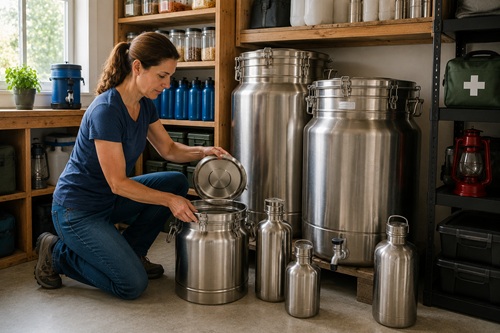
The smooth interior surfaces are also easier to sanitize than many plastic containers. Because bacteria have fewer microscopic imperfections in which to accumulate, thorough cleaning often requires less effort while providing excellent hygiene.
The primary disadvantages are cost and weight. Stainless steel containers frequently cost several times more than comparable HDPE containers while also weighing considerably more before they are even filled. Large stainless steel storage systems therefore become expensive investments that may exceed the budgets of many households.
For this reason, many preparedness-minded families use stainless steel selectively. Smaller containers may be reserved for everyday drinking water, camping, or portable emergency kits, while larger plastic barrels continue serving as the primary long-term household reserve.
When properly maintained, stainless steel containers can remain in service for decades, making them one of the longest-lasting investments available for emergency water storage.
Intermediate Bulk Containers (IBC Totes)
Intermediate Bulk Containers, commonly referred to as IBC totes, provide one of the most efficient methods of storing very large quantities of water. These cube-shaped containers are typically enclosed within galvanized steel support cages and mounted on heavy-duty pallets. Most food-grade IBC totes hold approximately 275 to 330 gallons (1,040 to 1,250 litres), making them an attractive option for households seeking substantial long-term water storage without installing permanent cisterns.
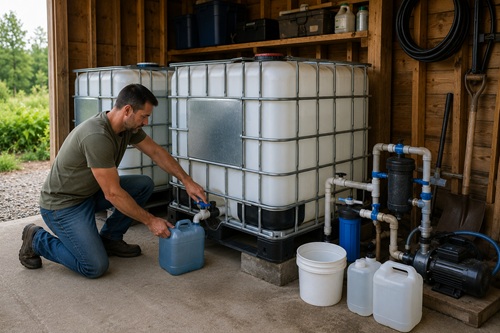
One of the greatest advantages of IBC totes is their efficient use of space. Unlike cylindrical barrels, their square shape allows them to sit tightly against walls or beside one another with very little wasted floor area. This design makes them especially useful inside barns, garages, workshops, storage buildings, and other locations where maximizing storage capacity is important.
Most IBC totes include a large fill opening at the top and an integrated dispensing valve near the bottom. These features simplify filling, draining, and transferring water into smaller containers. When combined with gravity-fed plumbing, transfer pumps, or filtration systems, IBC totes can become a central component of an advanced household water storage system.
However, selecting an IBC tote requires careful attention to its history. Many used totes previously contained industrial chemicals, agricultural products, detergents, or food-processing ingredients. Unless the container’s complete history is known and it has been specifically certified for potable water storage, it should never be used for drinking water. Purchasing new food-grade IBC totes or those with a documented food-safe history eliminates this risk.
Weight is another important consideration. A completely filled 275-gallon tote weighs well over 2,300 pounds (1,040 kilograms). Like large water tanks, IBC totes should always be positioned on stable, level surfaces capable of safely supporting their weight. Concrete slabs generally provide the best foundation.
Because of their tremendous capacity, IBC totes are often integrated with rainwater harvesting systems or private wells. Rather than serving solely as emergency reserves, they become active components of the household water system, storing renewable water that can be filtered, treated, and distributed as needed.
For preparedness-minded households with sufficient space, IBC totes offer an excellent balance between storage efficiency, affordability, and expandability.
Table 7 — Comparing Large Water Storage Systems
| Storage System | Typical Capacity | Portability | Best Use |
|---|---|---|---|
| 55-Gallon Barrel | 55 gal (208 L) | Poor | Household reserve |
| IBC Tote | 275–330 gal | Very Poor | Large stationary storage |
| Poly Storage Tank | 500–5,000+ gal | Stationary | Long-term household supply |
| Underground Cistern | 2,000–10,000+ gal | Permanent | Integrated water system |
Rainwater Collection Containers
Rainwater collection containers allow households to capture one of the most dependable renewable water sources available. While rainfall varies by region and season, every significant storm represents an opportunity to replenish emergency water supplies without relying on municipal infrastructure.
The most common rainwater collection container is the rain barrel. These barrels are typically connected to residential downspouts where they collect runoff from rooftops. For many households, a single rain barrel serves as an introduction to renewable water collection while demonstrating how quickly useful quantities of water can accumulate during moderate rainfall.
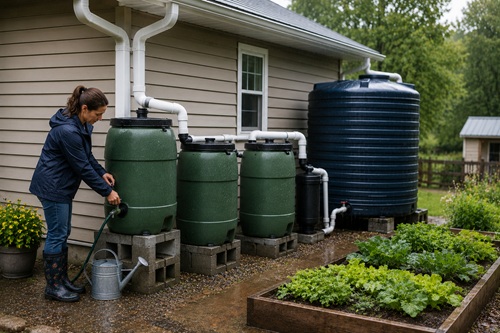
Larger rainwater systems often consist of interconnected barrels or dedicated storage tanks capable of holding hundreds or thousands of gallons. These systems dramatically increase collection capacity while reducing overflow during heavy rain events.
Collection containers should remain covered whenever possible. Tight-fitting lids, screened openings, and sealed plumbing connections reduce contamination from leaves, insects, rodents, and airborne debris while helping prevent algae growth caused by prolonged sunlight exposure.
The material used for rainwater storage is equally important. Food-grade polyethylene remains one of the most popular choices because it resists corrosion, tolerates outdoor conditions, and is available in many sizes. Dark-colored or opaque containers are generally preferred because they block sunlight and discourage biological growth inside the stored water.
Although rainwater collection provides an outstanding renewable resource, untreated rainwater should not automatically be considered safe for drinking. Rooftops, gutters, bird droppings, airborne pollutants, and organic debris may introduce contaminants before the water reaches the storage container. Appropriate filtration and purification remain essential whenever collected rainwater will be used for potable purposes.
Rainwater collection containers complement rather than replace traditional emergency water storage. Stored water provides immediate access during the early stages of an emergency, while rainwater systems gradually replenish reserves over time.
Portable Water Collection Containers
Eventually, most long-term preparedness plans require water to be transported from one location to another. Portable collection containers make this process safer, more efficient, and considerably less physically demanding.
Unlike stationary storage systems, portable containers are selected primarily for ease of handling. Comfortable handles, balanced weight distribution, secure lids, and durable construction become more important than maximizing storage capacity.
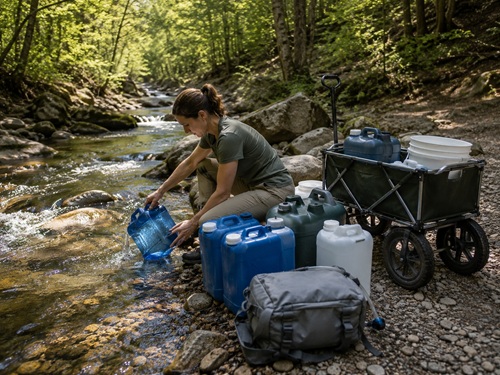
Wide-mouth containers simplify filling from shallow streams, springs, ponds, and rainwater systems. Narrow-neck containers generally reduce the chance of contamination during transport but may prove difficult to fill depending on the water source. Many preparedness households maintain both styles because each performs well under different circumstances.
Portable containers should always remain dedicated to potable water. Containers previously used for fuel, pesticides, fertilizers, automotive fluids, or household chemicals should never be reused for drinking water collection regardless of cleaning efforts. Maintaining dedicated water containers prevents accidental contamination while simplifying household organization.
Transportation equipment deserves equal attention. Hand trucks, utility carts, wheelbarrows, backpacks, sleds, bicycles with cargo trailers, and small wagons significantly reduce the physical effort required to transport water over long distances. Even households with relatively small water needs often benefit from planning transportation before an emergency occurs.
Many preparedness exercises reveal that transporting water is frequently more challenging than treating it. Selecting containers that match the physical capabilities of household members greatly improves the practicality of renewable water collection during prolonged emergencies.
Building a Layered Container System
No single water container performs every task equally well. Some containers excel at long-term storage but are impossible to move. Others are highly portable but inefficient for storing large reserves. Rather than searching for one perfect solution, experienced preparedness planners develop layered container systems that combine several complementary container types.
The first layer usually consists of commercially bottled water. These factory-sealed supplies provide immediate access to drinking water during the first hours or days of an emergency without requiring pumps, treatment, or additional preparation.
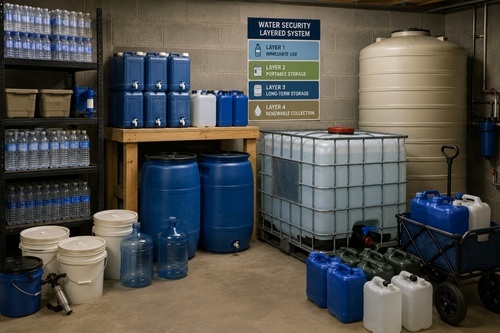
The second layer often includes modular water bricks and food-grade jerry cans. These containers expand storage capacity while remaining portable enough to transport around the property or load into vehicles if evacuation becomes necessary.
The third layer generally consists of large stationary storage such as barrels, IBC totes, or storage tanks. These containers provide economical long-term reserves that remain available throughout extended emergencies.
Supporting these storage layers are portable collection containers that replenish supplies from rainwater harvesting systems, private wells, springs, streams, rivers, or community distribution points. Water collected using these containers is then transferred into permanent storage after appropriate purification.
Each layer compensates for the limitations of the others. If bottled water supplies become exhausted, larger household reserves remain available. If stationary reserves begin to decline, renewable water collection gradually replaces consumed water. This redundancy creates a water storage system capable of adapting to changing conditions rather than depending upon a single container or storage method.
Households that build layered systems generally experience greater flexibility, easier maintenance, and improved resilience because no single failure compromises the entire water supply.
Table 8 — Example Layered Water Storage System
| Layer | Container Type | Primary Purpose |
|---|---|---|
| Layer 1 | Bottled Water | Immediate drinking |
| Layer 2 | Water Bricks | Organized household storage |
| Layer 3 | Jerry Cans | Transportation & collection |
| Layer 4 | Water Barrels | Long-term reserve |
| Layer 5 | Tanks / IBC Totes | Large stationary storage |
| Support Layer | Collapsible Containers | Renewable water collection |
A layered system provides immediate access, portability, redundancy, and long-term storage while allowing each container type to perform the role for which it is best suited.
Cleaning and Sanitizing Water Containers
Properly cleaning and sanitizing water storage containers is just as important as selecting the right container in the first place. Even the highest-quality food-grade container can compromise stored water if it contains dirt, dust, manufacturing residues, bacteria, or other contaminants. Every container should therefore be cleaned and sanitized before its first use and periodically throughout its service life.
Cleaning and sanitizing are two separate processes. Cleaning removes visible dirt, dust, oils, and residues from the container. Sanitizing reduces microorganisms that may remain after cleaning. Skipping either step can reduce the quality and safety of stored drinking water.
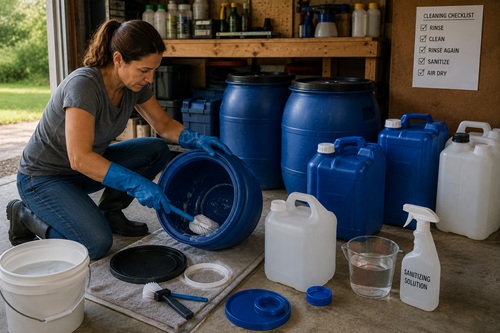
New food-grade containers often contain small amounts of dust or residue left over from manufacturing or shipping. Although these containers have never been used, they should still be rinsed and cleaned according to the manufacturer’s recommendations before filling them with potable water.
Previously used food-grade containers require additional attention. Any remaining residue from their original contents should be completely removed before sanitizing begins. Wide-mouth containers are generally easier to inspect because every interior surface can be examined visually.
Avoid using abrasive scrubbers or metal brushes on plastic containers. Deep scratches create tiny grooves where bacteria may accumulate and make future cleaning more difficult. Soft cleaning brushes specifically designed for food-grade containers provide effective cleaning while preserving the smooth interior surfaces.
Lids, gaskets, dispensing valves, and spigots should be cleaned and inspected separately. These components frequently receive the most handling and may become contaminated more quickly than the container itself. Damaged seals should be replaced immediately to maintain water quality during long-term storage.
Cleaning should become part of every water rotation cycle. Rather than waiting until contamination becomes visible, routine cleaning and sanitizing help ensure every container remains ready for immediate use while extending its useful service life.
Table 9 — Container Cleaning Schedule
| Container Type | Recommended Cleaning |
|---|---|
| Bottled Water | Inspect only until opened |
| Water Bricks | During each rotation |
| Jerry Cans | After each extended use or rotation |
| Water Barrels | At scheduled rotation |
| Rain Barrels | Seasonally |
| IBC Totes | Annual inspection and cleaning |
| Storage Tanks | According to manufacturer recommendations |
Organizing and Labeling Water Storage Containers
As emergency water supplies expand, organization becomes increasingly important. A few bottles stored in a pantry require very little management, but dozens of containers distributed throughout the home quickly become difficult to track without a consistent organizational system.
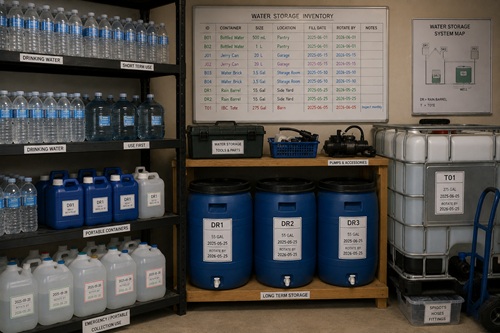
Every container should be labeled with at least the date it was filled and the planned rotation date. Some households also assign identification numbers that correspond with inventory records, allowing inspections and maintenance activities to be documented more efficiently.
Storage locations should be organized according to intended use. Frequently accessed bottled water should remain easy to reach, while larger long-term reserves can occupy dedicated storage areas where they are protected from damage and environmental extremes. Portable collection containers should remain close to vehicles or transportation equipment so they can be deployed quickly.
Inventory records become increasingly valuable as storage capacity grows. Recording container size, location, fill date, inspection history, and rotation schedule eliminates guesswork while making annual reviews much more efficient.
Good organization also supports every member of the household. During an emergency, everyone should understand where drinking water is stored, which containers should be used first, and how replacement supplies are managed. A clearly organized storage system reduces confusion while improving overall preparedness.
Inspecting and Maintaining Water Storage Containers
Long-term preparedness requires more than filling containers and placing them on a shelf. Every storage container should be inspected regularly to ensure it continues protecting the water inside. Small problems identified during routine inspections are usually easy to correct, whereas unnoticed damage may only become apparent when clean drinking water is urgently needed.
Begin by examining each container for cracks, punctures, bulging, discoloration, ultraviolet damage, or other signs of deterioration. Plastic containers that have become brittle or warped should be replaced before failure occurs. Stainless steel containers should be checked for dents, corrosion, damaged threads, and worn seals.
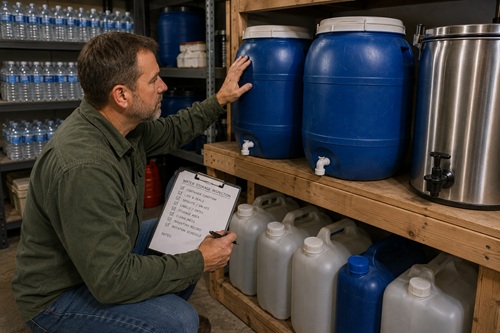
Lids deserve particular attention because they provide the primary barrier against contamination. Ensure that every lid seals securely, gaskets remain flexible, and dispensing valves operate correctly without leaking.
The storage area should be inspected along with the containers themselves. Look for evidence of insects, rodents, excessive humidity, chemical spills, roof leaks, flooding, or extreme temperatures. Even excellent containers cannot adequately protect water if they are stored in unsuitable environments.
Inspection routines also provide an excellent opportunity to verify inventory records, confirm rotation schedules, and identify containers requiring cleaning or replacement. Many preparedness households perform these inspections annually as part of a broader emergency preparedness review.
Routine maintenance requires very little time yet significantly improves confidence that stored water will remain available whenever it is needed.
Table 10 — Annual Container Inspection Checklist
| Inspection Item | Complete |
|---|---|
| Exterior inspected for cracks | ☐ |
| Lid and seal inspected | ☐ |
| Dispensing valve tested | ☐ |
| Labels readable | ☐ |
| Rotation date confirmed | ☐ |
| Storage area inspected | ☐ |
| Inventory updated | ☐ |
| Cleaning completed if required | ☐ |
Common Water Storage Mistakes
Many households unintentionally reduce the effectiveness of their water storage system through a few common mistakes. Fortunately, these problems are easy to avoid once they are recognized.
One of the most frequent mistakes is relying entirely on one type of container. Although bottled water, barrels, jerry cans, and storage tanks each provide important advantages, none performs every function equally well. A layered storage system almost always provides greater flexibility.
Another mistake involves purchasing containers before developing a household water plan. Without knowing storage goals, available space, or expected emergency duration, households often purchase containers that do not meet their long-term needs.
Using non-food-grade containers remains one of the most serious errors. Containers previously used for chemicals, fuels, pesticides, or industrial products should never be repurposed for drinking water regardless of cleaning efforts. Permanent contamination may remain within the container material itself.
Many people also underestimate the importance of portability. Large stationary reserves are valuable, but without portable containers, transporting water from renewable sources becomes unnecessarily difficult.
Neglecting inspection and rotation is another common oversight. Even high-quality containers should be inspected regularly to ensure they remain suitable for long-term storage.
Finally, many preparedness plans focus almost exclusively on storage capacity while overlooking supporting equipment such as transfer pumps, siphons, replacement lids, cleaning brushes, carts, and purification systems. Water preparedness involves an integrated system rather than containers alone.
Choosing the Right Containers for Your Household
There is no universally perfect water storage container. The best choice depends upon household size, available storage space, climate, budget, mobility requirements, renewable water availability, and long-term preparedness objectives.
Apartment dwellers often benefit from modular stackable containers because they maximize limited storage space while remaining easy to move. Rural households with workshops, barns, or garages frequently find that barrels, IBC totes, and large storage tanks provide economical long-term reserves.
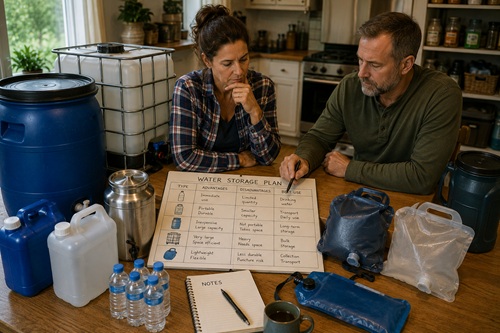
Budget should also be considered realistically. Preparedness does not require purchasing every container at once. Many successful storage systems have been built gradually over several years through steady incremental improvements.
Physical ability deserves equal attention. Water containers that cannot be lifted safely by the people expected to use them may prove impractical during an emergency. Selecting container sizes that match household capabilities improves both safety and flexibility.
Climate influences storage decisions as well. Regions experiencing prolonged freezing temperatures, intense summer heat, or severe ultraviolet exposure may require different storage methods than more moderate climates.
Ultimately, the strongest preparedness plans combine several container types into one integrated storage system. Immediate access, portability, bulk storage, renewable water collection, and routine household use are all supported more effectively when each container performs the role for which it is best suited.
In Summary
Choosing water storage containers involves much more than selecting where emergency water will be kept. Every container affects water quality, storage efficiency, portability, maintenance requirements, and the overall resilience of the household preparedness plan. Understanding these differences allows each container to contribute effectively to a complete water storage system.
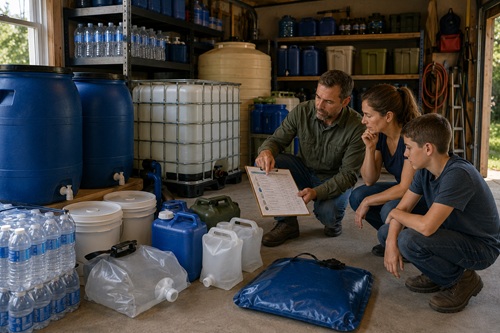
Commercially bottled water provides immediate convenience and readiness. Stackable modular containers maximize available storage space while remaining portable. Jerry cans combine storage with transportation. Barrels, IBC totes, tanks, and cisterns provide economical long-term reserves. Rainwater collection systems support renewable water production, while collapsible containers simplify transportation during emergencies.
The strongest preparedness plans rarely depend upon a single container type. Instead, they combine several complementary storage methods into a layered system that adapts to changing conditions while supporting both short-term emergencies and long-term resilience.
Regular cleaning, inspection, maintenance, organization, and rotation ensure these containers continue protecting one of the household’s most valuable emergency resources: safe drinking water.
By approaching container selection as part of an integrated preparedness strategy rather than an isolated purchasing decision, households gain greater flexibility, improved efficiency, and increased confidence in their ability to manage water during emergencies.
Preparedness Action Plan
Preparedness is most effective when it is approached as a continuous improvement process rather than a one-time purchase. The goal of this action plan is to help you evaluate your current water storage system, identify opportunities for improvement, and establish maintenance routines that will keep your emergency water supplies dependable for years to come. Work through each stage carefully and record your findings as you go. Even small improvements made consistently over time can greatly strengthen your household’s long-term water preparedness.
Begin by conducting a complete inventory of every water storage container currently used by your household. Walk through your home, garage, basement, workshop, storage sheds, vehicles, and any other locations where emergency water is kept. Verify that every container intended for drinking water is manufactured from food-grade materials and remains appropriate for potable water storage. As you inspect each container, note its capacity, current condition, storage location, fill date, and planned rotation schedule. This inventory becomes the foundation for all future inspections and maintenance activities.
| Inventory Item | Complete |
|---|---|
| Every water container located | ☐ |
| Food-grade materials verified | ☐ |
| Capacity recorded | ☐ |
| Storage location documented | ☐ |
| Fill and rotation dates recorded | ☐ |
Once your inventory has been completed, evaluate how well your current storage system supports your household’s preparedness goals. Consider whether your supplies rely too heavily on a single container type or whether they provide a balanced combination of immediate access, portable storage, and long-term reserves. A layered storage system generally provides greater flexibility because each container type serves a different purpose within the overall preparedness plan.
| Storage Layer | Current Status | Improvement Needed |
|---|---|---|
| Bottled Water | ||
| Modular Containers | ||
| Jerry Cans | ||
| Water Barrels | ||
| Bulk Storage Tanks | ||
| Portable Collection Containers |
Next, inspect every storage container for signs of deterioration. Examine exterior surfaces for cracks, punctures, discoloration, ultraviolet damage, or bulging. Carefully inspect lids, seals, dispensing valves, and spigots to ensure they remain watertight and free from damage. Containers showing excessive wear should be repaired or replaced before they become a source of contamination or water loss during an emergency.
| Inspection Item | Condition |
|---|---|
| Exterior Condition | □ Good □ Needs Attention |
| Lid and Seal | □ Good □ Replace |
| Dispensing Valve | □ Good □ Repair |
| Labels | □ Current □ Update |
| Overall Condition | □ Serviceable □ Replace |
Cleaning and sanitizing should become part of your normal maintenance routine rather than something performed only after problems appear. Select one or more containers and practice your complete cleaning procedure from start to finish. Verify that every member of the household responsible for emergency preparedness understands how to clean, sanitize, refill, and safely store each container. Practical experience before an emergency greatly improves confidence while reducing mistakes during stressful situations.
Review the organization of your storage area at the same time. Containers should remain protected from direct sunlight, excessive heat, freezing temperatures, and nearby chemicals. Frequently used containers should be easily accessible, while larger long-term reserves should be positioned where they can be inspected and maintained safely. A well-organized storage system reduces confusion and allows every household member to locate emergency water quickly when needed.
As your preparedness plan continues to develop, focus on gradual improvements rather than attempting to purchase every storage container at once. Adding one additional modular container, replacing an aging jerry can, installing a rain barrel, or expanding long-term storage each year steadily strengthens your preparedness while keeping costs manageable. Incremental improvements often produce the most practical and sustainable results.
Finally, establish a recurring maintenance schedule that ensures your water storage system remains dependable over time. Annual inspections, scheduled water rotation, equipment testing, inventory updates, and routine cleaning should become regular household activities rather than tasks remembered only after an emergency occurs. Consistent maintenance protects your investment while ensuring that clean drinking water remains available whenever it is needed.
| Annual Review Checklist | Complete |
|---|---|
| Water inventory updated | ☐ |
| Containers inspected | ☐ |
| Water rotated | ☐ |
| Containers cleaned and sanitized | ☐ |
| Storage locations reviewed | ☐ |
| Pumps and dispensing equipment tested | ☐ |
| Labels updated | ☐ |
| Household water requirements reviewed | ☐ |
| Renewable water systems inspected | ☐ |
| Improvements planned for next year | ☐ |
Skills Learned
After completing this handbook, you should understand the strengths, limitations, and best applications of the most common water storage containers used in emergency preparedness. You should be able to compare commercially bottled water, modular containers, jerry cans, barrels, storage tanks, cisterns, collapsible containers, stainless steel containers, and IBC totes according to their intended uses.
You should also understand how food-grade materials protect drinking water, why layered storage systems provide greater resilience, and how regular cleaning, inspection, labeling, organization, and maintenance support long-term water quality.
Most importantly, you should now be able to design a practical household water storage system that matches your available space, budget, family needs, and long-term preparedness goals.
Appendices
The following worksheets, inventories, planning tools, and inspection logs are intended to become working documents rather than additional reading material. Review and update them regularly as your household water storage system grows and changes.
Appendix A — Household Water Storage Inventory
Record every water storage container currently owned.
| Container Type | Quantity | Capacity Each | Total Capacity | Storage Location |
|---|---|---|---|---|
| Bottled Water | ||||
| Water Bricks / Modular Containers | ||||
| Jerry Cans | ||||
| Water Barrels | ||||
| IBC Totes | ||||
| Storage Tanks | ||||
| Rain Barrels | ||||
| Stainless Steel Containers | ||||
| Collapsible Containers | ||||
| Other | ||||
| TOTAL |
Appendix B — Water Storage Container Comparison Worksheet
Use this worksheet before purchasing additional storage containers.
| Container Type | Capacity | Estimated Cost | Portability | Long-Term Storage | Planned Purchase |
|---|---|---|---|---|---|
| Bottled Water | ☐ | ||||
| Water Bricks | ☐ | ||||
| Jerry Cans | ☐ | ||||
| Barrels | ☐ | ||||
| IBC Tote | ☐ | ||||
| Storage Tank | ☐ | ||||
| Stainless Steel | ☐ | ||||
| Collapsible Containers | ☐ |
Appendix C — Water Container Inspection Log
Document routine inspections throughout the year.
| Inspection Date | Container ID | Condition | Repairs Needed | Inspector |
|---|---|---|---|---|
Appendix D — Water Rotation Schedule
Track rotation dates for every major container.
| Container | Filled Date | Rotation Date | Completed |
|---|---|---|---|
| ☐ | |||
| ☐ | |||
| ☐ | |||
| ☐ | |||
| ☐ |
Appendix E — Container Cleaning and Sanitizing Log
Maintain records whenever containers are cleaned.
| Container ID | Cleaned | Sanitized | Next Cleaning | Notes |
|---|---|---|---|---|
Appendix F — Layered Water Storage Planner
Develop a balanced storage system using multiple container types.
| Storage Layer | Container Type | Current Capacity | Target Capacity |
|---|---|---|---|
| Immediate Drinking | Bottled Water | ||
| Portable Household Storage | Water Bricks | ||
| Transportation | Jerry Cans | ||
| Long-Term Storage | Water Barrels | ||
| Bulk Reserve | IBC / Tank | ||
| Renewable Collection | Rainwater System |
Appendix G — Water Storage Purchasing Planner
Prioritize future purchases.
| Item | Priority | Estimated Cost | Purchased |
|---|---|---|---|
| Bottled Water | High | ☐ | |
| Water Bricks | Medium | ☐ | |
| Jerry Cans | High | ☐ | |
| Water Barrels | Medium | ☐ | |
| Rain Barrel | Medium | ☐ | |
| IBC Tote | Low | ☐ | |
| Storage Tank | Low | ☐ | |
| Hand Pump | Medium | ☐ | |
| Transfer Pump | Medium | ☐ | |
| Replacement Spigots | Low | ☐ | |
| Cleaning Supplies | High | ☐ |
Appendix H — Water Storage Location Inventory
Document every storage location.
| Storage Area | Containers Stored | Total Capacity | Easily Accessible |
|---|---|---|---|
| Pantry | ☐ | ||
| Basement | ☐ | ||
| Garage | ☐ | ||
| Utility Room | ☐ | ||
| Shed | ☐ | ||
| Barn | ☐ | ||
| Vehicle | ☐ | ||
| Other | ☐ |
Appendix I — Annual Water Storage Review
Complete once each year.
| Annual Review Item | Complete |
|---|---|
| Household inventory updated | ☐ |
| Water containers inspected | ☐ |
| Water rotated | ☐ |
| Containers cleaned and sanitized | ☐ |
| Labels updated | ☐ |
| Storage locations inspected | ☐ |
| Pumps tested | ☐ |
| Spigots inspected | ☐ |
| Rainwater system inspected | ☐ |
| Family review completed | ☐ |
Appendix J — Water Storage Capacity Calculator
Estimate your storage goals.
| Household Members | Daily Need per Person | Total Daily Water | 72 Hours | 1 Week | 2 Weeks | 1 Month |
|---|---|---|---|---|---|---|
Repeat this worksheet whenever household size changes.
Appendix K — Container Maintenance Schedule
| Maintenance Task | Frequency |
|---|---|
| Inspect containers | Every 6 months |
| Check lids and seals | Every 6 months |
| Verify labels | Annually |
| Rotate water | According to household schedule |
| Clean containers | During rotation |
| Inspect storage locations | Every 6 months |
| Test dispensing equipment | Annually |
| Review household water plan | Annually |
Appendix L — Quick Reference Guide
Common Water Storage Containers
| Container | Typical Capacity | Best Use |
|---|---|---|
| Bottled Water | Individual bottles | Immediate drinking |
| Water Bricks | 3–4 gal (11–15 L) | Organized storage |
| Jerry Cans | 5–7 gal (19–26 L) | Storage & transportation |
| Water Barrel | 55 gal (208 L) | Long-term reserve |
| IBC Tote | 275–330 gal | Large stationary storage |
| Storage Tank | 500–5,000+ gal | Household reserve |
| Rain Barrel | 50–100 gal | Rainwater harvesting |
| Collapsible Container | 2–5 gal | Water collection |
Food-Grade Materials
| Material | Typical Uses |
|---|---|
| HDPE | Barrels, water bricks, jerry cans |
| PET | Commercial bottled water |
| Stainless Steel | Premium long-term storage |
| Food-Grade Silicone | Portable collapsible containers |
Example Layered Storage System
| Layer | Purpose |
|---|---|
| Bottled Water | Immediate access |
| Water Bricks | Household reserve |
| Jerry Cans | Collection and transport |
| Water Barrels | Long-term storage |
| Tanks / IBC | Bulk storage |
| Rainwater Collection | Renewable supply |
Final Notes
Water storage containers are more than simple vessels for holding water – they are essential components of a complete preparedness system. Selecting the right combination of containers allows a household to store water efficiently, transport it safely, protect it from contamination, and replenish supplies as conditions change.
As your preparedness evolves, review your storage system regularly. Expand it gradually, maintain it consistently, and continue refining it as your household’s needs change. A well-planned collection of water storage containers provides flexibility, redundancy, and confidence that no single container or storage method could achieve on its own.
© Prepping Communities. This content is for informational purposes only and not professional advice. Use at your own risk.
Terms | Privacy | Guidelines