
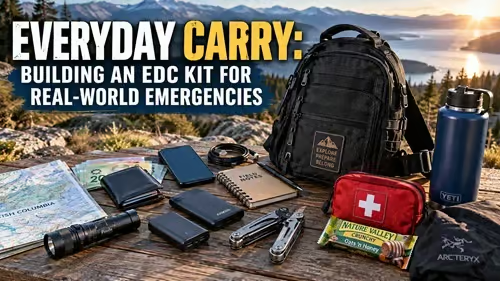
Preparedness does not begin when an emergency is declared. It begins with what is available when something unexpectedly goes wrong. A vehicle breaks down on a cold evening. The power goes out while you are away from home. Your phone battery dies. Someone suffers a minor injury. A debit or credit card network stops working. A road closure turns a twenty-minute drive into several hours. A flashlight is suddenly needed in a dark building. None of these situations necessarily qualifies as a disaster, yet each can become significantly more difficult when the basic tools needed to solve the problem are somewhere else.
That is the purpose of Everyday Carry, commonly called EDC. An everyday carry kit is a small collection of useful items that remain with you during normal daily activities. Unlike a bug-out bag, vehicle emergency kit, or large survival pack, EDC is designed to provide immediate capability without becoming cumbersome. The objective is not to carry everything that might possibly be needed. The objective is to carry enough capability to solve common problems, stabilize minor emergencies, communicate, improvise, and reach better resources.

Think of EDC as the First Layer of Preparedness
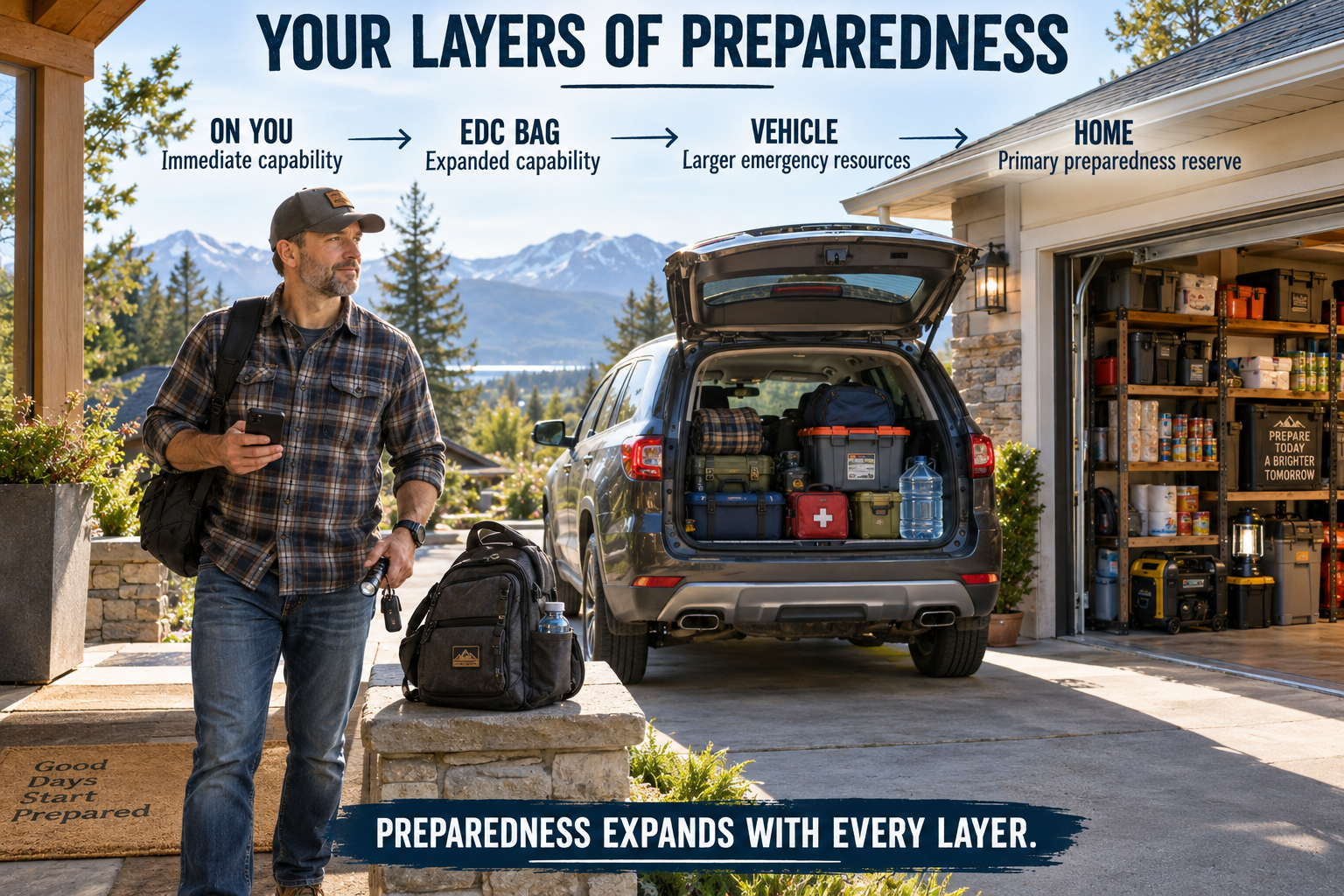
A good preparedness system contains layers. Your home may contain substantial food, water, medical supplies, tools, backup power, communications equipment, and other resources. Your vehicle may contain another emergency kit. A workplace may provide additional resources. But those supplies only help when they are accessible. EDC fills the gap between where you are when something happens and where your larger preparedness resources are located.
Imagine that your vehicle emergency kit contains an excellent flashlight, but you are inside an office building when the power fails. The flashlight might be only a few hundred metres away, but it is still unavailable when initially needed. A small flashlight in your pocket solves the immediate problem. The same principle applies to communications, money, medical supplies, identification, charging capability, navigation, and other basic needs.
EDC therefore functions as the smallest and most mobile layer of a larger preparedness system. Equipment carried directly on your body provides immediate capability. A small bag expands those capabilities. Your vehicle can hold larger supplies, and your home becomes the primary preparedness reserve. Each layer provides greater capability, but the smallest layer has one enormous advantage: it is the layer most likely to be with you when something happens.
Start With What You Already Carry
Most people already have an EDC system. They simply do not call it one. A typical person leaves home carrying a smartphone, wallet, and keys. Those three objects already provide considerable capability. A smartphone provides communication, navigation, information, a camera, notes, emergency alerts, stored documents, and sometimes payment capability. A wallet provides identification, financial resources, and important cards. Keys provide access to a home, vehicle, workplace, or other resources.
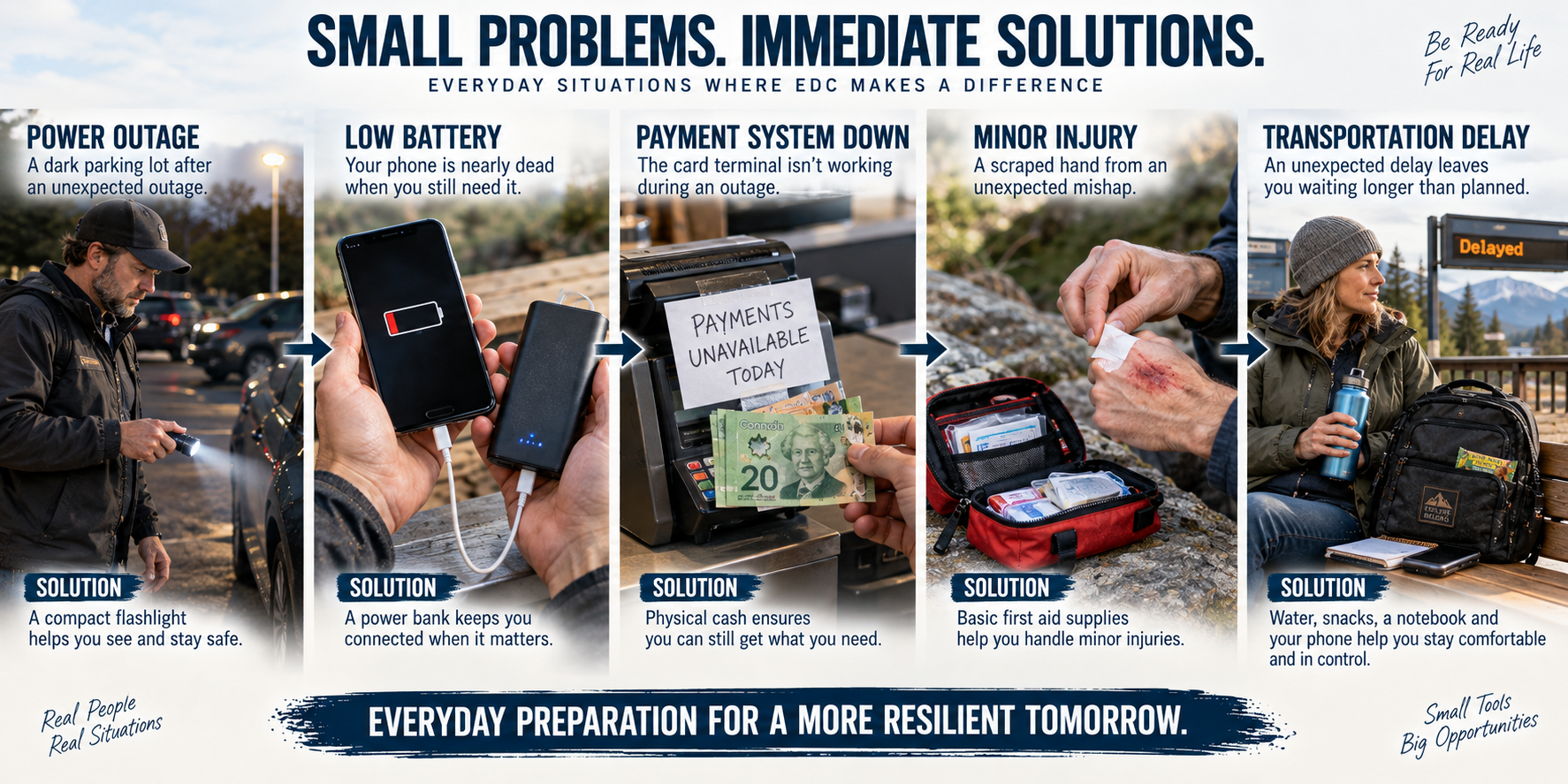
The preparedness challenge is determining what happens when one of those systems stops working. Your phone is useful, but what happens when its battery reaches zero? Electronic payment is convenient, but what happens when the payment terminal cannot connect? Navigation apps are excellent, but what happens when cellular service disappears? Building lights normally work, but what happens when they do not? EDC provides small backups for these predictable dependencies.
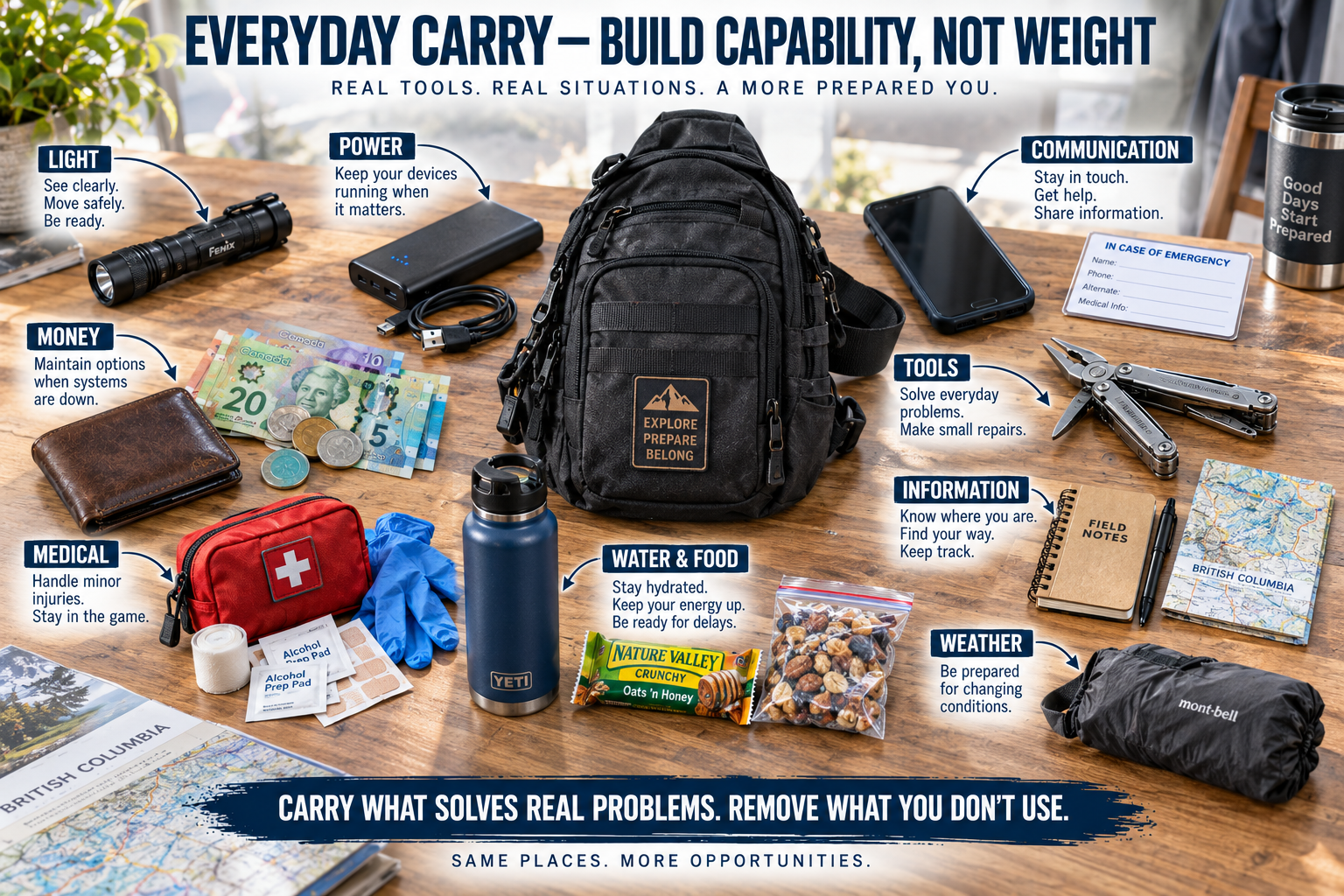
Instead of choosing equipment simply because another prepper carries it, think about the capabilities you need. A practical everyday carry system may provide communication, light, electrical power, money, identification, basic medical capability, tools, water, food, navigation, documentation, and some protection from weather. Not everyone requires every capability every day. Someone commuting across a major city has different requirements from someone driving rural highways. A construction worker has different requirements from an office worker. Someone routinely travelling through remote areas may reasonably carry considerably more equipment. Your EDC should reflect your environment, activities, distance from home, climate, transportation, and realistic risks.
Building Your Basic Everyday Carry
The first level of EDC should consist of items small enough that carrying them becomes automatic. For many people this begins with a phone, wallet, and keys, but a few carefully selected additions can greatly increase capability without turning your pockets into a survival pack.
A compact flashlight is one of the highest-value additions because darkness is an extremely common problem. Power outages, dark parking lots, vehicle problems, stairwells, dropped objects, and nighttime emergencies can all create an immediate need for independent lighting. A phone flashlight works, but it consumes the battery of your primary communications device. A separate flashlight preserves phone power and usually provides better runtime and handling. Reliability and battery life are generally more important than carrying the brightest flashlight available.
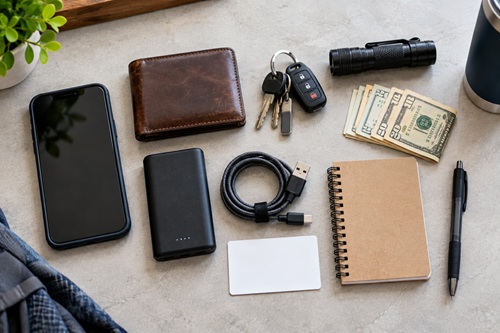
A small amount of cash provides another useful layer of redundancy. Modern life increasingly depends upon electronic transactions, and that dependency creates vulnerability. Payment terminals can stop working because of power outages, communications problems, damaged networks, or technical failures. Carrying some physical cash means losing electronic payment does not immediately eliminate your ability to purchase something you need. Several smaller bills are generally more useful than one large bill because businesses operating during a disruption may have difficulty making change.
Where legal and appropriate, a compact utility or cutting tool can also solve many everyday problems involving packaging, cordage, food preparation, and minor repairs. The emphasis should be usefulness rather than appearance. Local laws, workplace restrictions, transportation rules, and venue policies should always be considered. An EDC item that repeatedly prevents you from entering places you need to go is not functioning effectively as everyday carry.
Emergency contact information is another simple precaution. Smartphones contain enormous amounts of important information, but phones can become damaged, discharged, lost, or inaccessible. Keeping essential contact information somewhere independent of the phone provides a basic layer of redundancy. A small emergency information card can be extremely useful when technology is unavailable or when another person needs to contact someone on your behalf.
Expanding Beyond Your Pockets
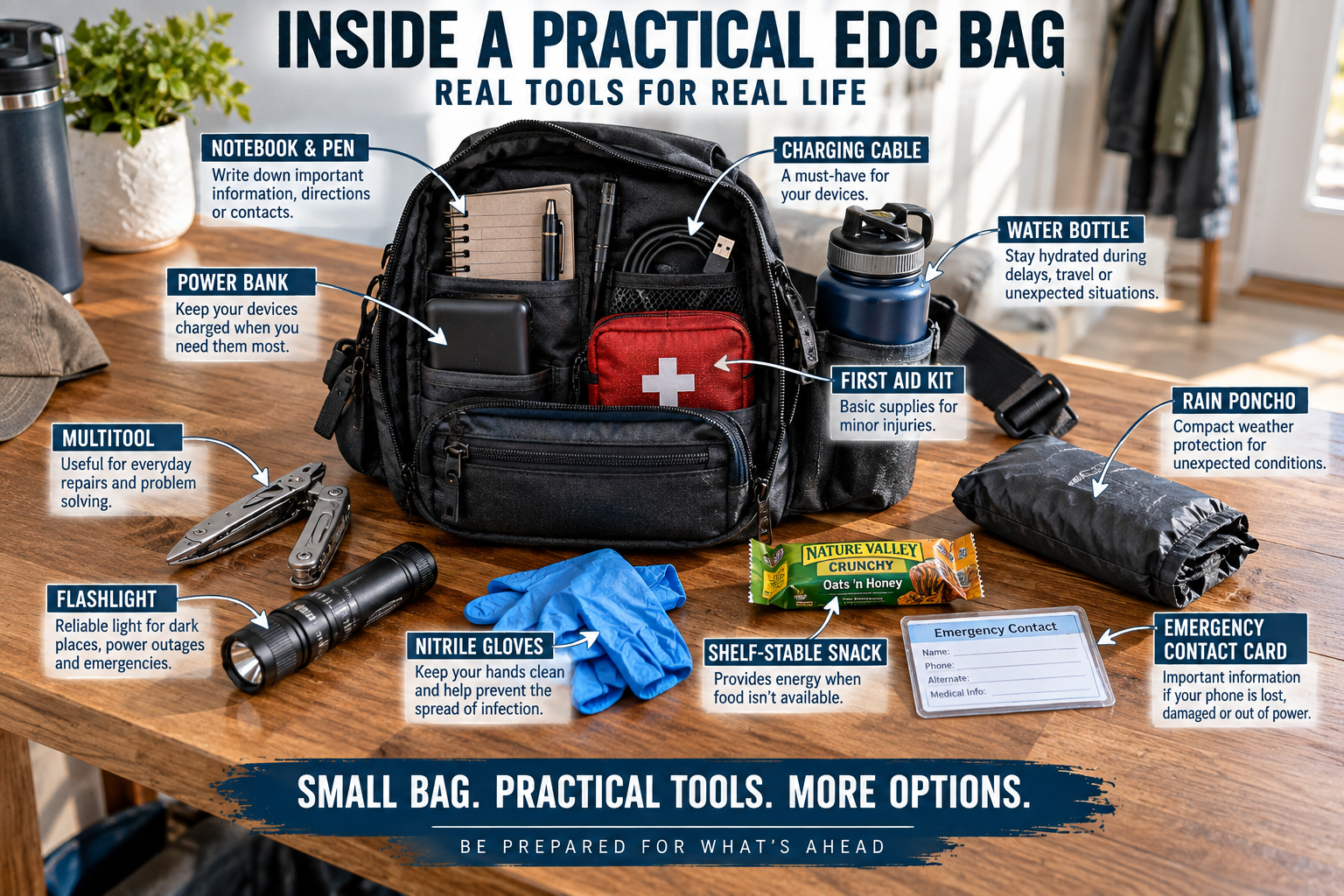
Pockets eventually reach their practical limit. Trying to carry too much equipment creates an EDC system that becomes uncomfortable and eventually gets left behind. A small sling bag, purse, backpack compartment, waist pack, or work bag can provide the next layer without becoming a full emergency pack.
One of the most useful additions is a small power bank and the correct charging cable. Modern preparedness increasingly depends upon electricity, and a charged power bank can extend phone availability during transportation delays, outages, vehicle problems, and communications disruptions. The charging cable is just as important as the battery itself. A fully charged power bank without a compatible cable is stored energy that cannot be used. Power banks should also be checked and recharged periodically because they gradually lose charge while sitting unused.
A compact first aid kit can address minor injuries until better medical resources are available. Everyday medical supplies do not need to duplicate a large home medical kit. Basic items such as adhesive bandages, sterile gauze, medical tape, antiseptic wipes, and nitrile gloves can handle many common situations. People who rely on personal medications should also consider how those needs affect their everyday preparedness while following appropriate storage requirements and professional medical guidance. The most important medical resource, however, remains knowledge. Equipment becomes much more useful when the person carrying it knows how and when to use it.
A multitool can provide several repair capabilities without requiring several separate tools. Depending on its design, it may provide pliers, screwdrivers, wire cutters, scissors, a file, and other useful implements. This can make it particularly valuable for minor equipment, household, or vehicle problems. As with any other tool, applicable laws and workplace or transportation restrictions should be considered.
A small notebook and pen may seem outdated in a smartphone world, but paper provides another form of redundancy. Addresses, directions, licence plates, instructions, names, phone numbers, observations, and emergency information can all be recorded without electricity or connectivity. Written information can also be handed directly to another person, something that can be surprisingly useful during a confusing or stressful situation.
Water and a small amount of food can extend the amount of time someone can comfortably remain away from normal resources. The goal is not necessarily to carry a day’s supply of water everywhere. Even a modest amount can help during transportation delays, road closures, unexpected overtime, or other disruptions. A shelf-stable snack or energy bar provides the same type of short-term buffer. People routinely travelling through remote areas should carry substantially more food and water in their vehicle or larger preparedness kit.
Build Your EDC Around Your Environment
There is no universal everyday carry kit because risk changes with location. Someone living in British Columbia may encounter long driving distances, winter conditions, wildfire disruptions, power outages, and areas with unreliable cellular coverage. Someone living in a large urban centre may be more concerned about public transportation disruptions, building evacuations, extended walks home, or being separated from a vehicle.
Climate matters just as much. During winter, gloves, a warm hat, or additional clothing may provide more practical survival value than another electronic gadget. During extreme heat, water and sun protection become more important. During wildfire season, appropriate respiratory protection may deserve consideration where smoke exposure is a realistic concern. The equipment should follow the environment rather than whatever happens to be popular in EDC communities.
Distance also changes what should be carried. Someone working five minutes from home has a very different preparedness problem from someone commuting sixty kilometres each way. The farther you routinely travel from your primary resources, the more important transportation, weather protection, navigation, communications, food, water, and backup power become.
Connect Your EDC to Your Vehicle and Home Supplies
For people who travel primarily by vehicle, the vehicle provides an excellent second or third preparedness layer. This prevents the everyday carry kit from becoming unnecessarily large. Instead of carrying everything personally, think of preparedness as expanding rings of capability.
Items on your body handle immediate problems. A small bag provides additional tools, power, medical supplies, food, and water. The vehicle can hold larger quantities of water, food, seasonal clothing, blankets, first aid supplies, tools, lighting, and vehicle emergency equipment. Home supplies provide the largest reserve of food, water, medical equipment, backup power, communications resources, and other preparedness materials.
The layers should complement one another rather than simply duplicate everything. The purpose of EDC is often to keep you functional long enough to reach the next layer.
Think About the Get-Home Problem
One of the best ways to evaluate an everyday carry system is to imagine being several kilometres from home when transportation suddenly becomes unavailable. Consider whether you could communicate, navigate, walk home safely, deal with darkness, handle a minor injury, purchase something if electronic payments stopped working, keep your phone operating, and protect yourself from the weather.
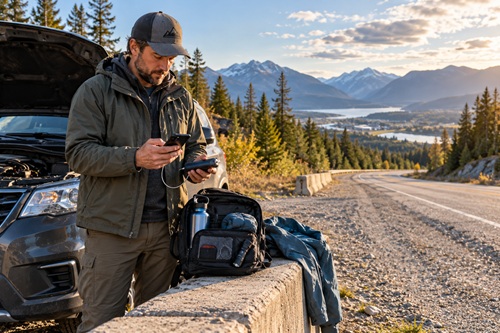
This exercise reveals weaknesses much more effectively than copying someone else’s equipment list. A person who lives in a cold climate and routinely travels thirty kilometres from home may discover that clothing and footwear are much more important than another multitool. Someone who regularly depends upon public transportation may discover that backup charging and comfortable walking shoes deserve greater attention.
The purpose is not to imagine every possible catastrophe. It is to identify the most likely obstacles between your current location and your larger preparedness resources.
Don’t Make Your Smartphone a Single Point of Failure
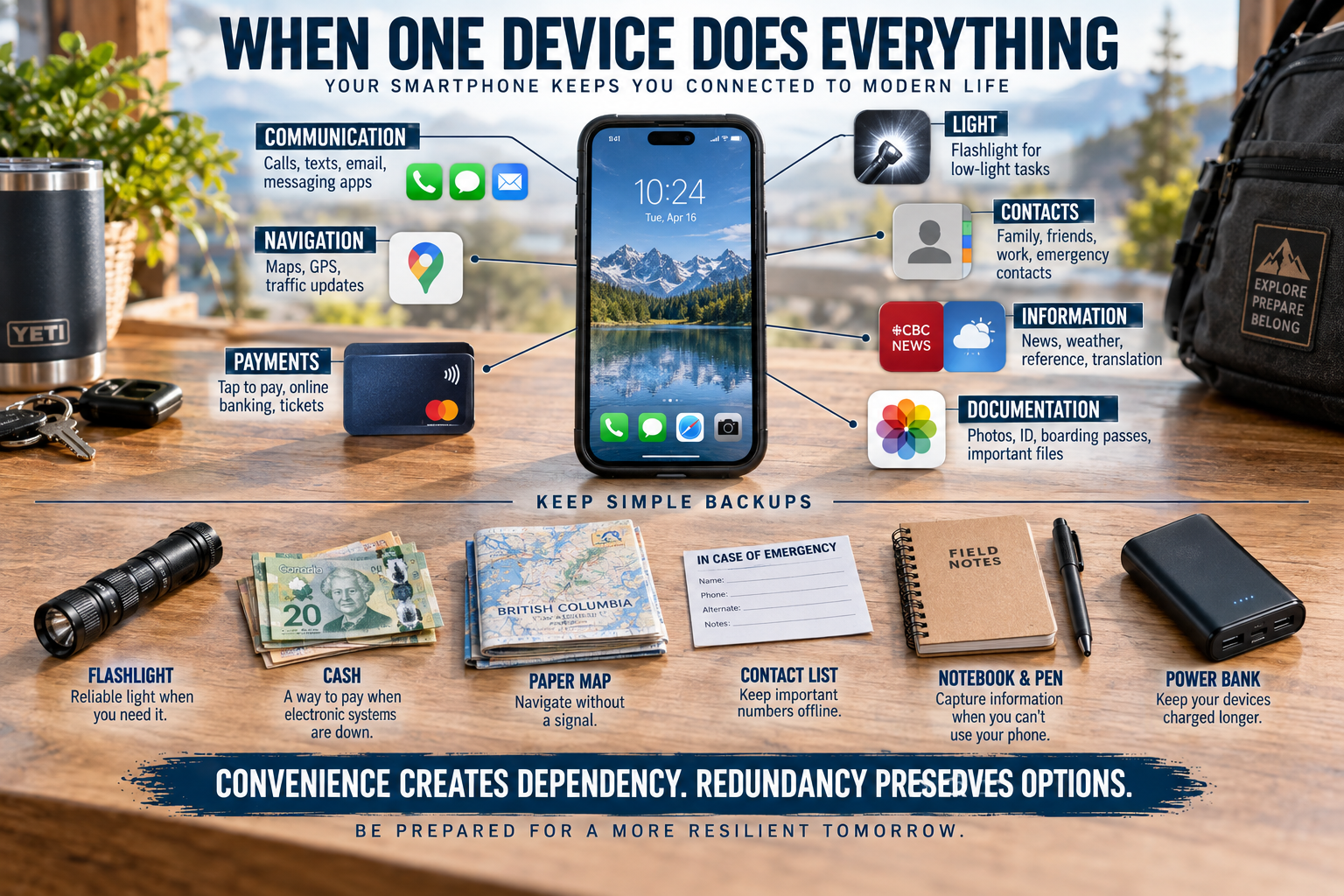
The smartphone may be the most powerful everyday carry tool ever created, but it has also become one of modern life’s greatest concentrations of dependency. Communication, maps, payment cards, contacts, photographs, schedules, notes, emergency alerts, and access to enormous amounts of information can all exist on one small device.
That convenience creates a weakness. When the phone is lost, damaged, discharged, or disconnected, several capabilities can disappear simultaneously.
A resilient EDC system provides limited alternatives rather than attempting to replace the smartphone entirely. A separate flashlight provides independent illumination. Cash provides independent purchasing capability. Written emergency contacts preserve important information. A power bank extends electrical availability. Offline maps can preserve some navigation capability when connectivity disappears. Important information can also be stored offline where appropriate.
The goal is not to abandon technology. It is to avoid allowing the failure of one device to eliminate several important capabilities at the same time.
Avoid the EDC Weight Trap
One of the most common EDC mistakes is continuously adding equipment. A small kit becomes a larger kit. The larger kit becomes heavier. Eventually it becomes inconvenient enough that it stays at home. At that point, much of its preparedness value disappears.
Every item should justify the space and weight it occupies. Consider whether it solves a realistic problem, whether another item already performs the same function, whether you know how to use it, and whether you are actually willing to carry it every day. Multi-purpose equipment can be particularly valuable because one object may provide several useful capabilities.
The objective is not maximum equipment. It is maximum useful capability for a reasonable amount of weight and space.
Test Your EDC Through Normal Life
Real experience is one of the best ways to improve an everyday carry system. Pay attention whenever something happens that makes you think, “I wish I had that with me.” Those moments reveal genuine preparedness gaps.
If your phone repeatedly runs low during long days, a power bank has demonstrated its value. If you regularly need additional light, your flashlight choice may need improvement. If you have carried a particular tool for six months without ever finding a practical use for it, consider whether it deserves its place. If the seasons change, reassess clothing, water, weather protection, and other environmental needs.
EDC should evolve from actual experience rather than imagination. This produces a system tailored to the problems you genuinely encounter instead of an impressive collection of equipment that rarely gets used.
Maintain What You Carry
Preparedness equipment quietly deteriorates. Batteries discharge, food expires, water containers leak, medications reach expiration dates, flashlights can corrode, contact information changes, power banks lose charge, and equipment disappears after being used or borrowed.
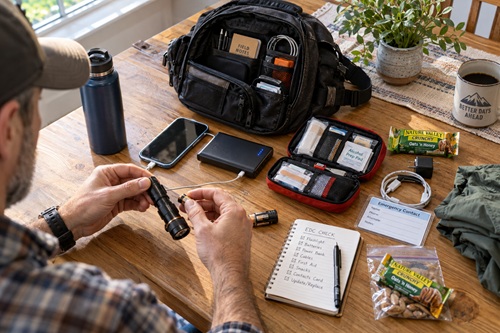
An EDC kit therefore needs periodic inspection. Test your flashlight, recharge the power bank, replace consumed medical supplies, check food and water, verify emergency information, and inspect equipment for damage. Seasonal transitions are convenient times to perform this check because changes in weather often require changes in preparedness equipment anyway.
An everyday carry kit should be treated as a small working preparedness system rather than a collection of objects.
Skills Matter More Than Gear
EDC equipment increases capability, but equipment without knowledge has limits. Someone carrying first aid supplies benefits enormously from knowing basic first aid. Someone carrying navigation tools benefits from understanding how to navigate without constant turn-by-turn instructions. Someone carrying a multitool should understand basic repairs. Someone carrying emergency supplies should understand how to prioritize problems when several things go wrong at once.
Preparedness improves when equipment and capability develop together. A person who understands how to improvise with a few basic tools may be considerably better prepared than someone carrying an expensive pack filled with equipment they have never used.
The ultimate purpose of EDC is therefore not the equipment itself. The equipment provides options. Knowledge allows those options to be used effectively.
Build a System You Will Actually Carry
A practical everyday carry system does not need to be complicated. A smartphone, wallet, identification, keys, some cash, and a compact flashlight can provide the foundation. A small bag might add a charging cable, power bank, basic first aid supplies, nitrile gloves, multitool where appropriate, notebook, pen, drinking water, and a shelf-stable snack. The vehicle can then provide larger first aid supplies, additional food and water, seasonal clothing, emergency blankets, lighting, charging equipment, tools, and vehicle-specific emergency supplies.
The exact equipment is less important than the logic behind it. Each layer should solve problems that the previous layer cannot reasonably handle. Your EDC keeps you functional until you reach your bag. Your bag provides additional capability until you reach your vehicle. Your vehicle helps you reach home or another safe location. Your home provides the deepest level of preparedness.
This approach creates resilience without requiring you to carry a survival pack everywhere you go.
Preparedness Action Plan
Begin by placing everything you normally carry on a table and identifying what each item allows you to do. Then consider several realistic disruptions such as a dead phone, power outage, payment failure, minor injury, transportation delay, unexpected walk home, severe weather, or several hours without access to normal resources.
Look for the capabilities that disappear when one system fails. Add only the smallest practical tools needed to close the most important gaps. Then examine your vehicle kit and home supplies and make sure your everyday carry provides a reasonable bridge to those larger resources.
Use the system for several weeks and pay attention to what gets used, what is missing, and what becomes annoying to carry. Remove unnecessary equipment and add items only when they solve a realistic problem. Reevaluate the system when your job, commute, vehicle, environment, health requirements, travel patterns, or seasons change.
The objective is not to build the perfect EDC kit in one afternoon. The objective is to develop a small preparedness system that becomes such a normal part of daily life that it is already available when something goes wrong.
Key Takeaways
Everyday carry is the first and most mobile layer of preparedness. Its purpose is not to prepare for every disaster imaginable but to provide immediate capability for ordinary problems and the opening stages of larger emergencies. Build EDC around useful capabilities rather than fashionable equipment, and pay particular attention to dependencies on smartphones, electronic payments, electrical power, transportation, and continuous connectivity.
Keep the system small enough that you will actually carry it. Connect it to larger preparedness resources in your vehicle and home. Test it through normal life, maintain it periodically, and adjust it as your circumstances change.
Most importantly, remember that the greatest value of EDC does not come from how much equipment you carry. It comes from having the right tools, practical knowledge, and enough capability to solve the immediate problem and reach the next layer of preparedness.
Disclaimer
This material is provided for general preparedness and educational purposes only. Equipment choices should reflect applicable laws, regulations, workplace policies, transportation restrictions, and individual circumstances. Medical supplies and medications should be selected, stored, and used according to appropriate professional guidance and manufacturer instructions.
© Prepping Communities. This content is for informational purposes only and not professional advice. Use at your own risk.
Terms | Privacy | Guidelines