
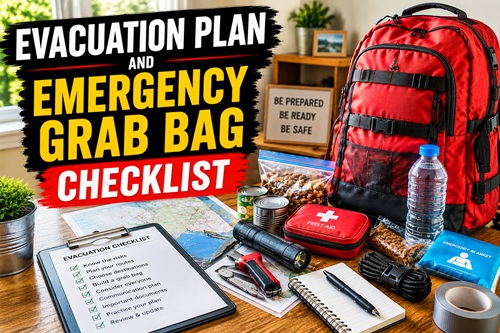
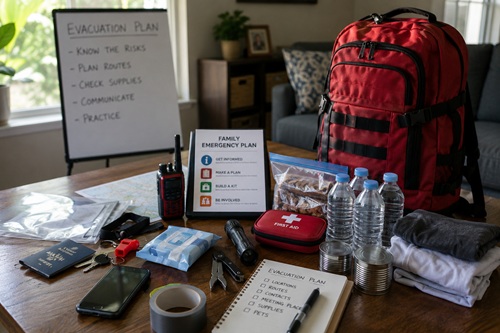
An emergency grab bag is useful, but the bag is only one part of evacuation preparedness. The real objective is being able to recognize when it is time to leave, know where you are going, get everyone out safely, and have enough essential supplies to manage the first stage of displacement.
Use this checklist to build and test your household evacuation plan.
EVACUATION PLAN
Know When You Will Leave
☐ Identify the emergencies most likely to require evacuation in your area.
☐ Decide which situations would cause your household to leave immediately.
☐ Know where official emergency alerts and evacuation notices are issued.
☐ Have at least one backup way to receive emergency information if Internet or cellular service is unavailable.
☐ Discuss the difference between preparing to leave and actually evacuating.
☐ Agree that you will not delay unnecessarily once conditions clearly require evacuation.
Know Where You Will Go
☐ Identify a primary evacuation destination.
☐ Identify at least one backup destination.
☐ Choose another option outside your immediate community in case the entire area is affected.
☐ Know where local emergency shelters may be established.
☐ Confirm that your destination can accommodate children, older family members, disabilities, medical needs and pets.
☐ Keep important destination addresses and phone numbers written on paper.
Plan More Than One Route
☐ Map your normal evacuation route.
☐ Identify at least two alternate routes.
☐ Include routes that avoid major highways if possible.
☐ Identify bridges, tunnels, mountain passes, flood zones or other potential choke points.
☐ Keep paper maps in your vehicle and emergency supplies.
☐ Mark your destinations and alternate routes on the maps.
☐ Periodically drive your alternate routes so they are familiar.
Transportation
☐ Keep your vehicle maintained and ready for unexpected travel.
☐ Avoid routinely allowing the fuel level to become extremely low.
☐ Know how everyone in the household will evacuate if the primary vehicle is unavailable.
☐ Have a backup transportation plan.
☐ Determine who is responsible for transporting children, older relatives or anyone requiring assistance.
☐ Make arrangements for pets or livestock.
☐ Keep vehicle keys in a consistent, easily accessible location.
☐ Keep essential vehicle supplies ready.
EMERGENCY GRAB BAG
Each person who can reasonably carry a bag should have one appropriate for their size and abilities.
A grab bag should help you evacuate. It should not become so heavy that it slows you down.
Identification and Documents
☐ Identification
☐ Copies of important household documents
☐ Emergency contact information
☐ Medical information
☐ Insurance information
☐ List of important phone numbers
☐ Copies of prescriptions when applicable
☐ Emergency destination addresses
☐ Paper map of the surrounding area
☐ Small amount of emergency cash
Keep sensitive documents protected from water and unauthorized access.
Water
☐ Drinking water
☐ Lightweight reusable water container
☐ Appropriate portable water-treatment option
☐ Knowledge of where additional water can be obtained along your evacuation route
Do not overload the bag with water if doing so makes it difficult to carry. Your evacuation plan should include ways to replenish supplies.
Food
☐ Lightweight ready-to-eat food
☐ Foods requiring little or no preparation
☐ Foods appropriate for children or household members with specific dietary needs
☐ Small eating utensil if needed
☐ Pet food if animals are evacuating with you
Choose foods that tolerate storage and transportation well.
Medical and Personal Needs
☐ Essential medications
☐ Basic first-aid supplies
☐ Prescription glasses
☐ Spare contact lenses or related supplies if needed
☐ Hearing-aid supplies if required
☐ Mobility or accessibility equipment
☐ Personal hygiene items
☐ Menstrual products where needed
☐ Necessary medical information
Critical medications and medical equipment should receive priority over convenience items.
Communication
☐ Mobile phone
☐ Charging cable
☐ Portable power bank
☐ Written emergency contact list
☐ Battery-powered or hand-crank radio if appropriate
☐ Backup communication method appropriate to your household
☐ Important frequencies or communication information written down where applicable
Do not depend entirely on information stored in a phone.
Clothing and Protection
☐ Durable footwear
☐ Spare socks
☐ Weather-appropriate clothing
☐ Rain protection
☐ Warm layer
☐ Work gloves
☐ Hat appropriate for the season
☐ Basic personal protective equipment appropriate to local hazards
Keep seasonal conditions in mind. A bag prepared during summer may be inadequate several months later.
Light and Basic Equipment
☐ Flashlight or headlamp
☐ Spare batteries where required
☐ Basic repair supplies
☐ Appropriate multi-purpose tool
☐ Whistle
☐ Notebook
☐ Pencil or pen
☐ Small amount of cordage
☐ Emergency blanket
Only carry equipment you understand how to use.
CHILDREN
☐ Identification and emergency contact information
☐ Age-appropriate water and food
☐ Necessary medications
☐ Spare clothing
☐ Comfort item
☐ Hygiene supplies
☐ Written information explaining who should be contacted if separated
☐ Recent family contact information
Children should understand the evacuation plan in simple terms without being unnecessarily frightened by it.
PETS
☐ Carrier, crate or restraint
☐ Food
☐ Water
☐ Collapsible bowls
☐ Necessary medications
☐ Vaccination or veterinary information
☐ Identification
☐ Leash or harness
☐ Waste-management supplies
☐ Recent photograph and identifying information
Never assume an evacuation destination will automatically accept animals. Include this in destination planning beforehand.
BEFORE LEAVING
If time and conditions safely allow:
☐ Confirm the evacuation destination.
☐ Check the planned route.
☐ Check current emergency information.
☐ Put on appropriate footwear and clothing.
☐ Collect medications.
☐ Take grab bags.
☐ Take phones and communication equipment.
☐ Take identification and important documents.
☐ Secure pets.
☐ Help anyone requiring assistance.
☐ Notify your designated contact where you are going when appropriate.
☐ Follow applicable emergency instructions for utilities or property.
☐ Lock the home if circumstances permit.
☐ Leave.
Do not risk your safety trying to complete every item. When immediate evacuation is necessary, people come first.
FAMILY COMMUNICATION PLAN
Every household member should know:
☐ Who the primary emergency contact is.
☐ Who the backup contact is.
☐ Where the household plans to meet.
☐ Where the household will go if the neighborhood must be evacuated.
☐ What to do if family members are separated.
☐ Who will collect children if parents or guardians cannot.
☐ Who will assist household members requiring additional help.
☐ How to communicate if cellular networks are congested or unavailable.
☐ Which relatives or friends outside the affected area should be contacted.
IF YOU BECOME SEPARATED
☐ Follow the household’s predetermined meeting plan.
☐ Do not repeatedly change locations unless safety requires it.
☐ Attempt agreed communication methods.
☐ Contact the designated out-of-area person.
☐ Follow legitimate emergency instructions.
☐ Make your location known to family when it is safe to do so.
☐ Preserve phone battery power when communications are unreliable.
A plan established beforehand can prevent family members from making conflicting decisions while trying to find one another.
TEST YOUR EVACUATION PLAN
A plan that has never been tested is mostly an assumption.
☐ Conduct a household evacuation practice.
☐ Time how long it takes everyone to get ready and leave.
☐ Practice during daylight.
☐ Practice after dark.
☐ Test an alternate route.
☐ Make sure everyone can carry their assigned bag.
☐ Check whether children understand what they should do.
☐ Test communication arrangements.
☐ Confirm pets can be loaded quickly and safely.
☐ Identify anything that caused unnecessary delay.
☐ Correct problems discovered during the exercise.
The goal is not speed for its own sake. The goal is making the process familiar enough that everyone knows what to do when conditions are stressful.
GRAB BAG WEIGHT CHECK
☐ Every person can comfortably carry their assigned bag.
☐ Children are not carrying adult-sized loads.
☐ Unnecessary duplicate equipment has been removed.
☐ Essential items have priority.
☐ Frequently needed items are easy to reach.
☐ Critical supplies are distributed between bags where practical.
☐ No single bag contains everything the household depends upon.
Losing one bag should not leave the entire household without critical medication, communication, identification or other essential resources.
SEASONAL CHECK
Review your evacuation supplies whenever seasons change.
☐ Clothing matches current weather conditions.
☐ Food has not expired.
☐ Water containers are clean and usable.
☐ Batteries and power banks are charged.
☐ Medications and medical supplies are current.
☐ Children’s clothing still fits.
☐ Contact information is current.
☐ Maps and evacuation destinations remain appropriate.
☐ Vehicle supplies are ready.
☐ Pet information and supplies are current.
FINAL EVACUATION READINESS CHECK
Before considering your evacuation planning complete, you should be able to answer YES to each of these:
☐ We know what could cause us to evacuate.
☐ We know when we would leave.
☐ We have more than one destination.
☐ We have more than one route.
☐ We have transportation and a backup plan.
☐ Everyone knows what they are responsible for.
☐ Our grab bags are packed.
☐ Our bags are light enough to carry.
☐ Essential medications are accounted for.
☐ Important information exists somewhere other than our phones.
☐ Children and pets are included in the plan.
☐ We have a plan if the family becomes separated.
☐ We have tested the plan.
☐ We periodically review and update it.
Preparedness Action Plan
Do not begin by buying more equipment.
Start by choosing your evacuation destinations and routes. Establish the family communication plan. Decide who is responsible for children, pets, transportation, medications and critical supplies.
Then build the grab bags around that plan.
Once everything is ready, conduct a simple evacuation exercise. Leave the house with the bags, load the vehicle and follow one of your planned routes. Pay attention to what slows you down, what you forgot and what proved unnecessary.
Correct those problems and repeat the exercise periodically.
The goal is simple:
Know when to leave. Know where to go. Know how to get there. Have what you need to make the journey safely.
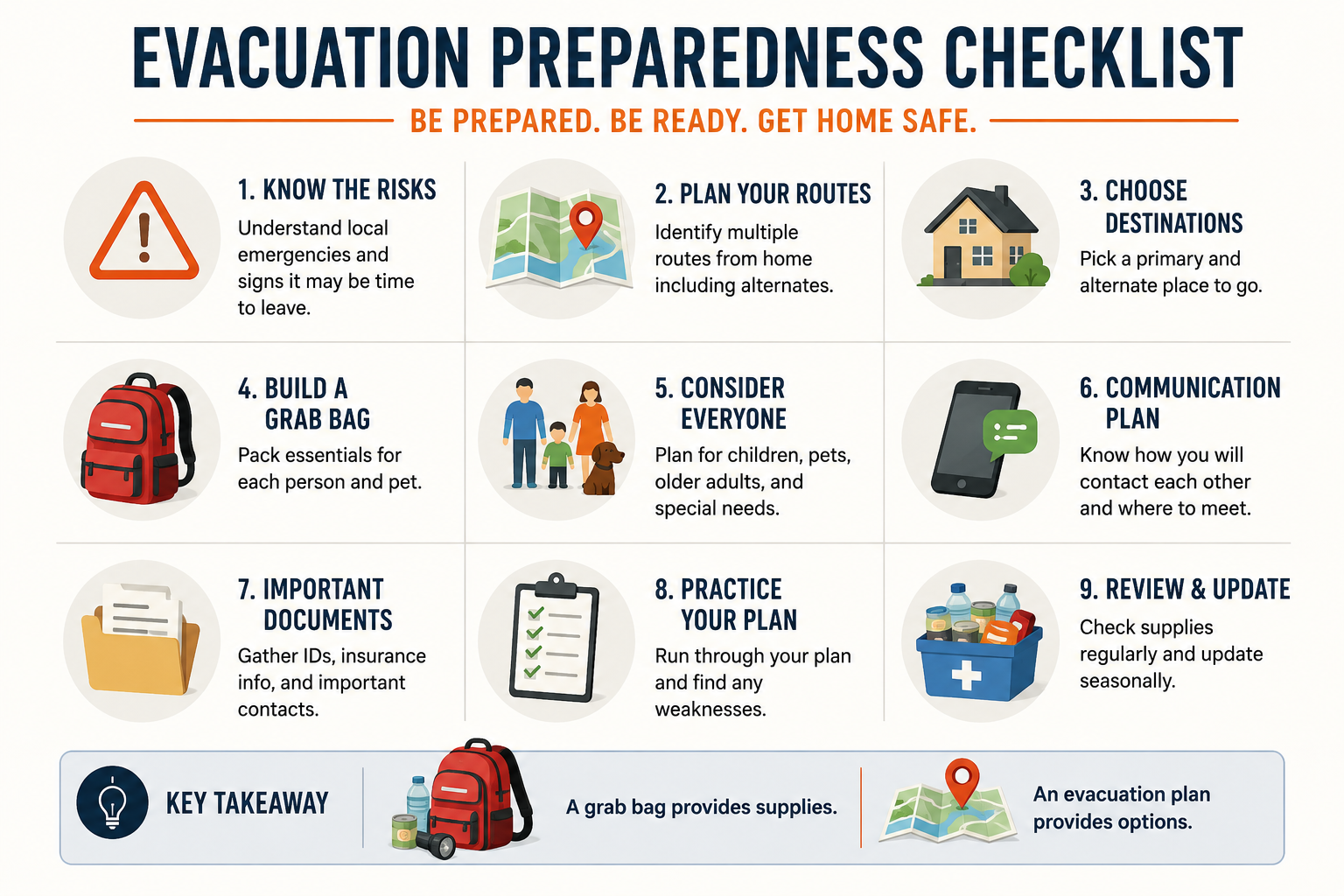
Key Takeaways
After completing this checklist, you should have:
✓ A clear understanding of when evacuation may become necessary.
✓ Identified primary and alternate evacuation destinations.
✓ Planned multiple evacuation routes from your home.
✓ Assembled or reviewed a practical emergency grab bag.
✓ Considered the needs of children, pets, older adults, and anyone requiring additional assistance.
✓ Established a family communication and reunification plan.
✓ Prepared important documents, contact information, and essential supplies for a quick departure.
✓ Identified improvements to your evacuation plan before an actual emergency occurs.
✓ Created a routine for reviewing and updating your evacuation supplies throughout the year.
Remember: A grab bag provides supplies. A well-practiced evacuation plan helps you use them effectively when every minute counts.
© Prepping Communities. This content is for informational purposes only and not professional advice. Use at your own risk.
Terms | Privacy | Guidelines