
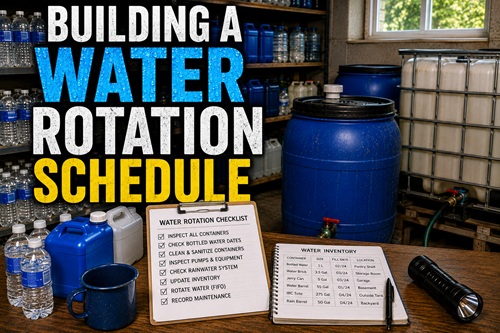
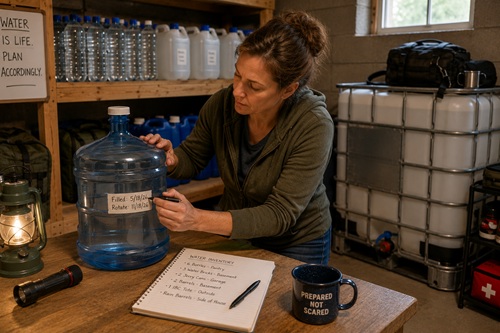
Introduction
Storing emergency water is one of the most important steps in household preparedness, but storage alone is only part of the process. Water reserves must also be maintained so they remain clean, safe, and ready whenever they are needed. This ongoing process is known as water rotation. A well-planned rotation schedule ensures that stored water remains in good condition while providing
regular opportunities to inspect containers, verify inventory, and maintain the equipment that supports the entire storage system.
Many people assume that once water has been placed into storage it can simply remain untouched until an emergency occurs. While properly stored water often remains usable for much longer than many people expect, every storage system benefits from routine inspection and periodic replacement. Containers age, seals deteriorate, labels become unreadable, storage conditions change, and household water requirements evolve over time. A rotation schedule helps identify these changes before they become problems.
Water rotation should not be viewed as an inconvenience or unnecessary chore. Instead, it should become a routine part of household preparedness in much the same way that smoke detectors are tested, vehicle maintenance is performed, or emergency food supplies are reviewed. Regular maintenance builds confidence because every inspection confirms that emergency water remains available, protected, and ready for immediate use.
An effective rotation schedule also simplifies long-term preparedness. Rather than facing the overwhelming task of replacing an entire household water supply at once, a planned schedule spreads maintenance throughout the year. Smaller, manageable tasks require less time, reduce waste, and make preparedness easier to sustain for many years.
Just as importantly, water rotation provides opportunities to practice using your equipment. Containers can be emptied, cleaned, sanitized, refilled, and returned to storage while pumps, dispensing valves, siphons, and purification equipment are tested under normal conditions. Familiarity with this equipment before an emergency greatly reduces uncertainty when clean water becomes critically important.
This handbook explains how to build a practical household water rotation schedule that matches your storage system and preparedness goals. You will learn how storage conditions influence water quality, how often different containers should be inspected, how to organize rotation schedules, how to integrate maintenance into your annual preparedness routine, and how to keep your emergency water system dependable for years to come. By the end of this guide, you should understand not only when to rotate stored water, but also how a well-maintained rotation schedule strengthens every part of your overall preparedness plan.
Why Water Rotation Matters
Water is unique among emergency supplies because it supports virtually every aspect of household survival. It is required for drinking, cooking, sanitation, hygiene, medical care, food preparation, and countless other daily activities. Because of its importance, households often invest significant time and money building emergency water reserves. A rotation schedule protects that investment by ensuring stored water remains dependable throughout its entire storage life.
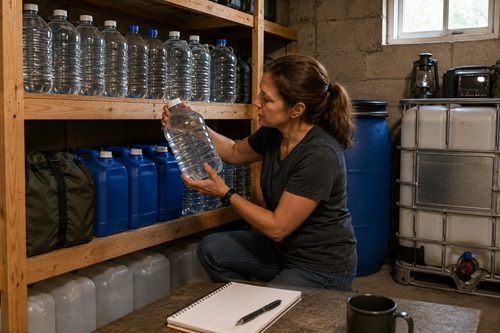
Many factors influence the condition of stored water over time. Containers may gradually deteriorate, seals can loosen, storage environments may become hotter or colder than expected, and labels may fade or become detached. Even if the water itself remains perfectly safe, these changes can reduce confidence in the storage system or create unnecessary confusion during an emergency. Routine rotation allows each of these issues to be identified and corrected before they become significant problems.
Another benefit of water rotation is that it reinforces good preparedness habits. Every scheduled inspection encourages households to review their overall emergency water system rather than focusing only on individual containers. Storage locations can be evaluated, inventory records updated, pumps tested, purification supplies checked, and household water requirements reassessed. What begins as a simple rotation schedule gradually becomes a complete water maintenance program.
Water rotation also supports long-term organization. As emergency water supplies expand, it becomes increasingly difficult to remember when each container was filled or which containers should be used first. Establishing a consistent rotation schedule eliminates guesswork by providing a predictable maintenance routine. Every container follows the same inspection process, reducing the likelihood that older supplies remain forgotten in storage for many years.
Perhaps most importantly, rotation builds confidence. During an emergency, there should be no uncertainty about whether stored water is still usable or whether containers remain in good condition. Households that routinely inspect and rotate their supplies know exactly what they have available because they have personally verified every part of the system. That confidence reduces stress while allowing attention to remain focused on managing the emergency itself rather than questioning the condition of stored resources.
Water rotation should therefore be viewed as an essential part of preparedness rather than optional maintenance. Proper storage protects water between inspections, while regular rotation confirms that the entire system continues functioning as intended. Together, these two practices ensure that emergency water remains one of the most reliable resources available to the household.
Table 1 — Benefits of a Water Rotation Schedule
| Benefit | Why It Matters |
|---|---|
| Maintains water quality | Helps ensure stored water remains safe and dependable. |
| Verifies container condition | Identifies damaged containers before they fail. |
| Updates inventory | Confirms storage quantities remain accurate. |
| Tests equipment | Verifies pumps, siphons, and dispensing systems function properly. |
| Reinforces preparedness habits | Encourages regular inspection of the entire water system. |
| Reduces waste | Allows gradual replacement instead of replacing all water at once. |
| Builds confidence | Provides assurance that emergency water is ready for immediate use. |
Understanding Water Shelf Life
One of the most common questions in emergency preparedness is how long stored water will remain safe to drink. Unlike many food products, water itself does not spoil in the traditional sense. Pure water is chemically stable and, by itself, does not become unsafe simply because time has passed. However, the condition of stored water is influenced by many other factors, including the quality of the water when it was stored, the type of container used, storage conditions, and how well the container continues protecting the water from contamination. Understanding these factors is the foundation of building a practical water rotation schedule.
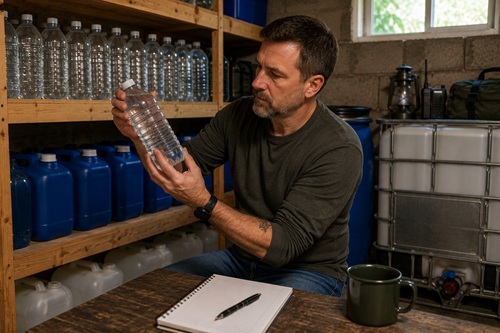
Confusion often arises because commercially bottled water frequently displays a “best before” or expiration date. In most cases, this date reflects manufacturer recommendations regarding packaging performance and product quality rather than a point at which the water suddenly becomes unsafe. Plastic bottles gradually age, labels deteriorate, and storage conditions vary widely during transportation and retail storage. Manufacturers establish conservative dates to ensure consistent product quality while simplifying inventory management throughout the supply chain.
Home-filled water containers present a different situation. Municipal tap water that has been properly treated and stored inside clean, food-grade containers often remains suitable for extended storage when protected from contamination, sunlight, and excessive temperatures. However, because households cannot always guarantee perfect storage conditions or sterile filling procedures, periodic rotation remains the most practical way to maintain confidence in the entire storage system.
Water collected from private wells, springs, rainwater systems, or other renewable sources may require additional attention depending on its treatment before storage. If untreated water is placed into storage, microorganisms may continue growing over time, particularly if nutrients or organic material are present. Proper purification before storage greatly improves long-term stability while reducing the likelihood that water quality will deteriorate during extended storage.
Container material also influences long-term storage performance. Food-grade HDPE barrels, modular storage containers, and jerry cans are designed specifically for potable water storage and generally provide excellent long-term protection when properly maintained. Stainless steel containers offer even greater durability because they resist corrosion, block sunlight completely, and do not gradually degrade in the same way as plastics. Commercial bottled water performs well for emergency storage but is generally intended for shorter-term commercial distribution rather than repeated refilling over many years.
Environmental conditions often have a greater influence on stored water than age alone. Containers stored in cool, dark, climate-controlled environments generally remain in better condition than identical containers exposed to direct sunlight, repeated freezing and thawing, or prolonged high temperatures. Heat accelerates plastic aging, while sunlight may promote algae growth in translucent containers if contamination is present. Proper storage conditions therefore become an important part of extending the useful life of both the water and its container.
Perhaps the most important concept to understand is that water rotation is not performed because every container automatically becomes unsafe after a specific number of months. Instead, rotation provides an organized opportunity to inspect containers, verify storage conditions, confirm inventory records, clean equipment, and replace water whenever necessary. Even if the stored water remains perfectly usable, the inspection process itself significantly strengthens long-term preparedness.
Rather than asking, “When does stored water expire?” a more useful question is, “When should this storage system be inspected and maintained?” That shift in thinking places the emphasis on managing the entire water system instead of focusing only on the age of the water itself. Preparedness is strengthened not simply by replacing water on a schedule, but by ensuring every part of the storage system continues performing as intended.
Table 2 — Typical Water Storage Expectations
| Water Storage Method | Typical Long-Term Performance* | Rotation Considerations |
|---|---|---|
| Commercial bottled water | Excellent when stored properly | Inspect packaging regularly and rotate according to your maintenance schedule or manufacturer guidance. |
| Municipal tap water in food-grade containers | Excellent when properly treated and stored | Inspect containers regularly and rotate periodically as part of household maintenance. |
| Water stored in HDPE barrels | Excellent | Verify seals, inspect container condition, and maintain a regular inspection schedule. |
| Stainless steel containers | Outstanding | Inspect seals and fittings; container lifespan is generally very long. |
| Rainwater (treated before storage) | Good to excellent | Depends on treatment method, storage conditions, and container maintenance. |
| Untreated collected water | Variable | Should generally be purified before long-term storage whenever possible. |
*Actual storage life depends upon water quality, treatment method, container condition, and storage environment.
Factors That Affect Stored Water
The condition of stored water depends on much more than the date it was placed into storage. Every storage system operates within an environment that continually influences both the water and the container protecting it. Understanding these factors allows households to reduce unnecessary deterioration while designing rotation schedules that reflect real storage conditions rather than arbitrary dates.
Temperature is one of the most significant influences on long-term water storage. Cool, stable temperatures slow the aging of plastic containers, reduce expansion and contraction caused by temperature fluctuations, and discourage biological activity should contaminants be introduced. Excessive heat, on the other hand, accelerates plastic degradation and may shorten the useful service life of certain containers even when the water itself remains safe.
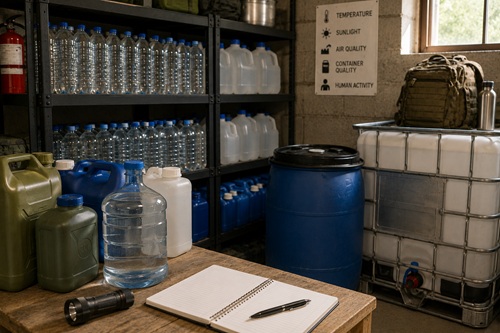
Sunlight also affects stored water. Ultraviolet radiation gradually weakens many plastics and can encourage algae growth if light reaches contaminated water inside translucent containers. Opaque containers or storage locations protected from direct sunlight provide substantially better long-term protection than containers left exposed in bright outdoor environments.
Air quality within the storage area deserves consideration as well. Although properly sealed containers prevent direct contamination, storing potable water beside gasoline, pesticides, solvents, paints, fertilizers, or other chemicals increases the risk of accidental contamination through spills, damaged containers, or improper handling. Separating water storage from hazardous materials remains one of the simplest and most effective protective measures.
The quality of the container itself is equally important. Food-grade containers manufactured specifically for potable water storage provide reliable long-term performance because they are designed to resist chemical breakdown while protecting water quality. Inferior or repurposed containers may deteriorate more quickly or fail to provide the same level of protection over extended storage periods.
Finally, human activity influences stored water more than many people realize. Every time a container is opened, moved, transported, refilled, or cleaned, there is an opportunity to either improve or reduce its long-term reliability. Careful handling, routine inspection, proper sanitation, and consistent labeling all contribute to maintaining a dependable water storage system.
Understanding these influences makes it easier to build a practical maintenance schedule. Rather than rotating water solely because a certain amount of time has passed, households can evaluate the complete storage environment and make informed decisions based on the actual condition of both the water and the system protecting it.
Table 3 — Environmental Factors Affecting Stored Water
| Factor | Effect on Water Storage | Best Practice |
|---|---|---|
| High temperatures | Accelerates container aging | Store in cool, stable environments |
| Freezing temperatures | May damage containers if water expands | Protect from freezing whenever possible |
| Direct sunlight | Promotes plastic degradation and possible algae growth | Store in dark or shaded locations |
| Chemical exposure | Increases contamination risk | Keep water separate from fuels and chemicals |
| Poor container quality | Shortens service life | Use food-grade containers only |
| Frequent handling | Increases contamination opportunities | Handle containers carefully and sanitize when necessary |
Determining Rotation Frequency
One of the most common misconceptions about emergency water storage is that every container must be emptied and refilled on the same schedule. In reality, there is no universal rotation interval that applies to every household or every storage system. The appropriate schedule depends upon several factors, including the type of water being stored, the quality of the storage container, environmental conditions, household maintenance practices, and the level of confidence the household wishes to maintain in its emergency supplies.
Many preparedness guides recommend rotating stored water every six months. While this recommendation encourages regular maintenance, it is intentionally conservative and does not necessarily reflect the actual condition of properly stored water. Modern food-grade containers, properly treated municipal water, and stable indoor storage environments often allow significantly longer maintenance intervals. Rather than viewing six months as a mandatory requirement, it is more useful to understand why inspections are performed and then establish a schedule appropriate for your own preparedness system.
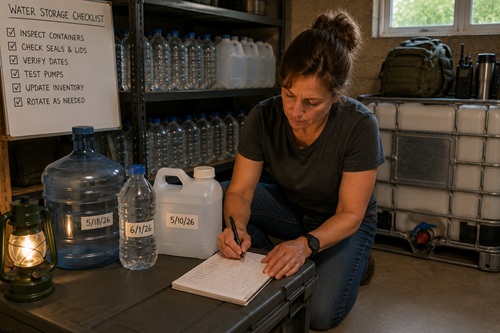
Commercially bottled water generally requires the least attention because it has already been packaged under controlled conditions using sealed factory equipment. When stored in a cool, dark location away from chemicals and excessive temperatures, commercially bottled water frequently remains in excellent condition for many years. Nevertheless, periodic inspections remain worthwhile to verify that packaging has not been damaged, crushed, punctured, or exposed to unsuitable environmental conditions.
Home-filled containers deserve more frequent attention because households typically cannot reproduce the sterile filling conditions used by commercial bottling facilities. Even when proper cleaning and sanitizing procedures are followed, routine inspection helps verify that lids remain secure, seals remain intact, and containers continue protecting the stored water as intended. Rotation schedules should therefore consider both the condition of the water and the condition of the container itself.
Large storage systems introduce additional considerations. Emptying and refilling several fifty-five-gallon barrels or a large storage tank represents a significant undertaking involving pumps, hoses, cleaning equipment, and considerable amounts of water. Many households choose to inspect these systems annually while rotating portions of the stored water over a longer period rather than replacing every gallon during a single maintenance session. This staggered approach spreads the workload throughout the year while maintaining confidence in the storage system.
Renewable water systems require their own maintenance schedules. Rainwater harvesting equipment, storage tanks, first-flush diverters, filters, pumps, and collection surfaces all benefit from seasonal inspection. These systems may require cleaning even when stored water itself does not require replacement. A complete water maintenance program therefore considers both stored reserves and the equipment responsible for collecting additional water.
The most effective rotation schedule is one that your household can realistically maintain year after year. A schedule that is overly complicated or excessively demanding often becomes neglected over time. Simplicity encourages consistency. Many preparedness-minded households choose one or two dedicated maintenance weekends each year when water storage, emergency food, medical supplies, communication equipment, generators, and other preparedness systems are inspected together. Combining maintenance activities reduces the number of separate preparedness tasks while helping ensure that nothing is overlooked.
Rather than asking how often water should be rotated, it is often more useful to ask how often the entire water system should be inspected. This broader perspective recognizes that preparedness depends upon much more than replacing water. Containers, storage conditions, inventory records, dispensing equipment, purification supplies, and household requirements all deserve regular review as part of one coordinated maintenance program.
Table 4 — Suggested Water Rotation and Inspection Intervals
| Storage Method | Routine Inspection | Typical Rotation Approach |
|---|---|---|
| Commercial bottled water | Every 6–12 months | Inspect packaging; rotate according to household schedule or manufacturer guidance if desired. |
| Home-filled food-grade containers | Annually | Inspect containers and rotate based on household maintenance practices. |
| Water bricks and modular containers | Annually | Rotate during scheduled maintenance while cleaning and sanitizing containers. |
| Food-grade jerry cans | After extended use and annually | Clean, sanitize, and refill after collection exercises or scheduled maintenance. |
| Large water barrels | Annually | Inspect yearly; rotate according to the household’s long-term maintenance plan. |
| IBC totes and storage tanks | Annually | Inspect complete system; rotate water as practical within the overall management plan. |
| Rainwater systems | Seasonally | Inspect collection equipment, filters, tanks, and overflow systems regularly. |
These intervals represent practical preparedness guidance. Actual maintenance schedules should reflect your storage conditions, water source, treatment method, and household preferences.
Building a Household Rotation Calendar
A written rotation calendar transforms water maintenance from an occasional reminder into a routine household activity. Instead of relying on memory, the calendar provides a predictable schedule for inspections, cleaning, inventory updates, and water replacement. Over time, these routine activities become as familiar as changing furnace filters or servicing a vehicle.
One of the simplest approaches is to divide maintenance throughout the year rather than attempting to complete every task during a single weekend. Smaller maintenance sessions require less time, reduce fatigue, and make it easier to perform thorough inspections. For example, bottled water may be reviewed during one season, modular containers during another, and large storage systems later in the year. This staggered approach keeps the entire water system under continuous review without creating an overwhelming workload.
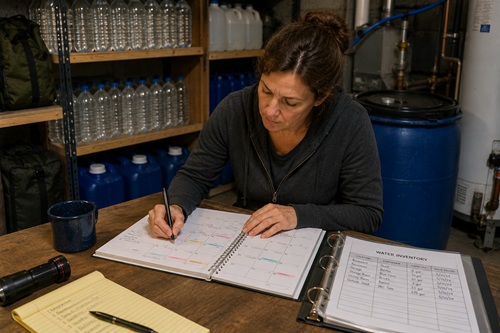
Some households prefer to coordinate water rotation with other seasonal preparedness activities. Spring often provides an excellent opportunity to inspect rainwater harvesting equipment before the wetter months begin. Summer may be used to test portable collection equipment and pumps. Autumn frequently becomes the time to prepare water systems for freezing temperatures, while winter offers an opportunity to review inventories, update documentation, and plan future improvements. Aligning water maintenance with the natural seasons helps establish predictable routines that are easy to remember.
Digital reminders have become increasingly useful for supporting rotation schedules. Calendar applications, recurring phone reminders, spreadsheet trackers, and preparedness management software can all notify household members when inspections or maintenance activities are due. These tools reduce the likelihood that important tasks will be forgotten while allowing maintenance records to be preserved over many years.
Paper records remain equally valuable. A preparedness binder containing inventories, inspection logs, maintenance schedules, and container identification numbers provides a permanent reference that remains available even during extended power outages or communication disruptions. Many households successfully combine digital reminders with printed records, benefiting from the strengths of both systems.
The rotation calendar should also remain flexible. Household size changes, storage systems expand, new equipment is purchased, and environmental conditions evolve over time. Reviewing the calendar annually allows maintenance activities to be adjusted as preparedness capabilities continue growing. A schedule that worked well for a small apartment may require significant revision after moving to a rural property with rainwater collection and large storage tanks.
Most importantly, the calendar should encourage consistency rather than perfection. Missing one scheduled inspection is far less significant than abandoning the maintenance program altogether. A practical schedule that the household follows every year provides far greater preparedness than an ambitious schedule that quickly becomes unrealistic.
Table 5 — Example Annual Water Rotation Calendar
| Season | Recommended Activities |
|---|---|
| Spring | Inspect rainwater harvesting systems, clean gutters, inspect rain barrels, review portable collection equipment. |
| Summer | Test pumps, siphons, and portable containers; inspect bottled water stored in vehicles and outdoor buildings. |
| Autumn | Inspect large barrels, modular containers, and jerry cans; rotate water as scheduled; prepare outdoor systems for freezing weather. |
| Winter | Update inventory records, review household water requirements, inspect indoor storage locations, and plan improvements for the coming year. |
Labeling and Tracking Your Water Storage System
A water rotation schedule is only effective if every container can be identified quickly and accurately. As emergency water reserves expand, relying on memory becomes increasingly unreliable. A household with a few cases of bottled water may have little difficulty remembering when they were purchased, but a preparedness system containing bottled water, modular containers, jerry cans, barrels, rainwater storage, and portable collection containers quickly becomes difficult to manage without an organized tracking system.
Labeling provides the simplest solution. Every container should display enough information to allow any member of the household to determine its purpose, age, and maintenance status without consulting additional records. At a minimum, each container should include the date it was filled, the planned inspection or rotation date, and an indication that it is intended for potable water. Larger storage systems often benefit from unique identification numbers that correspond with inventory records, making inspections easier to document over time.
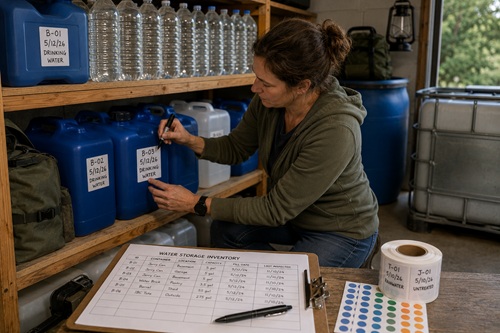
Container identification numbers become particularly valuable as storage capacity grows. Rather than referring to “the blue barrel in the garage,” a household can simply identify it as “Barrel B-03” or “Tank T-01.” Inspection logs, maintenance records, and cleaning schedules can then refer to these identification numbers, eliminating confusion even if containers are moved or storage areas are reorganized.
Labels should also be designed to survive the same environmental conditions as the containers themselves. Waterproof labels, permanent markers intended for outdoor use, engraved identification tags, or laminated labels generally provide better long-term durability than ordinary paper labels. Containers stored in damp basements, garages, sheds, or outdoor environments should be checked periodically to ensure labels remain readable.
Color coding provides another useful organizational tool. Some households assign different colors to different categories of water storage. For example, blue labels may identify drinking water, green labels may indicate untreated rainwater awaiting purification, while orange labels identify portable collection containers. Although color coding is optional, it allows containers to be recognized quickly during emergencies when time and visibility may be limited.
Tracking systems should remain simple enough that they are actually used. An overly complicated inventory requiring extensive recordkeeping often becomes neglected over time. Most households benefit from a straightforward system that combines clear container labels with a single inventory sheet recording location, capacity, fill date, inspection history, and maintenance notes. Simplicity encourages consistency, and consistency is far more valuable than unnecessary complexity.
Many preparedness-minded households also maintain digital copies of their inventory. Spreadsheets, preparedness software, or simple note-taking applications allow inventories to be updated quickly while making it easy to calculate total storage capacity or identify upcoming maintenance tasks. Nevertheless, printed records remain equally important because they continue functioning during extended power outages or equipment failures. Maintaining both paper and digital records provides valuable redundancy while ensuring information remains accessible under a wide range of conditions.
A well-organized tracking system ultimately supports every other aspect of water preparedness. Rotation schedules become easier to follow, inspections require less time, maintenance records remain accurate, and every household member understands the condition of the emergency water supply. Instead of wondering when a particular container was filled or whether it has already been inspected, the information is immediately available whenever it is needed.
Table 6 — Suggested Information for Every Water Container
| Label Information | Purpose |
|---|---|
| Container Identification Number | Uniquely identifies each storage container. |
| Fill Date | Records when the container was last filled. |
| Inspection Date | Indicates when the container should next be inspected. |
| Rotation Date | Identifies the planned replacement schedule. |
| Capacity | Assists with inventory calculations. |
| Water Source | Records whether the water came from municipal supply, well, rainwater, or another source. |
| Treatment Method | Documents whether the water was treated before storage. |
Developing an Inventory Management System
As emergency water storage expands beyond a few individual containers, an inventory becomes an essential planning tool. An inventory is more than a simple list of containers. It provides a complete picture of the household’s water preparedness by documenting where water is stored, how much is available, when it was last maintained, and how each container contributes to the overall storage system.
The first step is identifying every storage location used by the household. Water may be distributed throughout the home to improve redundancy and reduce the risk of losing the entire reserve because of flooding, structural damage, contamination, or other localized problems. Basements, garages, utility rooms, sheds, barns, vehicles, workshops, and emergency trailers may all contain portions of the household’s water supply. Recording these locations allows every container to be located quickly during both routine maintenance and emergency situations.
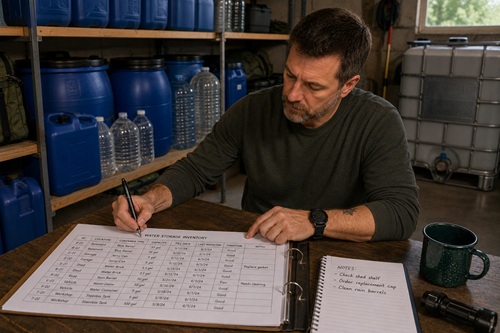
The inventory should also record the capacity of each container. Knowing the exact storage capacity allows households to compare available reserves with their calculated daily water requirements. As family size changes or preparedness goals evolve, inventory records make it easy to determine whether additional storage is required or whether existing capacity remains sufficient.
Maintenance history becomes increasingly valuable over time. Recording inspection dates, cleaning activities, water rotation, repairs, and replacement of damaged components creates a permanent maintenance record for every container. This documentation helps identify recurring problems while ensuring that no container is overlooked during future inspections.
Many households also include notes describing the condition of each container or any observations made during inspections. A barrel showing minor ultraviolet fading, a jerry can requiring a replacement gasket, or a rain barrel needing additional cleaning can all be documented for future attention. These notes reduce the likelihood that small issues will be forgotten between maintenance sessions.
An inventory also supports emergency planning. During a prolonged disruption, knowing exactly how much potable water remains available allows households to make informed decisions regarding conservation, collection, purification, and rationing. Accurate information replaces guesswork, allowing resources to be managed confidently even under stressful conditions.
The inventory should be reviewed whenever major changes occur. Purchasing new containers, replacing damaged equipment, expanding rainwater collection systems, or relocating storage areas all affect the accuracy of household records. Updating the inventory immediately after these changes ensures that documentation remains reliable throughout the year.
Table 7 — Household Water Inventory Example
| Container ID | Type | Capacity | Storage Location | Fill Date | Next Inspection | Notes |
|---|---|---|---|---|---|---|
| BW-01 | Bottled Water | 24 bottles | Pantry | Jan 2026 | Jan 2027 | Factory sealed |
| WB-03 | Water Brick | 3.5 gal (13 L) | Basement Shelf | Mar 2026 | Mar 2027 | Excellent condition |
| JC-02 | Jerry Can | 6 gal (23 L) | Garage | Apr 2026 | Apr 2027 | Replace gasket next inspection |
| BR-01 | 55-Gallon Barrel | 55 gal (208 L) | Basement | Feb 2026 | Feb 2027 | No issues noted
|
Using First In, First Out (FIFO) Water Management
One of the simplest ways to maintain emergency water supplies is to use the same inventory management method employed by grocery stores, restaurants, warehouses, and emergency management organizations around the world. Known as First In, First Out (FIFO), this approach ensures that the oldest stored water is used first while newly filled or newly purchased containers are placed at the back of the storage system. Rather than allowing water to remain forgotten on a shelf for many years, FIFO creates a continuous cycle in which supplies are regularly replaced through normal household use.
The principle itself is straightforward. Water that enters storage first should also leave storage first. Every time additional water is purchased or containers are refilled, the new supplies are placed behind the existing inventory. Older containers are then consumed naturally over time before newer ones are opened. This continuous movement prevents large portions of the household water reserve from becoming excessively old while eliminating the need to replace the entire supply on a single maintenance day.
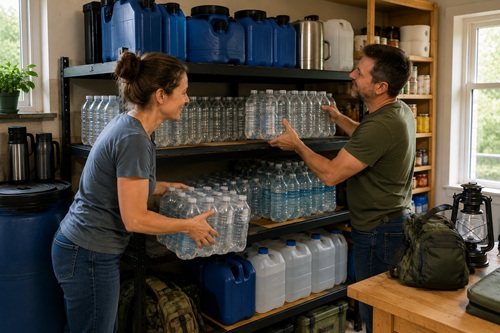
FIFO works particularly well with commercially bottled water because factory-sealed cases can easily be arranged in chronological order. New purchases are placed behind existing supplies, while the oldest cases remain closest to the front of the storage shelf. As bottled water is consumed during everyday activities or routine household use, replacement cases are added to the back of the storage area, maintaining the established rotation sequence with very little additional effort.
Home-filled containers can also benefit from FIFO management, although the process requires clear labeling. Fill dates and container identification numbers make it easy to determine which containers should be used first. Whenever a container is emptied, cleaned, sanitized, and refilled, it simply returns to the end of the rotation sequence while older containers continue moving toward the front.
Large storage systems require a slightly different approach because they are not easily moved. Instead of physically rearranging barrels or tanks, the rotation sequence is maintained through documentation. Each container receives an identification number and a maintenance record indicating when it was last filled or inspected. During scheduled rotation, the oldest container is serviced first while the remaining containers continue following the established maintenance schedule.
The greatest advantage of FIFO is that it transforms water rotation into an ongoing household habit rather than an occasional large-scale project. Instead of draining hundreds of gallons on one weekend, small portions of the storage system are continually refreshed throughout the year. This approach reduces waste, minimizes workload, and ensures that emergency supplies remain familiar because they are occasionally used under normal conditions.
FIFO management also encourages households to become more comfortable with their stored water. Drinking bottled water from emergency supplies during camping trips, outdoor work, travel, or recreational activities demonstrates that these reserves are practical household resources rather than supplies intended only for catastrophic emergencies. Every container used is immediately replaced, preserving overall storage capacity while naturally maintaining freshness.
Another important benefit involves equipment familiarity. Every time water is transferred from a barrel, pumped from a storage tank, or dispensed from a jerry can, household members gain additional experience using their equipment. Small issues involving pumps, valves, hoses, or dispensing systems are often discovered during routine use rather than during an actual emergency when reliable operation becomes far more critical.
FIFO should not be viewed as a rigid rule that requires perfect adherence. Household schedules, vacations, changing family needs, and unexpected circumstances may occasionally interrupt the normal rotation cycle. The objective is not perfection but consistency. Even an informal FIFO system maintained over many years provides significantly greater preparedness than allowing emergency water to remain untouched indefinitely.
Ultimately, FIFO management reflects one of the central principles of preparedness: emergency supplies should remain active components of everyday readiness rather than forgotten collections of equipment. Water that is regularly inspected, occasionally used, and consistently replaced is far more likely to remain dependable than water that is stored, ignored, and assumed to be ready years later.
Table 8 — Applying FIFO to Different Water Storage Systems
| Storage Method | FIFO Application |
|---|---|
| Commercial bottled water | Place new cases behind older cases and always use the oldest supply first. |
| Water bricks | Refill cleaned containers and return them to the end of the rotation sequence. |
| Jerry cans | After collection or household use, clean, sanitize, refill, and place back into rotation. |
| Water barrels | Rotate according to maintenance records rather than physical position. |
| IBC totes | Maintain documented service intervals and rotate according to inventory records. |
| Rainwater storage | Use stored water according to collection date while continuing seasonal maintenance. |
Integrating Water Rotation into Everyday Life
The most successful preparedness systems are those that become part of normal household routines rather than separate activities performed only once or twice each year. Water rotation is no exception. When maintenance is integrated into everyday life, it requires less effort, becomes easier to remember, and is far more likely to remain consistent over many years.
One of the simplest methods is to incorporate emergency water into routine household activities. Commercially bottled water can be used during camping trips, road travel, outdoor work, sporting events, or family outings. Every case removed from storage is immediately replaced with a newly purchased case, allowing the emergency reserve to remain at full capacity while naturally rotating the oldest inventory.
Preparedness-minded households often schedule small maintenance activities alongside other recurring responsibilities. For example, when changing smoke detector batteries, servicing a generator, rotating emergency food, or inspecting first aid supplies, a quick review of water storage can be performed at the same time. Grouping maintenance activities together reduces the number of separate preparedness tasks while reinforcing the habit of regular inspection.
Seasonal transitions provide another excellent reminder. Spring may become the time for inspecting rainwater collection systems, while autumn offers an opportunity to prepare outdoor storage for freezing weather. These natural milestones occur every year regardless of calendar reminders, making them reliable triggers for routine maintenance.
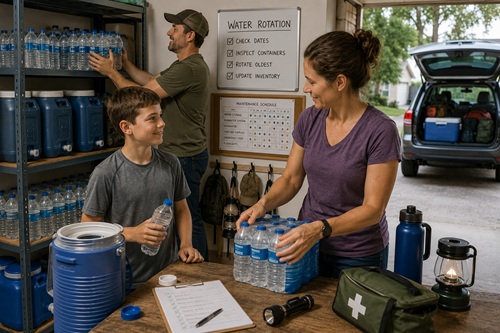
Households with children can also use water rotation as an educational opportunity. Older children can assist with labeling containers, updating inventory records, carrying lightweight bottled water, or helping inspect storage areas under adult supervision. Participation builds familiarity with the household preparedness plan while teaching practical organizational skills that remain valuable throughout life.
Digital technology can further simplify routine maintenance. Calendar reminders, recurring smartphone notifications, spreadsheet trackers, or preparedness applications can all prompt inspections before they are forgotten. These tools are especially helpful for larger storage systems where different components require maintenance at different times throughout the year.
Despite the convenience of digital reminders, printed maintenance records should always remain part of the preparedness plan. Paper inspection logs, inventories, and rotation schedules continue functioning during power outages, equipment failures, or communication disruptions. Using both digital reminders and printed records provides valuable redundancy while ensuring important maintenance information remains available under virtually any circumstances.
Integrating water rotation into everyday life ultimately reduces the effort required to maintain preparedness. Instead of becoming another demanding household responsibility, water maintenance gradually becomes a familiar routine supported by consistent habits, simple organization, and practical experience. Over time, these small routine activities produce one of the most dependable emergency water systems a household can develop.
Table 9 — Everyday Opportunities to Rotate Water
| Household Activity | Water Rotation Opportunity |
|---|---|
| Grocery shopping | Replace bottled water that has been used. |
| Camping trips | Use emergency bottled water and replace it afterward. |
| Vehicle maintenance | Inspect vehicle water supplies. |
| Spring cleaning | Review storage locations and inventory records. |
| Generator maintenance | Inspect pumps, siphons, and water containers at the same time. |
| Emergency kit review | Replace bottled water and verify expiration or inspection dates. |
| Annual preparedness review | Complete full inspection, cleaning, inventory update, and rotation as needed. |
Rotating Different Types of Water Storage Containers
Although every water storage container serves the same basic purpose, they do not all require the same maintenance procedures. Container size, construction, portability, intended use, and storage location all influence how inspections and rotation should be performed. Understanding these differences allows households to maintain each component of their water storage system efficiently while avoiding unnecessary work.
Rather than treating every container identically, it is helpful to think of each storage method as performing a specific role within the overall preparedness system. Small portable containers are frequently handled and transported, while large stationary reserves may remain untouched for extended periods. Commercially bottled water arrives already sealed, whereas home-filled containers depend entirely upon household cleaning and filling procedures. Tailoring maintenance to each container type improves both efficiency and long-term reliability.
Regardless of the container being maintained, every inspection should follow the same basic principles. Examine the container for physical damage, confirm that labels remain readable, verify that lids and seals remain secure, inspect the storage environment, and update maintenance records. These consistent inspection habits create a dependable routine that can be applied across the entire household water system.
Rotating Commercially Bottled Water
Commercially bottled water is generally the easiest emergency water supply to maintain because it arrives from the manufacturer already cleaned, filled, sealed, and packaged. The primary maintenance task is not replacing the water itself but ensuring that the packaging continues protecting the contents throughout storage.
Routine inspections should focus on the condition of the bottles and packaging. Look for crushed cases, punctured bottles, damaged caps, evidence of leakage, or prolonged exposure to excessive heat or direct sunlight. Cases stored in garages, sheds, or vehicle trunks deserve particular attention because seasonal temperature extremes can accelerate deterioration of plastic packaging.
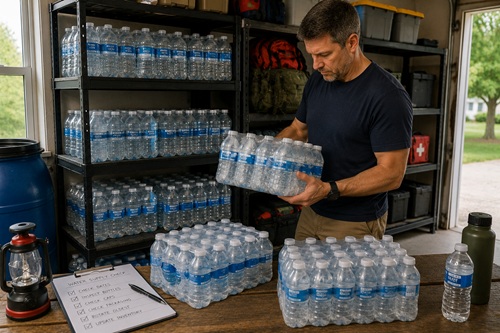
FIFO management works exceptionally well with bottled water. Newly purchased cases should always be placed behind older inventory so that the oldest water is used first. This simple practice naturally rotates supplies without requiring large-scale replacement projects. Many households incorporate bottled water into camping trips, outdoor recreation, travel, or household activities, replacing every case immediately after use.
Vehicle emergency kits should receive additional inspections because bottled water stored inside vehicles experiences some of the harshest environmental conditions encountered by household preparedness supplies. Containers exposed to repeated heating and freezing cycles should be examined more frequently than those stored in climate-controlled areas.
Commercial bottled water often becomes the first layer of a household water system because it provides immediate access without requiring pumps, treatment, or additional preparation. Maintaining this first layer requires very little effort while providing excellent reliability during the early stages of an emergency.
Rotating Modular Water Containers and Water Bricks
Modular water containers require a more active maintenance routine because they are commonly filled and maintained by the household rather than the manufacturer. Their relatively small size makes them easy to inspect, carry, clean, and sanitize, allowing maintenance to be performed without specialized equipment.
Each inspection should begin by examining the exterior of the container for cracks, impact damage, ultraviolet deterioration, and signs of leakage. Handles, stacking surfaces, and threaded openings deserve particular attention because these areas receive the greatest mechanical stress during normal handling.
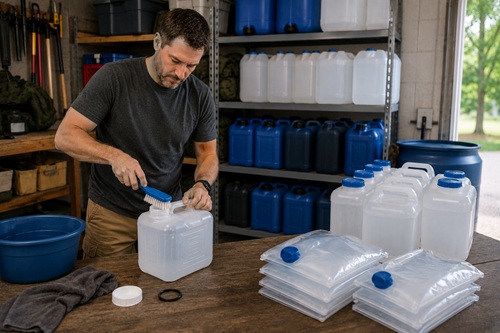
Lids and gaskets should be removed periodically for inspection and cleaning. A damaged gasket may allow contaminants to enter the container even though the water itself remains unchanged. Replacement seals are inexpensive and should be kept available for containers that are expected to remain in long-term service.
Because modular containers are easily moved, many households rotate them one or two at a time throughout the year rather than servicing every container simultaneously. This staggered approach reduces workload while ensuring that maintenance remains consistent. Once cleaned, sanitized, and refilled, each container simply returns to the end of the FIFO rotation sequence.
Their manageable size also encourages practical training. Household members can practice dispensing water, carrying containers, and transferring water into smaller vessels during routine maintenance. These simple exercises increase familiarity with the equipment while confirming that every container remains fully functional.
Rotating Food-Grade Jerry Cans
Food-grade jerry cans often receive more frequent handling than any other long-term water storage container because they serve both as storage vessels and transportation containers. They are commonly used during camping trips, property maintenance, water collection exercises, and emergency preparedness training. This frequent use makes routine cleaning and inspection especially important.
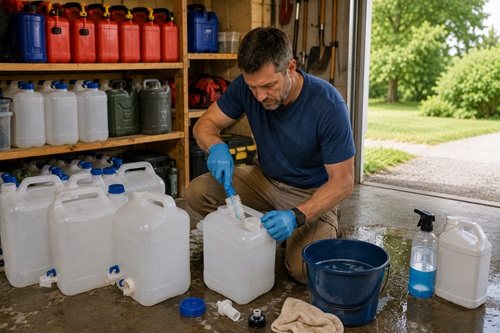
Every time a jerry can returns from transporting water, it should be emptied completely, inspected, and cleaned before returning to long-term storage. Even containers used only with potable water may accumulate sediment, dust, or minor contamination through repeated filling and dispensing.
Wide-mouth jerry cans simplify cleaning because the interior surfaces can be inspected directly. Brushes designed specifically for food-grade containers help remove residue without scratching the plastic. After cleaning, the container should be sanitized, thoroughly rinsed if appropriate for the sanitizing method used, and allowed to dry before refilling.
Pay particular attention to dispensing spouts, vents, threaded caps, and sealing gaskets. These components receive the greatest wear and are most likely to develop leaks or contamination issues over time. Maintaining spare replacement caps and seals is inexpensive insurance against equipment failure during an emergency.
Because jerry cans are intended for transportation, inspect the handles carefully for signs of cracking or excessive wear. A damaged handle may not fail until the container is fully loaded, creating both a safety hazard and the potential loss of valuable drinking water.
Jerry cans should also remain clearly identified as potable water containers. Fuel cans often resemble water jerry cans in size and shape, making consistent labeling essential. Maintaining separate storage areas for fuel and drinking water containers further reduces the possibility of accidental cross-contamination.
Table 10 — Maintenance Priorities by Container Type
| Container Type | Primary Inspection Focus | Typical Maintenance |
|---|---|---|
| Commercial Bottled Water | Bottle condition, packaging, storage environment | FIFO rotation and visual inspection |
| Water Bricks | Container body, lid, gasket | Clean, sanitize, inspect, refill |
| Jerry Cans | Handles, caps, dispensing spouts | Clean after use, sanitize, inspect seals |
| Large Barrels | Exterior condition, fittings, pumps | Scheduled inspection and periodic rotation |
| IBC Totes | Valves, support cage, plumbing | Annual inspection and system maintenance |
| Rainwater Containers | Screens, lids, sediment | Seasonal cleaning and inspection |
Rotating Large Water Barrels, Tanks, and IBC Totes
Large-capacity storage systems present different maintenance challenges than smaller portable containers. A household may easily empty, clean, and refill a five-gallon jerry can in a matter of minutes, but rotating several fifty-five-gallon barrels or an IBC tote containing hundreds of gallons requires considerably more planning. For this reason, maintaining large storage systems should focus on careful inspection, organized maintenance, and practical water management rather than unnecessary replacement of every gallon on a fixed schedule.
One of the most important principles is planning the storage location before the containers are filled. A fifty-five-gallon barrel weighs approximately 460 pounds (209 kilograms) when full, while an IBC tote may exceed 2,300 pounds (1,040 kilograms). Once filled, these containers should generally be considered permanent fixtures. Attempting to move them after filling increases the risk of injury, structural damage, and container failure. Maintenance procedures should therefore be designed around the assumption that the container will remain in place.
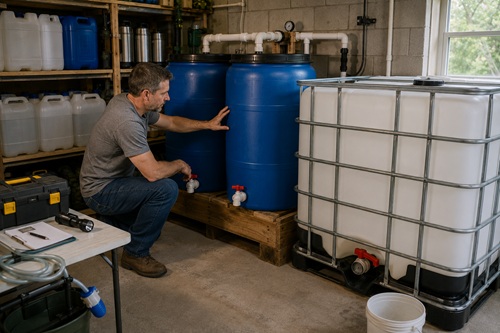
Routine inspections should begin with the exterior of the container. Examine the barrel or tank for cracks, bulging, ultraviolet deterioration, impact damage, corrosion on metal fittings, or signs of leakage around valves and threaded connections. Small problems discovered during routine inspections are usually inexpensive to correct, whereas unnoticed damage may result in the loss of hundreds of gallons of stored water.
Large containers also require inspection of the supporting structure. Concrete floors should be checked for signs of settling, cracking, or moisture accumulation beneath the storage system. Elevated platforms, wooden supports, and shelving should be examined periodically to ensure they remain capable of safely supporting the tremendous weight of stored water. Any indication of structural movement should be investigated before additional water is added to the system.
Access openings deserve careful attention. Lids should remain tightly sealed, vents should function correctly, and removable covers should continue protecting the stored water from insects, dust, rodents, and other contaminants. If the container uses threaded fittings, inspect them for wear and verify that sealing gaskets remain flexible and undamaged.
Unlike smaller containers, large barrels and tanks are often maintained through partial rotation rather than complete replacement. Instead of draining hundreds of gallons during every maintenance session, some households periodically remove a portion of the stored water for appropriate household uses such as landscape irrigation, cleaning, or other non-potable applications where permitted. The container is then refilled with fresh treated water, gradually renewing the overall supply while reducing waste and minimizing the effort required during each maintenance cycle.
Dispensing equipment should be tested during every scheduled inspection. Hand pumps, electric transfer pumps, siphons, gravity-fed valves, and associated hoses all represent potential points of failure. Equipment that has remained unused for several years may not operate properly when finally needed during an emergency. Routine testing ensures that every component continues functioning as expected while allowing worn parts to be replaced before they become critical.
Cleaning large containers requires additional planning because of their size. Barrels with removable lids or large access openings are generally much easier to inspect and sanitize than containers with narrow openings. If interior cleaning becomes necessary, use cleaning tools specifically designed for potable water storage and avoid abrasive materials that may damage food-grade surfaces. After cleaning, sanitize the container according to the manufacturer’s recommendations before returning it to service.
Large storage systems often become the foundation of long-term household preparedness because they provide economical storage capacity while requiring relatively little floor space compared to hundreds of individual bottles. Their reliability, however, depends upon regular maintenance rather than simple storage. Scheduled inspections, equipment testing, and thoughtful rotation practices allow these systems to provide dependable service for many years while avoiding the unnecessary work of complete water replacement whenever it is not required.
Maintaining Rainwater Storage Systems
Rainwater collection systems require maintenance that differs from conventional emergency water storage because they actively collect new water throughout the year. Instead of simply protecting stored water from deterioration, rainwater systems must continuously manage changing environmental conditions, seasonal debris, and varying water quality. Building these maintenance activities into the household water rotation schedule ensures that renewable water sources remain dependable whenever they are needed.
The collection surface should receive regular attention before the water even reaches the storage container. Leaves, twigs, bird droppings, pollen, roofing debris, and accumulated dirt can all affect the quality of collected rainwater. Gutters, downspouts, and collection screens should therefore be cleaned routinely, particularly during autumn or following severe storms.
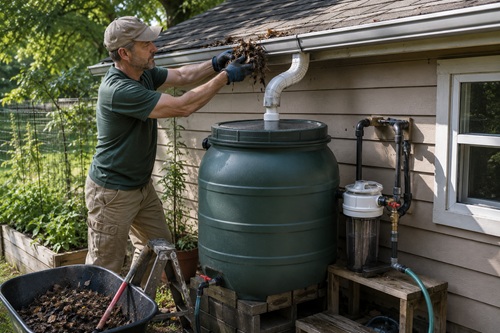
First-flush diverters deserve periodic inspection as well. These devices are designed to divert the initial runoff from the roof, reducing the amount of debris entering the storage system. Verify that they continue operating correctly, remove accumulated sediment, and replace worn components whenever necessary.
Storage containers should remain tightly covered throughout the year. Screened vents, sealed lids, and insect-resistant openings help prevent contamination from mosquitoes, rodents, birds, and windblown debris. During inspections, confirm that these protective features remain intact and free from damage.
Sediment naturally accumulates over time, particularly in systems collecting large volumes of rainwater. Although small amounts of sediment may not present immediate problems for non-potable uses, excessive accumulation reduces storage capacity and may interfere with pumps, valves, or filtration systems. Periodic cleaning helps maintain efficient operation while improving overall water quality.
Algae growth should also be monitored carefully. Most algae require sunlight to thrive, making opaque storage tanks and dark-colored containers particularly effective at limiting biological growth. If translucent containers are used, additional attention should be given to protecting them from prolonged direct sunlight.
Seasonal changes influence maintenance requirements as well. In colder climates, outdoor plumbing, valves, and collection equipment may require winterization before freezing temperatures arrive. In warmer regions, inspections may focus more heavily on ultraviolet exposure, insect activity, and water evaporation. Adjusting maintenance activities to local environmental conditions helps ensure the system performs reliably throughout the year.
Rainwater harvesting systems should be viewed as active components of the household water supply rather than passive storage containers. Like any working system, they benefit from regular inspection, cleaning, equipment testing, and documentation. When these activities become part of the annual water rotation schedule, renewable water collection remains dependable while supporting long-term household resilience.
Table 11 — Maintenance Schedule for Large Storage Systems
| System Component | Recommended Inspection | Maintenance Activity |
|---|---|---|
| 55-gallon barrels | Annually | Inspect exterior, fittings, lids, and rotate according to household schedule |
| IBC totes | Annually | Inspect cage, valves, plumbing, and supporting surface |
| Large storage tanks | Annually | Inspect structure, fittings, vents, and access hatches |
| Transfer pumps | Annually | Test operation, inspect hoses, lubricate if required |
| Hand pumps | Annually | Verify operation and inspect seals |
| Rain barrels | Spring and Autumn | Clean screens, remove sediment, inspect lids |
| Gutters and downspouts | Seasonally | Remove debris and verify proper drainage |
| First-flush diverters | Seasonally | Clean and inspect moving components |
| Rainwater filters | According to manufacturer | Clean or replace filter media |
Common Water Rotation Mistakes
A well-designed water storage system requires surprisingly little maintenance when compared to the confidence it provides during an emergency. Unfortunately, many households unintentionally create problems by overlooking a few simple maintenance practices. Most of these mistakes are not the result of poor planning but rather of assuming that water storage is a one-time project rather than an ongoing preparedness system. Recognizing these common problems makes them easy to avoid while improving the long-term reliability of every stored water supply.
Perhaps the most common mistake is assuming that stored water never requires attention. Once containers have been filled and placed on a shelf, it is easy to believe the job is complete. Over time, however, containers age, storage conditions change, household needs evolve, and maintenance records become outdated. Even when the water itself remains perfectly usable, neglecting the storage system increases uncertainty. Regular inspections are intended to verify the condition of the entire system rather than simply replace water according to a calendar.
Another frequent mistake is rotating every container at the same time. While this may seem organized, it often creates an overwhelming maintenance project involving hundreds of gallons of water. Large rotation days consume significant time, increase waste, and discourage future maintenance. Staggering inspections and rotating smaller portions throughout the year distributes the workload while making preparedness easier to sustain over many years.
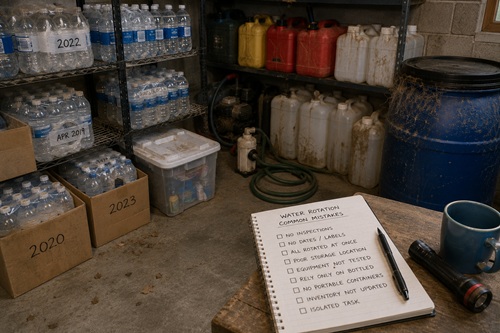
Many households also underestimate the importance of labeling. Containers without fill dates, inspection dates, or identification numbers quickly become difficult to manage as storage capacity increases. When maintenance records depend entirely on memory, uncertainty gradually replaces organization. Clear labeling eliminates guesswork while making inspections faster and more consistent.
Improper storage locations create another avoidable problem. Water stored beside fuels, pesticides, solvents, paints, or other chemicals faces unnecessary contamination risks. Likewise, containers exposed to prolonged sunlight, freezing temperatures, or excessive heat often deteriorate more rapidly than those stored in stable indoor environments. Selecting appropriate storage locations remains one of the simplest ways to extend the useful life of both the water and its containers.
Some households become so focused on replacing stored water that they overlook the equipment required to use it. Pumps, siphons, transfer hoses, dispensing valves, filters, and purification equipment all require occasional testing. Equipment that has remained unused for several years may not operate correctly during an emergency. Regular maintenance should therefore include every component of the water system rather than concentrating exclusively on the stored water itself.
Another mistake involves relying exclusively on commercially bottled water. Factory-sealed bottles provide an excellent foundation for emergency preparedness, but they are not always the most efficient solution for larger household reserves. A balanced system that combines bottled water with modular containers, jerry cans, barrels, or other storage methods generally provides greater flexibility while reducing long-term costs.
The opposite mistake also occurs. Some households invest heavily in large barrels or storage tanks while neglecting smaller portable containers. Although large storage systems provide economical capacity, they cannot easily be transported during evacuations or used to collect water from renewable sources. Portable containers remain essential even when substantial long-term reserves are available.
Inventory records are frequently neglected as preparedness systems grow. Purchasing additional containers, relocating storage areas, or replacing equipment without updating household records gradually reduces the accuracy of the inventory. During an emergency, uncertainty regarding available supplies can complicate decision-making. Keeping inventory records current requires only a few minutes after each change yet provides significant benefits throughout the life of the preparedness system.
Perhaps the most significant mistake is treating water rotation as an isolated task. Water storage functions best when it becomes part of a broader household maintenance routine that also includes emergency food, medical supplies, communication equipment, lighting, fuel storage, and other preparedness resources. Combining these activities into one coordinated preparedness program reduces workload while strengthening every part of the household emergency plan.
Avoiding these common mistakes does not require expensive equipment or advanced technical knowledge. Consistent inspection, thoughtful organization, clear documentation, and practical maintenance habits provide far greater long-term reliability than simply purchasing additional storage containers. Preparedness is ultimately strengthened by routine attention rather than extraordinary effort.
Table 12 — Common Water Rotation Mistakes
| Mistake | Potential Consequence | Recommended Solution |
|---|---|---|
| Never inspecting stored water | Unnoticed container damage or outdated inventory | Perform scheduled annual inspections. |
| Rotating all water at once | Large workload and unnecessary waste | Rotate smaller portions throughout the year. |
| Poor labeling | Difficulty identifying older containers | Label every container with fill and inspection dates. |
| Storing water near chemicals | Increased contamination risk | Separate potable water from hazardous materials. |
| Ignoring pumps and dispensing equipment | Equipment failure during emergencies | Test all equipment during routine maintenance. |
| Depending on only one container type | Reduced flexibility | Build a layered storage system. |
| Failing to update inventory records | Inaccurate storage information | Update records whenever changes are made. |
| Neglecting portable containers | Difficult water collection and transportation | Maintain both stationary and portable storage. |
Building an Annual Water Maintenance Program
The most dependable emergency water systems are supported by regular maintenance rather than occasional large projects. An annual maintenance program organizes inspections, cleaning, equipment testing, inventory updates, and water rotation into one coordinated schedule that can be repeated year after year. Instead of relying on memory or reacting only when problems appear, households follow a predictable routine that keeps every component of the water system ready for immediate use.
An annual maintenance program begins with a complete inspection of all storage containers. Examine bottled water, modular containers, jerry cans, barrels, tanks, and rainwater systems using the inspection procedures described throughout this handbook. Record observations, replace damaged components, and update maintenance logs as necessary. Completing this inspection first provides an accurate understanding of the current condition of the entire storage system.
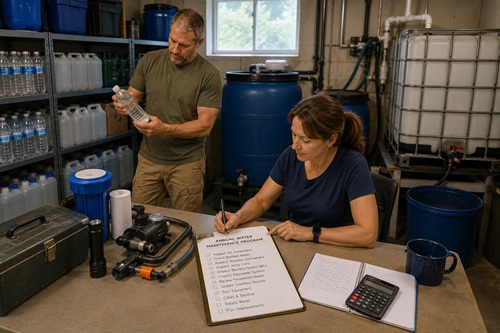
The next step involves reviewing household water requirements. Family size, medical needs, pets, gardening activities, or changes in lifestyle may increase or decrease daily water consumption over time. Comparing current storage capacity with updated household requirements ensures that preparedness goals remain realistic and appropriate. This annual review often identifies opportunities to improve storage rather than simply maintaining existing supplies.
Inventory records should then be updated to reflect any changes made during the inspection process. New containers, relocated storage areas, replacement equipment, or changes in renewable water systems should all be documented immediately. Accurate records simplify future maintenance while providing reliable information during emergencies.
Equipment testing forms another essential part of the annual program. Pumps, siphons, transfer hoses, water treatment equipment, valves, pressure regulators, and collection systems should all be operated under normal conditions. Equipment that functions properly during annual testing is far more likely to perform reliably when an emergency occurs.
Cleaning and sanitizing activities should also be incorporated into the maintenance schedule. Containers requiring routine rotation can be serviced according to household procedures, while rainwater collection equipment, gutters, first-flush diverters, and filters should be cleaned before seasonal weather changes affect their performance. Combining these tasks during one planned maintenance period improves efficiency while reducing the likelihood that important work will be overlooked.
Finally, use the annual review to identify future improvements. Preparedness is never truly finished. Every inspection offers an opportunity to strengthen the water system by adding portable containers, improving labeling, expanding renewable water collection, upgrading pumps, replacing aging equipment, or refining maintenance procedures. Continuous improvement, even in small increments, gradually transforms a basic water reserve into a highly dependable household water system capable of supporting emergencies of many different durations.
An annual maintenance program provides much more than clean containers and updated records. It creates familiarity with the equipment, reinforces preparedness habits, builds confidence in the storage system, and ensures that every member of the household understands how emergency water will be managed when it is truly needed.
Table 13 — Annual Water Maintenance Program
| Maintenance Activity | Recommended Frequency |
|---|---|
| Inspect all containers | Annually |
| Review household water requirements | Annually |
| Update inventory records | Annually or after major changes |
| Test pumps and dispensing equipment | Annually |
| Clean and sanitize containers as scheduled | During rotation |
| Inspect rainwater collection systems | Spring and Autumn |
| Review labeling and identification | Annually |
| Evaluate future improvements | Annually |
Integrating Water Rotation into Your Overall Preparedness Plan
Water rotation should never be viewed as an isolated maintenance task. Like every other aspect of preparedness, it functions most effectively when it becomes part of a coordinated household maintenance program that includes food storage, emergency medical supplies, backup power, communications, fuel storage, sanitation equipment, and emergency planning. Integrating these activities creates a preparedness system that remains dependable through regular attention rather than requiring large-scale efforts every few years.
Many households already perform routine maintenance throughout the year. Smoke detector batteries are replaced, furnaces are serviced, vehicles receive scheduled maintenance, and fire extinguishers are inspected. Emergency preparedness benefits from the same structured approach. Rather than creating a separate schedule solely for water rotation, many preparedness-minded families coordinate water maintenance with these existing household routines. This reduces the likelihood that important inspections will be overlooked while making preparedness feel like a normal part of home ownership rather than an occasional project.
Emergency food storage provides an excellent example of this integration. Dry foods, canned goods, freeze-dried meals, and emergency rations all require periodic inspection and rotation. Conducting food and water maintenance during the same annual preparedness review simplifies inventory management while ensuring that both systems continue supporting one another. Water and food are closely connected during emergencies, making coordinated maintenance both practical and efficient.
Medical preparedness also benefits from synchronized inspections. While reviewing water storage, households can inspect first aid kits, replace expired medications where appropriate, verify the availability of oral rehydration supplies, and confirm that distilled water required for medical equipment remains available if needed. These related tasks require little additional time yet significantly improve overall emergency readiness.
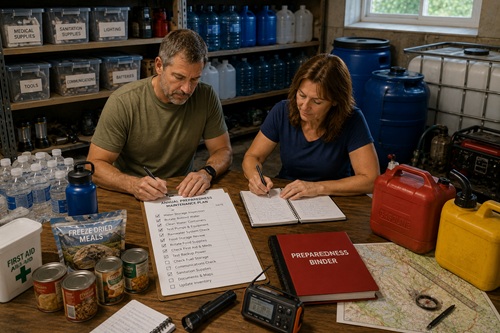
Backup power systems should also be included in the maintenance program. Portable generators, solar power stations, battery banks, transfer pumps, and electrically powered water purification equipment all support the household water system during extended emergencies. Testing these systems at the same time as water storage ensures that every component required to access, transfer, or treat water continues functioning correctly.
Communication equipment provides another opportunity for integration. Handheld radios, weather radios, satellite communicators, charging systems, and emergency contact information should all be reviewed alongside water supplies. Reliable communication allows households to monitor boil water advisories, emergency instructions, weather conditions, and infrastructure repairs while making informed decisions about water conservation and collection.
Fuel storage also deserves consideration. Vehicles, generators, pumps, chainsaws, and other emergency equipment may depend upon stored fuel to support water collection or transportation. Inspecting fuel containers, stabilizer schedules, and storage conditions during annual water maintenance ensures that supporting equipment remains operational if renewable water collection becomes necessary.
Household documentation should not be overlooked. Maps identifying nearby water sources, well records, pump manuals, maintenance logs, inventory sheets, purification instructions, and emergency contact information should all be reviewed periodically. Maintaining these records in a dedicated preparedness binder provides valuable reference material that remains available even during prolonged power outages.
Integrating preparedness maintenance also encourages participation from every member of the household. Instead of one person becoming solely responsible for every inspection, responsibilities can be divided according to experience, physical ability, and interest. One person may inspect storage containers while another updates inventories, tests pumps, or reviews emergency communications equipment. Shared participation builds familiarity with the preparedness plan while ensuring that critical knowledge is not limited to a single individual.
Perhaps the greatest benefit of an integrated maintenance program is consistency. Small, well-organized annual reviews are much easier to sustain than attempting to rebuild preparedness after years of neglect. Every inspection reinforces the habit of preparedness while identifying opportunities for continuous improvement. Over time, these routine activities transform emergency planning from a collection of supplies into a dependable household capability.
Preparedness is strongest when every system supports the others. Water storage, purification, transportation, food, medical supplies, communications, fuel, shelter, sanitation, and documentation all contribute to the resilience of the household. Integrating water rotation into this larger framework ensures that emergency water remains not only available but fully supported by the equipment, knowledge, and organization needed to use it effectively.
Table 14 — Annual Preparedness Maintenance Integration
| Preparedness System | Maintenance Activity |
|---|---|
| Water Storage | Inspect containers, rotate water, clean and sanitize as needed |
| Food Storage | Rotate inventory, inspect packaging, update inventory |
| Medical Supplies | Replace expired items, inspect equipment, review special medical needs |
| Communications | Test radios, replace batteries, update emergency contacts |
| Backup Power | Test generators, batteries, solar charging systems, and pumps |
| Fuel Storage | Inspect containers, verify stabilizer schedule, rotate fuel if required |
| Water Purification | Test filters, inspect treatment supplies, replace consumables |
| Documentation | Update inventories, maps, manuals, and emergency plans |
In Summary
Building a water rotation schedule is about much more than replacing stored water at regular intervals. It is a structured maintenance program that ensures every part of the household water system remains dependable, organized, and ready for immediate use whenever normal water supplies become unavailable. By understanding how water is stored, how containers age, and how storage conditions influence long-term reliability, households can develop maintenance routines that protect one of their most valuable preparedness resources.
A successful rotation schedule begins with organization. Clearly labeled containers, accurate inventory records, and practical inspection schedules eliminate uncertainty while making routine maintenance straightforward. Rather than relying on memory, households follow established procedures that ensure every container, pump, valve, and storage location receives regular attention.
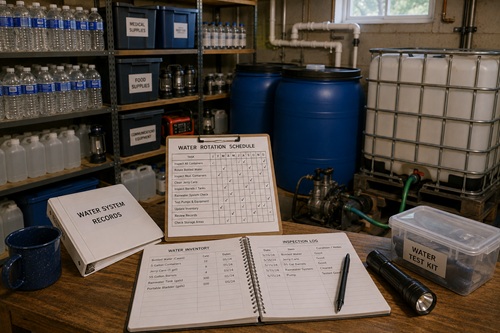
Water rotation should also be viewed as a gradual, continuous process rather than an occasional large-scale project. First In, First Out (FIFO) management, staggered inspections, and routine maintenance distribute the workload throughout the year while reducing waste and making preparedness easier to sustain. Smaller, consistent efforts generally produce more dependable results than infrequent, large replacement events.
Different storage systems naturally require different maintenance approaches. Commercially bottled water, modular containers, jerry cans, barrels, storage tanks, rainwater systems, and portable collection containers each contribute unique strengths to the overall preparedness plan. Understanding these differences allows maintenance to be tailored appropriately while ensuring every component continues performing its intended role.
Perhaps most importantly, water rotation should become part of a broader household preparedness program rather than existing as an isolated task. Coordinating water maintenance with food storage, medical supplies, communications, backup power, fuel storage, and emergency planning creates an integrated preparedness system that remains reliable through regular attention and continuous improvement.
When approached in this way, water rotation becomes much more than routine maintenance. It becomes an ongoing process that builds familiarity, reinforces preparedness habits, strengthens confidence, and ensures that clean drinking water remains available whenever it is needed. A well-maintained water system is not measured solely by the number of gallons stored, but by the confidence that every component has been inspected, maintained, and prepared for dependable service under emergency conditions.
Preparedness Action Plan
A dependable water rotation schedule is built through consistent maintenance rather than occasional large-scale efforts. The purpose of this action plan is to help you evaluate your current water storage system, organize routine maintenance, and establish habits that will keep your emergency water supplies reliable for many years. Work through each step methodically, recording your observations and making improvements where necessary. Even small changes completed consistently over time will significantly strengthen your household’s overall preparedness.
Begin by conducting a complete review of your current water storage system. Visit every location where emergency water is stored, including your home, garage, basement, workshop, storage sheds, vehicles, recreational equipment, and emergency kits. Verify that each container is intended for potable water storage, remains in good physical condition, and continues to meet the needs of your household. This review establishes a clear understanding of your current capabilities before any changes are made.
During the same inspection, confirm that every container has been properly identified. Fill dates, inspection dates, container identification numbers, and storage locations should all be clearly documented. Replace faded or damaged labels immediately so that every member of the household can quickly identify each container during both routine maintenance and emergency situations.
Table 15 — Initial Water Storage Assessment
| Assessment Item | Complete |
|---|---|
| All storage locations inspected | ☐ |
| Food-grade containers verified | ☐ |
| Container labels updated | ☐ |
| Inventory records reviewed | ☐ |
| Household water capacity confirmed | ☐ |
Next, evaluate your current rotation schedule. Determine whether inspections are occurring consistently or whether maintenance has become irregular over time. If no formal schedule currently exists, establish one that matches your household’s storage system and available time. The most effective maintenance schedule is one that can realistically be followed every year rather than an ambitious plan that quickly becomes difficult to maintain.
As you review your schedule, examine every storage container for signs of deterioration. Check for cracks, ultraviolet damage, bulging, damaged lids, worn gaskets, leaking valves, or other conditions that may affect long-term reliability. Containers requiring repair or replacement should be identified immediately so corrective action can be taken before an emergency occurs.
Table 16 — Container Inspection Record
| Container Type | Condition | Action Required |
|---|---|---|
| Bottled Water | ||
| Water Bricks | ||
| Jerry Cans | ||
| Water Barrels | ||
| IBC Totes / Tanks | ||
| Rainwater Containers |
After the physical inspection has been completed, review the equipment supporting your water storage system. Pumps, siphons, hoses, dispensing valves, water treatment supplies, rainwater collection equipment, and transfer accessories should all be tested under normal conditions. Equipment that has remained unused for several years often develops problems that are easily corrected during routine maintenance but may become significant during an actual emergency.
Once equipment has been verified, compare your current storage system with the layered approach discussed throughout this handbook. Confirm that your household maintains immediate drinking water, portable storage, long-term reserves, and practical methods for collecting and transporting renewable water. Any missing components should be incorporated into your long-term preparedness plan gradually rather than attempting to complete every improvement at once.
Table 17 — Layered Water System Review
| Storage Layer | Current Status | Planned Improvement |
|---|---|---|
| Immediate Drinking Water | ||
| Portable Storage | ||
| Long-Term Storage | ||
| Renewable Collection | ||
| Water Purification | ||
| Water Transportation |
Finally, establish an annual maintenance calendar that combines water rotation with the inspection of other preparedness systems. Coordinating water maintenance with emergency food, medical supplies, communications equipment, generators, fuel storage, and emergency documentation greatly reduces the likelihood that important maintenance tasks will be forgotten. Over time, these annual reviews become routine household activities that steadily strengthen overall preparedness.
Preparedness should never be viewed as a project that is eventually finished. Every inspection, inventory update, cleaning session, and equipment test provides an opportunity to improve the reliability of the entire system. Consistent attention, even in small amounts, produces a level of readiness that cannot be achieved through occasional large efforts alone.
Table 18 — Annual Maintenance Planner
| Annual Activity | Scheduled |
|---|---|
| Inspect all water containers | ☐ |
| Update inventory records | ☐ |
| Rotate water as required | ☐ |
| Clean and sanitize containers | ☐ |
| Test pumps and dispensing equipment | ☐ |
| Inspect rainwater collection system | ☐ |
| Review household water requirements | ☐ |
| Plan improvements for next year | ☐ |
Skills Learned
After completing this handbook, you should understand how a structured water rotation schedule supports the long-term reliability of your household emergency water system. You should be able to explain why water rotation is necessary, identify the factors that influence stored water quality, and recognize how storage conditions affect both containers and the water they protect.
You should also understand how different container types require different maintenance procedures. Commercially bottled water, modular storage containers, food-grade jerry cans, large barrels, storage tanks, IBC totes, and rainwater collection systems each have unique inspection and rotation requirements. By understanding these differences, you can maintain each part of your water storage system more efficiently while avoiding unnecessary work.
In addition, you should now be able to organize your emergency water system using container labels, inventory records, inspection schedules, and First In, First Out (FIFO) management principles. These organizational tools simplify long-term maintenance while ensuring that every member of the household understands how the storage system operates.
Finally, you should recognize that water rotation is only one part of a complete preparedness program. Integrating water maintenance with food storage, medical supplies, communications, backup power, fuel storage, and emergency planning creates a coordinated household preparedness system that remains dependable through regular inspection and continuous improvement.
By applying the principles presented throughout this handbook, you should now possess the practical knowledge needed to build, maintain, and confidently manage a household water rotation schedule capable of supporting both short-term emergencies and long-duration disruptions.
© Prepping Communities. This content is for informational purposes only and not professional advice. Use at your own risk.
Terms | Privacy | Guidelines