
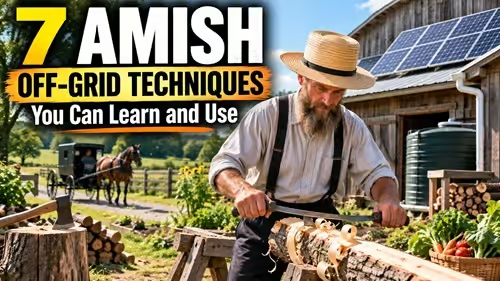
Practical Ways to Maintain Water, Power, Food, Heat, and Essential Capabilities Without Depending Entirely on the Grid
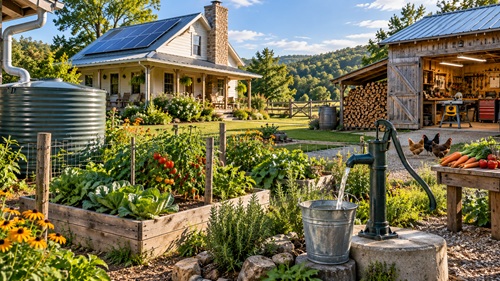
There is a useful preparedness lesson in looking at how Amish households and businesses approach everyday work. The lesson is not that everyone should abandon electricity or try to recreate an Amish lifestyle. It is that many tasks we automatically associate with grid electricity can be accomplished in other ways.
Water can move because of gravity or stored pressure. Tools can operate from compressed air. Heat that is already being produced can sometimes perform more than one job. Small electrical loads can be supported with batteries instead of trying to power an entire house. Food can be preserved so refrigeration is not the only thing standing between a household and food loss. Some foods normally purchased from a store can be produced locally. Most importantly, critical jobs can have a simpler fallback when the preferred system stops working.
That is the preparedness principle worth learning:
Do not begin by asking how to keep everything operating normally when the grid disappears. Begin by asking what capabilities actually need to continue and how many different ways you have to maintain them.
The following seven techniques are not meant to turn a modern home into an Amish farm. They are ways to rethink your own dependencies and build practical alternatives before you need them.
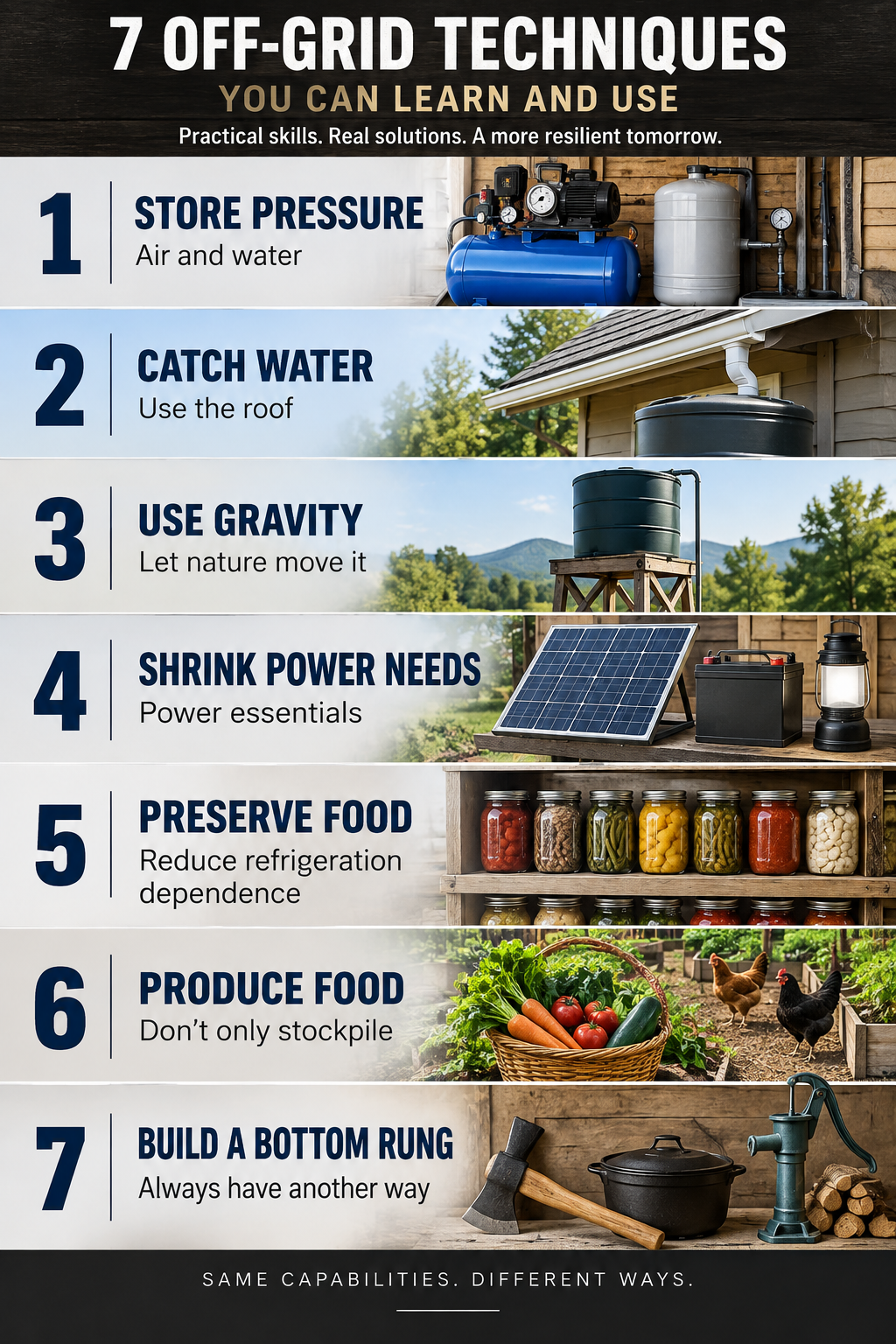
1. Use Stored Pressure and Compressed Air to Do Work
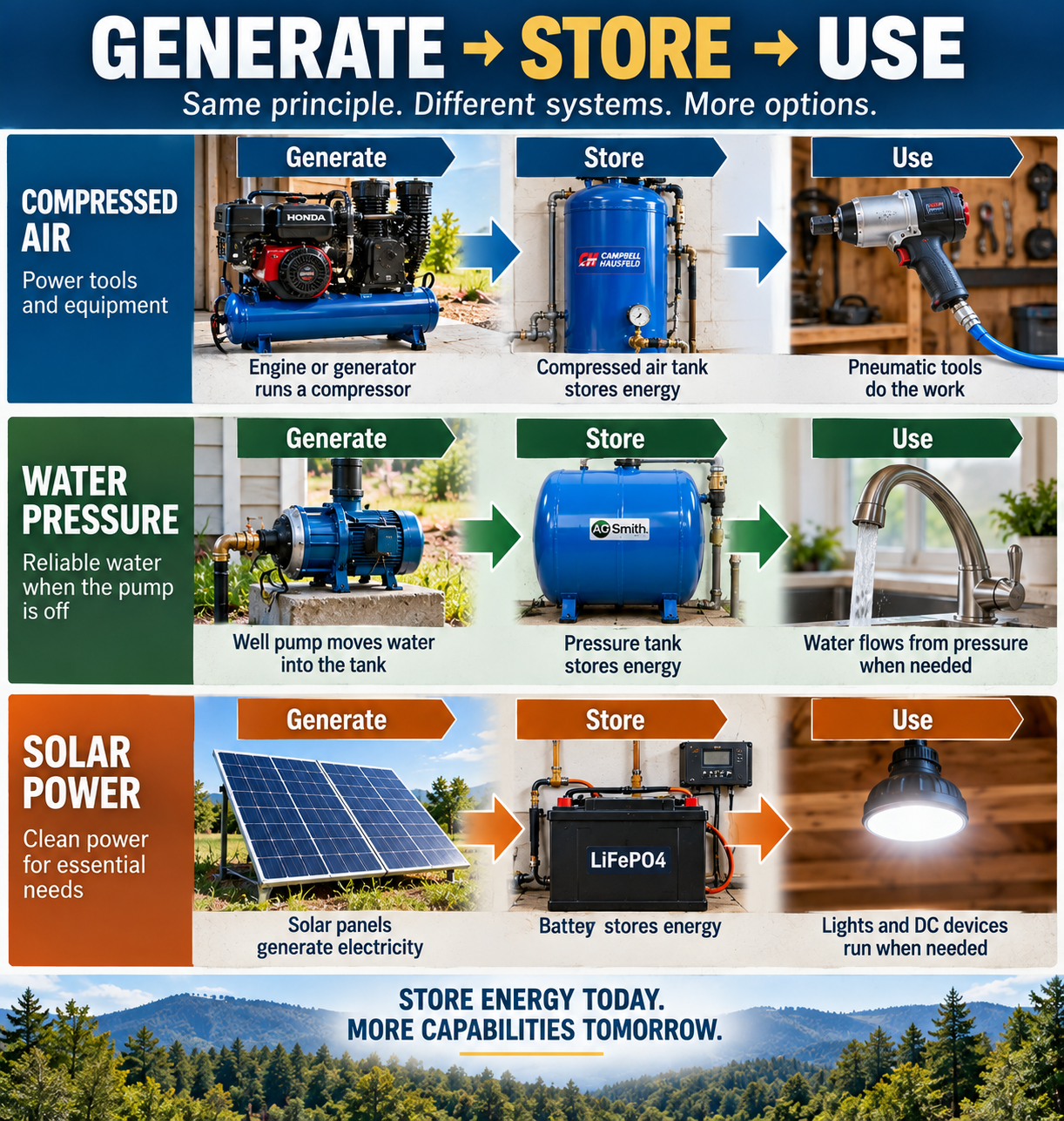
Electricity is not the only way to move a tool or machine. Compressed air and hydraulic pressure can also transmit energy. Some Amish workshops have developed extensive compressed-air and hydraulic systems that allow machinery to operate without conventional grid-connected electric motors at every workstation. The source describes workshops where a central engine supplies compressed air or hydraulic pressure that is distributed to equipment throughout the building.
The preparedness lesson is not that you should convert every appliance in your home to compressed air. It is to recognize that the energy source and the work being performed do not always have to be the same thing. A generator, engine, solar system, or other source can sometimes produce energy for storage, and that stored energy can then perform useful work after the original source has stopped.
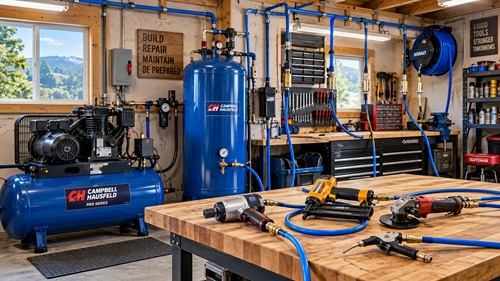
If you already own an air compressor, begin by looking at the tools you use for important maintenance and repairs. Pneumatic impact wrenches, nailers, inflators, ratchets, grinders, and other air tools can provide useful redundancy alongside electric tools. You do not need to replace everything. Start with equipment that would matter if you needed to repair a vehicle, maintain your property, or make an emergency repair during an extended outage.
The same principle appears in household water systems. A pressure tank stores energy by compressing air against water. The pump does not necessarily need to run every second a faucet is open because stored pressure continues moving water after the pump stops.
You can apply the principle by asking a simple question whenever you have a machine that normally runs continuously: Could I run the energy source periodically, store something useful, and then shut the source down?
That stored resource might be compressed air, pressurized water, battery charge, elevated water, or heat. Running equipment in efficient bursts can reduce fuel consumption and wear compared with keeping an engine running simply because one small load needs energy.
Compressed-air systems still require properly rated tanks, hoses, fittings, pressure regulators, relief devices, and maintenance. Never improvise pressure vessels from containers that were not designed for compressed air. Stored pressure contains considerable energy and deserves the same respect as electricity.
2. Catch Water Before You Need It
A house with a deep electric well can have an excellent water supply right up until the pump loses electricity. The water may still be underground, but getting it into the house becomes the problem.
Rainwater collection provides another possible layer of water resilience because gravity can collect the water without electricity. The source describes systems using roofs, gutters, filtration, cisterns, hand pumps, and elevated storage rather than relying exclusively on an electric well pump.
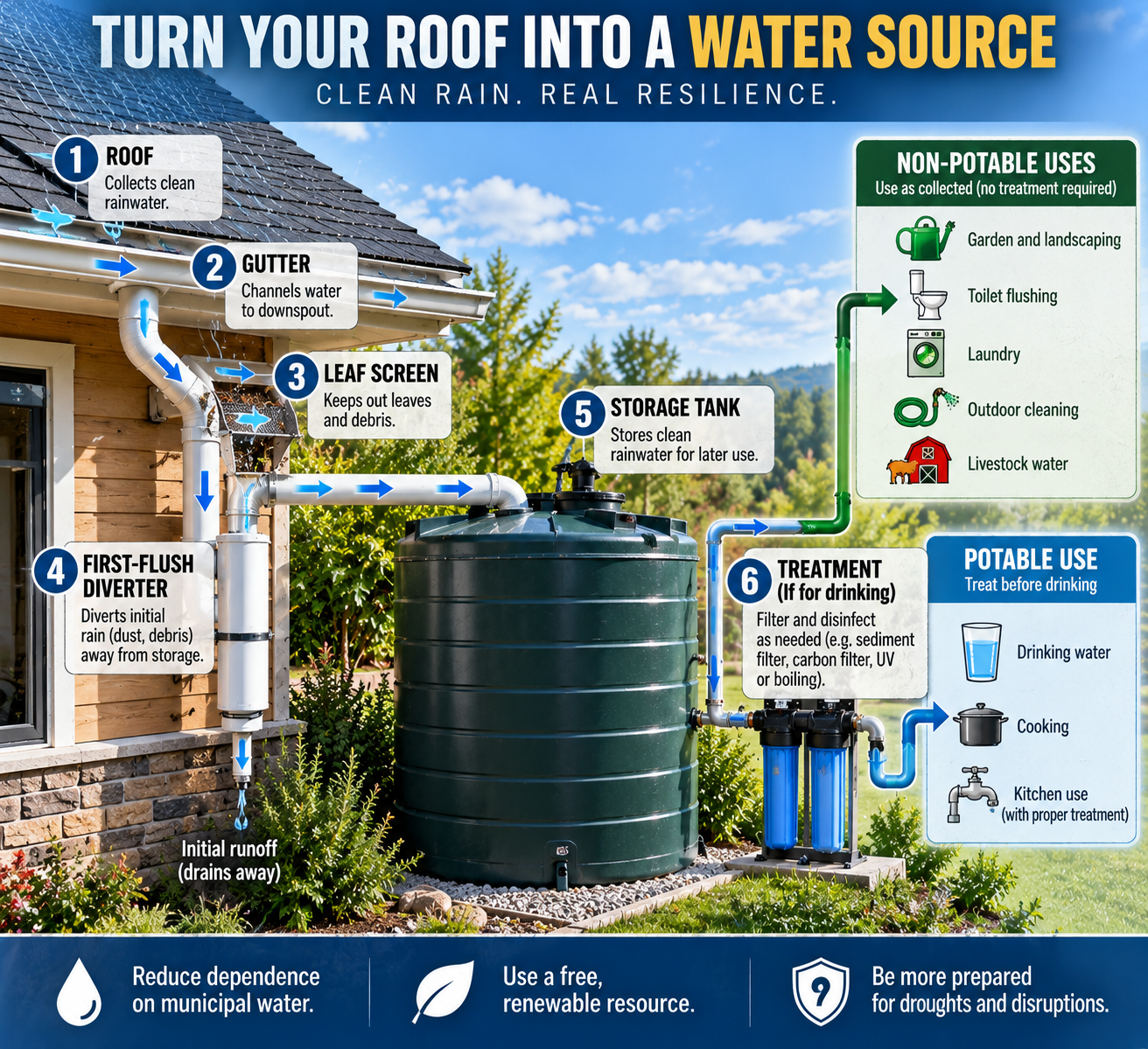
Start by looking at your roof differently. It is not simply keeping rain out of your house. It is also a large surface that concentrates rainfall into gutters and downspouts.
A basic preparedness system can begin with existing gutters feeding a suitable rainwater storage container. Install screening to keep large debris and insects out, and consider an appropriately designed first-flush system that diverts some of the initial runoff carrying dirt and debris from the roof.
Begin by using collected rainwater for non-potable purposes such as garden irrigation or cleaning while you learn how the system behaves. Watch how quickly the container fills during an ordinary rainfall and how quickly you use the stored water. That experience will tell you much more about your real storage needs than simply buying the largest tank you can afford.
If collected rainwater is intended for drinking, the requirements become more serious. Roof material, contamination, storage conditions, filtration, disinfection, local regulations, and other factors matter. Never assume roof water is safe to drink simply because it looks clear. Use an appropriate treatment method for potable water.
Storage is only half of the system. You also need a way to move the water when electricity is unavailable. A hand pump can provide direct access to suitable stored water. Where conditions permit, elevated storage can use gravity to create water flow without continuously operating a pump.
Be very cautious about putting large water tanks inside or above a house. Water is extremely heavy—approximately 8.3 pounds per U.S. gallon. A 50-gallon container therefore holds more than 400 pounds of water before the weight of the container itself is considered. Elevated tanks need appropriate structural support and safe plumbing.
The goal is not necessarily to replace your well or municipal water system. The goal is to make sure one failed electric pump does not eliminate every way you have to access water.
3. Let Gravity and Natural Circulation Move Water
Modern homes usually solve water movement by adding another electric pump. Older systems often took advantage of gravity, elevation, pressure differences, and natural circulation instead.
One example is a hydraulic ram pump. Where a property has an appropriate continuously flowing water source and sufficient elevation difference, a ram pump can use the energy of falling water to move a smaller portion of that water uphill without electricity or conventional fuel. The source describes this principle as water flowing downhill into the pump and creating pressure pulses that move some of the flow to a higher elevation.
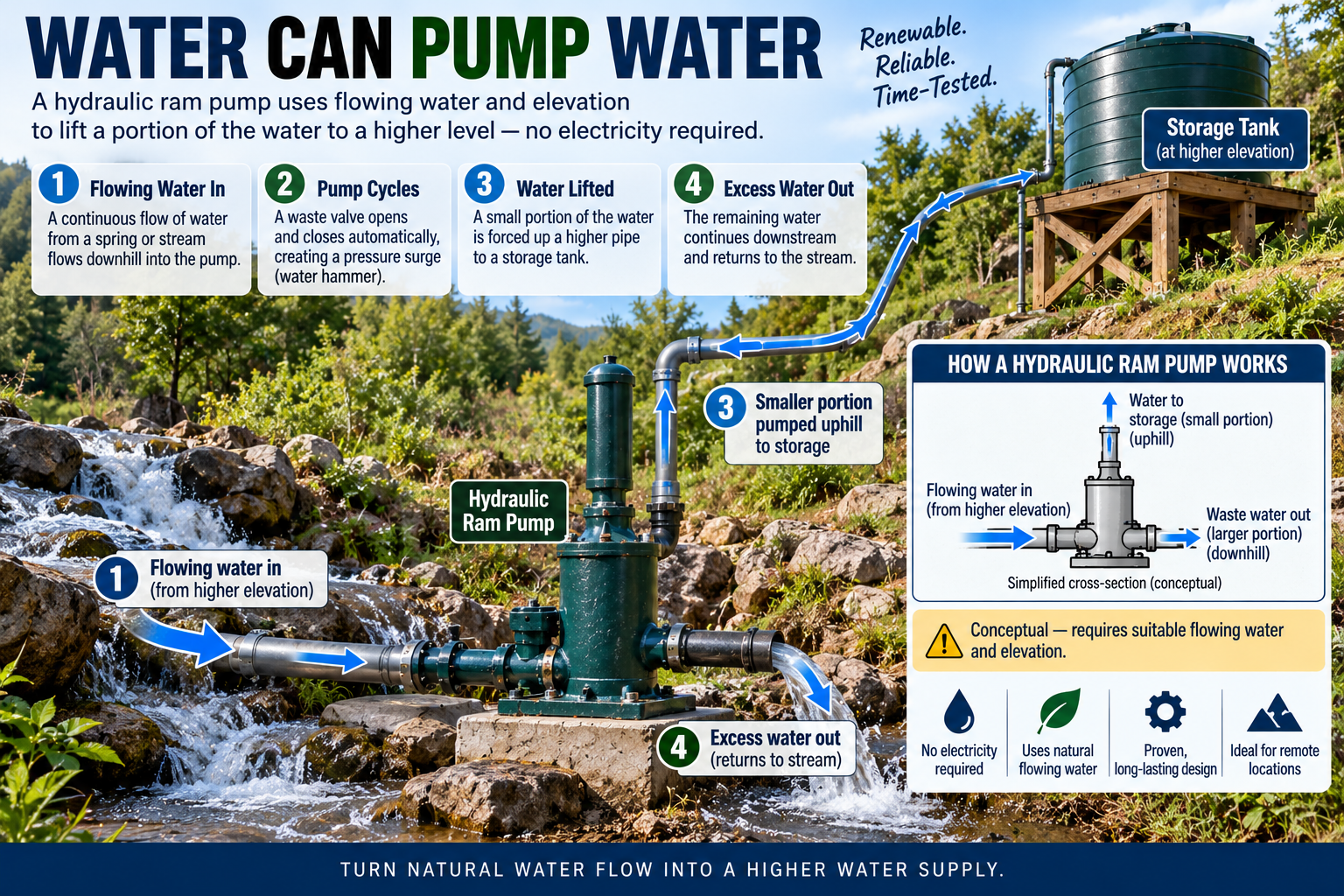
A ram pump is not appropriate everywhere. You need the right water source, elevation, flow, plumbing, and legal permission to use the water. But the principle is valuable even if you never install one: use the energy already present in your environment before adding another powered machine.
Gravity-fed water uses the same thinking. If suitable water is safely stored above the point where it will be used, gravity can move it downward without a pump. This can be useful for gardens, outdoor washing stations, livestock watering, emergency sanitation, and other applications.
Natural circulation can also move heated water. When water is heated, its density changes, and under the right system design this can create a circulation pattern known as a thermosiphon. Properly designed systems can use this effect to move heat without an electric circulation pump.
This does not mean running homemade coils through a fire and connecting them to a sealed water tank. Heated water in a closed system can produce dangerous pressure and steam. The source itself emphasizes the danger of trapping heated water without adequate expansion and pressure relief.
Instead, learn the principle and use professionally designed or appropriately engineered equipment if you want to incorporate thermosiphon water heating into your preparedness system.
For a beginner, the safest place to start is much simpler: identify where gravity can replace pumping around your property. A raised garden-water container, gravity-fed outdoor washing station, or properly supported non-potable water tank can teach the basic principle without creating a pressurized hot-water system.
4. Build a Small 12-Volt Survival Power Layer
One of the biggest mistakes in emergency power planning is trying to recreate the electrical grid inside your house.
A large generator gets connected and suddenly the goal becomes keeping refrigerators, freezers, televisions, lights, computers, pumps, appliances, and everything else operating as though nothing happened.
That consumes fuel quickly.
A different approach is to identify the smallest electrical layer that keeps the household functional.
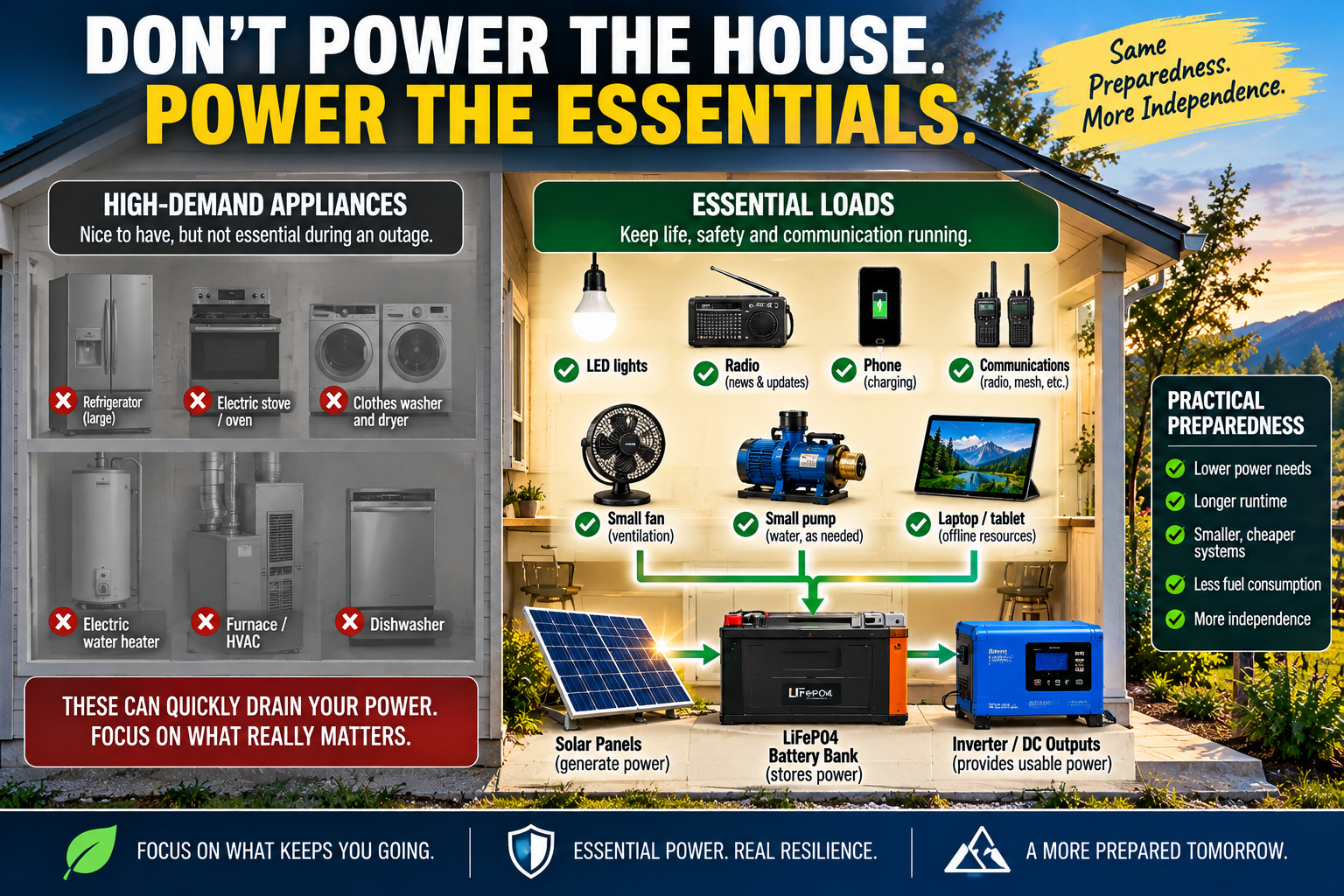
Lighting requires relatively little electricity when efficient LEDs are used. Radios, phones, communications equipment, small fans, USB devices, and some pumps can also operate from modest amounts of DC power. The source describes extensive use of 12-volt batteries and equipment for these kinds of smaller electrical jobs rather than trying to reproduce full household power.
You can build the same principle into your preparedness plan without copying an entire Amish electrical system.
Start by listing the electrical equipment you genuinely need during an outage. Separate it from equipment that is merely convenient.
Then identify which essential loads can operate from batteries or appropriate DC power. LED lighting, communications equipment, phone charging, radios, and certain pumps are good places to investigate.
A deep-cycle battery or LiFePO4 battery designed for repeated cycling is generally more appropriate for ongoing household loads than repeatedly draining a vehicle starting battery. Your vehicle’s starting battery has an important job already: starting the vehicle.
A properly designed solar charging system can provide another way to replenish the battery. A compatible vehicle charging arrangement or generator-powered charger can provide additional redundancy.
The important change is conceptual:
Do not ask, “How do I power my house?”
Ask:
“What is the minimum amount of electricity required to preserve the capabilities that matter?”
Once the electrical requirement becomes smaller, batteries and solar become dramatically more practical.
5. Preserve Food So the Freezer Is Not Your Only Plan
A freezer is extremely useful, but it creates a dependency. If electricity disappears long enough, the food inside eventually has to be cooked, preserved another way, or discarded.
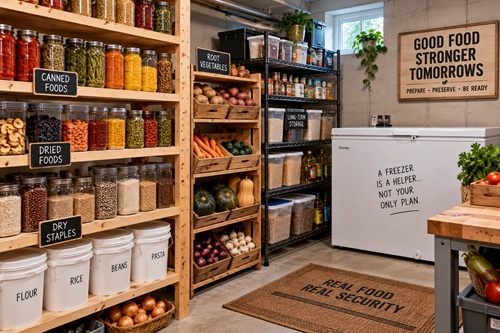
One way traditional households reduce that dependency is by storing more food in forms that do not require continuous refrigeration. The source discusses pressure canning, curing, smoking, rendering fat, cellar storage, and timing certain food-processing activities around colder weather.
For a modern prepper, pressure canning is one of the most useful skills to learn because it allows certain low-acid foods—including properly prepared meats and vegetables—to be preserved safely when tested procedures are followed.
This is not something to improvise.
Low-acid foods require pressure canning because temperatures achieved in ordinary boiling-water canning are not sufficient to control the botulism hazard. Use current tested instructions from authoritative food-preservation sources for the exact food, preparation method, jar size, canner, processing time, pressure, and altitude involved.
Practice while the grid is operating. Learn how your pressure canner works, how to inspect jars, how to prepare lids, how to vent the canner, how to maintain the required pressure, and how to recognize a proper seal.
Then look beyond canning. Dehydrating, fermenting, root-cellar storage, freezing, and other tested preservation techniques each solve different problems.
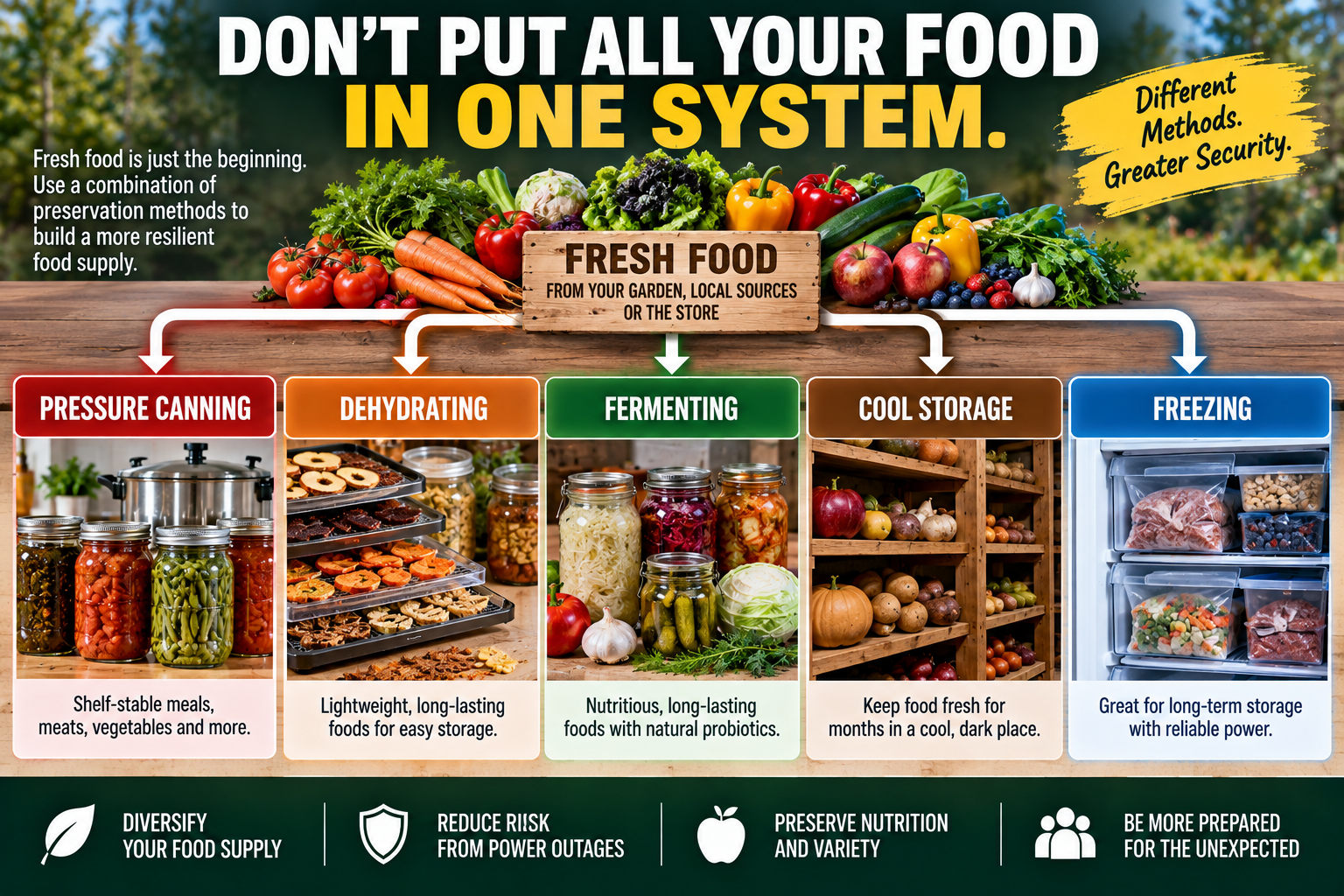
The preparedness objective is not to eliminate refrigeration. It is to make sure your entire food supply does not depend on one compressor continuing to run.
Also think about consumable supplies. Reusable jars may last for years, but conventional canning lids, seals, salt, spices, fuel, and other supplies can become limiting factors. Store the consumables required by the preservation methods you actually know how to use.
Most importantly, build the skill before you have hundreds of pounds of food that suddenly need to be saved.
6. Learn to Produce Something You Normally Buy
Preparedness discussions tend to focus heavily on storing food. Eventually, however, stored supplies are consumed.
Traditional self-reliant households also maintain the ability to produce important foods.
The source uses sweet sorghum and maple syrup as examples. In regions suitable for sorghum, the crop can be grown and its juice pressed and concentrated into syrup. In suitable maple-growing regions, sap can be collected seasonally and boiled into syrup.
The lesson is broader than sugar.
Look through your pantry and ask which foods you currently purchase but could potentially produce locally.
Maybe your answer is potatoes.
Maybe it is beans.
Maybe it is garlic.
Maybe it is eggs.
Maybe it is apples, berries, honey, maple syrup, herbs, or vegetables.
Choose one.
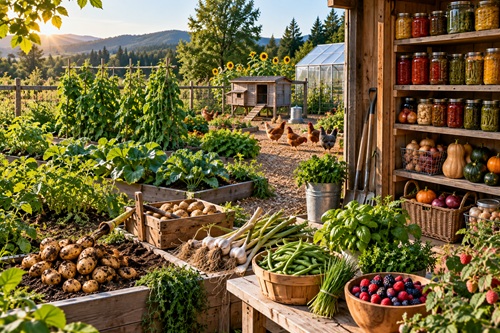
Learn how to produce it from beginning to end. Do not simply buy seeds and put them in storage. Grow the crop. Harvest it. Save some seed when appropriate. Process the harvest. Store it. Cook with it.
Then add another food.
Over time, you begin replacing a pantry that only stores calories with a household that also possesses some ability to produce calories.
That distinction becomes increasingly important the longer a disruption lasts.
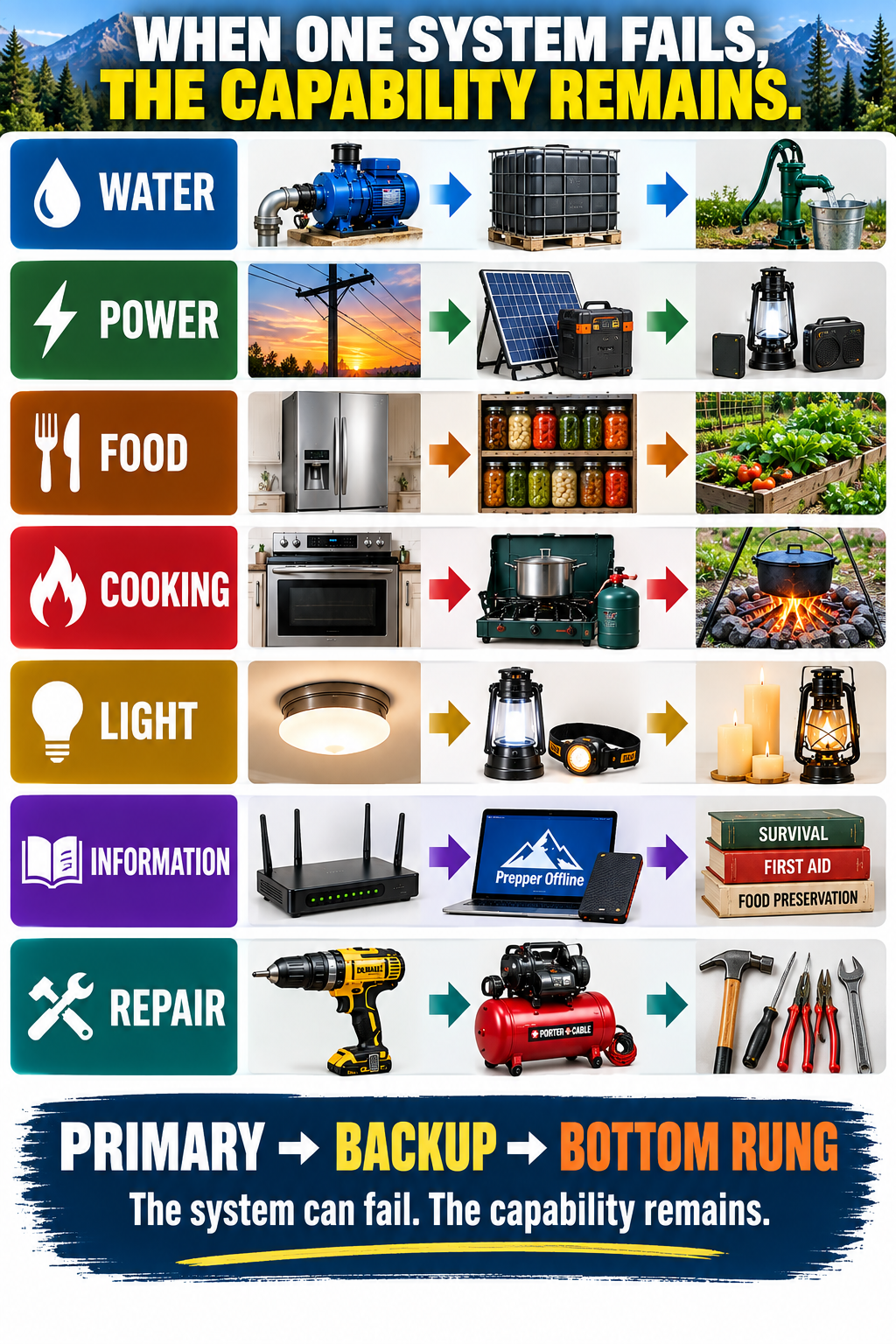
7. Give Every Critical System a Bottom Rung
This may be the most useful technique of all.
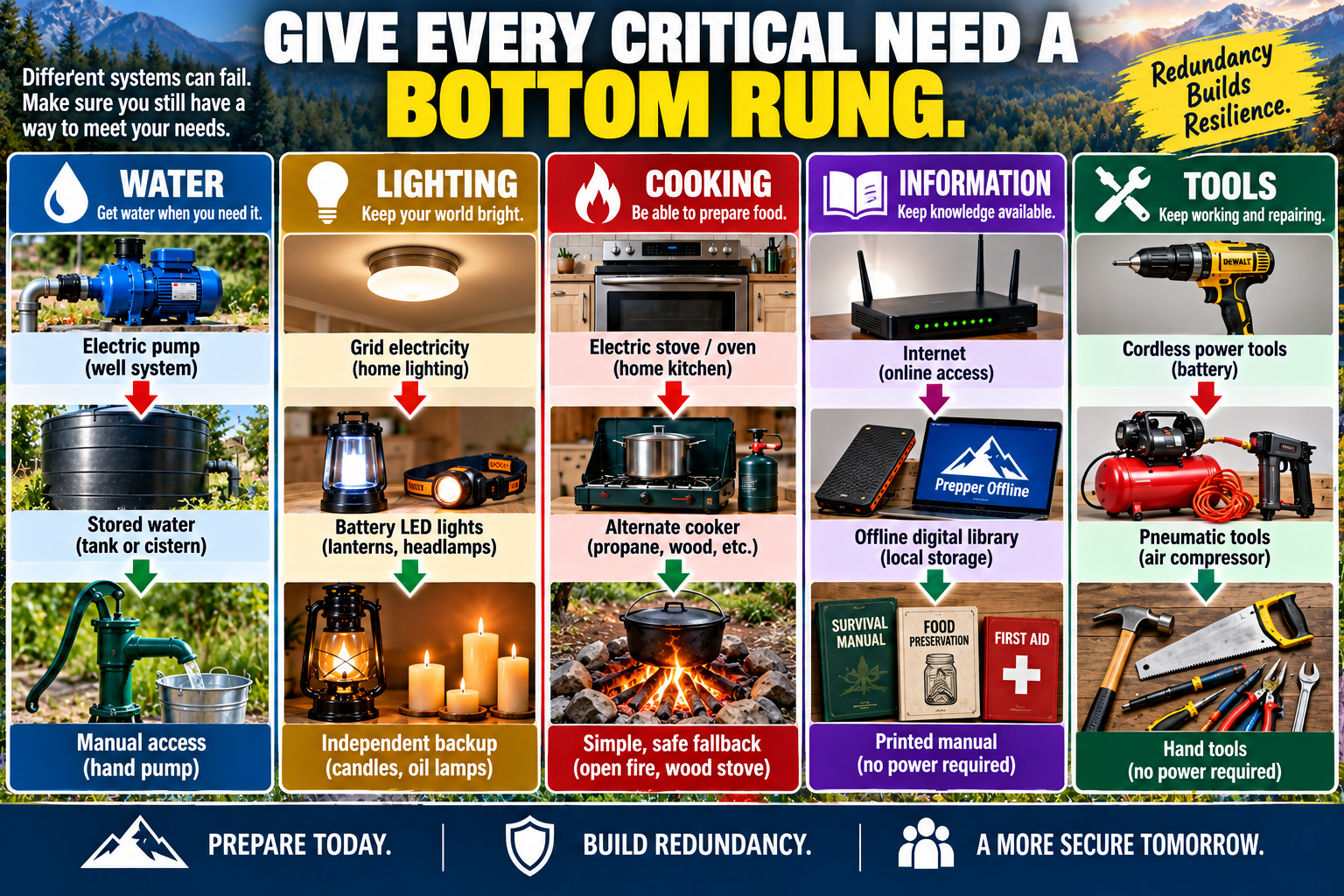
For every important capability in your household, identify what happens when the preferred method stops working.
If your well uses electricity, what is the next way you obtain water?
If your refrigerator stops, what happens to your food?
If your generator runs out of fuel, what provides lighting?
If your electric stove stops working, how do you cook?
If your power tools stop, what repairs can still be completed manually?
If the internet disappears, where is the information you need?
The source describes a similar principle: powered systems are useful, but important jobs often retain a simpler fallback—manual water access, hand-operated equipment, alternative lighting, or food storage that does not require continuous refrigeration.
Build that concept deliberately into your preparedness plan.
Your normal water system might be a well pump. The next rung could be stored water. Below that might be manually accessible water.
Your normal lighting might be household AC lighting. The next rung could be rechargeable LED lights. Below that might be another independent lighting method appropriate to your situation.
Your normal cooking method might be an electric range. The next rung might be a properly used outdoor propane stove. Below that could be another safe off-grid cooking method you have practiced.
Your normal information source might be the internet. The next rung could be locally stored digital information. Below that might be printed manuals and the knowledge already in your head.
Your normal tools might be cordless electric tools. The next rung might be pneumatic equipment where appropriate. Below that are hand tools.
The purpose of the bottom rung is not comfort.
It is continuity.
As resources disappear, your household may become slower and less convenient, but the essential capability remains.
Build Systems You Can Understand and Repair
There is another lesson running through all seven techniques: simple equipment is valuable partly because people can understand it.
A hand pump is visible. A gravity-fed tank is understandable. A manual can opener has very few mysteries. A basic pneumatic tool can often be disassembled. A garden can be replanted. A jar of properly preserved food does not require software to open.
That does not make modern technology bad. Modern equipment can provide extraordinary efficiency, safety, convenience, and capability.
The preparedness question is whether you understand enough about the systems you depend upon to recognize their failure points.
Start learning maintenance now.
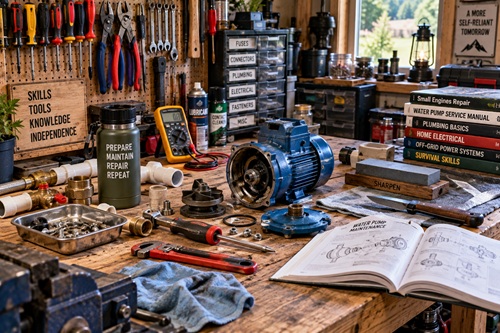
Know where your water shutoff is. Know how your pressure tank works. Learn basic plumbing. Learn basic DC electrical concepts. Learn how to sharpen tools. Learn how to repair simple equipment. Learn food preservation. Learn gardening. Keep manuals and diagrams available offline.
Equipment without knowledge creates another dependency.
Build Community Alongside the Equipment
There is one aspect of traditional self-reliance that cannot be purchased at a farm store: other people.
A household cannot realistically become expert at everything. One person may understand engines. Another may know livestock. Someone else may be an excellent gardener. Another may understand food preservation, carpentry, first aid, electrical systems, welding, or communications.
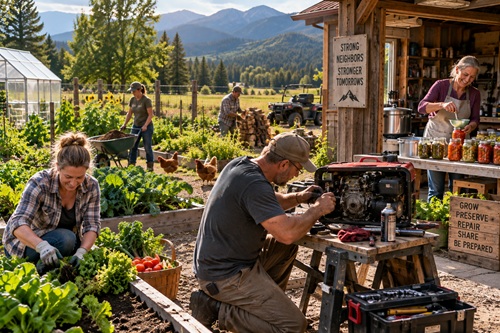
Long-term resilience becomes much stronger when those skills exist across a group rather than inside one person’s head.
Start building those relationships during normal conditions.
Meet the people around you. Learn who has useful skills. Help other people when you can. Share knowledge. Practice projects together.
A pressure canner is useful.
Knowing someone who has safely used one for twenty years can be even more useful.
Preparedness Action Plan
Walk through your home and identify the systems that provide water, food preservation, cooking, heat, lighting, communications, sanitation, and essential repairs. For each one, determine what currently makes it work and what would happen if electricity, fuel, replacement parts, or outside services disappeared.
Then choose one capability and build its next rung.
Add stored water and learn how you would access it without electricity. Build a small battery-powered lighting and communications system. Learn pressure canning using current tested procedures. Add useful hand tools. Begin collecting rainwater for appropriate non-potable uses. Grow one food you currently purchase. Learn how to maintain a piece of equipment instead of replacing it.
Do not try to build everything in a weekend.
Build one capability, practice it, understand it, and then move to the next.
Eventually your preparedness system begins changing from a collection of supplies into something much more valuable: a collection of capabilities that can continue working even when the systems around them do not.
Key Takeaways
The most useful lesson from Amish off-grid practices is not that modern technology should be abandoned. It is that important capabilities do not have to depend on a single technology.
Water can be collected and stored before it is needed. Gravity and pressure can move it. Energy can be stored instead of continuously generated. Small electrical loads can be separated from large ones. Food can be preserved without depending entirely on refrigeration. Some supplies can be produced instead of endlessly stockpiled.
Most importantly, every critical capability can have a simpler fallback.
Preparedness becomes much stronger when losing electricity, fuel, a pump, an appliance, a circuit board, an internet connection, or another convenience makes life slower rather than impossible.
That is the principle worth copying: build your life so the loss of one system does not mean the loss of the capability it provided.
© Prepping Communities. This content is for informational purposes only and not professional advice. Use at your own risk.
Terms | Privacy | Guidelines