
Why This Matters More Than Ever
Most people think they’re prepared because they have a stocked freezer, shelves of food, and maybe even a backup generator. But all of that depends on one fragile system – the electrical grid.
Take that away for a week, and everything changes.
Food spoils. Freezers fail. Supply chains stop. What looked like security turns into a countdown.
Real preparedness isn’t about how much food you have—it’s about whether you can keep that food usable without relying on systems outside your control.
For generations, people preserved food without electricity. These methods weren’t “survival tricks”—they were normal life. And they still work today.
The Hidden Weakness in Modern Food Storage
Modern storage methods rely on:
- Refrigeration
- Freezers
- Continuous power
- Stable supply chains
All of these can fail and when they do, they fail fast.
A power outage lasting a few hours is manageable. A week-long outage starts causing real losses. A long-term disruption means you either adapt… or you run out.
This is where older methods become critical. They don’t rely on power. They rely on process, materials, and understanding how food spoils.
The Core Principles Behind Food Preservation
Every preservation method works by controlling one or more of these:
- Moisture – Bacteria need water to grow
- Oxygen – Many spoilage organisms require air
- Temperature – Cooler slows decomposition
- pH levels – Extreme acidity or alkalinity kills microbes
- Barriers – Salt, fat, or ash block contamination
Once you understand this, you’re not just following instructions—you’re building your own system.
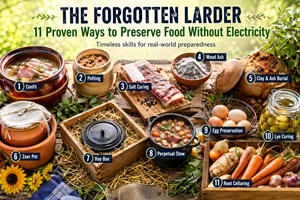
Preserving Meat in Fat (Confit Method)
One of the most reliable ways to store meat without refrigeration is by preserving it in its own fat.
The process is simple but powerful. Meat is salted, then slowly cooked in fat until tender. After cooking, it’s stored completely submerged in that same fat. Once the fat cools and solidifies, it forms a barrier that blocks oxygen and bacteria.
This method has been used for centuries and works extremely well when stored in a cool, dark place.
Practical example:
If you harvest multiple chickens at once, instead of freezing everything, you can preserve portions in fat and store them for later use.
A Faster Alternative: Potting
Potting is a simplified version of fat preservation.
Instead of slow cooking in fat, you cook the meat first, then pack it tightly into a container and pour melted fat over the top. Once it hardens, it seals the food.
This is a great method when you need something quick and effective without a long cooking process.
Salt Curing: One of the Oldest Methods
Salt has been used for thousands of years to preserve food. It works by pulling moisture out of meat, making it impossible for bacteria to survive.
You can dry cure meat with salt or use brine solutions depending on what you’re preserving.
Example uses:
- Jerky
- Salted fish
- Preserved pork
Salt is one of the most important prepper supplies for this reason alone.
Using Wood Ash for Preservation
Most people throw away wood ash—but it can be used to preserve food.
Clean hardwood ash creates an alkaline environment that bacteria and mold struggle to survive in.
Cheese can be buried in ash to extend its life significantly. Meat can also be stored this way when done properly.
The key is using clean, untreated hardwood ash only.
Long-Term Burial with Clay and Ash
This method combines multiple preservation techniques into one.
Food is packed in a mixture of ash, salt, and sometimes clay, then sealed and buried. The ash fights bacteria, the salt removes moisture, and the clay limits oxygen.
This creates a stable environment that can preserve food for extended periods.
Historically, this method was used in harsh environments where long-term storage was critical.
The Zeer Pot: A Simple Cooling System
The zeer pot is one of the simplest ways to extend the life of fresh food in hot climates.
It uses two clay pots, one inside the other, with wet sand in between. As the water evaporates, it cools the inner chamber.
It doesn’t freeze food, but it can dramatically extend the life of vegetables and fruits.
Example use:
- Keeping tomatoes fresh for days longer
- Preventing greens from wilting
The Hay Box: Cooking Without Fuel
The hay box is an overlooked tool that reduces fuel use while also helping preserve food.
Food is brought to a boil, then placed inside an insulated container filled with hay, blankets, or similar materials. The retained heat continues cooking the food slowly.
This is especially useful in fuel-limited situations.
The Perpetual Stew Concept
This is less about preservation and more about sustainability.
A pot of broth is kept warm continuously. Ingredients are added as needed, and portions are taken out for meals.
Nothing goes to waste, and food is always available.
This approach was used for centuries in inns and homes.
Preserving Eggs for Long-Term Use
Fresh eggs can be stored for months without refrigeration using sealing techniques.
The goal is to block air from entering the egg through the shell.
When done correctly, eggs can last far longer than most people expect.
Lye Curing: Advanced Preservation
Lye is a strong alkaline substance that can be used to preserve certain foods.
It’s commonly used for:
- Olives
- Corn (hominy)
This method requires caution, but it’s extremely effective.
Root Cellaring: Nature’s Refrigerator
A root cellar uses stable underground temperatures to store food.
Ideal conditions include:
- Cool temperatures
- Darkness
- Proper humidity
Foods that store well include:
- Potatoes
- Carrots
- Onions
This is one of the easiest systems to implement if you have the space.
Building a Complete Off-Grid Food System
The key is not relying on one method.
Instead, layer your approach:
- Use root storage for vegetables
- Use fat and salt for meats
- Use evaporation cooling for fresh foods
- Use continuous cooking methods when needed
Each method supports the others.
Real-World Example
Imagine a long-term outage:
- Your freezer fails
- Grocery stores are empty
- Fuel is limited
If you only rely on modern systems, you’re in trouble.
If you’ve built a layered system:
- Meat is preserved in fat or salt
- Vegetables are in a root cellar
- Fresh food is extended using a zeer pot
Now you’re not reacting—you’re operating.
Common Mistakes to Avoid
- Relying on only one preservation method
- Not practicing before you need it
- Using contaminated materials (especially ash or water)
- Ignoring storage conditions (temperature matters)
- Waiting too long to start learning
Why This Knowledge Changes Everything
These methods shift your mindset.
Instead of hoping the system holds, you become independent of it.
You gain:
- Food security
- Confidence
- Flexibility
- Real resilience
And the best part—most of these methods require very little equipment.
Final Thoughts
Modern convenience made these skills easy to forget.
But in a real disruption, convenience disappears fast.
What remains is knowledge.
Learning even a few of these methods puts you ahead of most people. Over time, combining them builds a system that can carry you through almost any situation.
You’re no longer just storing food.
You’re controlling your ability to keep it.
© Prepping Communities. This content is for informational purposes only and not professional advice. Use at your own risk.
Terms | Privacy | Guidelines