
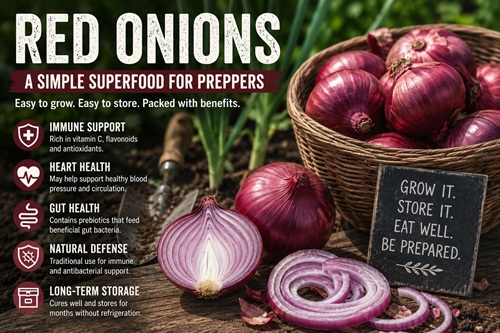
If you asked most gardeners which crops they couldn’t live without, you’d probably hear answers like tomatoes, potatoes, beans, or squash. Red onions rarely make the top of the list.
That’s surprising because red onions quietly do something that many other crops can’t. They’re easy to grow, they don’t require much space, they store for months, and they end up in almost every meal you make.
In a preparedness garden, that combination is hard to beat.
Many beginning gardeners focus on growing foods that produce large harvests. That’s important, but long-term food security isn’t just about calories. It’s also about flavor, nutrition, food preservation, and maintaining a healthy diet over time. After all, surviving on stored rice, beans, and canned food is one thing. Eating well month after month is something entirely different.
That’s where red onions shine.
The Forgotten Workhorse of the Garden
Most people don’t get excited about onions.
Nobody posts pictures of giant onion harvests the way they do with tomatoes or pumpkins. Yet experienced gardeners know that onions are one of the most useful crops they can grow.
Think about how many meals start with an onion.
Soups.
Stews.
Chili.
Roasts.
Sauces.
Stir-fries.
Egg dishes.
Casseroles.
Fresh salads.
The list goes on and on.
A well-stocked pantry becomes far more versatile when you have onions available. They add flavor, depth, and nutrition to foods that would otherwise be bland and repetitive.
During a long emergency or supply disruption, that matters more than most people realize.
Food fatigue is real. People eventually get tired of eating the same foods over and over again. A simple onion can transform a basic meal into something much more satisfying.
More Than Just Flavor
Red onions are often viewed as a seasoning vegetable, but they contribute much more than taste.
They contain:
- Vitamin C
- Several B vitamins
- Potassium
- Dietary fiber
- Prebiotic compounds that support gut health
Although onions won’t provide a large number of calories, they help create a more balanced diet.
This is an important preparedness lesson.
Many emergency food plans focus heavily on calories and shelf life while overlooking nutrition. Over time, nutritional deficiencies can become a serious concern.
A preparedness garden shouldn’t simply produce food.
It should produce health.
Why Red Onions Stand Out
All onions provide nutritional value, but red onions contain particularly high levels of plant compounds known as flavonoids.
One of the most studied is quercetin.
Quercetin is a naturally occurring antioxidant found in many fruits and vegetables. Researchers continue to investigate its role in supporting normal inflammatory responses and protecting cells from oxidative stress.
While headlines often exaggerate the benefits of antioxidants, most health experts agree that consuming a wide variety of colorful fruits and vegetables is beneficial for long-term health.
Red onions fit perfectly into that strategy.
The darker the outer layers, the more of these compounds they typically contain.
This is one reason many gardeners choose to grow red onions alongside traditional yellow and white varieties.
A Crop Built for Preparedness
What truly makes red onions valuable from a prepper’s perspective isn’t their nutritional profile.
It’s their storage capability.
Many garden crops require immediate consumption, freezing, dehydration, or canning.
Onions are different.
Once properly harvested and cured, many varieties can remain usable for months.
No electricity.
No freezer.
No pressure canner.
No special equipment.
Just proper storage conditions.
For anyone concerned about power outages, supply chain disruptions, or emergency food security, this is a major advantage.
A successful onion harvest in late summer can continue providing food deep into winter.
The Hidden Benefit: Gut Health
Modern research increasingly points toward the importance of maintaining a healthy digestive system.
Inside the digestive tract live trillions of beneficial microorganisms that help process food and support normal bodily functions.
Red onions contain natural prebiotic fibers that feed these beneficial bacteria.
Unlike probiotics, which introduce beneficial bacteria directly, prebiotics help existing beneficial bacteria thrive.
This makes onions one of several preparedness foods that support long-term wellness while also contributing to food security.
Healthy people are more resilient.
Preparedness isn’t just about storing supplies.
It’s also about maintaining the physical condition needed to use them.
Easy to Grow, Even for Beginners
One reason onions have remained popular for centuries is that they don’t demand constant attention.
They can be grown in:
- Backyard gardens
- Raised beds
- Containers
- Greenhouses
- Small urban plots
Unlike some crops, onions generally experience fewer problems with insects and disease.
They’re also forgiving.
Even gardeners with limited experience can often produce respectable harvests during their first growing season.
For preppers trying to increase self-sufficiency, onions provide one of the easiest ways to gain confidence as a food producer.
Storing Red Onions for the Long Term
A harvest is only valuable if you can preserve it.
Fortunately, onions are among the easiest vegetables to store.
After harvesting, allow the bulbs to cure in a dry, well-ventilated location.
Once the outer layers have dried and the necks have tightened, they can often be stored in:
- Root cellars
- Cool basements
- Pantries
- Storage sheds
- Cold rooms
Proper airflow is important.
Many experienced gardeners store onions in mesh bags, crates, or braided bundles to maximize ventilation.
Under good conditions, certain varieties can remain usable for several months.
One of the Most Versatile Foods You Can Grow
Few garden crops are used as frequently as onions.
They can be:
- Eaten raw
- Cooked
- Roasted
- Pickled
- Dehydrated
- Fermented
- Added to soups and stews
- Mixed into sauces and marinades
This versatility increases their value in any preparedness plan.
A crop that can be used in dozens of different ways is often more valuable than a crop that serves only one purpose.
Final Thoughts
Preparedness is often about identifying simple solutions that provide multiple benefits.
Red onions do exactly that.
They’re easy to grow.
Easy to store.
Nutrient-rich.
Inexpensive.
Versatile.
And they help transform basic food supplies into meals people actually enjoy eating.
When people talk about preparedness crops, they often focus on the obvious choices. Potatoes, corn, beans, and squash deserve their reputation.
But if you’re building a garden designed for resilience, self-reliance, and long-term food security, don’t overlook the humble red onion.
It may never be the star of the garden.
But when the pantry is running low and every meal matters, you’ll be glad you planted them.
© Prepping Communities. This content is for informational purposes only and not professional advice. Use at your own risk.
Terms | Privacy | Guidelines