
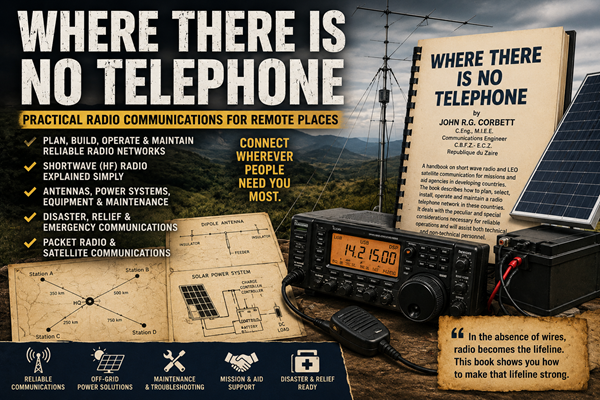
Where There Is No Telephone by John R.G. Corbett is one of the most comprehensive practical communications handbooks ever written for organizations operating in remote areas without reliable telecommunications infrastructure. Originally written for missionaries, aid agencies, humanitarian organizations, and rural development projects in Africa and other developing regions, the book provides detailed guidance on planning, building, operating, and maintaining radio communication networks where conventional telephone systems are unavailable or unreliable.
The handbook focuses primarily on HF (High Frequency) shortwave radio communications, explaining how radio waves travel, how the ionosphere affects long-distance communication, frequency selection, propagation prediction, antenna design, radio installation, network planning, maintenance, troubleshooting, and operator procedures. One of its strengths is that it is written for both technical and non-technical readers, making complex radio concepts understandable to field personnel with limited communications experience.
A substantial portion of the book is devoted to practical field implementation. It explains how to design radio networks connecting isolated villages, mission stations, clinics, schools, relief centers, and headquarters locations. Topics include antenna construction, radio licensing, equipment selection, solar-powered radio systems, battery charging, generators, power management, emergency communications, network discipline, message handling, and preventative maintenance. The book repeatedly emphasizes reliability, simplicity, and self-sufficiency in locations where technical support may be hundreds of miles away.
The handbook is particularly valuable from a preparedness perspective because it includes extensive sections on off-grid power systems, including solar panels, batteries, charging systems, pedal-powered generators, backup power, and communications during disasters. Later chapters cover disaster and relief communications, packet radio, satellite communications, and methods for maintaining communications when normal infrastructure has failed.
For preparedness-minded readers, the book provides a practical bridge between modern emergency communications and older, highly resilient radio technologies that continue to function independently of cellular networks, internet infrastructure, and conventional telephone systems.
© Prepping Communities. This content is for informational purposes only and not professional advice. Use at your own risk.
Terms | Privacy | Guidelines