
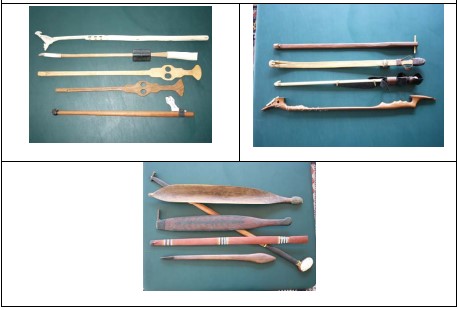
Weapon Trials: The Atlatl and Experiments in Hunting Technology is a scholarly paper by John Whittaker of Grinnell College, written in 2005 for a volume on experimental archaeology. The paper examines the history, archaeology, mechanics, and experimental study of the atlatl (spear thrower)—a prehistoric hunting weapon that predates the bow and arrow. The author reviews over a century of archaeological and experimental research into how atlatls worked, how effective they were, and how archaeologists identify them in the archaeological record.
The paper explains that much of what archaeologists know about prehistoric hunting technology comes from fragmentary remains such as stone projectile points. Because complete hunting systems rarely survive, experimentation has played a major role in understanding how atlatls functioned and how they compare to bows and arrows. The article discusses ethnographic observations from Australia, the Arctic, and the Americas, along with archaeological discoveries from Europe and North America.
A major focus is the debate over the mechanics of the atlatl. The author reviews competing theories including the lever-action model, extended-force model, and flexing-spring model. Drawing on experimental data and high-speed photography, the paper argues that the atlatl primarily functions as a lever that increases projectile velocity through wrist motion rather than through spring-like flexing of the thrower itself. The paper also examines long-standing debates over bannerstones (stone weights often associated with atlatls), their purpose, and whether they improved performance.
The latter sections analyze the strengths and weaknesses of experimental archaeology itself. Whittaker argues that experiments are essential but often difficult to interpret because of human variation, differences in equipment, environmental conditions, and small sample sizes. The paper concludes that while experimentation cannot perfectly recreate prehistoric behavior, it provides valuable insight into ancient technology and helps archaeologists interpret archaeological evidence more realistically.
© Prepping Communities. This content is for informational purposes only and not professional advice. Use at your own risk.
Terms | Privacy | Guidelines