
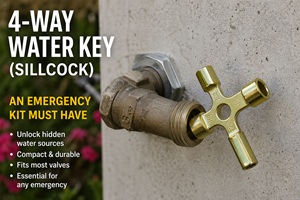
Why a 4-Way Water Key (Sillcock) Belongs in Every Emergency Kit
Why This Small Tool Matters
When people think about water preparedness, they think big—barrels, tanks, filtration systems, wells.
But in a real-world emergency, especially a fast-moving, localized event, access to water often comes down to something much simpler:
Can you physically turn on a water source that others can’t?
That’s where a 4-way water key—also known as a sillcock key—becomes one of the most underrated tools you can own.
It’s small, cheap, and almost invisible in most prep kits… but it can give you access to water in places where most people walk right past it.
What Is a 4-Way Water Key?
A 4-way water key is a compact metal tool designed to open commercial-grade outdoor water valves that don’t have handles.
You’ve probably seen these without realizing it:
- Outside buildings
- On schools
- Behind restaurants
- On commercial properties
- Near maintenance areas
They usually look like a short pipe sticking out of a wall—no handle, no knob.
That’s intentional.
Without the proper key, they’re unusable.
Why These Valves Exist
These handle-less faucets are designed to:
- Prevent unauthorized use
- Reduce vandalism
- Limit water theft
- Control access to maintenance water
But during an emergency, that same restriction becomes an opportunity—if you have the right tool.
What the “4-Way” Means
Most sillcock keys include four different socket sizes, typically:
- 1/4 inch
- 9/32 inch
- 5/16 inch
- 11/32 inch
Why? Because different buildings use different valve stems.
Instead of carrying multiple tools, one key fits most.
Real-World Scenarios Where This Tool Shines
This isn’t a “grid-down fantasy” tool—it’s useful in real, everyday emergencies.
Scenario 1: Evacuation Delay
You’re stuck in traffic during an evacuation. It’s hot, and you’re running low on water.
Nearby buildings have external valves—but no handles.
With a sillcock key, you can access water quickly.
Scenario 2: Urban Water Access
Power is out. Stores are closed. Supply chains are disrupted.
You find a commercial building with an exterior valve.
Most people ignore it.
You don’t.
Scenario 3: Wildfire or Heat Event
Hydration becomes critical.
Even a small amount of accessible water can make a difference.
Scenario 4: Vehicle Breakdown
Stranded roadside. No immediate help.
Nearby structures may have water—but only if you can access it.
Why Most People Don’t Have One
Simple:
- They don’t know it exists
- It’s not marketed heavily
- It doesn’t look important
But experienced preppers know:
The smallest tools often solve the biggest problems.
How to Use a Sillcock Key
Using it is simple:
- Identify the valve stem
- Choose the correct socket size
- Slide it onto the stem
- Turn counterclockwise to open
- Turn clockwise to close
That’s it.
No learning curve.
What Kind of Water Are You Accessing?
This is important.
Water from these sources is often:
- Potable (drinking water), but not guaranteed
- Connected to building supply lines
Always treat or filter before drinking if unsure.
Pairing This Tool With Other Gear
The sillcock key becomes far more powerful when paired with:
- Water bottles or containers
- Collapsible jugs
- Portable filters
- Purification tablets
It’s not just about access—it’s about making that access usable.
Where to Store It
This tool is small enough to keep anywhere:
- Bug-out bag
- Vehicle kit
- Work desk
- Everyday carry pouch
Best practice: keep at least two—one in your main kit, one in your vehicle.
Weight, Size, and Cost
- Weight: a few ounces
- Size: fits in your palm
- Cost: typically under $15
This is one of the highest value-to-cost tools you can own.
Limitations You Need to Understand
This tool is powerful—but not magic.
It Won’t Work If:
- Water is shut off entirely
- System pressure is gone
- Pipes are damaged
It May Be Restricted:
- Some newer buildings use different valve types
- Certain areas may have security systems or covers
Legal and Ethical Considerations
Be smart here.
Using a sillcock key:
- May be restricted in some areas
- Should only be used in legitimate emergency situations
This isn’t about abusing access—it’s about having options when you need them most.
Practice Before You Need It
Don’t wait until an emergency to try it.
- Find a legal, accessible valve
- Test your key
- Learn how it feels
That confidence matters under pressure.
How This Fits Into a Bigger Water Strategy
This tool is not your primary water plan.
It’s a gap-filler.
Your full strategy should include:
- Stored water
- Filtration
- Collection methods
- Redundancy
The sillcock key adds:
unexpected access
Why This Is a Prepper-Level Tool
Anyone can store water.
But fewer people think about:
- Accessing hidden infrastructure
- Solving problems creatively
- Using small tools for big advantages
That’s the difference between casual prep and real preparedness.
Common Mistakes
- Assuming all water is safe to drink
- Not carrying containers
- Forgetting to close valves after use
- Not testing the tool beforehand
Real Advantage: Speed
In an emergency:
- Time matters
- Decisions matter
- Access matters
This tool gives you instant capability where others hesitate.
Final Thoughts
The 4-way water key is one of those tools that:
- Costs almost nothing
- Takes up no space
- Gets overlooked by most people
But in the right situation, it can mean:
- Hydration
- Mobility
- Survival
You don’t need a massive system to improve your preparedness.
Sometimes…
you just need the right key.
Quick Checklist
Add this to your kit:
- ✔ 4-way sillcock key
- ✔ Water container
- ✔ Filter or purification method
- ✔ Backup storage
© Prepping Communities. This content is for informational purposes only and not professional advice. Use at your own risk.
Terms | Privacy | Guidelines