
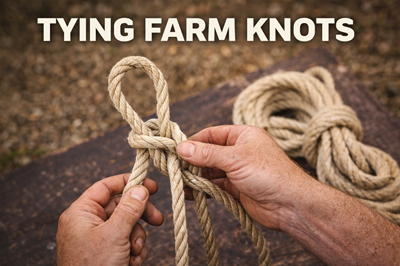
This publication, titled “Tying Farm Knots”, is a practical, hands-on guide focused on essential rope skills used in farming, livestock handling, and everyday utility tasks. As explained on page 1, rope is one of the most common tools used to restrain animals, yet many people never learn the most effective knots for different situations. The guide aims to correct that by teaching simple, reliable knots that can be applied immediately in real-world scenarios.
The manual begins by introducing basic knots and rope fundamentals, including the parts of a rope and foundational knots like the overhand knot, square knot, and the often-mistaken granny knot (page 1). The diagrams clearly show the differences between these knots, reinforcing how proper technique impacts strength and reliability. This section builds a strong base, emphasizing that even simple knots can serve critical purposes such as preventing rope fraying or securely joining two lines.
From there, the guide moves into more functional and specialized knots used in farm work. On page 2, it introduces knots like the bowline, which creates a non-slip loop ideal for securing animals, and the surgeon’s knot, which provides extra friction when tying under tension. The “rabbit in the hole” analogy used for the bowline helps make the technique easy to remember, highlighting the guide’s practical teaching approach. These knots are not just theoretical—they are chosen specifically for reliability, safety, and ease of use in demanding conditions.
The next section (page 3) focuses on quick-release and high-control knots, such as the quick-release knot and double half hitch. These are especially important when working with animals, where being able to quickly release a rope can prevent injury. The diagrams illustrate how these knots are tied around posts or fences, showing real-world applications like securing livestock while still maintaining control and safety.
The latter part of the guide expands into building and repairing rope equipment, including detailed instructions for making a rope halter (pages 4–6). It walks through selecting the correct rope size, finishing rope ends to prevent unraveling, and step-by-step halter construction. The diagrams on these pages show how loops, splices, and knots come together to form a functional piece of equipment, turning basic rope into a reliable tool for handling animals.
Overall, this PDF is a highly practical skill guide that teaches essential rope techniques for farming, homesteading, and survival situations. For preppers, it provides a critical capability: the ability to secure loads, control animals, build equipment, and solve problems using nothing more than rope and knowledge. It’s a simple but powerful skill set that can make a significant difference in both everyday tasks and emergency scenarios.
Working with Heifers
Tying Farm Knots
© Prepping Communities. This content is for informational purposes only and not professional advice. Use at your own risk.
Terms | Privacy | Guidelines