
What You Actually Need to Know
When cell phones work, communication is easy. We call, text, send locations and check messages without giving much thought to everything happening behind the scenes. Cell phones depend on towers, electricity, network connections and equipment outside our control. Most of the time that’s fine. During a major emergency, prolonged power outage or network failure, it can become a weakness.
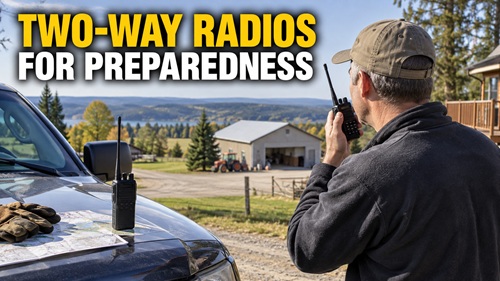
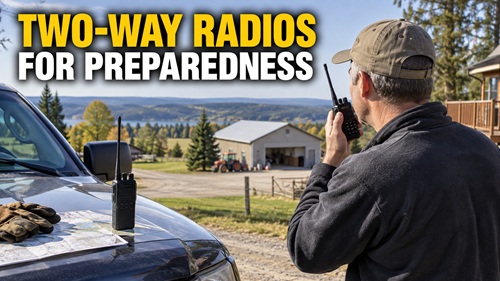
Two-way radios give you another option. They won’t replace cell phones, and they certainly don’t provide unlimited range, but they can allow people to communicate directly without depending entirely on cellular or internet service. That’s useful for a family, neighborhood group, farm, rural property, convoy of vehicles or preparedness group trying to stay in contact when normal communications aren’t reliable.
Buying radios is the easy part. The more important question is whether the people who have them can actually communicate when they need to.
Before buying more equipment, think about what you’re trying to accomplish. Keeping in touch between the house and workshop is very different from communicating several kilometers down a rural road. Talking between vehicles presents another situation. So does communicating through a neighborhood filled with houses and buildings. Hills, trees and valleys change things again.
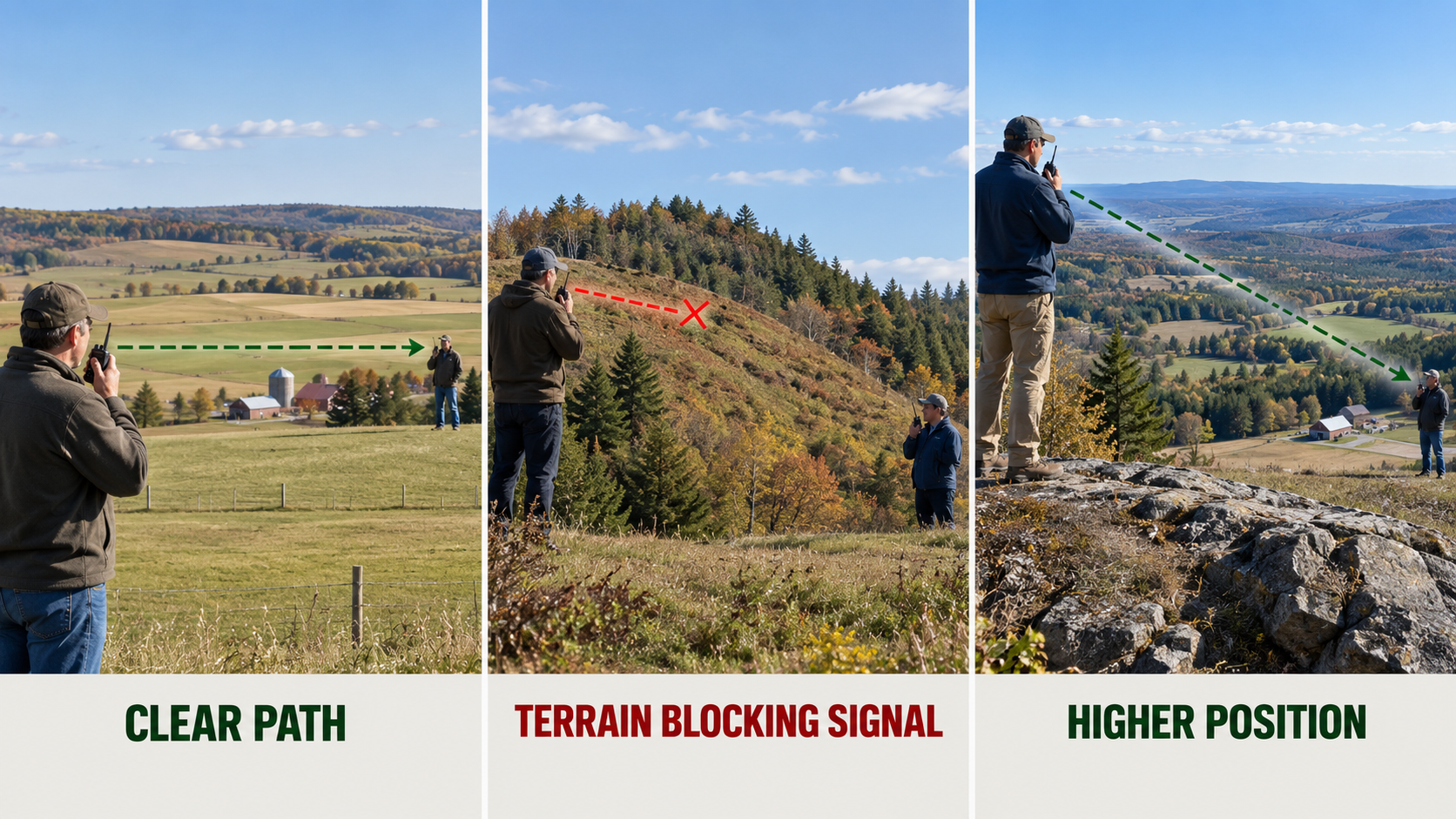
Radio performance depends on more than the number printed on the package. Frequency, transmitter power, antenna, terrain, buildings, vegetation, elevation and even where you’re standing can affect whether another person hears you. VHF radios are commonly useful in more open outdoor environments, while UHF is widely used where buildings and other obstacles are involved, although real-world conditions can make either situation more complicated.
This is why advertised range shouldn’t be treated as the distance you’ll automatically get at home. Two people may communicate perfectly across several kilometers of open country and then struggle over a much shorter distance when a hill sits between them.
Imagine testing two radios around a rural property. Communication between the house and barn is perfectly clear. Someone goes into the basement and suddenly the signal becomes scratchy. Later, one person drives down the road and everything works fine until the vehicle disappears behind a ridge.
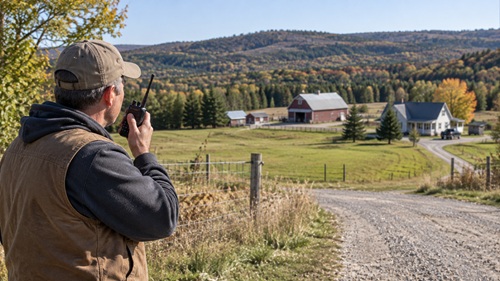
The radios didn’t suddenly stop working. You discovered something about your terrain.
Sometimes moving a short distance can help. Walking outside, moving around a building or gaining a little elevation may improve a weak signal considerably. These are things you’ll never learn while the radios are sitting in their boxes.
Keep the Communication System Simple
Direct radio-to-radio communication is one of the most useful capabilities for preparedness. This is generally called simplex communication. One radio transmits directly to another without requiring a repeater between them.
The simplicity is part of its value. If both radios work, their batteries have power, they’re configured correctly and they’re within usable range, communication may still be possible when cellular service and internet access aren’t.
Repeaters can extend radio coverage considerably and can be extremely useful, but they also add another dependency. A repeater has equipment, a location and a power requirement of its own. If you normally use one, it is worth knowing what your radios can still accomplish if that repeater isn’t available.
The people using the radios matter just as much as the equipment. Hand an unfamiliar radio to someone who rarely uses one and you’ll quickly see why practice is important. Someone may accidentally change the channel. Another person may start speaking before pressing the push-to-talk button properly. Someone else turns down the volume and thinks the radio isn’t receiving anything.
None of this is a big problem on an ordinary afternoon. During an emergency, it can become frustrating very quickly.
Keep things simple enough that everyone who might need the radios can operate them. They should know how to turn the radio on, adjust the volume, select the agreed channel and transmit a message. If someone in the family rarely uses the equipment, keeping a small instruction card with the radios isn’t a bad idea.
Then use them.
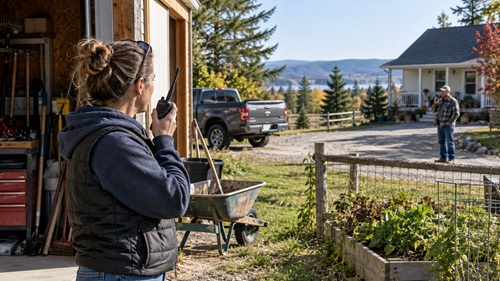
Walk around your property with one radio while somebody remains at the house. Try communicating from the basement, driveway, garden, workshop and vehicle. Go farther down the road. If hills or heavy trees are part of your surroundings, test them too.
You may discover a place where communication consistently fails. You may also find that walking twenty meters in one direction suddenly makes the signal clear again. Write down what you learn. Over time, you begin building a practical understanding of your own communication area.
Learn How to Talk on a Radio
Good radio communication doesn’t need to sound complicated or overly formal. The important thing is getting the message through clearly.
Think about what you want to say before pressing the button. Keep messages reasonably short and speak clearly. If several people are using the same channel, long conversations can prevent someone else from getting through when they need to.
After pressing the push-to-talk button, pause briefly before speaking. Some radios can clip the beginning of a transmission when someone starts talking immediately.
If you’re sending important information such as an address, number, location or change of plans, have the receiving person repeat it back. It takes a few extra seconds and confirms that both people heard the same thing.
There are a few standard radio terms worth knowing. “Say again” asks someone to repeat a message. “Stand by” tells them you’ve heard the call but can’t respond immediately. “Roger” confirms that a message was received and understood.
The NATO phonetic alphabet is another useful skill. Instead of trying to distinguish between similar-sounding letters over a poor connection, letters are spoken as words such as Alpha, Bravo, Charlie and Delta. You don’t necessarily need to memorize the entire alphabet immediately, but becoming familiar with it can make names, locations and call signs easier to communicate when reception isn’t perfect.
NATO Phonetic Alphabet
When radio reception is poor, individual letters can be surprisingly easy to misunderstand. Letters such as B, D, E, G, P, T and V can sound similar through static or a weak signal. The NATO phonetic alphabet replaces individual letters with standardized words that are much easier to distinguish.
For example, instead of trying to transmit “BC7” as individual letters, you would say “Bravo Charlie Seven.” It’s worth keeping a copy of the alphabet with your radios until everyone becomes familiar with it.
| Letter | Word | Letter | Word |
|---|---|---|---|
| A | Alpha | N | November |
| B | Bravo | O | Oscar |
| C | Charlie | P | Papa |
| D | Delta | Q | Quebec |
| E | Echo | R | Romeo |
| F | Foxtrot | S | Sierra |
| G | Golf | T | Tango |
| H | Hotel | U | Uniform |
| I | India | V | Victor |
| J | Juliett | W | Whiskey |
| K | Kilo | X | X-ray |
| L | Lima | Y | Yankee |
| M | Mike | Z | Zulu |
Don’t Assume Your Conversation Is Private
This is easy to forget because we’re accustomed to talking on phones.
Normal two-way radio communication should generally be treated as something another person may be able to hear. This is particularly important when using commonly shared radio services and frequencies.
That doesn’t mean every conversation is being monitored. It simply means you shouldn’t use an ordinary radio conversation as though it were a private telephone call.
There is usually no reason to announce that your house is empty, describe exactly where valuable supplies are stored or broadcast personal information that isn’t needed. During an emergency, communicate what the other person needs to know and leave unnecessary details out.
It’s an easy habit to develop now.
Power Matters Too
A drawer containing several radios isn’t much of a backup communication system if all the batteries are dead.
Keep your radios charged and learn how long the batteries actually last during normal use. Don’t rely entirely on the manufacturer’s estimate. A radio being actively used may perform differently from one sitting quietly in standby.
Then think about what happens if household electricity is unavailable for several days.
Depending on the radios you own, you might be able to recharge them from a vehicle, USB battery bank, portable power station or solar charging system. Some radios also accept replaceable battery packs or common disposable batteries.
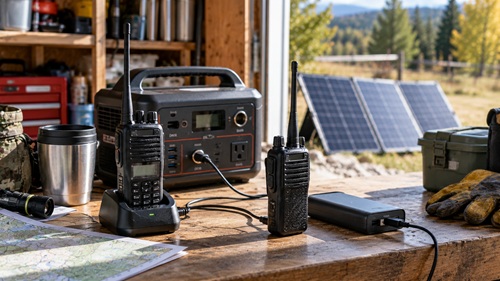
Whatever method you plan to use, test it. Plug the radio into the power bank. Try the vehicle charger. Connect it to the portable power station. Make sure the cables fit and the radio actually charges.
Finding out that the charging adapter you were counting on doesn’t work is much better today than three days into a power outage.
Build More Than One Way to Communicate
Preparedness doesn’t mean abandoning modern communications. Cell phones are incredibly useful and should remain part of the plan. The goal is having alternatives.
If cellular voice service works, use it. If calls aren’t going through but data is available, internet messaging may still work. Local two-way radios provide another option for nearby communication. More advanced radio equipment can extend those capabilities for people willing to learn how to use it.
Satellite and cellular-based communication devices provide additional options as well, but they come with dependencies of their own. LTE-based equipment depends on cellular infrastructure, while satellite systems require access to the satellite network and suitable line of sight.
This is why layers matter. You don’t need one communication device that supposedly does everything. You need enough options that losing one doesn’t leave you completely unable to communicate.
For one household, that might simply mean cell phones plus a pair of handheld radios and a way to keep them charged. Another family might eventually add amateur radio, satellite communication or other equipment because their circumstances require it.
Start with the problem you’re actually trying to solve.
Know What You’re Allowed to Use
Radio regulations vary between countries, and this is one area where information online can become confusing quickly. A lot of radio advice is written for the United States and discusses FCC regulations, while Canadian regulations are different.
FRS and GMRS are a good example. In Canada, compliant FRS/GMRS equipment can operate under license-exempt rules. In the United States, GMRS operates under a different licensing framework.
The practical lesson is not to assume that because a radio can transmit on a frequency you’re automatically permitted to use it.
This becomes particularly important with programmable handheld radios. Some can transmit across a wide range of frequencies, including frequencies assigned to services you may not be authorized to use.
Know what service you’re operating under, use appropriate equipment and check the current regulations for your country before experimenting with unfamiliar frequencies, antennas, repeaters or higher-powered equipment.
You don’t need to become an expert in radio regulation to use a basic family radio. You just need to make sure the equipment and frequencies you’re using are appropriate for where you live.
Test Everything While Nothing Is Wrong
One of the best ways to improve your radio preparedness costs almost nothing. Pick an afternoon when everything is working normally and put the phones away for an hour.
Give the radios to the people who would actually use them. Have someone remain at home while another person walks or drives to places where you realistically might need communication. Try the grocery route, nearby roads, the workshop, the neighbor’s property or wherever makes sense for your situation.
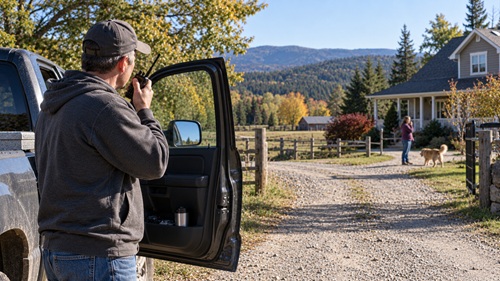
Don’t make the exercise too perfect. Have somebody accidentally switch to the wrong channel and see whether they know how to get back. Try one radio with a partially depleted battery. Send an address or number and see whether it arrives correctly. Try communicating from inside a vehicle. Walk behind the house. Go into the basement.
If you’re doing this with children or someone who isn’t particularly interested in radios, that’s useful too. They’re often the people who reveal whether your supposedly simple communication plan is actually simple.
Maybe you discover the radios work beautifully everywhere around your property except behind one hill. Perhaps the vehicle charger you assumed would work doesn’t. Maybe someone can’t remember how to unlock the keypad.
Those aren’t failures. That’s what practice is supposed to uncover.
A radio sitting in an emergency kit gives you equipment. Using it occasionally teaches you its limitations. After a few real tests, you’ll begin to know which parts of your property have poor reception, how far down the road you can communicate, which family members need more practice and how long your batteries actually last.
That’s far more useful than a range number printed on a box.
Preparedness Action Plan
Start with the radios you already own. Decide who you actually need to communicate with and where those people are likely to be. Then take the radios outside and test those places. Walk around your property, drive the roads you normally use and find the areas where communication becomes unreliable.
Make sure everyone who may need a radio understands the basic controls. Keep the batteries charged and test at least one method of charging them when household electricity isn’t available. If some family members rarely use the radios, keep simple operating instructions with the equipment.
Check the radio regulations that apply where you live before using unfamiliar frequencies, programmable radios, higher-powered equipment or repeaters. Most importantly, use the radios occasionally when nothing is wrong. Even an hour of practice can expose problems that would otherwise remain hidden until you actually needed the system.
Key Takeaways
Two-way radios can provide an important communication option when cellular networks or internet access aren’t available, but simply owning radios doesn’t create a reliable communication system. Terrain, buildings, batteries, equipment settings and the people using the radios all affect whether communication actually works.
The useful question isn’t simply whether you have radios stored away. It’s whether the people who may need them can pick them up, use them correctly and communicate from the places that matter.
Take them out of the drawer once in a while and find out.
That’s how a couple of handheld radios become an actual preparedness capability.
© Prepping Communities. This content is for informational purposes only and not professional advice. Use at your own risk.
Terms | Privacy | Guidelines