
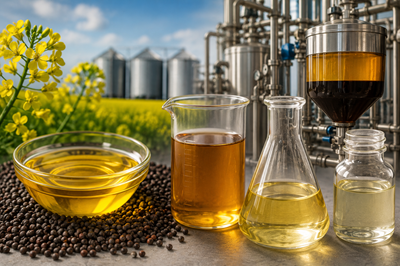
Transesterification Process to Manufacture Ethyl Ester of Rape Oil is a research paper from the University of Idaho Department of Chemical Engineering that investigates the production of biodiesel from rapeseed oil using ethanol. The study focuses on converting rapeseed oil into ethyl ester of winter rape oil (EEWR), a biodiesel fuel, through a chemical process known as transesterification. The research was conducted to determine optimal production conditions and evaluate the technical and economic feasibility of producing biodiesel from agricultural crops.
The paper explains that vegetable oils can be converted into biodiesel by reacting triglycerides (vegetable oil) with alcohol in the presence of a catalyst. During the reaction, the oil is transformed into fatty acid esters (biodiesel) and glycerin as a by-product. The process flow diagram shown on page 11 illustrates the complete system, including oil extraction, transesterification, phase separation, washing, and final fuel production.
Researchers evaluated several variables affecting biodiesel production, including:
- Reaction temperature
- Catalyst selection
- Agitation intensity
- Water content of ethanol
- Amount of excess alcohol
The study found that water contamination significantly reduced conversion efficiency and that absolute (200 proof) ethanol was required for high biodiesel yields. Extremely vigorous mixing was necessary at the beginning of the reaction to create a homogeneous mixture, after which continued agitation was less important. The researchers ultimately determined that room-temperature processing with sodium methoxide catalyst produced excellent conversion rates while reducing energy costs.
The paper also examines fuel properties of the finished biodiesel. The resulting ethyl ester exhibited acceptable viscosity, cloud point, and pour point characteristics for diesel-engine use. The study references engine testing and injector evaluations, including the comparison image on page 10 showing significantly cleaner injector performance for rapeseed methyl ester compared with raw vegetable oil after extended operation.
The final sections analyze economics. The cost chart on page 12 shows that feedstock oil represents the largest component of biodiesel production costs. The authors conclude that production costs could be significantly reduced by using lower-cost feedstocks such as waste frying oils, waste animal fats, and low-grade industrial oils instead of virgin rapeseed oil.
© Prepping Communities. This content is for informational purposes only and not professional advice. Use at your own risk.
Terms | Privacy | Guidelines