
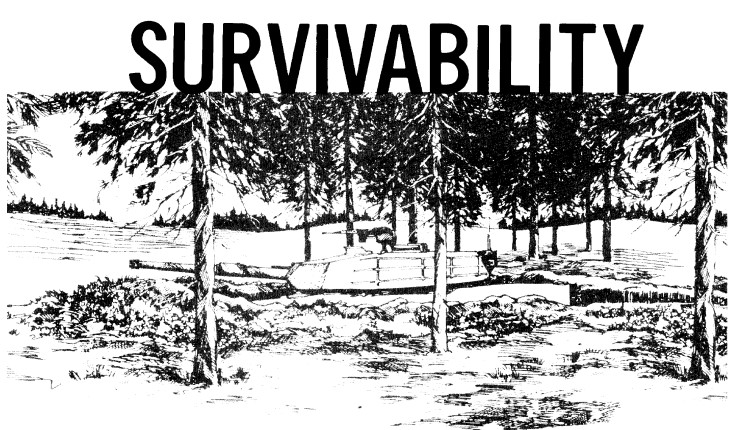
FM 5-103 Survivability is a detailed United States Army field manual focused on battlefield survivability, defensive position construction, protective structures, concealment, camouflage, and force protection during combat operations. Published by the Department of the Army in 1985, the manual teaches how military units can improve their chances of survival against modern battlefield threats including artillery, tanks, air attack, nuclear weapons, chemical weapons, and reconnaissance systems. The manual integrates survivability into the larger AirLand Battle doctrine and emphasizes that battlefield survival depends heavily on preparation, terrain use, concealment, engineering, and continuous improvement of fighting positions.
The book explains that survivability is not simply about building bunkers or trenches, but about a complete system of protection involving terrain analysis, camouflage, mobility, dispersion, deception, overhead cover, hardened shelters, and defensive planning. A major theme throughout the manual is that units must begin improving their positions immediately using whatever resources and terrain are available, then progressively strengthen those positions over time. The manual repeatedly stresses that concealment and terrain masking are often just as important as physical fortifications themselves.
A large section of the manual focuses on analyzing battlefield threats and how different weapons affect personnel and structures. The book explains the effects of direct fire weapons, artillery fragmentation, blast pressure, anti-tank weapons, mines, rockets, thermal radiation, nuclear effects, electromagnetic pulse (EMP), and chemical weapons. It details how each threat influences the design of fighting positions, shelters, parapets, revetments, bunkers, and covered routes. The manual also discusses how terrain, weather, soil conditions, and available construction materials influence defensive planning and survivability engineering decisions.
Another major focus of the book is survivability planning and battlefield engineering. It explains how commanders and engineers evaluate mission requirements, enemy threats, troop capabilities, terrain, time constraints, logistics, and available resources when determining defensive priorities. The manual outlines how engineer units support mobility, countermobility, survivability, and general engineering missions while balancing limited resources during combat operations. It also explains the importance of command and control, reconnaissance, position selection, and coordination between maneuver forces and combat engineers.
The manual includes detailed sections on constructing defensive positions for infantry, armor, mechanized units, artillery, air defense systems, aviation assets, logistics systems, command posts, and rear-area operations. It provides guidance on trench systems, overhead cover, bunker construction, camouflage techniques, protective shelters, fighting positions, blast protection, dispersion methods, and hardened structures. Numerous diagrams, engineering drawings, tables, and examples illustrate how to construct survivable positions under different battlefield conditions.
Overall, FM 5-103 Survivability serves as both a military engineering handbook and a broader study of battlefield protection and defensive preparation. Although written for military use, much of the content also reflects broader preparedness concepts such as redundancy, concealment, resource management, defensive planning, infrastructure protection, and adapting to hostile environments under extreme pressure.
© Prepping Communities. This content is for informational purposes only and not professional advice. Use at your own risk.
Terms | Privacy | Guidelines