
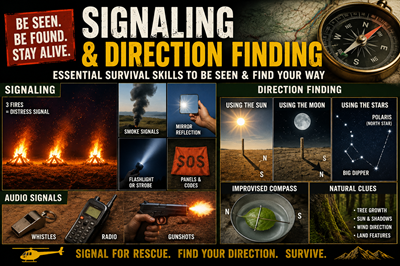
Signaling and Direction Finding is a practical survival guide focused on two critical wilderness and emergency survival skills: attracting rescuers and determining direction without modern navigation tools. The document serves as a field reference covering visual signals, audio signals, emergency codes, ground-to-air communication methods, and natural navigation techniques that can help stranded individuals increase their chances of rescue.
The first half of the guide focuses on signaling techniques. It explains how to use fires, smoke, mirrors, flashlights, clothing, natural materials, whistles, radios, and other signaling devices to attract attention from search aircraft or rescue teams. The guide discusses internationally recognized distress signals such as three fires, three smoke columns, and SOS patterns, while also covering specialized emergency signaling methods including ground-to-air codes, body signals, and panel signals that can communicate specific needs such as medical assistance, supplies, or directions to rescuers. Numerous diagrams illustrate the symbols and signals recognized by aircraft crews.
The second half of the document focuses on direction finding and navigation without a compass. It describes how to determine direction using the sun, shadows, analog watches, the moon, and star constellations such as the Big Dipper, Cassiopeia, Polaris, and the Southern Cross. The guide also explains how to construct improvised compasses using common materials and how environmental clues such as tree growth, slope orientation, and prevailing winds can assist with navigation. These methods provide practical alternatives when maps, GPS units, or compasses are unavailable.
Overall, the guide is a concise but highly useful survival reference that combines rescue signaling techniques with fundamental navigation skills. Rather than focusing on long-term survival, it emphasizes increasing visibility to rescuers, communicating effectively with aircraft, and maintaining orientation when lost or stranded. The numerous illustrations and field-expedient techniques make it especially valuable for wilderness travelers, preppers, hunters, hikers, and anyone interested in emergency preparedness.
© Prepping Communities. This content is for informational purposes only and not professional advice. Use at your own risk.
Terms | Privacy | Guidelines