
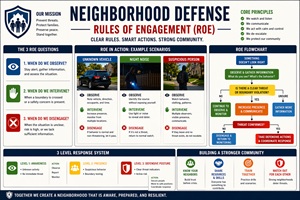
Why ROE Matters More Than Any Tool or Gear
Most neighborhoods don’t fail because they lack supplies.
They fail because:
- People react emotionally
- Decisions are inconsistent
- Nobody knows who should act—or when
Without clear ROE, even a well-prepared group turns into:
- Confusion
- Overreaction
- Internal conflict
ROE is what turns a group of individuals into a controlled, predictable, and stable system.
What ROE Actually Is (Simplified)
Rules of Engagement answer one core question:
“What do we do in this situation—every single time?”
It removes hesitation.
It removes guesswork.
It removes dangerous improvisation.
CORE ROE FRAMEWORK
1. OBSERVE (Default State)
This is your baseline.
You are always:
- Watching
- Listening
- Assessing
Example Scenario
You see an unfamiliar vehicle slowly driving through the neighborhood.
Without ROE:
- One person panics
- Another ignores it
- Someone confronts aggressively
With ROE:
- Log the vehicle
- Share info via comms
- Continue observation
No escalation.
2. VERIFY BEFORE ACTION
Never act on assumptions.
Always confirm:
- Is it a real threat?
- Is it normal activity?
- Is it misinterpreted?
Example Scenario
You hear noise near a fence at night.
Bad Reaction:
- Immediate confrontation
- Panic escalation
ROE-Based Response:
- Observe from a safe position
- Use light/noise to identify
- Communicate with others
3. INTERVENE (CONTROLLED, NOT AGGRESSIVE)
Intervention means:
- Presence
- Awareness
- Controlled interaction
NOT escalation.
When to Intervene
Only when:
- A boundary is crossed
- Behavior becomes suspicious or persistent
- There is a clear safety concern
Example Scenario
A person is walking through yards instead of using sidewalks.
ROE Response:
- Two people observe from visible positions
- Presence is made known (visibility, not confrontation)
- Person leaves → situation resolved
No unnecessary escalation.
4. DISENGAGE (CRITICAL RULE MOST PEOPLE MISS)
Knowing when NOT to act is just as important.
Disengage when:
- Situation is unclear
- Risk outweighs benefit
- You lack information
Example Scenario
You see a group passing through the neighborhood quickly.
Bad Reaction:
- Attempt to stop them
- Escalate unnecessarily
ROE Response:
- Observe
- Document
- Communicate
Let them pass unless they present a direct threat.
THE 3 LEVEL RESPONSE SYSTEM
Level 1: Awareness
- Unknown activity
- No immediate threat
Action:
- Observe
- Report
- Monitor
Level 2: Presence
- Suspicious behavior
- Boundary testing
Action:
- Increase visibility
- Multiple observers
- Controlled awareness
Level 3: Defensive Posture
- Clear threat indicators
- Active risk
Action:
- Secure people
- Move to safe positions
- Coordinate response
REAL-WORLD APPLICATION EXAMPLES
Example 1: “The Gate Test”
Someone rattles a gate.
What criminals often do:
They test response time.
ROE Response
- Do NOT ignore
- Do NOT rush blindly
Instead:
- Observe from inside
- Turn on controlled lighting
- Communicate with neighbors
Result:
You show awareness without exposing yourself.
Example 2: “False Alarm Trap”
Trash can knocked over at night.
ROE Response
- Treat as potential test
- Observe before reacting
- Confirm source
Why?
Some threats test small reactions before bigger moves.
Example 3: “Daytime Presence Check”
Unknown person walking slowly, observing houses.
ROE Response
- Visible presence from multiple homes
- Casual awareness (not confrontation)
- Communication shared
Outcome:
Most leave immediately when they feel watched.
COMMON ROE FAILURES
1. Overreaction
- Escalating too quickly
- Acting without information
Result: creates risk
2. Underreaction
- Ignoring warning signs
- Failing to respond
Result: invites targeting
3. Inconsistent Behavior
- Everyone reacts differently
Result: unpredictable system (easy to exploit)
BUILDING YOUR NEIGHBORHOOD ROE (STEP-BY-STEP)
Step 1: Define Scenarios
Write down:
- Unknown vehicles
- Night disturbances
- Suspicious movement
- Emergency situations
Step 2: Assign Default Actions
For each:
- Observe
- Communicate
- Escalate (only if needed)
Step 3: Keep It Simple
If people can’t remember it…
They won’t follow it.
Step 4: Train It
Run drills:
- Night scenario
- Communication test
- Rapid response simulation
THE MOST IMPORTANT RULE
You are not trying to win a confrontation.
You are trying to avoid becoming a target.
ADVANCED PRINCIPLE: CONTROL WITHOUT ESCALATION
The strongest neighborhoods:
- Show awareness
- Show coordination
- Show presence
Without:
- Aggression
- Panic
- Chaos
FINAL TAKEAWAY
ROE is what separates:
- Reaction vs control
- Panic vs discipline
- Vulnerability vs deterrence
Without it:
Even prepared groups fail.
With it:
Even simple setups become powerful.
© Prepping Communities. This content is for informational purposes only and not professional advice. Use at your own risk.
Terms | Privacy | Guidelines