
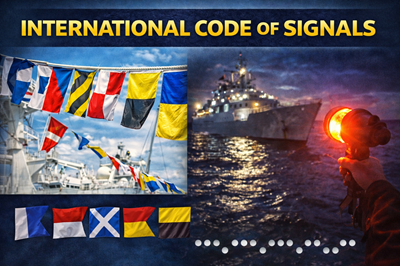
This publication, titled “International Code of Signals,” is a globally recognized communication system designed to enable clear, standardized communication between ships, aircraft, and coastal stations—especially when language barriers exist. Originally developed in the 19th century and refined over time, the code provides a universal “language” of signals that can be transmitted using flags, lights, sound, radio, or even hand signals. Its primary purpose is to support safety of navigation and the protection of life at sea, particularly in emergency or high-risk situations.
A central feature of the document is its structured signal system, where each signal—whether a single letter or a group of letters—has a complete and predefined meaning. For example, single-letter signals can indicate urgent conditions like “man overboard” or “I require assistance,” while more complex two- and three-letter codes allow for detailed communication about distress, navigation, medical needs, and operational coordination. This system eliminates ambiguity and allows critical messages to be understood quickly, even between parties who do not share a common spoken language.
The publication also provides detailed instruction on multiple communication methods, including flag signaling, Morse code (via light or sound), radiotelephony, and visual signaling using hand flags or body movements. It explains how each method works, when it should be used, and how to structure messages properly. This redundancy ensures that communication can still occur even if one method fails—an important principle in both maritime operations and survival scenarios.
Another key component of the guide is its practical application to real-world situations, including distress signals, search and rescue coordination, medical communication, navigation hazards, and vessel maneuvering. Entire sections are dedicated to emergency communication, enabling ships or individuals to quickly signal for help, report dangers, or coordinate rescue efforts. The inclusion of phonetic spelling tables, Morse code charts, and standardized procedures further enhances clarity and reduces the risk of miscommunication.
Overall, this PDF is more than just a signaling manual—it is a complete communication framework built for reliability under pressure. For preppers, homesteaders, and anyone focused on resilience, it offers valuable insight into how to maintain communication when modern systems fail. Its emphasis on redundancy, simplicity, and universal understanding makes it a powerful resource for off-grid communication planning, emergency coordination, and situational awareness in challenging environments.
PUB. 102
INTERNATIONAL
CODE OF SIGNALS
FOR VISUAL, SOUND, AND RADIO COMMUNICATIONS
UNITED STATES EDITION
1969 Edition
(Revised 2003)
© Prepping Communities. This content is for informational purposes only and not professional advice. Use at your own risk.
Terms | Privacy | Guidelines