
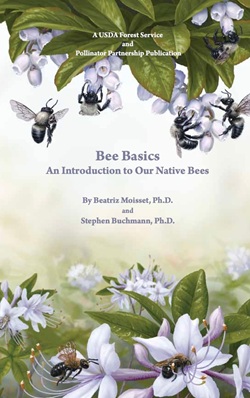
The publication , titled “Bee Basics: An Introduction to Our Native Bees,” is a comprehensive educational guide produced by the USDA Forest Service and the Pollinator Partnership. It serves as an accessible yet detailed introduction to the world of native bees, focusing on their diversity, biology, ecological importance, and role in pollination across North America. From the opening pages, the document emphasizes that native bees are a largely overlooked but critical part of natural and agricultural ecosystems, with roughly 4,000 species found across the United States alone.
A central theme of the publication is the importance of native bees in pollination. The guide explains that bees are responsible for pollinating approximately 75% of fruits, nuts, and vegetables, as well as about 80% of flowering plants, making them essential to both food production and biodiversity. It also highlights that while honey bees receive most of the attention, many native bees are actually more efficient pollinators for certain crops such as blueberries, tomatoes, and squash. The document reinforces that without these pollinators, ecosystems and food systems would be severely impacted.
The PDF also dives into the biology and behavior of bees, covering topics like anatomy, evolution, and life cycles. For example, it explains how bees evolved from wasp ancestors and adapted to collect pollen instead of hunting prey. It provides detailed explanations of bee anatomy—such as the head, thorax, abdomen, wings, and specialized pollen-carrying structures—and shows how these features support their role as pollinators. The guide further explores differences between species, including long-tongued and short-tongued bees, and how these adaptations influence which flowers they can access.
Another major section focuses on nesting habits and lifestyles, showing that most bees are solitary rather than social. The publication describes a wide variety of nesting strategies, including underground burrows, hollow stems, wood tunnels, and pre-existing cavities. It also explains behaviors like “cuckoo” parasitism, where some bees lay eggs in the nests of others. These insights help readers understand how diverse bee species survive, reproduce, and interact with their environments.
Finally, the guide explores different families of bees and their unique roles, such as bumble bees, carpenter bees, leafcutter bees, and sweat bees. It provides real-world examples of how specific species specialize in pollinating certain plants, including squash bees and blueberry bees. The publication closes with an important discussion on conservation, noting that both honey bees and native bees are facing population declines due to factors like habitat loss, pesticides, and environmental stress. This reinforces the need for awareness and action to protect pollinators.
Bee Basics
An Introduction to Our Native Bees
By Beatriz Moisset, Ph.D.
and
Stephen Buchmann, Ph.D.
© Prepping Communities. This content is for informational purposes only and not professional advice. Use at your own risk.
Terms | Privacy | Guidelines