
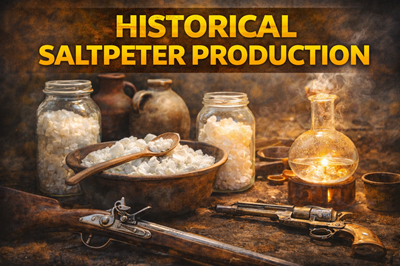
This publication is a historical and instructional guide focused on the production of saltpeter (potassium nitrate)—a critical ingredient historically used in gunpowder manufacturing. Drawing from 19th-century sources and traditional practices, the document explains how saltpeter was produced using natural materials such as soil rich in organic matter, manure, wood ashes, and urine. It highlights that saltpeter production was once an essential industry, especially during wartime, when access to manufactured supplies was limited and communities had to rely on local, self-sufficient production methods.
A major portion of the document is dedicated to the process of creating “nitre beds,” which are carefully constructed piles of organic material, soil, and alkaline substances designed to encourage the formation of nitrates over time. These beds require moisture, airflow, and periodic turning to support the chemical and biological processes that convert organic waste into usable nitrate compounds. The guide explains that this process is slow—often taking many months to years—but can produce a sustainable supply when managed properly.
Once the nitrates are formed, the publication details the leaching and extraction process, where water is passed through the nitrified earth to dissolve the salts, creating a liquid solution known as “ley.” This solution is then processed further by adding wood ashes to convert impurities into usable potassium nitrate. The liquid is boiled, filtered, and cooled to allow crystals to form, which are then collected, dried, and sometimes refined further to improve purity. The document provides multiple traditional methods used in different regions, showing how the same basic principles were adapted to local conditions.
The guide also includes sections on refining and testing the purity of saltpeter, explaining how to remove contaminants and evaluate quality using relatively simple techniques. It even provides tables and methods for estimating purity based on crystallization temperatures and chemical reactions. Throughout, the publication emphasizes practical knowledge, resourcefulness, and the ability to produce essential materials from locally available resources—reflecting a time when self-reliance and chemical understanding were critical for survival and industry.
From The Foxfire Book, Volume 5 – © 1979 The Foxfire Fund; Published by Doubleday Books
© Prepping Communities. This content is for informational purposes only and not professional advice. Use at your own risk.
Terms | Privacy | Guidelines