
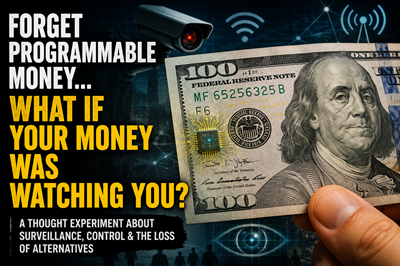
A Thought Experiment About Surveillance, Technology, and the Disappearance of Alternatives
Before we begin, let’s be absolutely clear.
This article is a thought experiment.
I have seen no evidence that today’s cash is secretly tracking people. I do not believe that banknotes currently contain hidden technologies that monitor purchases or report transactions.
This is not a claim.
It is not a prediction.
It is simply an exploration of a question.
What if the future of surveillance doesn’t require eliminating cash?
What if cash itself eventually becomes part of the surveillance system?
 That question came from a conversation my wife and I were having recently. Like many people interested in preparedness, privacy, and self-reliance, we’ve spent time discussing digital identities, central bank digital currencies, programmable money, and the increasing digitization of everyday life.
One argument comes up repeatedly.
If digital systems become too restrictive, people can always use cash.
Cash is often viewed as the last escape hatch.
The backup plan.
The alternative that allows individuals to operate outside of fully digital systems.
But what if we’re thinking about it the wrong way?
What if the goal was never simply to replace cash?
What if the goal was to eliminate every alternative?
The Traditional View of Control
When people discuss financial control systems, the conversation usually follows a predictable path.
- First comes digital money.
- Then transaction monitoring.
- Then restrictions.
- Then programmable money that determines what can be purchased, where it can be spent, or how long it remains valid.
Whether these concerns are realistic or not is a separate discussion.
What matters is that most people assume cash remains the fallback option.
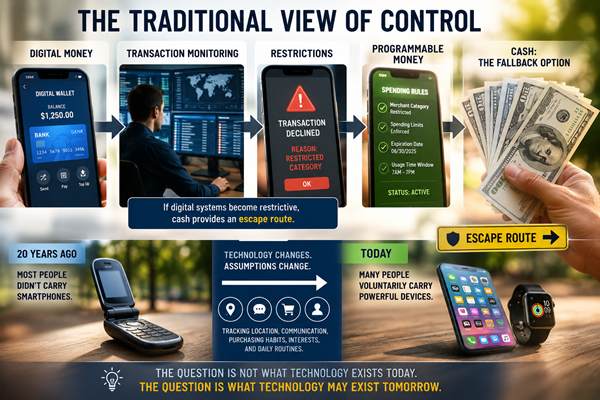 If digital systems become restrictive, cash provides an escape route.
But technology often changes assumptions that once seemed permanent.
Twenty years ago, most people didn’t carry smartphones.
Today many voluntarily carry devices capable of tracking location, communication, purchasing habits, interests, and daily routines.
Technologies that once sounded futuristic have become ordinary.
The question is not what technology exists today.
The question is what technology may exist tomorrow.
Could Physical Cash Become Smart?
At first glance the idea sounds absurd.
How could a piece of paper possibly track anyone?
The reality is that modern technology is already far more advanced than many people realize.
Today’s world includes:
- RFID tags
- NFC chips
- Printable electronics
- Smart labels
- Flexible sensors
- Battery-free identification systems
- Wireless communication technologies
- Advanced miniaturization
Many of these technologies already exist in products we interact with every day.
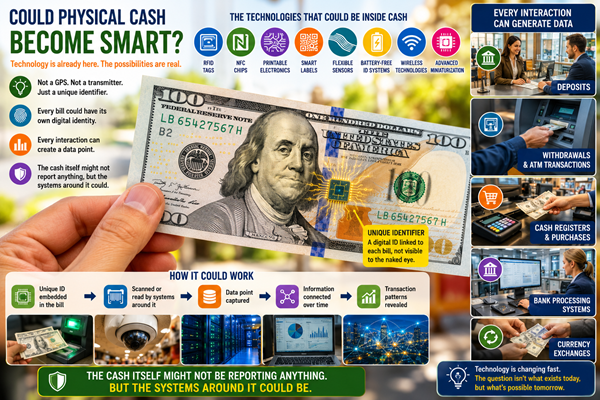 Now imagine a future where physical currency contains some form of advanced identifier.
Not necessarily a GPS device.
Not necessarily a transmitter.
Not necessarily a tracking beacon.
Simply an identifier unique to that particular piece of currency.
Every interaction involving that bill could potentially generate another data point.
- Deposits.
- Withdrawals.
- ATM transactions.
- Cash registers.
- Bank processing systems.
- Currency exchanges.
The cash itself might not be reporting anything.
But the systems around it could be.
The More Likely Scenario
Ironically, the most realistic version of this future may not require changing cash at all.
Think about the systems already surrounding us.
Security cameras monitor stores.
Parking lots use cameras.
Roadways use cameras.
License plate readers collect information.
Smartphones continuously generate location data.
Retailers collect customer information.
Loyalty programs track purchases.
AI systems are becoming increasingly capable of connecting information from multiple sources.
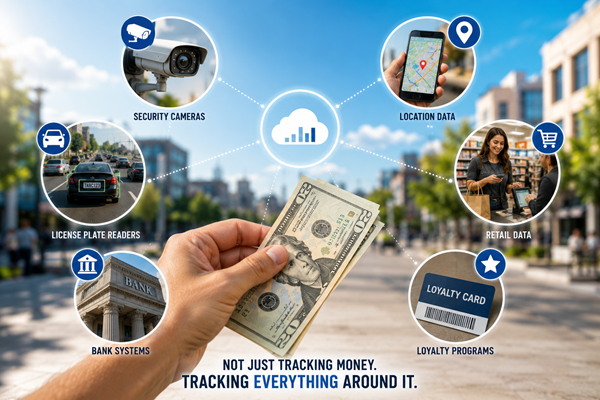 In that environment, physical cash may not need to identify itself.
The surrounding infrastructure may already provide most of the information necessary to reconstruct transactions and movement patterns.
This raises an interesting possibility.
Perhaps the future isn’t about tracking money.
Perhaps the future is about tracking everything around the money.
The Real Preparedness Question
For many preparedness-minded individuals, the concern isn’t technology itself.
 Technology can be incredibly useful.
The concern is dependence.
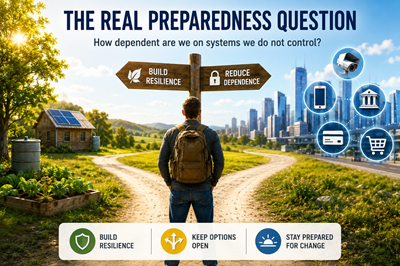
Preparedness has always involved reducing dependence on systems beyond our control.
We store food because supply chains can fail.
We store water because infrastructure can fail.
We learn skills because services may not always be available.
We create redundancies because single points of failure create risk.
Financial systems are no different.
The question becomes:
How dependent are we on systems we do not control?
What alternatives remain if those systems change?
What happens if every alternative eventually becomes visible, monitored, regulated, or restricted?
The Gradual Disappearance of Alternatives
This may be the most important part of the discussion.
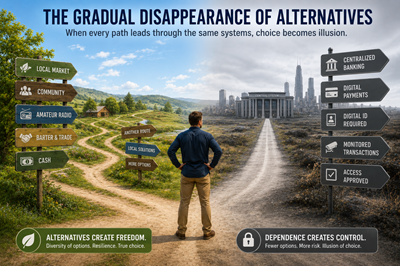
Throughout history, alternatives have provided resilience.
 When one system failed, another remained available.
If one communication method became unavailable, people found another.
If one transportation route closed, another route existed.
If one marketplace became inaccessible, another marketplace emerged.
Alternatives create flexibility.
Alternatives create resilience.
Alternatives create freedom of choice.
The concern many people have is not necessarily that a particular technology exists.
The concern is what happens when alternatives gradually disappear.
When every path leads through the same systems.
When every transaction becomes dependent on the same infrastructure.
When every form of access requires approval from the same network of institutions.
At that point, control is no longer exercised through force.
Control emerges through dependence.
Access Is Becoming the Real Currency
Perhaps the biggest lesson from this thought experiment has nothing to do with cash.
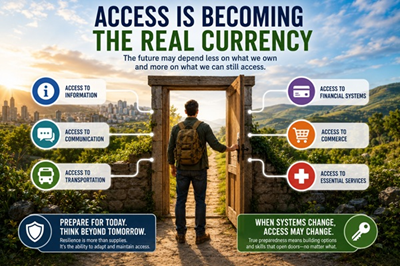 Perhaps it has everything to do with access.
- Access to information.
- Access to communication.
- Access to transportation.
- Access to financial systems.
- Access to commerce.
- Access to essential services.
Modern life increasingly depends on access granted through interconnected systems.
As these systems become more centralized, integrated, and technologically sophisticated, preparedness may require us to think beyond traditional supplies and equipment.
The future preparedness conversation may be less about what we own and more about what we can still access when systems change.
Final Thoughts
Again, I am not suggesting that today’s cash is secretly tracking people.
 I have seen no evidence that this is happening.
But thought experiments can be valuable because they force us to examine assumptions.
- Most people assume cash will always remain the alternative.
- Most people assume there will always be another option.
- Most people assume there will always be an escape hatch.
History shows that assumptions deserve scrutiny.
The most important question may not be whether money could someday watch you.
The more important question may be this:
What happens when every alternative gradually becomes part of the same system?
And if that ever happens, what does preparedness look like then?
© Prepping Communities. This content is for informational purposes only and not professional advice. Use at your own risk.
Terms | Privacy | Guidelines