
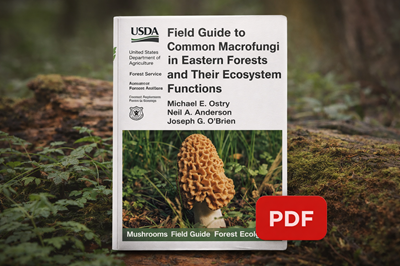
This PDF is a U.S. Forest Service technical field guide titled “Field Guide to Common Macrofungi in Eastern Forests and Their Ecosystem Functions”. It is a scientific reference document designed to help readers identify common mushrooms and fungal species found in forests across the Midwest and Northeastern United States. The guide combines high-quality photographs, taxonomic descriptions, and ecological notes to support field identification and ecological understanding of macrofungi.
A major focus of the guide is fungal identification and classification within different forest ecosystems, including aspen-birch, northern hardwood, lowland conifer, and upland conifer environments. Each species entry includes key identification features such as cap shape, color, gill structure, spore characteristics, and growth patterns. The manual also organizes fungi by ecological role, including mycorrhizal species that form symbiotic relationships with trees, saprophytic species that break down dead wood and litter, and pathogenic species that contribute to disease and forest turnover.
The PDF places strong emphasis on ecosystem function and forest health, explaining how fungi contribute to nutrient cycling, soil formation, decomposition, and habitat creation for wildlife. It highlights both beneficial and harmful roles—for example, species that support tree growth through root symbiosis versus those that cause wood rot and tree decline. Each entry also includes seasonal fruiting patterns and ecological context, helping readers understand when and where different fungi are likely to appear.
Another important element is the guide’s strong safety and education focus, particularly around edible mushrooms. Many species are clearly labeled as poisonous or inedible, and the text repeatedly warns readers not to consume wild mushrooms unless absolutely certain of identification due to the high risk of toxic lookalikes. The guide therefore serves not only as an identification manual but also as a safety-oriented educational resource for foragers, students, and forest professionals.
United States Department of Agriculture
Forest Service
Northern Research Station
General Technical
Report NRS-79
Michael E. Ostry
Neil A. Anderson
Joseph G. O’Brien
© Prepping Communities. This content is for informational purposes only and not professional advice. Use at your own risk.
Terms | Privacy | Guidelines