
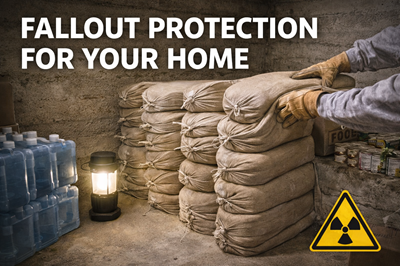
This publication, titled “Fallout Protection for Homes with Basements”, is a Cold War–era civil defense manual designed to help homeowners protect themselves and their families from radioactive fallout following a nuclear event. Produced by the U.S. Department of Defense Office of Civil Defense, the guide focuses on a practical and reassuring idea: even an ordinary home—especially one with a basement—can provide meaningful protection if used correctly (page 5). It aims to turn existing living spaces into life-saving shelters using knowledge rather than expensive infrastructure.
A key concept explained early in the manual is radioactive fallout, which occurs when debris from a nuclear explosion is lifted into the atmosphere and then falls back to earth, carrying harmful radiation (pages 5–6). The guide emphasizes three critical factors for protection: time, distance, and shielding. As described on page 6, radiation levels decrease over time, distance from the source reduces exposure, and dense materials like earth, concrete, or bricks can block radiation. These principles form the foundation of all the shelter strategies presented in the booklet.
The manual goes on to explain how to evaluate and improve the protection level of your basement, introducing the idea of a “Protection Factor” (PF), which measures how much radiation exposure is reduced inside a shelter compared to being outside (pages 7–8). It provides practical guidance on finding the safest location—typically the most below-ground corner—and then enhancing it by adding mass and shielding. The diagrams throughout the guide illustrate how rearranging materials and reinforcing certain areas can significantly increase protection.
One of the most valuable sections focuses on building and improving shelters using everyday materials. The guide outlines several approaches, from permanent modifications (like reinforcing ceilings and walls with additional mass) to pre-planned and improvised shelters that can be assembled quickly in an emergency (pages 9–16). Examples include using furniture, books, sand, bricks, or even earth to create effective barriers. The illustrations clearly show how common household items can be repurposed into protective structures, making the guidance accessible to almost anyone.
The later sections expand into alternative shelter designs, including above-ground and semi-buried shelters for those without basements (pages 29+). These designs include A-frame structures, plywood box shelters, and steel igloo-style shelters, complete with construction details, ventilation considerations, and material lists. The manual also stresses practical concerns like airflow, structural integrity, and avoiding collapse when adding heavy shielding materials.
Overall, this PDF is a highly practical survival and preparedness manual, focused on one of the most serious threat scenarios. For preppers, it offers a clear, actionable takeaway: you don’t need a purpose-built bunker to survive fallout—you can significantly improve your chances by understanding how to use and modify the space you already have. It’s an essential addition to any preparedness library, especially for those planning for large-scale or long-term emergencies.
Produced by the U.S. Department of Defense Office of Civil Defense
© Prepping Communities. This content is for informational purposes only and not professional advice. Use at your own risk.
Terms | Privacy | Guidelines