
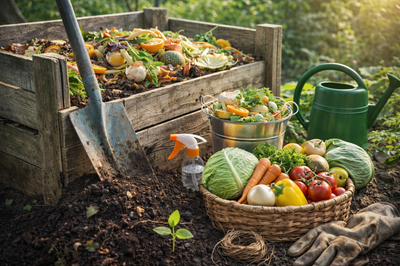
This publication, titled “Backyard Composting Basics” by the Master Gardeners of El Dorado County, is a practical, easy-to-follow guide to turning everyday organic waste into nutrient-rich soil. It explains that composting is simply a controlled version of a natural process—where organic materials break down into a humus-like substance that improves soil health. The guide emphasizes that composting is not complicated or expensive, making it accessible to anyone, whether they have a large homestead or a small backyard setup.
A key focus of the document is understanding the biology behind composting, particularly the role of microorganisms. As shown on page 1, bacteria, fungi, and other organisms form a “compost food web” that actively breaks down materials into usable nutrients. The guide highlights just how active this process is, noting that even a small amount of compost can contain billions of beneficial microbes. This reinforces the idea that composting is less about “managing waste” and more about supporting a living system that builds soil fertility naturally.
The publication also provides clear guidance on how to build and maintain a successful compost pile, including the five key control factors: aeration, moisture, volume, particle size, and the carbon-to-nitrogen ratio. As outlined on page 3, achieving the right balance between “greens” (nitrogen-rich materials like food scraps and grass clippings) and “browns” (carbon-rich materials like leaves and cardboard) is critical for efficient decomposition. It also explains what should not be added—such as meat, dairy, and oils—to avoid pests and odors.
Another important section focuses on the benefits and uses of compost, showing how it improves soil structure, increases water retention, reduces erosion, and replaces the need for chemical fertilizers. On page 2, the guide describes compost as a “multivitamin for your soil,” highlighting its role in promoting plant health and reducing the need for frequent watering. It also explains how finished compost can be used as a soil amendment, mulch, or potting mix component, making it a versatile resource for gardeners and homesteaders.
Finally, the guide includes practical troubleshooting advice, such as the table on page 5, which helps identify and fix common issues like bad odors, low temperatures, or pest problems. This makes it especially useful for beginners, as it not only teaches how to start composting but also how to maintain and improve the system over time.
Overall, this PDF is a complete introduction to sustainable soil building, showing how simple materials and basic management can create a reliable, long-term source of fertility—an essential skill for preppers, gardeners, and anyone focused on self-sufficiency.
THE UNIVERSITY OF CALIFORNIA WORKING IN COOPERATION WITH COUNTY GOVERNMENT AND THE UNITED STATES DEPARTMENT OF AGRICULTURE .
Master Gardeners
Of El Dorado County
Public Education 2017
© Prepping Communities. This content is for informational purposes only and not professional advice. Use at your own risk.
Terms | Privacy | Guidelines