
Application Chart for Determining Electrical Load for Generator is a practical reference guide designed to help users calculate the electrical load requirements for portable and standby generators. The document explains the basic relationship between volts, amps, and watts using the formula “Volts × Amps = Watts,” allowing users to determine the power requirements of household appliances, tools, motors, and electrical equipment. The guide emphasizes the importance of understanding both running wattage and starting or surge wattage when sizing a generator, since many devices—especially motors—require significantly more power during startup than during normal operation.
The chart provides estimated running and surge wattage values for a wide range of common household appliances and workshop tools. Items covered include refrigerators, freezers, sump pumps, furnace blowers, microwaves, air conditioners, coffee makers, drills, chain saws, circular saws, water heaters, televisions, fans, and battery chargers. The guide explains that motor-driven appliances often require two to three times their normal operating wattage during startup, with some motors requiring up to nine times higher surge loads. This makes proper generator sizing critical to prevent overloads, equipment damage, or generator shutdowns during heavy startup demands.
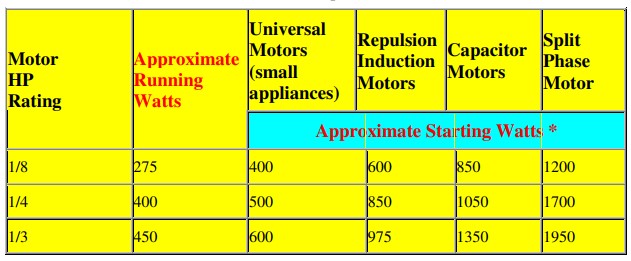
A major section focuses specifically on electric motor wattage requirements. The document breaks down approximate running and starting wattages for various motor types, including universal motors, repulsion induction motors, capacitor motors, and split-phase motors across multiple horsepower ratings. Tables provide estimates for motors ranging from 1/8 horsepower to 3 horsepower, showing how startup demands increase dramatically as motor size grows. The guide repeatedly advises users to calculate generator capacity based on starting wattage rather than running wattage to ensure sufficient power during equipment startup cycles.
Overall, the PDF serves as a simple but highly useful preparedness and emergency power planning reference for homeowners, preppers, contractors, RV users, and anyone operating portable generators. It helps users better understand power consumption, avoid overloading generators, and estimate the generator size needed to safely run appliances, pumps, tools, and emergency household systems during outages or off-grid situations.
© Prepping Communities. This content is for informational purposes only and not professional advice. Use at your own risk.
Terms | Privacy | Guidelines