
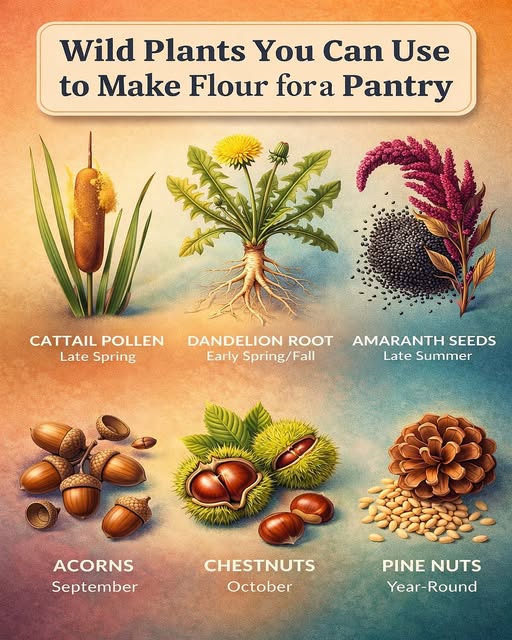
🌿 Wild Plants You Can Use to Make Flour for Your Pantry
When you start looking at the land differently, you realize flour doesn’t just come from a store shelf. Many wild plants can be processed into usable flour — a powerful skill for preppers, homesteaders, and anyone building food resilience.
Here’s a breakdown of the plants shown and how they can be used:
🌾 Cattail Pollen (Late Spring)
Often called the “supermarket of the swamp,” cattails are incredibly versatile.
How to use it:
Collect yellow pollen in late spring.
Sift to remove debris.
Mix with wheat flour or use as a protein-rich additive.
Why it’s valuable:
High in protein.
Grows abundantly near water.
Easy seasonal harvest.
Note: Always positively identify cattails and harvest from clean water sources.
🌼 Dandelion Root (Early Spring / Fall)
Dandelions aren’t weeds — they’re survival food.
How to use it:
Dig roots in early spring or fall.
Wash, chop, and dry thoroughly.
Roast lightly, then grind into powder.
This produces a flour-like powder often blended into baking mixes or used as a coffee substitute.
Bonus: Dandelion is everywhere. Accessibility = resilience.
🌺 Amaranth Seeds (Late Summer)
Amaranth is technically a “pseudo-grain” and has been cultivated for thousands of years.
How to use it:
Harvest mature seed heads.
Dry and thresh.
Grind into flour.
Why it’s powerful:
High in protein.
Contains essential amino acids.
Gluten-free option.
Many wild varieties naturalize easily.
🌰 Acorns (September)
Acorns are one of the most abundant wild starch sources in North America.
How to use them:
Shell and crush.
Leach tannins (cold water soak method preferred).
Dry fully.
Grind into flour.
Acorn flour works well in:
Flatbreads
Pancakes
Thickening stews
It stores well once fully dried.
🌰 Chestnuts (October)
Unlike acorns, chestnuts are naturally lower in tannins and sweeter.
How to use:
Peel outer shell and inner skin.
Dry thoroughly.
Grind into flour.
Chestnut flour is slightly sweet and excellent for baking.
🌲 Pine Nuts (Year-Round)
Pine nuts can be ground into meal or flour and mixed into baking recipes.
How to use:
Harvest cones (varies by species).
Extract seeds.
Dry and grind.
High in fat and calories — great for energy-dense food storage.
🛡 Prepper Perspective: Why This Matters
Learning wild flour sources gives you:
🌍 Local food independence
🧠 Skill-based security
📦 Pantry diversification
💰 Less reliance on supply chains
But remember:
⚠️ Always properly identify plants.
⚠️ Know local regulations before harvesting.
⚠️ Process correctly to remove toxins (especially with acorns).
⚠️ Avoid polluted areas (roadsides, industrial zones).
🌱 Final Thought
Resilience isn’t just about stockpiling.
It’s about knowing:
What grows around you.
When to harvest it.
How to process it.
How to turn it into usable calories.
Your land is more productive than you think.
© Prepping Communities. This content is for informational purposes only and not professional advice. Use at your own risk.
Terms | Privacy | Guidelines