
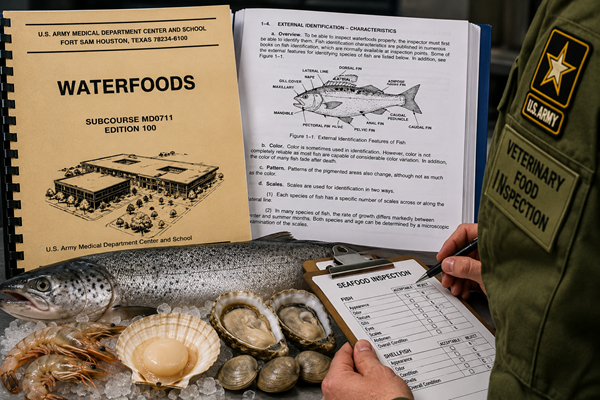
Waterfoods (MD0711) is a U.S. Army Medical Department training manual designed to teach veterinary food inspection specialists how to inspect fish and shellfish for safety, quality, identity, condition, and quantity. The manual focuses on the composition, anatomy, preservation, deterioration, handling, and inspection of seafood products intended for military procurement and consumption.
The first section covers fish biology and food science fundamentals. It explains the chemical composition of fish, including water, protein, fats, minerals, and vitamins, and describes both external and internal anatomy used for species identification and inspection. The manual discusses common market forms such as whole fish, dressed fish, fillets, steaks, canned products, vacuum-packed products, and freeze-dried seafood. It also explains preservation methods including icing, freezing, glazing, vacuum packaging, canning, and freeze dehydration.
A significant portion of the document examines seafood deterioration and spoilage. Readers learn how bacterial growth, enzyme activity, oxidation, freezer burn, and improper storage affect fish quality. The manual explains rigor mortis, autolysis, putrefaction, and methods inspectors use to distinguish fresh, stale, and spoiled fish through visual appearance, odor, texture, gills, scales, slime, and flesh characteristics. Detailed inspection criteria are provided to help determine product acceptability.
The manual also discusses common fish parasites, including tapeworms, roundworms, codworms, flatworms, and sea lice. It explains which parasites may pose human health concerns, how proper cooking and freezing eliminate risk, and how inspection methods such as candling are used to identify and remove parasites from fish fillets before distribution.
The second lesson focuses on shellfish inspection, covering oysters, clams, scallops, shrimp, lobsters, crabs, and other shellfish. The manual explains shellfish anatomy, spoilage characteristics, inspection procedures, approved sourcing requirements, labeling, packaging, storage, shelf-life determination, temperature verification, and methods used by military inspectors to evaluate seafood shipments. It also includes procedures for determining glaze percentages and calculating net product weight when frozen seafood is coated with protective ice glazing.
Overall, the publication serves as a practical seafood inspection handbook combining food safety, preservation science, quality assurance, and military procurement standards. It provides useful knowledge for anyone interested in seafood handling, food preservation, food safety, fishing, aquaculture, or emergency food storage..
© Prepping Communities. This content is for informational purposes only and not professional advice. Use at your own risk.
Terms | Privacy | Guidelines