
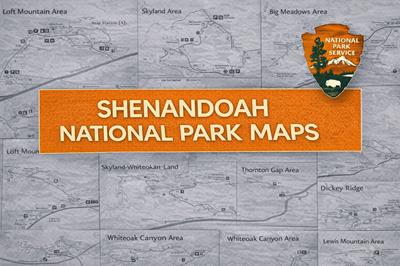
These PDFs form a comprehensive collection of trail maps, campground layouts, and regional guides for Shenandoah National Park, covering multiple areas along Skyline Drive. Together, they provide a layered view of how the park is structured, combining road-based navigation, hiking trail systems, waterfalls, summits, and campground infrastructure into a unified planning resource.
The area trail maps (such as Loft Mountain, Skyland, South River, Hawksbill, and Whiteoak Canyon) emphasize movement through terrain, showing how Skyline Drive acts as the central spine of the park with milepost markers (e.g., MP 79–85 in the Loft Mountain area) . From this main corridor, a network of trails branches out into valleys, ridges, and waterways. These maps highlight major features like waterfalls (e.g., South River Falls at 83 feet ), summits (Hightop Mountain, Hawksbill), and overlooks. They also include detailed hiking descriptions with distances, elevation gain, and difficulty ratings, reinforcing that travel in Shenandoah is terrain-driven and often physically demanding despite relatively short distances.
Several maps focus on iconic or specialized hiking areas, such as the Bearfence rock scramble and Old Rag circuit. The Bearfence map shows a short but technical loop with a 360° viewpoint and explicit warnings about steep rock scrambling and unsafe conditions when wet or icy . The Old Rag map outlines a much longer and very strenuous 9.4-mile circuit with significant elevation gain and a defined rock scramble section . These maps highlight how Shenandoah includes both accessible trails and highly technical routes requiring preparation and awareness.
The campground maps (Big Meadows, Lewis Mountain, Loft Mountain, and Mathews Arm) shift focus to infrastructure and basecamp logistics. For example, the Big Meadows Campground map shows a large, highly organized site layout with loops, designated tent-only areas, utility stations, and direct access to the Appalachian Trail . Similarly, Loft Mountain Campground includes hundreds of sites, reservation systems, and amenities such as showers, dump stations, and campstores . In contrast, Lewis Mountain is smaller and more basic, operating on a first-come, first-served basis with limited hookups . These variations illustrate how campground design scales based on demand and location.
Other regional maps—like Compton Gap, Dickey Ridge, Thornton Gap, and Keyser Run—highlight less-traveled areas with interconnected trail systems, including fire roads, horse trails, and sections of the Appalachian Trail. These maps emphasize route-finding, intersections, and access points, often with fewer services and more reliance on navigation skills. The presence of multiple trail types (hiking, horse, fire road) shows how the park supports diverse travel methods but requires users to understand trail markings and terrain transitions.
Overall, these PDFs collectively present Shenandoah National Park as a linear, ridge-based wilderness system built around Skyline Drive, with extensive trail networks branching into valleys and peaks. They serve as both navigation tools and planning guides, helping users understand how to move through the park, where to camp, and how to manage elevation, distance, and terrain. For preppers or outdoor users, they highlight key realities: limited access routes, reliance on trail systems, variable difficulty, and the importance of planning for water crossings, elevation gain, and changing conditions across different sections of the park.
© Prepping Communities. This content is for informational purposes only and not professional advice. Use at your own risk.
Terms | Privacy | Guidelines