
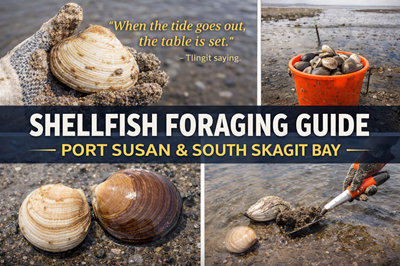
This PDF, Shellfish Foraging Guide to Port Susan and South Skagit Bay (Pacific Shellfish Institute, 2014), is a detailed public education and resource manual focused on recreational shellfish harvesting in Puget Sound, Washington. It explains how shellfish populations are managed, how water quality affects harvesting safety, and how residents can responsibly forage clams and oysters in approved intertidal areas. The guide is rooted in both ecological science and public health policy, combining practical harvesting knowledge with environmental monitoring information.
A major focus of the document is the relationship between water quality and shellfish safety, emphasizing that bivalve shellfish are filter feeders that can accumulate bacteria, pollutants, and marine biotoxins from their environment. The guide explains how contamination from sewage, storm runoff, and agricultural sources can impact shellfish beds, and why strict monitoring by the Washington Department of Health is required to classify growing areas as approved, restricted, or prohibited for harvest. It also outlines how these classifications directly affect whether recreational and commercial harvesting is allowed.
The PDF also provides a historical overview of shellfish bed classification changes in Port Susan and South Skagit Bay, showing how water quality improvements over time have led to expanded approved harvesting areas. It highlights the role of long-term monitoring programs, tribal partnerships, and local government initiatives in restoring shellfish habitats and improving coastal water conditions. These sections demonstrate how environmental policy and restoration efforts directly influence food access and ecosystem health.
In addition, the guide covers the nutritional and ecological importance of shellfish, explaining that clams, oysters, and mussels are highly nutritious sources of protein, omega-3 fatty acids, and essential minerals. It also describes their role as natural water filters that improve water clarity and ecosystem stability by removing nutrients, bacteria, and suspended particles from marine waters. The document further includes detailed sections on common recreational species such as Pacific oysters, Manila clams, varnish clams, and softshell clams, along with harvesting techniques, regulations, and safe handling practices.
Finally, the PDF includes an extensive human health and safety section, warning about risks from fecal coliform bacteria, Vibrio infections, and marine biotoxins such as DSP, PSP, and ASP. It stresses the importance of checking official closures, properly cooking shellfish, and following safe storage practices to reduce illness risk. Overall, the document serves as both a scientific guide and a practical field manual for safe, legal, and sustainable shellfish foraging in coastal environments.
Shellfish Foraging Guide to Port Susan and South Skagit Bay (Pacific Shellfish Institute, 2014)
Compiled and edited by the Pacific Shellfish Institute December 2014
© Prepping Communities. This content is for informational purposes only and not professional advice. Use at your own risk.
Terms | Privacy | Guidelines