
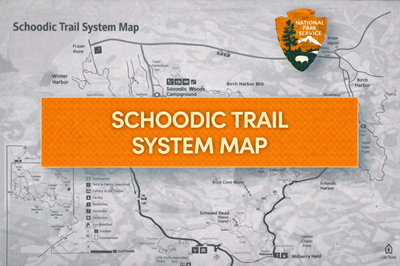
This PDF is a Schoodic Peninsula Trail System map, part of Acadia National Park in Maine, and serves as a compact but detailed guide to both the road network and hiking trail system across this more remote section of the park. Unlike the busier Mount Desert Island area, this map highlights a quieter, less crowded coastal environment with a strong emphasis on self-guided exploration.
The main map (single page) clearly outlines the loop road system, which operates as a one-way route around the peninsula. As shown on the map, traffic flows in a controlled direction along the coastline, connecting key locations like Schoodic Point, Frazer Point, and Blueberry Hill. This one-way design helps manage traffic while allowing continuous scenic travel along rugged oceanfront terrain. The map also marks access points such as parking areas, picnic spots, restrooms, and Island Explorer bus stops, giving users a clear sense of where services are available.
A major focus of the document is the trail network, which is layered throughout the peninsula. Trails like the Alder Trail, Anvil Trail, East Trail, and Schoodic Head Trail are shown with distances (for example, Schoodic Head at 440 ft elevation), allowing users to plan hikes based on difficulty and length. As seen across the map, trails connect inland forest areas with coastal viewpoints, creating a mix of terrain that includes rocky shoreline, low mountains, and wooded sections. The inclusion of intersection numbers helps with navigation, especially when multiple trails intersect.
The map also highlights key natural and geographic features, including Schoodic Head, Buck Cove Mountain, Birch Harbor Mountain, and surrounding islands such as Little Moose Island and Schoodic Island. Coastal features like harbors and coves are clearly labeled, reinforcing the maritime nature of the area. The presence of the Schoodic Woods Campground and the Schoodic Institute indicates limited but important infrastructure supporting visitors in this otherwise quiet region.
Overall, this PDF functions as a hybrid navigation and exploration map, combining road routing, hiking trails, and key landmarks into a single, easy-to-use layout. It emphasizes simplicity, orientation, and movement through a relatively isolated coastal environment. For preppers or outdoor users, it highlights important considerations such as limited access points, reliance on loop travel, and the need to understand terrain transitions between forest, elevation, and exposed shoreline.
© Prepping Communities. This content is for informational purposes only and not professional advice. Use at your own risk.
Terms | Privacy | Guidelines