
1. Understanding Water Survival
1.1 Introduction to Water as a Survival Priority
 Water is the most critical resource in any survival situation. While food supports long-term endurance, water determines immediate survival. The human body can function for weeks without food under the right conditions, but without water, physical and cognitive decline begins within hours and can become life-threatening within days.
Water is involved in nearly every essential bodily function. It regulates temperature, supports circulation, aids digestion, removes waste, and enables cellular processes. Even mild dehydration affects decision-making, coordination, and energy levels—factors that are critical in a survival scenario where mistakes can have serious consequences.
In modern environments, access to clean water is often taken for granted. Municipal systems deliver treated water directly into homes, and bottled water is readily available. However, these systems are dependent on infrastructure—power, treatment facilities, distribution networks, and supply chains. When any part of that system fails, access to safe water can disappear quickly.
Preparedness requires a shift in mindset. Instead of assuming water will always be available, it must be treated as a resource that can become limited, contaminated, or inaccessible. This means developing the ability to locate, assess, collect, purify, and store water under a wide range of conditions.
Water survival is not just about having supplies—it is about having capability. Stored water can run out. Equipment can fail. Situations can change. The ability to adapt and secure water in real time is what separates short-term readiness from long-term resilience.
Ultimately, water is not just another prep—it is the foundation of all preparedness. Every other system—food, hygiene, medical care, even security—depends on it.
1.2 The Rule of 3: Why Water Comes First
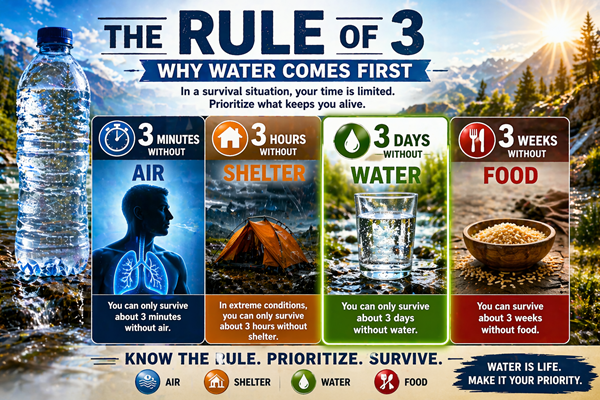 A commonly referenced guideline in survival is the “Rule of 3”:
- 3 minutes without air
- 3 hours without shelter (in extreme conditions)
- 3 days without water
- 3 weeks without food
While these are general estimates, they highlight a key point: water is second only to air in immediate importance.
In reality, the “3 days without water” guideline can vary significantly depending on conditions. High temperatures, physical exertion, illness, or stress can reduce this window dramatically. In hot or arid environments, dehydration can become critical within a single day. Even in moderate climates, lack of water quickly leads to reduced physical performance and impaired judgment.
The importance of water extends beyond hydration. Without adequate water:
- The body cannot regulate temperature effectively
- Blood volume decreases, reducing oxygen delivery
- Toxins accumulate due to reduced kidney function
- Mental clarity declines, increasing risk of poor decisions
In a survival scenario, these effects compound quickly. Reduced physical ability limits your capacity to gather resources or move to safer locations. Impaired judgment increases the likelihood of mistakes. Together, these factors can escalate a manageable situation into a critical one.
Understanding the Rule of 3 is not about memorizing numbers—it is about prioritization. When planning or responding to a situation, water must be addressed immediately, alongside shelter and environmental exposure.
1.3 Daily Water Requirements (Hydration, Hygiene, Medical)
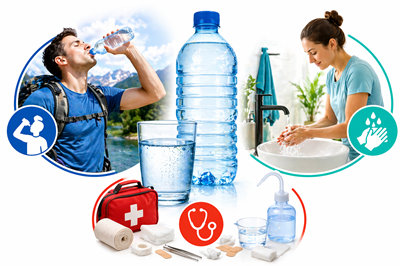 Water needs extend beyond simple drinking. A complete water strategy must account for multiple uses:
Hydration
The average adult requires approximately 2–4 liters of water per day under normal conditions. This requirement increases with:
- Heat and sun exposure
- Physical activity
- Illness (fever, diarrhea, vomiting)
- High altitude
In survival situations, these factors are often present simultaneously, significantly increasing demand.
Hygiene
Basic hygiene is essential for preventing illness and maintaining overall health. Water is required for:
- Hand washing
- Cleaning wounds
- Personal sanitation
- Cleaning tools and surfaces
Poor hygiene can lead to infections and disease, which can become serious threats when medical care is limited.
Medical Use
Water plays a critical role in medical care:
- Cleaning and irrigating wounds
- Mixing medications
- Rehydration during illness
- Managing burns or infections
Inadequate water for medical use can turn minor injuries into life-threatening conditions.
Minimum vs. Optimal Use
In emergency conditions, water usage may need to be rationed. However, reducing water intake below safe levels can accelerate dehydration and increase risk. A balance must be maintained between conservation and maintaining health.
A practical preparedness approach includes:
- Stored water for immediate needs
- Access to renewable sources for ongoing use
- Methods to purify water for all purposes
1.4 Water vs. Dehydration: Early Warning Signs
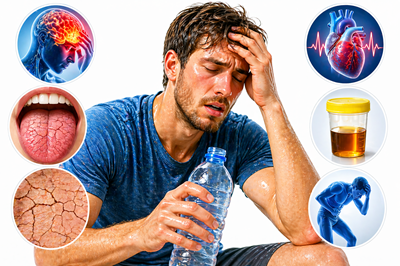
Dehydration does not occur suddenly—it progresses through stages, each with increasing severity. Recognizing early signs is critical for prevention.
Early Signs
- Thirst
- Dry mouth or lips
- Reduced urine output
- Dark yellow urine
- Fatigue or slight dizziness
At this stage, dehydration is easily reversible with fluid intake.
Moderate Dehydration
- Headache
- Increased heart rate
- Irritability or confusion
- Reduced physical performance
- Muscle cramps
Decision-making begins to degrade, increasing risk in survival situations.
 Severe Dehydration
- Extreme weakness
- Rapid breathing
- Lack of sweating despite heat
- Disorientation or confusion
- Potential loss of consciousness
This stage is life-threatening and requires immediate intervention.
Compounding Factors
Dehydration is often worsened by:
- Heat exposure
- Physical exertion
- Illness
- Lack of electrolytes
Managing dehydration is not just about water intake—it may also require electrolyte balance and reduced exertion.
Early recognition allows for timely correction, preventing escalation into more dangerous stages.
1.5 Water Storage vs. Water Sourcing Strategy
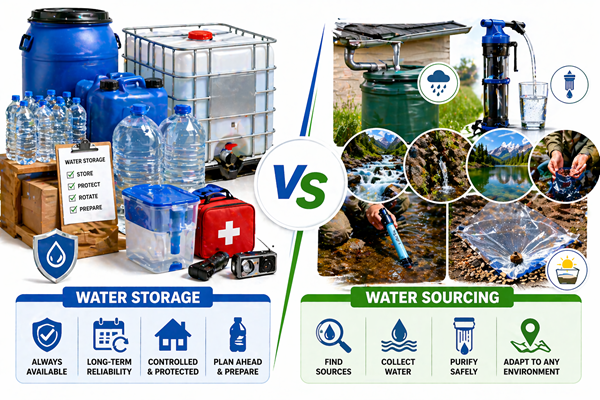 A complete water plan is built on two pillars:
Water Storage
Stored water provides immediate, reliable access. It is your first line of defense.
Advantages:
- Immediate availability
- Known quality
- No processing required
Limitations:
- Finite supply
- Requires space and maintenance
- Vulnerable to contamination if stored improperly
Water Sourcing
Sourcing involves locating and collecting water from the environment.
Advantages:
- Renewable supply
- Adaptable to changing conditions
Limitations:
- Requires knowledge and effort
- Water may be contaminated
- Dependent on environment
Balanced Strategy
Relying solely on storage or sourcing is risky. A resilient approach includes:
- Short-term stored water
- Identified local water sources
- Multiple purification methods
This layered approach ensures continuity even if one system fails.
1.6 Short-Term vs. Long-Term Water Planning
Short-Term Planning
Focused on immediate survival (hours to days):
- Stored water supply
- Portable filtration devices
- Quick purification methods
Long-Term Planning
Focused on sustained survival (weeks to months):
- Renewable water sources
- Scalable purification systems
- Storage and rotation systems
Transition Phase
Most real scenarios involve a transition from short-term to long-term. The goal is to:
- Stabilize using stored water
- Identify and secure a reliable source
- Establish purification and storage systems
Planning for this transition is critical. Many people prepare for one phase but not the other.
1.7 Building a Water Resilience Mindset
Water preparedness is not just about tools—it is about thinking differently.
A resilient mindset includes:
Redundancy
Never rely on a single method. Always have backups.
Adaptability
Conditions change. Systems fail. You must be able to adjust quickly.
Awareness
Know your environment:
- Where water is located
- Seasonal changes
- Risks and contaminants
Conservation
Use water efficiently without compromising health.
Practical Experience
Knowledge alone is not enough. Practice:
- Filtering water
- Building improvised systems
- Identifying sources
Decision-Making Under Pressure
In real scenarios, you may face difficult choices:
- Drink questionable water or risk dehydration
- Stay and purify vs. move to find better sources
Preparation reduces uncertainty and improves decision-making.
1.8 Summary
Water is the most immediate and critical survival resource after air. It supports every essential function in the body and becomes a limiting factor quickly when unavailable.
A complete water strategy includes:
- Understanding your needs
- Recognizing dehydration early
- Balancing storage and sourcing
- Planning for both short-term and long-term scenarios
- Developing a resilient, adaptable mindset
Preparedness is not about having water—it is about ensuring you can always get it, always make it safe, and always use it effectively.
2. Water Sources: Finding Water Anywhere
2.1 Natural Water Sources (Rivers, Lakes, Springs)
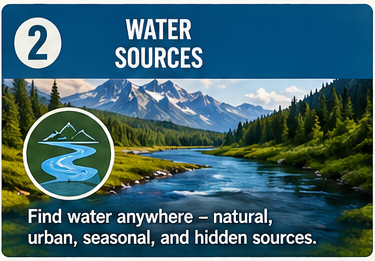 Natural water sources are the most obvious and often the most reliable starting point when sourcing water in the wild. Rivers, lakes, streams, and springs exist because of natural collection and movement of water across the landscape. However, not all natural water is safe, and understanding how to approach these sources is critical.
Flowing water, such as rivers and streams, is generally preferable to stagnant water because movement reduces the buildup of contaminants and limits bacterial growth. Fast-moving water is typically safer than slow-moving or pooled sections, especially those downstream of human activity, agriculture, or animal presence. When collecting from a river or stream, the ideal location is upstream, away from visible contamination sources such as campsites, livestock crossings, or industrial runoff.
Lakes and ponds present a different challenge. Because they are stagnant or slow-moving, contaminants can accumulate over time. Algae growth, sediment buildup, and animal activity all increase risk. If a lake is the only available source, selecting water from deeper areas or areas with minimal surface disturbance can reduce contamination risk, but purification remains essential.
Springs are often considered one of the best natural water sources because they originate from groundwater. A true spring, where water emerges directly from the ground, is often cleaner than surface water. However, even spring water should not be assumed safe without treatment, as contamination can still occur through soil, wildlife, or upstream activity.
Natural sources are valuable, but they require judgment. The key is not just finding water—it is selecting the least risky option available and preparing it properly for use.
2.2 Groundwater & Seep Collection
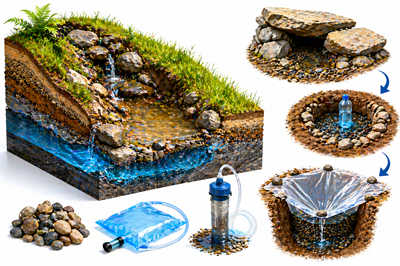 Groundwater is one of the most reliable sources of water because it is naturally filtered as it moves through soil and rock layers. While accessing deep groundwater typically requires wells or equipment, shallow groundwater can often be located and collected with minimal tools.
One common method is identifying areas where water naturally collects below the surface. Low-lying terrain, valleys, and areas with dense vegetation often indicate the presence of groundwater. Digging in these locations, particularly in dry riverbeds or near the base of slopes, can produce water through seepage. The process may take time, as water slowly fills the hole, but it can provide a usable source when surface water is unavailable.
Seep collection is particularly useful in arid environments where visible water is scarce. By digging a small pit and allowing it to fill gradually, sediment settles at the bottom, resulting in clearer water at the top. While this does not make the water safe to drink, it reduces particulate matter and makes subsequent filtration and purification more effective.
Another indicator of groundwater is plant life. Certain types of vegetation, especially those that remain green in dry conditions, often have access to subsurface water. Observing these patterns can help identify where to dig or collect.
Groundwater sources are often cleaner than surface water, but they are not risk-free. Chemical contaminants, bacteria, and parasites can still be present. As with all sources, treatment is required before consumption.
2.3 Rainwater Harvesting (Urban & Wilderness)
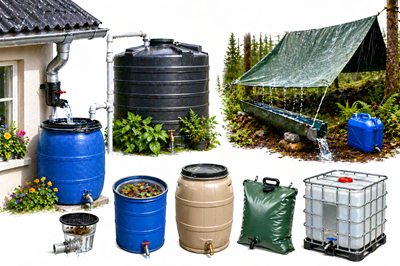 Rainwater is one of the most accessible and renewable water sources available, and when collected properly, it can be one of the safest. Unlike surface water, rainwater begins as distilled water in the atmosphere, free from many of the contaminants found on the ground. However, once it contacts surfaces, it can pick up debris, chemicals, and biological contaminants.
In wilderness environments, rainwater can be collected directly using tarps, plastic sheets, or natural materials shaped to funnel water into containers. Positioning collection systems to maximize surface area and directing flow efficiently can significantly increase yield, even during light rainfall. In forested areas, rainwater can also be collected from leaves and branches, though this may introduce additional contaminants that require filtration.
Urban rainwater harvesting introduces additional considerations. Rooftops, gutters, and collection systems can accumulate dust, chemicals, and pollutants. The first rainfall after a dry period is often the most contaminated, as it washes accumulated debris from surfaces. Allowing this initial runoff to pass before collecting water improves quality.
Rainwater harvesting is highly scalable. Small systems can provide immediate drinking water, while larger systems can support ongoing needs. The key advantage is sustainability—rain continues to replenish the source without depletion.
Despite its relative purity, rainwater should still be treated before use. Environmental pollutants, airborne particles, and collection surface contamination can all introduce risk. Proper filtration and purification ensure that rainwater remains a reliable and safe resource.
2.4 Snow, Ice, and Seasonal Sources
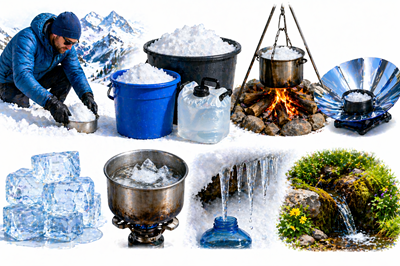 In cold environments, snow and ice can serve as primary water sources, but they come with unique challenges. While frozen water may appear clean, it often contains trapped contaminants, including airborne particles and microorganisms.
Melting snow is one of the most common methods of obtaining water in winter conditions. However, eating snow directly is inefficient and dangerous, as it lowers body temperature and increases the risk of hypothermia. Instead, snow should always be melted before consumption, ideally using a heat source. Adding a small amount of liquid water to the container before melting snow helps prevent scorching and improves efficiency.
Ice is generally a better option than snow because it is more dense and contains more water by volume. Clear ice is preferable to cloudy or discolored ice, as it typically contains fewer impurities. When possible, ice should be collected from flowing water sources rather than stagnant bodies.
Seasonal sources such as snowmelt streams can provide abundant water during certain times of the year. These sources are often cleaner than stagnant water but can still carry contaminants from upstream areas. Monitoring seasonal changes is important, as availability can fluctuate rapidly.
Cold environments reduce bacterial activity, but they do not eliminate contamination. Water from snow and ice must still be treated before drinking. The key advantage of these sources is availability—they can provide a consistent supply when other sources are limited.
2.5 Coastal & Saltwater Considerations
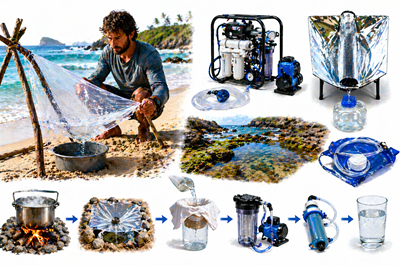 Saltwater presents a unique challenge because it is abundant but not directly usable for hydration. Drinking saltwater accelerates dehydration by increasing the body’s need to eliminate excess salt, making it more dangerous than having no water at all.
In coastal environments, the goal is not to use saltwater directly but to find ways to access fresh water within the environment. One method is identifying freshwater runoff points where rivers or streams meet the ocean. These areas often contain lower salinity levels and may provide usable water upstream.
Another approach is locating natural freshwater lenses. In some coastal regions, rainwater accumulates beneath the surface, forming pockets of freshwater above saltwater. Digging slightly inland from the shoreline, particularly in areas with vegetation, can sometimes access these sources.
Distillation is one of the most reliable methods for converting saltwater into fresh water. By evaporating water and capturing the condensation, salt and most contaminants are left behind. While effective, this process requires time, energy, and equipment, making it less practical without preparation.
Coastal environments often provide other opportunities, such as rainwater collection and groundwater access. The key is understanding that while saltwater is not directly usable, the surrounding environment may still offer viable freshwater sources.
2.6 Urban Water Sources (Buildings, Infrastructure, Hidden Sources)
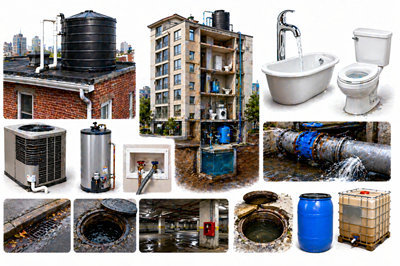 Urban environments contain more water than most people realize, but accessing it requires knowledge and awareness. When municipal systems fail, water can still be found in infrastructure, buildings, and stored systems.
One of the most accessible sources is residential plumbing. Water heaters, pipes, and toilet tanks (not bowls) often contain clean water that can be used in emergencies. These sources are typically overlooked but can provide significant volumes of usable water.
Commercial buildings may contain water in fire suppression systems, storage tanks, and maintenance systems. While accessing these sources may require tools or effort, they can provide valuable reserves when other options are limited.
Public infrastructure such as fountains, swimming pools, and irrigation systems can also serve as water sources. However, these sources often contain chemicals or contaminants and require thorough treatment before use.
Urban environments also present risks. Industrial areas, road runoff, and chemical contamination can make water sources hazardous. Identifying cleaner areas, such as residential zones or parks, improves the likelihood of finding usable water.
The advantage of urban environments is volume—there is often more water available than expected. The challenge is distinguishing between usable and contaminated sources and applying proper treatment methods.
2.7 Emergency Water Sources Most People Overlook
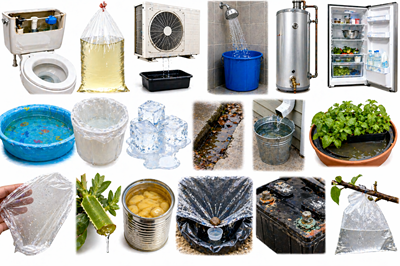 In survival situations, the most valuable water sources are often the ones that are not immediately obvious. These overlooked sources can provide critical support when primary sources are unavailable.
One example is condensation. Water can be collected from surfaces where temperature differences cause moisture to accumulate. This can occur on metal, plastic, or even vegetation under the right conditions. While the volume may be small, it can supplement other sources.
Another overlooked source is food. Many fruits, vegetables, and even meats contain water that contributes to hydration. While not a primary solution, this can extend survival time when water is scarce.
Morning dew is another potential source. By wiping cloth across grass or vegetation and collecting the moisture, small amounts of water can be gathered. This method is labor-intensive but can be useful in extreme conditions.
Man-made materials can also serve as collection tools. Plastic sheets, containers, and debris can be repurposed to capture rainwater or channel water flow. Creativity and adaptability are key in these situations.
The ability to identify unconventional sources is a critical survival skill. It requires awareness, observation, and a willingness to use what is available. In many cases, these overlooked sources provide the margin needed to bridge the gap between scarcity and stability.
2.8 Summary
Water can be found in almost any environment, but it requires knowledge and judgment to locate and use it effectively. Each source presents different advantages and risks, and no single method is sufficient on its own.
A strong water source strategy includes:
- Identifying multiple potential sources
- Selecting the least contaminated option available
- Understanding environmental indicators
- Preparing to treat all collected water
The goal is not just to find water, it is to ensure that you can consistently locate, access, and secure it under any conditions.
3. How to Identify Safe vs. Contaminated Water (Clean Version)
3.1 Types of Water Contamination (Biological, Chemical, Physical)
 Before determining whether water is safe, it is essential to understand what types of contamination may be present. Not all threats are the same, and each type requires a different response. Water contamination generally falls into three categories: biological, chemical, and physical.
Biological contamination is the most common and immediate threat in survival situations. It includes bacteria, viruses, and parasites introduced through animal waste, human sewage, or decaying organic matter. These contaminants are responsible for most waterborne illnesses. The challenge is that they are invisible. Water can appear clean while still containing dangerous microorganisms.
Chemical contamination is more complex and often more dangerous over time. It includes pesticides, industrial chemicals, heavy metals, fuel runoff, and other toxic substances. These contaminants are typically found near agricultural areas, roads, or industrial zones. Unlike biological threats, many chemicals cannot be removed by boiling or basic filtration.
Physical contamination refers to visible particles such as sediment, dirt, debris, and organic material. While these are usually less dangerous on their own, they often indicate the presence of other contaminants. Sediment can also reduce the effectiveness of purification methods by shielding microorganisms.
In real-world conditions, contamination types often overlap. A single water source may contain all three. The objective is not to find perfect water, but to identify the least contaminated source and apply the correct treatment methods.
3.2 Visual Indicators (Color, Sediment, Algae)
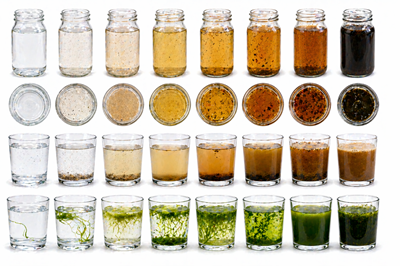 Visual inspection is the first step in assessing water quality. While it cannot confirm safety, it can quickly help eliminate poor choices.
Clear water is generally better than cloudy water, but clarity alone does not guarantee safety. Cloudiness usually indicates suspended particles such as dirt or organic matter. These particles can carry bacteria and reduce the effectiveness of purification.
Color can provide important clues. Brown or reddish water may indicate sediment or mineral content. Green water often signals algae growth. Certain types of algae can produce toxins that are harmful even after treatment. Water with strong or unusual coloration should be approached cautiously.
Surface conditions also matter. Oily films, foam, or unnatural colors can indicate chemical contamination. These are strong warning signs and should be avoided whenever possible.
It is important to understand that many dangerous contaminants are invisible. Water that looks clean can still be unsafe. Visual inspection should be used to rule out the worst options, not to confirm that water is safe.
3.3 Smell & Taste Warning Signs
Smell can provide useful clues about water quality. Unusual odors often indicate contamination.
A sulfur or “rotten egg” smell may suggest the presence of certain bacteria or chemical compounds. A chemical or fuel-like odor can indicate industrial contamination. A strong organic or decaying smell may point to biological activity such as algae or decomposing material.
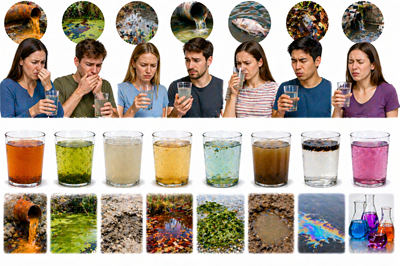 Taste is a less reliable indicator and should not be used as a primary method of assessment. While a bitter or metallic taste may indicate contamination, many dangerous substances have no taste at all. Tasting untreated water carries risk and should only be considered in extreme situations where no alternatives exist.
One of the most common mistakes is assuming that water is safe because it has no smell or taste. Many harmful contaminants cannot be detected this way.
Smell and taste should be treated as warning indicators, not confirmation tools. If water smells unusual, it should be considered higher risk and avoided if possible. If it must be used, it should be treated thoroughly.
3.4 High-Risk Water Sources to Avoid
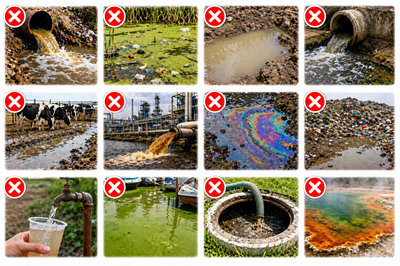 Certain water sources consistently present higher levels of risk and should be avoided whenever possible.
Stagnant water is one of the highest-risk sources. Ponds, swamps, and standing pools allow contaminants to accumulate and create ideal conditions for bacteria and parasites. These sources should only be used as a last resort.
Water located near human activity is also high risk. Areas downstream from settlements, campsites, or sewage discharge are likely to contain biological contamination. Even remote areas can be affected by occasional human use.
Agricultural areas present additional risk. Water near farmland may contain fertilizers, pesticides, and animal waste. These contaminants can be difficult to remove and may pose both short-term and long-term health risks.
Urban and industrial areas are among the most dangerous. Water near roads, factories, or infrastructure may contain fuel residues, heavy metals, and chemicals. These contaminants are often not removable with basic treatment methods.
Animal activity is another important factor. Water sources with heavy animal use are more likely to be contaminated. While animals rely on these sources, their presence increases the risk for humans.
Avoiding high-risk sources is one of the most effective ways to improve water safety. Choosing a better source reduces the need for complex treatment.
3.5 Agricultural, Industrial & Urban Runoff Risks
Runoff is a major source of contamination and is often overlooked. It occurs when rainwater or melting snow carries substances from the land into nearby water sources.
Agricultural runoff can introduce fertilizers, pesticides, and animal waste into water. Fertilizers can promote algae growth, while pesticides introduce toxic chemicals. Animal waste adds bacteria and parasites, increasing the risk of illness.
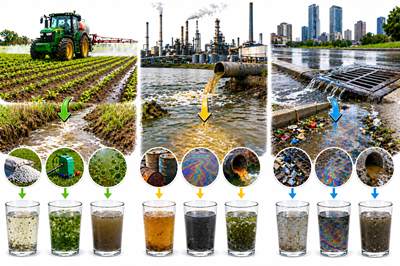 Industrial runoff can contain heavy metals, solvents, and other hazardous substances. These contaminants can persist in the environment and may not be removed by basic filtration or boiling.
Urban runoff includes oil, fuel, metals, and debris from roads and buildings. During rainfall, these substances are washed into drainage systems and natural water sources.
The challenge with runoff is that it is often invisible. Water may appear clean while containing dissolved contaminants.
Understanding what is upstream from a water source is critical. If water flows through agricultural, industrial, or urban areas, the risk of contamination increases significantly.
When runoff is likely, the safest option is to find an alternative source. If that is not possible, treatment must be as thorough as possible, though some risks may remain.
3.6 Animal Activity & Disease Risk Indicators
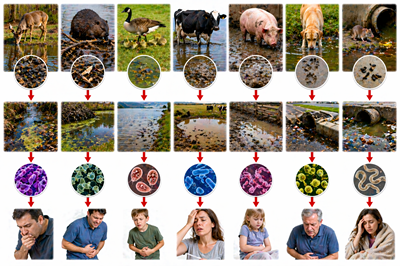 Animal presence can help locate water, but it also increases contamination risk.
Animals introduce bacteria and parasites into water through waste and direct contact. Water sources frequently used by animals are more likely to be contaminated.
Tracks and trails leading to water are common indicators of animal activity. While these signs can help you find water, they also suggest higher risk.
Dead animals near water are a major warning sign. Decomposition releases bacteria and toxins into the water, making it unsafe.
Insects can also provide clues. High concentrations of insects, especially near stagnant water, may indicate poor conditions.
It is important to understand that animals can tolerate water that is unsafe for humans. Their presence does not mean the water is safe.
Water in these areas should always be treated before use, and alternative sources should be considered if available.
3.7 When “Clear Water” Is Still Dangerous
One of the most dangerous assumptions in survival is that clear water is safe.
Many harmful contaminants, including bacteria and viruses, are invisible. Water can look perfectly clean while still being unsafe to drink.
Chemical contamination is even harder to detect. Many chemicals have no color, smell, or taste. Water affected by runoff or pollution may appear normal while containing harmful substances.
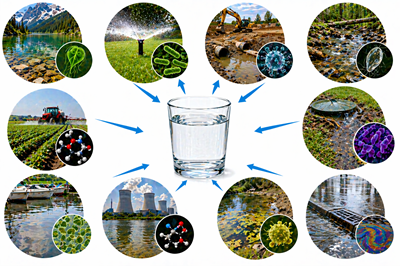 Even remote sources, such as mountain streams, are not guaranteed to be safe. Wildlife, environmental factors, and upstream contamination can all affect water quality.
The key principle is simple: appearance does not equal safety.
Every water source should be treated before consumption, regardless of how clean it looks. This removes uncertainty and reduces risk.
3.8 Summary
Identifying safe water is about making informed decisions based on available information.
A reliable approach includes:
- Understanding the different types of contamination
- Using visual and environmental clues to assess risk
- Avoiding high-risk sources whenever possible
- Recognizing that clear water may still be unsafe
- Treating all water before use
Water safety is a process of risk reduction. The better your assessment, the more effective your treatment will be.
4. Water Filtration Fundamentals
4.1 Filtration vs. Purification (Critical Difference)
 One of the most important concepts in water safety is understanding that filtration and purification are not the same thing. People often use the words interchangeably, but in a survival setting, confusing them can lead to dangerous decisions.
Filtration is the process of removing particles and, in some cases, certain microorganisms from water by passing it through a barrier or medium. Depending on the type of filter, this can include dirt, sediment, organic debris, protozoa, and some bacteria. Filtration improves clarity and can reduce biological risk, but it does not automatically make water safe in every situation.
Purification is a broader process intended to make water safe for drinking by neutralizing or removing harmful pathogens and, in some cases, other contaminants. Purification methods include boiling, chemical treatment, ultraviolet light, and distillation. These methods are designed to address threats that may pass through a filter, especially viruses and some forms of chemical contamination.
This distinction matters because many people assume that if water has been filtered, it is safe. That is not always true. A filter may remove sediment and larger organisms while leaving viruses or dissolved chemicals behind. In a remote mountain stream, filtration alone may be enough if the risk is mostly sediment and protozoa. In an urban flood zone or an area with sewage contamination, filtration alone is often not enough.
A practical water strategy treats filtration and purification as separate but complementary steps. Filtration usually comes first. It removes debris, improves water clarity, and makes purification methods more effective. Purification comes next, especially when the source is questionable or the consequences of illness are high.
The safest mindset is simple: filtration makes water better; purification makes water safer. In many situations, you need both.
4.2 Particle Size & What Filters Actually Remove
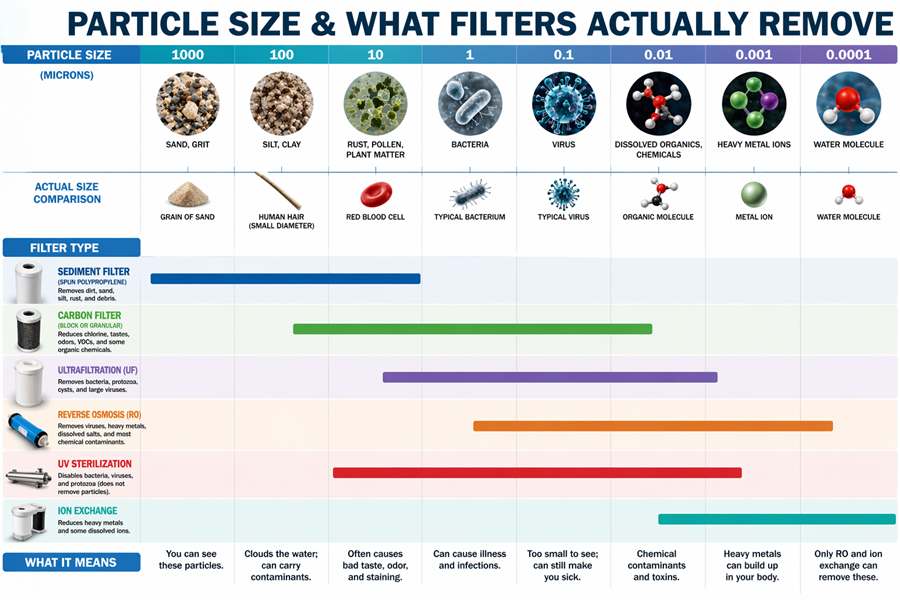 To understand how filters work, it helps to understand particle size. Filters remove contaminants based on how small the openings are in the filter media. The smaller the opening, the smaller the particles the filter can capture.
Large visible particles such as sand, silt, leaves, and insect parts are the easiest to remove. Even a simple cloth pre-filter can catch some of these materials. These contaminants affect the appearance and taste of water, but they are also important because they can protect microorganisms from later treatment.
Protozoa, such as Giardia and Cryptosporidium, are larger than bacteria and are commonly removed by quality backpacking or gravity filters. This is one reason mechanical filters are often effective in wilderness settings where protozoan contamination is a primary concern.
Bacteria are smaller than protozoa and require a finer filter. Many good field filters are designed to remove bacteria, but not all do so equally. The effectiveness depends on the filter’s pore size, condition, and design. A damaged or poorly maintained filter may no longer perform at its intended level.
Viruses are much smaller than bacteria and are the main reason filtration alone is not always enough. Most standard portable filters do not reliably remove viruses. This is especially important in areas with human sewage contamination, disaster zones, dense populations, or compromised sanitation infrastructure.
Dissolved chemicals, salts, and many heavy metals are different again. These are not particles suspended in water in the same way as sediment or microbes. Many of them pass right through basic filters because they are dissolved at the molecular level. Removing them usually requires activated carbon, specialty media, reverse osmosis, or distillation.
This is why no single filter solves every problem. Before relying on a filtration system, you need to understand what it is designed to remove and what it cannot handle. Good decision-making starts with matching the method to the threat.
4.3 Types of Filters (Mechanical, Carbon, Ceramic, Membrane)
Water filters use different materials and designs depending on what they are meant to remove. Understanding the main filter types helps you choose the right tool for the situation.
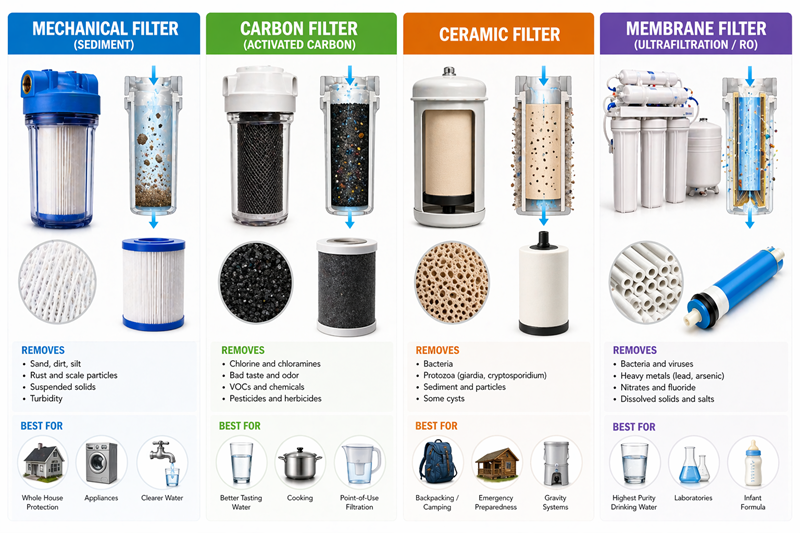 Mechanical filters work by physically trapping particles as water passes through a material. This is the most basic and common form of filtration. Mechanical systems are effective for removing sediment, protozoa, and, in many cases, bacteria. Their performance depends on pore size and build quality. Many portable survival filters fall into this category.
Activated carbon filters work differently. Instead of just blocking particles, carbon attracts and binds certain chemicals, odors, and compounds. This makes carbon useful for improving taste and reducing some pesticides, chlorine, and chemical residues. However, carbon is not usually enough on its own for reliable biological safety. It is best viewed as a supplement to mechanical filtration, not a replacement.
Ceramic filters are a type of mechanical filter known for durability and cleanability. The ceramic material contains tiny pores that block contaminants while allowing water to pass through. These filters can be very effective against sediment, protozoa, and bacteria. One of their advantages is that the outer layer can often be scrubbed clean in the field, restoring flow. Their weakness is that they can crack if dropped or frozen, and a damaged ceramic filter may no longer be safe to use.
Membrane filters use very fine synthetic materials with carefully controlled pore sizes. Hollow-fiber membrane systems are common in portable water filters. They are lightweight and effective against many microorganisms. However, they can be damaged by freezing if water remains inside, and they may clog if used on very dirty water without pre-filtering.
Some systems combine these technologies. A high-quality water filter may use a mechanical membrane for pathogens and activated carbon for taste and certain chemicals. That combination can be very effective, but it still does not guarantee removal of every threat.
The best way to think about filters is in layers. Each type has strengths and limitations. The more you understand those limits, the safer your water decisions will be.
4.4 Portable Filters (Straw, Pump, Gravity Systems)
Portable water filters are among the most useful tools in any preparedness setup because they allow you to treat water where you find it. However, different designs serve different purposes, and each comes with trade-offs.
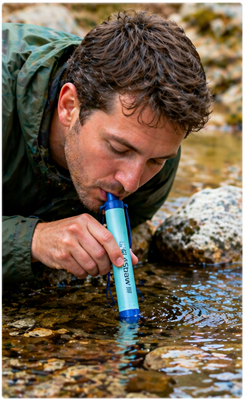 Straw-style filters are compact and simple. They allow you to drink directly from a source or from a container without carrying much extra equipment. Their main advantage is portability. They are lightweight, easy to pack, and useful in emergencies or as a backup. Their biggest limitation is volume. They are not ideal for treating large amounts of water for cooking, hygiene, or group use. They also require you to remain close to the source unless you pair them with another container.
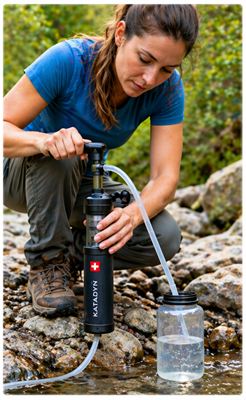 Pump filters are designed to pull water through a filter manually. They are useful when water must be drawn from shallow sources, muddy pools, or awkward locations. Pump systems can be efficient and versatile, especially when you need to fill bottles or containers. The downside is that they require effort, moving parts, and maintenance. In cold or dirty conditions, they may clog or wear faster.
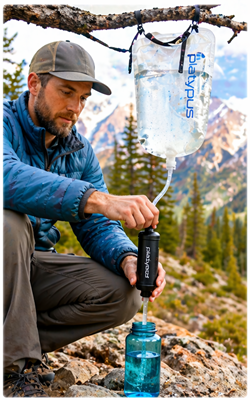 Gravity filters are highly practical for camps, homes, and group use. Water is placed in an upper reservoir and allowed to flow downward through the filter into a clean container. This design reduces effort and allows larger volumes to be processed. Gravity systems are especially useful when you need a steady supply and do not want to spend all day pumping by hand. Their limitations are size, setup time, and reduced portability compared with smaller filters.
No portable system is perfect. A straw filter may be ideal for movement. A pump filter may be ideal for collecting from hard-to-reach sources. A gravity system may be ideal for sustained use at a fixed location. The smartest preparedness plan includes more than one option so you can match the tool to the situation.
4.5 Household Filtration Systems
Household filtration systems are designed for larger-volume, more consistent water treatment. They are useful for home preparedness because they can support daily living, not just emergency drinking.
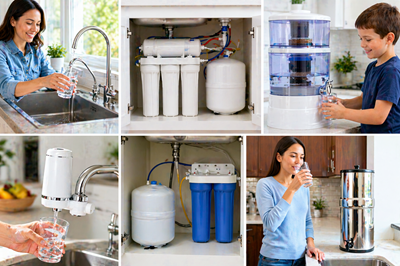 Countertop gravity units are one of the most practical household options. They can process a meaningful amount of water without power and are simple to operate. These systems are well suited for home emergency use because they combine capacity, ease of use, and independence from the grid.
Under-sink filters are common in normal home use and can improve taste and reduce certain contaminants. However, many depend on existing plumbing pressure and may not function during outages or infrastructure failure unless the system is designed with backup access in mind. They can be part of preparedness, but only if their limitations are understood.
Pitcher filters are convenient but limited. They may improve taste and reduce some basic contaminants, but they are not usually designed for high-risk emergency water. They are best seen as convenience tools, not primary survival equipment.
Larger whole-house systems can address water at the point where it enters the home, but these are often expensive, maintenance-heavy, and dependent on infrastructure. They are useful for long-term resilience in stable settings, especially where groundwater or rainwater systems are involved, but they are not usually the first line of defense in a sudden crisis.
The most important factor in household filtration is realism. Many home systems are excellent for improving municipal water quality under normal conditions, but not all are suitable for contaminated emergency sources. A serious home plan should include both a household system for volume and a backup portable method for flexibility.
4.6 Field Maintenance & Filter Lifespan
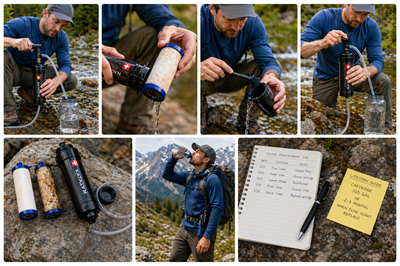 A water filter is only as reliable as its condition. Many failures in real-world use do not happen because the filter was poorly designed. They happen because the filter was neglected, clogged, cracked, frozen, contaminated, or used beyond its service life.
Sediment is one of the biggest enemies of filter performance. Dirty water clogs filter media, slows flow, and increases stress on the system. This is why pre-filtering matters. Letting muddy water settle, straining it through cloth, or collecting from the clearest part of a source can extend filter life significantly.
Many filters require regular cleaning or backflushing. Backflushing forces clean water backward through the filter to clear trapped material. If this maintenance step is ignored, flow rates drop and performance suffers. In a real emergency, a filter that takes too long to use may not be used properly at all.
Freezing is a serious risk for many membrane filters. If water remains inside and freezes, expanding ice can damage the internal structure. The filter may look normal afterward but no longer be safe. In cold conditions, filters often need to be kept inside clothing or sleeping gear to prevent freezing.
Physical damage also matters. Cracks, worn seals, damaged hoses, and contaminated clean-side components can all compromise safety. A good habit is to inspect gear before and after use, not just when something goes wrong.
Every filter has a lifespan. Some are rated by gallons or liters processed. Others decline more gradually depending on water quality and maintenance. Knowing the expected service life of your filter and tracking its use prevents false confidence. A filter that has exceeded its intended life should not be trusted just because water still moves through it.
In preparedness, maintenance is part of readiness. A neglected filter is not backup gear. It is a problem waiting to happen.
4.7 Common Filtration Mistakes
Many water problems do not come from having no filter. They come from using a filter incorrectly. Small mistakes can undo the benefit of good equipment.
One common mistake is assuming all filters remove all threats. This leads people to use standard field filters in environments where viruses or chemicals are the real danger. If you do not understand the limits of your filter, you may trust water that is still unsafe.
Another mistake is skipping pre-filtration when water is heavily contaminated with sediment. Muddy water clogs filters quickly and reduces performance. It also makes later purification steps less effective. Taking a few extra minutes to let sediment settle or strain water through cloth can make a major difference.
Cross-contamination is another frequent problem. Clean containers, filter outlets, and treated water can become re-contaminated if they touch dirty hands, untreated water, or unclean surfaces. This is especially common when people rush or fail to separate dirty and clean equipment.
Poor storage is another issue. Filters left wet for long periods, exposed to freezing temperatures, or packed carelessly can fail when needed most. A filter should be stored according to its design, inspected regularly, and tested before relying on it.
Overconfidence is the most dangerous mistake of all. Water treatment gear is not magic. It is a tool with conditions, limitations, and failure points. The safest users are not the ones with the most expensive filters. They are the ones who understand exactly what their gear can and cannot do.
Good filtration is as much about judgment as equipment. The filter helps, but the user makes the outcome safe or unsafe.
4.8 Summary
Water filtration is one of the core skills of preparedness, but it only works when its limits are understood.
A solid filtration strategy includes:
- Knowing the difference between filtration and purification
- Understanding what different filters remove
- Matching the filter type to the water threat
- Choosing systems based on mobility, volume, and context
- Maintaining filters properly and tracking their lifespan
- Avoiding common mistakes that lead to false confidence
Filtration is not just about cleaner-looking water. It is about reducing risk step by step so that every gallon you process is safer than the one before it.
5. Water Purification Methods
5.1 Boiling (When, How, and Limitations)
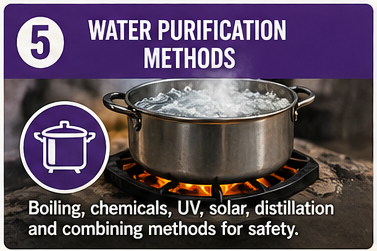 Boiling is one of the most reliable and widely understood methods of water purification. It works by using heat to destroy biological contaminants, including bacteria, viruses, and parasites. When done properly, boiling provides a high level of confidence that water is microbiologically safe.
The process itself is simple in principle but must be done correctly to be effective. Water should be brought to a rolling boil, not just heated or simmered. A rolling boil ensures that the entire volume of water reaches a temperature high enough to neutralize harmful organisms. Once boiling, maintaining that state for a short period provides sufficient treatment under most conditions.
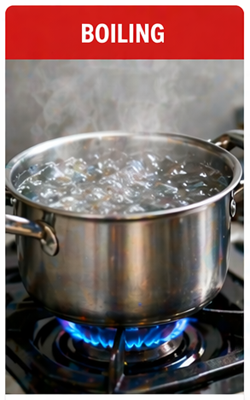 Boiling is particularly valuable because it does not rely on specialized equipment beyond a heat source and a container. This makes it one of the most dependable methods in both wilderness and emergency urban environments. Whether using a stove, fire, or improvised heat source, boiling can be applied in almost any scenario where heat is available.
However, boiling has important limitations. It does not remove chemical contaminants, heavy metals, or sediment. In fact, boiling can concentrate certain chemicals as water evaporates. This makes it less suitable for water suspected of industrial or agricultural contamination. Additionally, boiling does not improve taste and may leave water flat or unpleasant due to the loss of dissolved oxygen.
Another limitation is resource dependency. Boiling requires fuel, time, and a suitable container. In situations where fuel is scarce or movement is required, boiling may not be practical as a primary method.
Despite these limitations, boiling remains one of the most trusted purification methods. It is especially effective when combined with prior filtration to remove sediment and improve overall water quality.
5.2 Chemical Treatment (Chlorine, Iodine, Tablets)
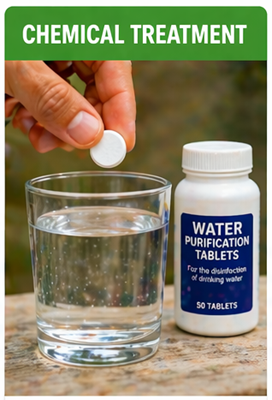 Chemical treatment is a portable and efficient method of water purification that uses disinfectants to neutralize harmful microorganisms. It is widely used in both emergency preparedness and field operations because it requires minimal equipment and can be carried easily.
Chlorine-based treatments are among the most common. They work by disrupting the cellular processes of bacteria and viruses, rendering them inactive. Chlorine is effective against most biological contaminants and is commonly used in municipal water systems. In field use, it is often available in liquid form or as tablets designed for emergency water treatment.
Iodine is another option, functioning in a similar way by targeting microorganisms. It has been used for decades in survival and military applications. However, iodine has some drawbacks, including taste, potential sensitivity in some individuals, and limitations for long-term use.
Tablet-based systems provide convenience and consistency. They are pre-measured, easy to carry, and simple to use. This makes them ideal for bug-out bags, travel kits, and backup systems. However, they require time to work. Water must sit for a specified period after treatment to allow the chemicals to fully neutralize contaminants.
Chemical treatment is effective against most bacteria and viruses but may be less reliable against certain parasites, particularly in cold or heavily contaminated water. It also does not remove sediment or chemical pollutants. For best results, water should be pre-filtered to remove particles before chemical treatment.
Taste is another consideration. Treated water may have a noticeable chemical flavor, which some people find unpleasant. While this does not affect safety, it can impact long-term usability.
Chemical treatment is best viewed as a lightweight, flexible solution. It works well as a primary method in some situations and as a backup in others. Its strength lies in portability and simplicity, especially when other methods are not available.
5.3 UV Purification (Devices & Limitations)
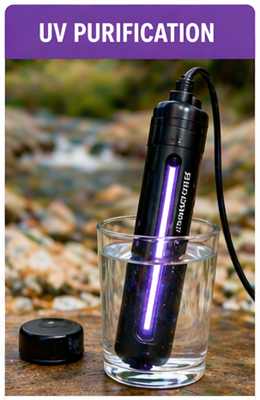 Ultraviolet (UV) purification uses light to neutralize microorganisms by damaging their genetic material. This prevents bacteria, viruses, and parasites from reproducing, effectively rendering them harmless.
UV purification devices are compact and easy to use. They typically consist of a handheld unit that is placed into a container of water. When activated, the device emits UV light for a set period, treating the water. The process is fast and does not require chemicals or heat.
One of the main advantages of UV purification is that it preserves the taste and quality of water. Because it does not introduce chemicals or remove minerals, the water remains close to its original state. This makes it more pleasant to drink over extended periods.
However, UV purification has strict requirements. The water must be clear for the light to penetrate effectively. Suspended particles can block or scatter the light, reducing its ability to reach microorganisms. For this reason, pre-filtration is essential when water is cloudy or contains sediment.
UV devices also depend on power. Batteries or charging systems must be maintained, and failure of the device can leave you without a treatment option. In cold environments, battery performance may decline, further limiting reliability.
Another limitation is that UV does not remove chemical contaminants or physical debris. It addresses biological threats only. This makes it less suitable as a standalone solution in environments where chemical contamination is a concern.
UV purification is a strong option for controlled conditions where water can be pre-filtered and power is available. It is best used as part of a layered approach rather than a single solution.
5.4 Solar Disinfection (SODIS Method)
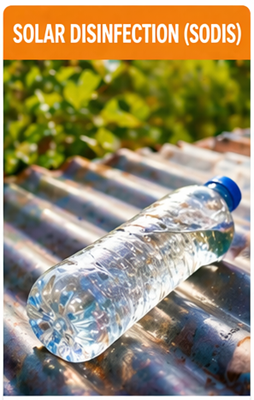 Solar disinfection, often referred to as SODIS, uses sunlight to treat water by combining ultraviolet radiation and heat. It is a low-tech method that can be used when other purification options are unavailable.
The process involves placing water in clear containers and exposing them to direct sunlight for an extended period. The combination of UV radiation and increased temperature helps reduce biological contamination. This method has been used in many parts of the world where access to clean water is limited.
One of the main advantages of solar disinfection is that it requires minimal equipment. As long as clear containers and sunlight are available, the method can be applied. This makes it useful in long-term or resource-limited scenarios.
However, SODIS has significant limitations. It requires time, often several hours, and depends heavily on weather conditions. Cloud cover, low sun angle, and short daylight periods reduce effectiveness. It is also less reliable in cold environments where temperatures do not rise sufficiently.
Water clarity is critical. Like UV devices, solar disinfection requires relatively clear water to work effectively. Turbid water must be filtered before treatment.
SODIS does not remove chemical contaminants or sediment. It is designed primarily to reduce biological risk. As a result, it is best used when no other methods are available or as a supplementary approach.
Solar disinfection is not a first-choice method in most preparedness plans, but it is a valuable fallback when resources are limited and conditions allow.
5.5 Distillation (Removing Heavy Contaminants)
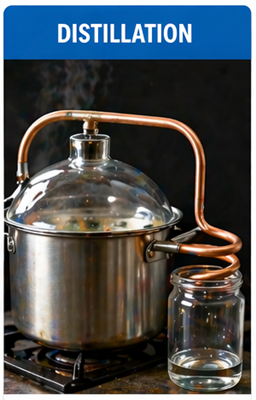 Distillation is one of the most comprehensive water purification methods available. It works by heating water until it evaporates and then capturing the vapor as it condenses back into liquid form. This process separates water from many types of contaminants.
The key advantage of distillation is its ability to remove not only biological contaminants but also many chemical pollutants, salts, and heavy metals. Because these substances do not evaporate with the water, they are left behind during the process.
This makes distillation particularly valuable in environments where chemical contamination is a concern, such as coastal areas, industrial zones, or disaster situations involving unknown pollutants.
However, distillation requires significant energy and time. Heating water to produce vapor and then condensing it is resource-intensive. This limits its practicality in many field situations, especially where fuel is scarce.
Distillation systems can range from simple improvised setups to more advanced equipment. Improvised systems can be built using basic materials, but they are often inefficient and produce limited amounts of water.
Another consideration is that some volatile chemicals may evaporate along with water and require additional steps to remove. While distillation is highly effective, it is not perfect in every scenario.
Distillation is best viewed as a high-level solution for specific conditions where other methods are insufficient. It provides a level of purification that few other methods can match, but it comes at a cost in time and resources.
5.6 Combining Methods for Maximum Safety
No single purification method addresses every possible threat. The most reliable approach is to combine methods to create layers of protection.
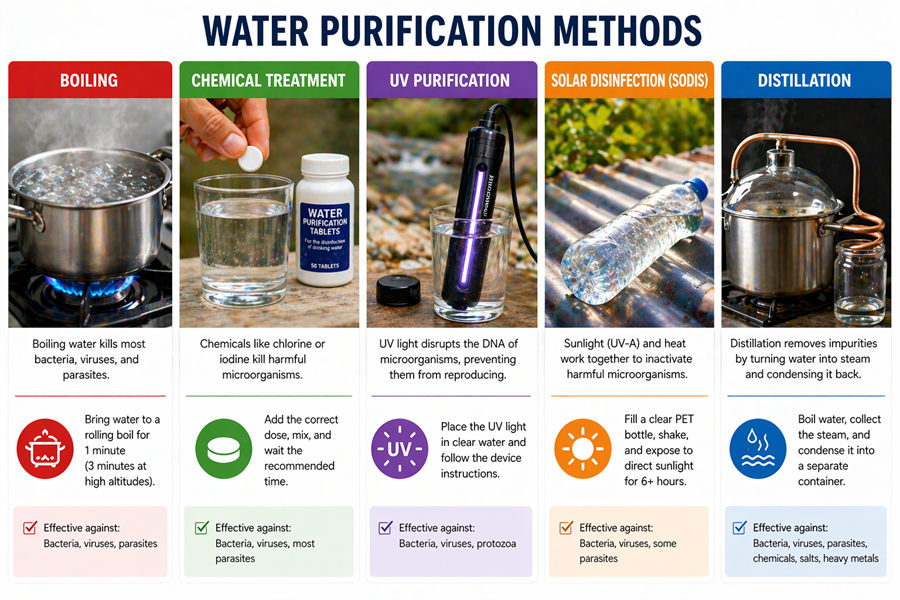
A common strategy begins with filtration to remove sediment and larger contaminants. This improves water clarity and allows purification methods to work more effectively. After filtration, a second step such as boiling, chemical treatment, or UV purification is used to address microorganisms.
In higher-risk environments, additional steps may be required. For example, water suspected of chemical contamination may need to be filtered with activated carbon and then distilled. While this may not always be practical, understanding the options allows for better decision-making.
Combining methods also provides redundancy. If one method fails or becomes unavailable, another can take its place. This is critical in long-term or unpredictable situations.
The goal is not to use every method every time. It is to match the level of treatment to the level of risk. In low-risk environments, filtration followed by boiling may be sufficient. In high-risk environments, multiple layers may be necessary.
Layering methods is one of the most effective ways to reduce uncertainty and increase safety.
5.7 Purification in Extreme Conditions
Extreme conditions introduce additional challenges that affect how water can be purified.
In cold environments, boiling becomes more difficult due to fuel demands and environmental conditions. Filters may freeze, and chemical treatments may become less effective at low temperatures. Keeping equipment warm and allowing additional treatment time becomes important.
In hot environments, dehydration risk increases, and water demand rises. Purification must be efficient and continuous. Chemical treatments may degrade faster in heat, and stored water may require more frequent rotation.
In disaster environments, contamination levels are often higher and more complex. Floodwater, for example, may contain sewage, chemicals, and debris. In these situations, multiple purification steps are often required, and even then, risk may remain.
In mobile scenarios, such as evacuation, portability becomes critical. Lightweight methods such as chemical treatment or compact filters may take priority over more robust but stationary systems.
Extreme conditions highlight the importance of flexibility. There is no single solution that works everywhere. The ability to adapt methods to the environment is what makes a purification strategy effective.
5.8 Summary
Water purification is the step that turns uncertain water into something you can rely on.
A strong purification strategy includes:
- Understanding the strengths and limits of each method
- Matching the method to the type of contamination
- Combining filtration and purification when needed
- Planning for resource limitations such as fuel and time
- Adapting to environmental conditions
No method is perfect, but the right combination can make almost any water source usable.
6. Improvised & Emergency Filtration (DIY Systems, No Gear Scenarios)
6.1 Building a DIY Water Filter (Layered Systems)
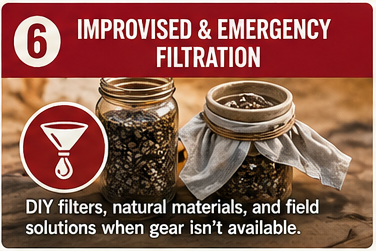 When no commercial filtration equipment is available, a layered filter can be constructed using basic materials found in the environment or salvaged from available resources. While improvised filters are not as precise as manufactured systems, they can significantly improve water quality and make further purification more effective.
A layered filter works by passing water through different materials, each designed to remove progressively smaller contaminants. The typical structure includes coarse material at the top to catch large debris, followed by finer layers to remove smaller particles. The final stage often includes a material that improves clarity and, to a limited extent, reduces odor.
The key to building an effective layered filter is proper arrangement. Larger materials such as gravel or small stones should be placed first to remove leaves, insects, and visible debris. Beneath that, sand or fine soil can capture smaller particles. If available, charcoal can be added as a lower layer to help reduce some impurities and improve taste.
Water should be poured slowly through the system to allow each layer to function effectively. Rushing the process reduces contact time and lowers filtration effectiveness. It is also important to collect the filtered water in a clean container to avoid recontamination.
This type of filter does not make water safe on its own. It is a preparation step that removes sediment and improves clarity. After filtration, the water must still be purified using boiling, chemicals, or another reliable method.
A well-built layered filter is not a replacement for proper equipment, but it is a powerful tool when nothing else is available. It turns unusable water into something that can be treated more effectively.
6.2 Using Sand, Charcoal, and Natural Materials
Natural materials can be used to create effective filtration systems when processed and arranged correctly. Sand, charcoal, and plant-based materials each play a role in improving water quality.
Sand is one of the most effective natural filtration materials. Fine sand can trap small particles and significantly improve water clarity. The tighter the sand layer, the more effective it becomes, but it also slows the flow of water. Finding the right balance between filtration and flow is important.
Charcoal, particularly from hardwood, can help reduce certain impurities and improve taste. It works by binding to some contaminants, although its effectiveness is limited compared to processed activated carbon. For best results, charcoal should be crushed into small pieces to increase surface area.
Plant materials such as grass, cloth, or fibrous bark can serve as pre-filters. They are useful for removing large debris before water reaches finer filtration layers. While these materials do not provide precise filtration, they extend the life and effectiveness of the system by reducing clogging.
Combining these materials creates a more effective system than using any single material alone. Each layer contributes to overall performance, and together they produce cleaner water than any individual component.
It is important to recognize that natural materials vary in quality. Sand may contain organic matter, and charcoal may carry ash or contaminants. Whenever possible, materials should be rinsed before use to improve performance.
Natural filtration is about using what is available to reduce risk. It is not perfect, but it is often the difference between unusable water and water that can be safely purified.
6.3 Cloth Filtration & Pre-Filtering
Cloth filtration is one of the simplest and most accessible methods of improving water quality. It requires minimal resources and can be applied quickly in almost any environment.
The primary purpose of cloth filtration is to remove large particles such as sediment, insects, and debris. By pouring water through fabric, these materials are trapped, resulting in clearer water. This is especially useful when dealing with muddy or heavily contaminated sources.
Multiple layers of cloth increase effectiveness. A single layer may catch only the largest particles, while several layers can improve filtration significantly. The type of fabric also matters. Tightly woven materials perform better than loose or worn fabrics.
Cloth filtration is particularly valuable as a pre-treatment step. Removing large particles before using a filter or purification method improves overall performance. It prevents clogging, increases efficiency, and allows purification methods to work more effectively.
However, cloth filtration does not remove microorganisms or chemical contaminants. It is not a standalone solution for safe drinking water. Its role is to prepare water for further treatment.
Cleanliness is important. Using dirty cloth can introduce additional contaminants into the water. Whenever possible, cloth should be rinsed or cleaned before use.
Despite its simplicity, cloth filtration is one of the most practical tools in emergency situations. It requires no specialized equipment and can be applied immediately, making it a valuable first step in any improvised water system.
6.4 Improvised Boiling & Heating Methods
When standard cooking equipment is unavailable, improvisation becomes necessary. Boiling remains one of the most reliable purification methods, but it requires the ability to heat water effectively.
Containers are often the limiting factor. Metal containers are ideal, but in their absence, alternatives can be used. Thick glass, certain ceramics, and even some types of plastic can tolerate heat under controlled conditions. Care must be taken to avoid cracking or melting.
One effective method is using heated stones. Stones are placed in a fire until hot and then transferred into a container of water. The heat from the stones gradually raises the temperature of the water until it reaches a boil. This method allows water to be heated even in containers that cannot be placed directly over a fire.
Fire management is also critical. A consistent heat source is required to bring water to a boil. Wind, fuel availability, and environmental conditions all affect the process. Building a stable fire and maintaining it long enough to complete the process is essential.
In some situations, solar heating or reflective surfaces can be used to raise water temperature, but these methods are generally less reliable for achieving a full boil.
Improvised boiling methods require time, attention, and resource management. They are not as efficient as standard equipment, but they provide a way to purify water when conventional tools are unavailable.
6.5 Field-Expedient Solutions When You Have Nothing
In extreme situations, you may have no tools, no containers, and no prepared materials. At this point, survival depends on improvisation and the ability to use the environment itself.
Natural depressions, hollowed wood, or rock formations can sometimes serve as containers. These can hold water long enough to allow sediment to settle or to be treated using heated stones.
Improvised collection systems can be created using available materials. Plastic debris, leaves, or even clothing can be used to collect rainwater or channel water into a usable form.
In some environments, digging a small pit near a water source allows cleaner water to seep in while leaving sediment behind. This does not purify the water, but it improves its quality enough to make further treatment more effective.
These solutions are not ideal, and they often require more effort for less output. However, they provide options when none appear to exist. The ability to improvise under pressure is a defining skill in survival situations.
The focus in these scenarios is not perfection. It is doing enough to reduce risk and maintain function until a better solution can be found.
6.6 Multi-Step Improvised Systems
The most effective improvised approach combines multiple steps into a simple system. Each step reduces a different type of risk, and together they produce safer water.
A typical sequence begins with pre-filtration using cloth or natural materials to remove large debris. This is followed by a layered filtration system using sand, charcoal, and other materials to improve clarity. Finally, a purification step such as boiling or chemical treatment is applied.
Each stage improves the effectiveness of the next. Removing sediment allows heat or chemicals to work more efficiently. Clearer water reduces the likelihood of hidden contaminants surviving treatment.
This layered approach mirrors professional systems on a smaller scale. While each individual step may be limited, their combined effect is significantly stronger.
The key is consistency. Skipping steps or rushing the process reduces effectiveness. Even in difficult conditions, taking the time to apply each stage properly increases the likelihood of safe water.
Improvised systems are most effective when treated as processes rather than single actions. The more structured the approach, the better the outcome.
6.7 Limitations of Improvised Methods
Improvised filtration has clear limitations that must be understood to avoid false confidence. While these methods can improve water quality, they do not guarantee safety.
The most important limitation is that improvised filters do not reliably remove microorganisms. Bacteria, viruses, and parasites may still be present after filtration. Without a proper purification step, the water may remain unsafe.
Chemical contamination is another major concern. Improvised systems cannot remove many dissolved chemicals, heavy metals, or pollutants. In environments where chemical contamination is likely, alternative sources should be prioritized whenever possible.
Consistency is also a challenge. Unlike manufactured systems, improvised filters vary in quality depending on materials, construction, and conditions. Results can be unpredictable.
Time and effort are additional factors. Improvised systems often require more work to produce smaller amounts of water. In high-demand situations, this can become a limiting factor.
The most dangerous limitation is overconfidence. Assuming that filtered water is safe without proper purification can lead to serious consequences.
Improvised methods are tools for risk reduction, not complete solutions. They are most effective when combined with proper purification and used with a clear understanding of their limits.
6.8 Summary
Improvised filtration provides a way to improve water quality when standard equipment is unavailable.
A strong improvised approach includes:
- Using layered systems to remove particles
- Combining natural materials for better results
- Pre-filtering to improve effectiveness
- Applying heat or chemical purification after filtration
- Understanding the limits of each method
Improvised systems are not about perfection. They are about making water safer, step by step, until it can be relied on.
7. Backup Strategies When Gear Fails (What to Do When Everything Breaks)
7.1 Redundancy Planning (Primary, Secondary, Tertiary Methods)
 A reliable water strategy is built on redundancy. No single method, tool, or system should ever be your only option. Filters clog, break, or freeze. Chemical supplies run out. Fire may not be available. When one method fails, another must be ready to take its place.
Redundancy means planning in layers. A primary method is what you rely on under normal conditions. This might be a portable filter, a household filtration system, or stored water. A secondary method serves as a backup if the primary fails. This could include chemical treatment, boiling, or a second type of filter. A tertiary method is your last line of defense, often involving improvised solutions or low-resource techniques.
The key is diversity. Using different types of methods reduces the chance that a single failure will eliminate all options. For example, combining filtration, chemical treatment, and boiling provides coverage across a wide range of scenarios. If one fails, the others still function.
Redundancy also applies to equipment. Having multiple containers, spare parts, or additional treatment supplies increases reliability. A single broken component should not end your ability to produce safe water.
Planning redundancy is not about carrying excessive gear. It is about selecting methods that complement each other and provide coverage across different conditions. The goal is simple: no single point of failure.
7.2 What to Do When Filters Break
When a filter fails, the first priority is to confirm whether it is still usable. Some issues, such as clogging, can be resolved through cleaning or backflushing. Others, such as cracks or internal damage, may render the filter unsafe.
If a filter is clogged, cleaning it can restore performance. This may involve rinsing, scrubbing, or reversing the flow of water through the system. Pre-filtering water before use can prevent future clogging and extend the life of the filter.
If the filter is physically damaged, it should not be trusted. Cracks or compromised seals allow untreated water to bypass the filtration media, making the output unreliable. In these cases, the filter should be considered unusable.
When a filter is no longer an option, the focus shifts to alternative methods. Boiling becomes one of the most reliable replacements, provided a heat source is available. Chemical treatment is another option, especially when portability is required.
Improvised filtration can still play a role. While it does not replace a proper filter, it can remove sediment and improve water quality before applying a purification method.
The key is to transition quickly. A failed filter is not the end of your water system—it is a signal to switch methods and continue processing water using other available options.
7.3 No-Fire Purification Options
Fire is one of the most dependable ways to purify water, but it is not always available. Wet conditions, lack of fuel, movement requirements, or security concerns can make fire impractical or impossible.
In these situations, chemical treatment becomes one of the primary alternatives. Chlorine-based solutions or purification tablets can be used to disinfect water without heat. These methods are lightweight, portable, and effective against most biological threats when used correctly.
Ultraviolet purification devices are another option if power is available. They provide fast treatment and are easy to use, but they depend on clear water and functioning equipment.
Solar disinfection can also be used in environments with strong sunlight. While slower and less reliable, it provides a low-resource option when other methods are unavailable.
When none of these options are available, risk management becomes critical. Pre-filtration, settling, and selecting the best possible source can reduce contamination levels. While this does not guarantee safety, it improves outcomes when no direct purification method is possible.
No-fire scenarios require flexibility. The goal is to maintain the ability to treat water without relying on a single resource.
7.4 No-Chemical Backup Options
Chemical treatments are effective, but they are finite. Once supplies are exhausted, alternative methods must be used.
Boiling becomes the primary backup when chemicals are no longer available. It provides reliable purification as long as a heat source and container are available. In long-term scenarios, maintaining the ability to boil water is essential.
UV purification can serve as a chemical-free option if the device is functional and power is available. However, reliance on electronics introduces its own risks.
Improvised distillation can also be used in certain situations. While resource-intensive, it provides a way to remove a wide range of contaminants, including some chemicals and salts.
Natural filtration and settling can improve water quality, but they must be followed by a purification step. Without chemicals, this usually means boiling or distillation.
Planning for no-chemical scenarios means ensuring that at least one reliable, non-chemical purification method is always available. This prevents dependency on consumable supplies.
7.5 Last-Resort Survival Decisions
There may be situations where no safe water source is available and no reliable purification method can be applied. In these cases, difficult decisions must be made.
Dehydration progresses quickly and can become life-threatening. In some situations, the risk of dehydration may outweigh the risk of consuming contaminated water. This is not a decision to be taken lightly, but it is a reality in extreme conditions.
When forced to use questionable water, every possible step should be taken to reduce risk. This includes selecting the least contaminated source, allowing sediment to settle, filtering through available materials, and using any available treatment method, even if incomplete.
Small amounts of water may be consumed gradually rather than large quantities at once. This can reduce immediate stress on the body and allow for monitoring of symptoms.
The goal in these situations is not to eliminate risk, but to manage it. Survival often involves choosing the least dangerous option available.
Preparation reduces the likelihood of reaching this point, but understanding how to respond if it happens is part of a complete strategy.
7.6 Risk Management: Drink vs. Don’t Drink
One of the most critical decisions in a survival situation is whether to consume questionable water. This decision requires balancing two risks: dehydration and contamination.
Dehydration reduces physical and mental performance quickly. It limits mobility, decision-making, and the ability to respond to changing conditions. In hot environments or during exertion, dehydration can become critical within hours.
Contaminated water introduces the risk of illness. Depending on the type of contamination, symptoms may develop within hours or days. In some cases, illness can be severe enough to prevent further movement or self-care.
The decision to drink or not drink depends on the situation. If safe water is likely to be found soon, it may be better to wait. If conditions are worsening and no alternative is available, consuming treated or partially treated water may be necessary.
Understanding the environment, available resources, and personal condition helps guide this decision. There is no universal answer. Each situation requires assessment and judgment.
Risk management is about making informed choices, not perfect ones. The goal is to maintain function and extend survival long enough to reach a better solution.
7.7 Decision-Making Under Pressure
In real-world scenarios, decisions about water are often made under stress. Time pressure, fatigue, and uncertainty can lead to mistakes.
Preparation reduces this pressure by providing clear options and practiced responses. Knowing your methods, understanding your equipment, and having a plan allows you to act quickly without hesitation.
Situational awareness is critical. Observing the environment, identifying potential sources, and recognizing risks improves decision-making. Small details, such as water movement or nearby activity, can influence outcomes.
Maintaining discipline is equally important. Skipping steps, rushing processes, or ignoring warning signs increases risk. Even under pressure, following a structured approach improves safety.
Confidence comes from experience. Practicing filtration, purification, and improvisation in controlled settings builds familiarity and reduces uncertainty during real events.
Decision-making under pressure is not about being perfect. It is about being consistent, informed, and adaptable. The better your preparation, the more effective your decisions will be when it matters most.
7.8 Summary
Backup strategies ensure that water access continues even when primary systems fail.
A strong backup plan includes:
- Multiple layers of redundancy
- Clear alternatives for each method
- The ability to operate without fire or chemicals
- Understanding of last-resort options
- Strong decision-making under pressure
Failure is part of any system. Preparedness is about ensuring that failure does not stop you.
8. Water Storage & Transport (How to Keep Water Safe and Move It Efficiently)
8.1 Safe Storage Containers (Short vs. Long-Term)
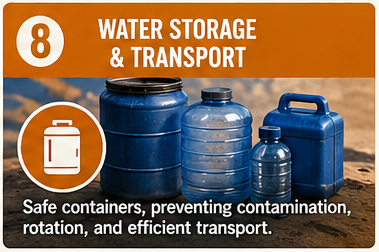 Choosing the right container is one of the most important factors in maintaining water safety. A container is not just a holding vessel—it becomes part of your water system. The wrong container can contaminate water, degrade over time, or fail when you need it most.
Short-term storage focuses on immediate access and convenience. Bottles, canteens, and portable containers are designed for mobility and frequent use. These are typically lightweight, easy to handle, and suitable for daily rotation. However, they are not always designed for long-term durability or extended storage without maintenance.
Long-term storage requires a different approach. Containers must be durable, resistant to environmental conditions, and capable of maintaining water quality over time. Larger containers such as dedicated water storage tanks, sealed barrels, or heavy-duty jugs are commonly used for this purpose. These systems are designed to minimize exposure to light, air, and contaminants.
Material matters. Containers designed for water storage are made from materials that do not leach chemicals or degrade easily. Using containers that were previously used for other substances introduces risk, even if they appear clean. Residual chemicals can remain and contaminate stored water.
Sealing is equally important. A secure, tight-fitting lid prevents contamination from dust, insects, and airborne particles. It also reduces the chance of accidental spillage or evaporation.
A well-planned system includes both short-term and long-term containers. One provides immediate usability, while the other ensures sustained supply. Together, they form a complete storage strategy.
8.2 Preventing Contamination in Stored Water
Storing water is only effective if the water remains safe over time. Contamination can occur even after proper purification if storage practices are not controlled.
The first step in preventing contamination is ensuring that containers are clean before use. Even new containers may contain residues from manufacturing or storage. Cleaning and rinsing containers before filling them reduces the risk of introducing contaminants.
Handling is another critical factor. Water can be recontaminated through contact with unclean hands, tools, or surfaces. Pouring water instead of dipping into containers helps reduce this risk. If water must be accessed frequently, using a dedicated dispensing method improves safety.
Environmental exposure also plays a role. Light, heat, and air can all affect stored water. Direct sunlight promotes the growth of microorganisms, while heat can accelerate chemical changes. Storing water in a cool, dark place helps maintain quality.
Sealed containers reduce the risk of contamination, but they are not immune to failure. Over time, seals can degrade, and containers can develop small leaks or openings. Regular inspection helps identify issues before they become significant problems.
Cross-contamination is one of the most common failures. Mixing untreated water with treated water, even in small amounts, can compromise the entire supply. Clear separation between untreated and treated water is essential.
Preventing contamination is about maintaining control. Once water is safe, every step afterward should be designed to keep it that way.
8.3 Rotation & Shelf Life of Stored Water
Stored water does not remain unchanged indefinitely. While properly stored water can last a long time, rotation ensures that it remains fresh and reliable.
Rotation involves replacing stored water at regular intervals. This prevents stagnation, reduces the risk of contamination, and ensures that containers remain in good condition. A simple system of labeling and tracking helps maintain consistency.
Shelf life depends on storage conditions. Water stored in clean, sealed containers and kept in stable conditions can remain usable for extended periods. However, environmental factors such as heat, light, and container quality can shorten this timeframe.
Even when water remains safe, it may develop an off taste over time. This is often due to changes in dissolved gases rather than contamination. While not harmful, it can affect usability. Aerating the water by pouring it between containers can improve taste.
Rotation also provides an opportunity to inspect containers and identify potential issues. Cracks, leaks, or degraded seals can be addressed before they lead to failure.
In a preparedness context, rotation is not just maintenance—it is assurance. It ensures that stored water is not just present, but ready to use when needed.
8.4 Transporting Water Efficiently
Transporting water is physically demanding and often underestimated. Water is heavy, and moving it requires planning and efficiency.
The first consideration is container size. Smaller containers are easier to carry and manage, especially over distance or uneven terrain. Larger containers hold more water but can become difficult to move once filled. A combination of sizes allows for flexibility.
Carrying methods also matter. Handles, straps, and balanced loads reduce strain and improve efficiency. Distributing weight evenly prevents fatigue and allows for longer movement without injury.
Route planning is another factor. Identifying the shortest and safest path between the water source and storage location reduces effort and risk. In some cases, multiple smaller trips may be more practical than a single heavy load.
In group scenarios, coordination improves efficiency. Assigning roles, staggering trips, and maintaining a steady flow of water can support larger operations.
Transport is not just about movement—it is about maintaining water quality during that movement. Containers should remain sealed, and care should be taken to avoid contamination during handling.
Efficient transport extends your reach. It allows you to access better water sources and maintain supply even when conditions are difficult.
8.5 Bug-Out vs. Homestead Water Strategy
Water strategy changes depending on whether you are mobile or stationary. Each scenario requires a different approach.
In a bug-out situation, mobility is the priority. Carrying large amounts of water is often impractical due to weight. The focus shifts to carrying enough for immediate needs and having the ability to source and treat water along the way. Lightweight containers, portable filters, and compact purification methods become essential.
In a homestead or fixed-location scenario, storage becomes the primary focus. Larger volumes of water can be stored and maintained over time. Systems can be established to collect, filter, and store water in a more controlled environment. Efficiency and sustainability are key.
The transition between these two states must also be considered. A plan that works at home may not translate directly to movement. Having adaptable systems ensures continuity.
A strong preparedness plan accounts for both scenarios. It provides the ability to operate independently at a fixed location while maintaining the flexibility to move when necessary.
8.6 Large-Scale Storage Systems
Large-scale storage provides long-term stability and reduces dependence on external sources. These systems are designed to hold significant volumes of water and support extended use.
Common approaches include tanks, barrels, and integrated storage systems. These containers are often positioned in locations that protect them from environmental exposure and allow for easy access.
One of the key considerations is placement. Storage systems should be located in areas that remain cool and shaded. Elevation can also play a role, allowing gravity to assist in water distribution.
Maintenance is critical. Large systems require periodic inspection, cleaning, and monitoring to ensure continued safety. Sediment buildup, algae growth, and container degradation can all affect water quality.
Access and distribution must also be considered. A system that holds large amounts of water but cannot be easily accessed or distributed is of limited use. Valves, spigots, and controlled dispensing improve usability.
Large-scale storage is a long-term investment in resilience. It provides a buffer against disruption and supports sustained independence when properly maintained.
8.7 Hidden & Distributed Water Storage
Relying on a single storage location introduces risk. Damage, contamination, or loss of that location can eliminate your entire supply. Distributing water storage reduces this risk.
Hidden storage involves placing water in locations that are not immediately visible or obvious. This can protect supplies from theft, damage, or environmental exposure. It also provides backup options if primary storage is compromised.
Distributed storage spreads water across multiple locations. This ensures that a single failure does not affect the entire system. Smaller containers placed in different areas provide redundancy and flexibility.
Accessibility is important. Hidden or distributed storage must still be reachable when needed. A balance must be maintained between security and usability.
Tracking is also essential. Knowing where water is stored and in what quantity prevents confusion and ensures that resources are used effectively.
Distributed storage is about resilience. It creates a system that can absorb loss and continue functioning, even under difficult conditions.
8.8 Summary
Water storage and transport are essential for maintaining a reliable supply.
A strong strategy includes:
- Using appropriate containers for short-term and long-term needs
- Preventing contamination through proper handling and storage
- Rotating water to maintain quality
- Transporting water efficiently and safely
- Adapting strategies for both mobile and fixed scenarios
- Building large-scale storage where possible
- Distributing storage to reduce risk
Water is not just something you find—it is something you manage. The better you manage it, the more reliable your entire system becomes.
9. Water for Hygiene & Medical Use (Critical for Preventing Illness)
9.1 Clean Water for Wound Care
 In any survival situation, even minor wounds can become serious if not treated properly. Clean water plays a central role in preventing infection and supporting healing. Dirt, bacteria, and debris introduced into a wound can quickly lead to complications, especially when medical care is limited.
The primary purpose of water in wound care is irrigation. Flushing a wound removes foreign material and reduces the number of bacteria present. This process is often more important than the application of topical treatments. A wound that is not properly cleaned is far more likely to become infected, regardless of what is applied afterward.
Water used for wound care should be as clean as possible. Ideally, it should be purified water that has been boiled, chemically treated, or otherwise made safe. If purified water is not available, the cleanest possible source should be used, and additional care should be taken to monitor for signs of infection.
Pressure matters. Gently flushing a wound with a steady stream of water is more effective than soaking. This helps dislodge contaminants without forcing them deeper into the tissue. Repeated irrigation may be necessary depending on the severity of the wound.
Using contaminated water on an open wound introduces risk, but leaving debris in place may be worse. When forced to choose, removing visible contamination is usually the priority, followed by monitoring and further treatment when better resources become available.
Clean water is not just helpful in wound care—it is essential. It is often the difference between a manageable injury and a serious infection.
9.2 Preventing Infection Through Hygiene
In survival conditions, hygiene is one of the most effective ways to prevent illness. Water is the primary tool for maintaining hygiene, and its use extends far beyond basic comfort.
Hand hygiene is the most important practice. Hands come into contact with food, surfaces, tools, and wounds. Without regular cleaning, they become a primary pathway for infection. Washing hands before eating, after handling waste, and before treating injuries significantly reduces the spread of harmful microorganisms.
Body hygiene also plays a role. Sweat, dirt, and bacteria accumulate over time, especially in demanding conditions. While full bathing may not always be possible, targeted cleaning of high-risk areas helps maintain health and comfort.
Clothing and equipment should not be overlooked. Dirty clothing can harbor bacteria and contribute to skin infections. Cleaning tools and surfaces used for food preparation or medical care reduces cross-contamination.
Water use for hygiene must be balanced with availability. In limited conditions, small amounts of water used consistently are more effective than occasional large amounts. Prioritizing key hygiene practices ensures that water is used where it has the greatest impact.
Hygiene is often neglected when resources are tight, but it is one of the most effective forms of prevention. Maintaining basic cleanliness reduces the likelihood of illness and supports overall resilience.
9.3 Hand Washing Without Running Water
In many scenarios, running water is not available, but hand hygiene must still be maintained. Effective hand washing can be achieved with minimal resources when proper techniques are used.
A small amount of water, combined with soap if available, can be used to clean hands thoroughly. The key is method rather than volume. Rubbing all surfaces of the hands, including between fingers and under nails, removes contaminants effectively.
When water is limited, a controlled pouring method can be used. One container is used to pour water over the hands while another collects runoff. This minimizes waste and allows for repeated use in a controlled manner.
Soap improves effectiveness by breaking down oils and helping remove microorganisms. If soap is not available, friction and water alone still provide significant benefit. In some cases, ash or other abrasive materials can be used carefully to assist with cleaning.
Drying is also important. Clean cloth or air drying reduces the chance of recontamination. Using dirty materials to dry hands can undo the benefits of washing.
Maintaining hand hygiene without running water requires discipline and consistency. Small, regular cleaning efforts are more effective than infrequent attempts. This practice plays a critical role in preventing the spread of disease.
9.4 Waste Management & Sanitation
Improper waste management is one of the fastest ways to contaminate water sources and spread disease. In survival situations, sanitation must be actively managed to protect both individuals and the surrounding environment.
Human waste should be kept as far away from water sources as possible. Distance reduces the risk of contamination through runoff, especially during rain. Selecting appropriate locations for waste disposal is one of the first steps in establishing a safe environment.
Water is often used in sanitation practices, but it must be applied carefully. Using clean water to maintain hygiene after waste handling reduces the spread of bacteria. However, contaminated water should never be introduced into areas used for drinking or food preparation.
Simple sanitation systems can be established with minimal resources. Designated areas for waste, combined with basic hygiene practices, create a controlled environment that reduces risk.
The relationship between waste and water is direct. Poor sanitation leads to contaminated water, which leads to illness. Managing one effectively protects the other.
Sanitation is not just about cleanliness—it is about preventing the conditions that allow disease to spread.
9.5 Waterborne Illness Prevention
Waterborne illnesses are among the most common and dangerous threats in survival situations. They are caused by consuming or coming into contact with contaminated water and can lead to symptoms that quickly reduce a person’s ability to function.
Common effects include gastrointestinal distress, dehydration, weakness, and in severe cases, life-threatening complications. In a survival context, even mild illness can become serious due to limited resources and increased physical demands.
Prevention begins with proper water treatment. Drinking untreated water is one of the fastest ways to become ill. Even when water appears clean, it should be filtered and purified whenever possible.
Hygiene practices also play a major role. Contaminated hands, tools, or surfaces can transfer pathogens even when water itself is safe. Maintaining cleanliness reduces the risk of indirect contamination.
Food preparation is another factor. Using contaminated water to prepare food introduces risk, even if the food itself is safe. Ensuring that all water used in cooking and cleaning is treated helps prevent this.
Monitoring symptoms is important. Early signs of illness should be taken seriously, and hydration should be maintained to prevent further complications.
Preventing waterborne illness is not a single action—it is a system of practices that work together to reduce risk.
9.6 Field Sanitation Systems
Establishing a basic sanitation system in the field improves safety and organization. Even simple structures and routines can significantly reduce the spread of contamination.
A field sanitation system begins with separation. Areas for water collection, food preparation, waste disposal, and sleeping should be clearly defined and kept apart. This reduces the chance of cross-contamination.
Water used for hygiene should be managed separately from drinking water. Using designated containers for different purposes helps maintain control and prevents accidental mixing.
Drainage and runoff should be considered. Water used for cleaning or washing should be directed away from living areas and water sources. This prevents contamination from spreading through the environment.
Regular routines improve effectiveness. Establishing consistent practices for cleaning, waste management, and water use creates a stable system that supports health over time.
Field sanitation does not require complex equipment. It requires planning, awareness, and discipline. These systems form the foundation of a safe and sustainable environment.
9.7 Medical Priorities When Water Is Limited
In situations where water is scarce, difficult decisions must be made about how it is used. Medical needs often compete with hydration and hygiene, requiring careful prioritization.
The first priority is maintaining hydration. Without adequate water intake, all other functions decline. Medical treatment becomes less effective if the body is already compromised by dehydration.
The second priority is wound care. Preventing infection in open wounds reduces the risk of serious complications. Even small amounts of clean water used for irrigation can make a significant difference.
Hygiene remains important, but it may need to be adjusted based on available resources. Focus should be placed on critical areas such as hands, face, and any areas at risk of infection.
Water used for medical purposes should be as clean as possible. If necessary, it should be purified before use, even if that requires additional time or resources.
Conservation becomes essential. Using water efficiently ensures that limited supplies last longer and support multiple needs.
When water is limited, every use must be intentional. Prioritizing correctly ensures that the most critical needs are met first, maintaining health and increasing the chances of recovery.
9.8 Summary
Water for hygiene and medical use is essential for preventing illness and maintaining health.
A strong approach includes:
- Using clean water for wound care and infection prevention
- Maintaining hygiene to reduce disease transmission
- Adapting hand washing and sanitation practices to available resources
- Managing waste to protect water sources
- Preventing waterborne illness through consistent practices
- Establishing basic sanitation systems
- Prioritizing water use when resources are limited
Water is not only for drinking—it is a critical tool for staying healthy and functional.
10. Advanced Water Strategies (Off-Grid Systems, Long-Term Sustainability)
10.1 Off-Grid Water Systems (Wells, Pumps, Gravity Systems)
 Off-grid water systems are designed to provide a reliable supply without dependence on municipal infrastructure. These systems allow you to access and manage water directly, making them one of the most valuable long-term preparedness investments.
Wells are one of the most common off-grid solutions. They access groundwater that has been naturally filtered through soil and rock. When properly constructed, wells can provide a consistent and renewable water source. However, access depends on depth, location, and equipment. Electric pumps are common, but they introduce dependency on power.
Manual pumps provide an alternative that does not rely on electricity. They require physical effort but offer reliability when power systems fail. In many setups, combining electric and manual options provides flexibility, allowing the system to function under a wide range of conditions.
Gravity systems are another powerful approach. By storing water at a higher elevation, gravity can be used to distribute water without pumps. This reduces complexity and eliminates reliance on mechanical systems. Gravity-fed systems are particularly effective when paired with rainwater collection or elevated storage tanks.
Each system has strengths and limitations. Wells provide depth and consistency, pumps provide access, and gravity provides distribution. A well-designed system often combines these elements to create a stable and resilient water supply.
10.2 Rainwater Collection Systems (Permanent Setups)
Rainwater collection is one of the most accessible and sustainable long-term water strategies. Unlike stored water, it replenishes naturally, making it a reliable source when managed correctly.
Permanent rainwater systems are built to capture, direct, and store water efficiently. Roof surfaces are commonly used as collection areas, with gutters and downspouts channeling water into storage containers. The size of the collection surface directly affects the amount of water that can be gathered.
Pre-filtration is an important part of the system. Debris such as leaves, dirt, and insects must be removed before water enters storage. This reduces contamination and simplifies later treatment.
Storage is typically handled through tanks or barrels designed for long-term use. These containers must be sealed and protected from light to prevent contamination and biological growth. Overflow management is also important to prevent damage and maintain system stability during heavy rainfall.
Rainwater systems are highly adaptable. They can be scaled from small setups for individual use to larger systems that support entire households. The key is consistency—capturing water whenever it is available and maintaining the system over time.
While rainwater is relatively clean, it still requires treatment before drinking. However, its accessibility and renewability make it one of the most valuable long-term resources.
10.3 Water Caching & Hidden Reserves
Water caching involves storing water in multiple locations to ensure access under different conditions. This strategy reduces risk and provides flexibility in both stationary and mobile scenarios.
Caches can be placed near travel routes, backup locations, or areas where water access is uncertain. By distributing supplies, you avoid relying on a single source that could be compromised or inaccessible.
Hidden reserves provide an additional layer of security. Concealed storage protects water from theft, damage, or environmental exposure. It also ensures that backup supplies remain available if primary systems fail.
Planning is critical. Cache locations should be chosen based on accessibility, environmental conditions, and long-term stability. Containers must be durable and properly sealed to maintain water quality over time.
Tracking is also important. Knowing where water is stored and how much is available prevents confusion and ensures that resources are used effectively.
Water caching is about creating options. It ensures that no matter where you are or what conditions you face, there is always a fallback supply available.
10.4 Community Water Planning
Water systems become more complex when multiple people are involved. Community water planning focuses on managing shared resources to support a group over time.
The first step is identifying available sources. This includes natural sources, stored water, and collection systems. Understanding the capacity and limitations of each source allows for better planning.
Distribution is another key factor. Water must be allocated in a way that meets the needs of the group while preventing waste. Clear roles and responsibilities help maintain consistency and reduce confusion.
Sanitation and hygiene must also be managed at the community level. Shared water sources increase the risk of contamination, making proper handling and treatment essential.
Communication plays a major role. Everyone involved must understand the system, follow established practices, and contribute to maintenance. A well-organized group can manage water efficiently, while poor coordination can lead to shortages and contamination.
Community planning transforms water from an individual responsibility into a shared system. When managed correctly, it increases resilience and supports long-term survival.
10.5 Water Security & Protection
Water is a critical resource, and in certain situations, it may need to be protected. Security involves both physical protection and maintaining control over access.
Physical protection includes safeguarding storage containers and collection systems from damage. This may involve placing systems in secure locations, reinforcing structures, or using barriers to prevent tampering.
Environmental protection is equally important. Exposure to sunlight, heat, and contamination can degrade water quality. Proper placement and maintenance reduce these risks.
Access control is another consideration. Limiting access to trusted individuals prevents misuse and ensures that water is used responsibly. This is particularly important in group settings where demand may exceed supply.
Monitoring systems help identify problems early. Regular checks for leaks, contamination, or damage allow for timely intervention.
Water security is not about restricting use unnecessarily. It is about ensuring that the resource remains available and safe for those who depend on it.
10.6 Long-Term Sustainability Planning
Sustainability focuses on maintaining water access over extended periods without depleting resources. This requires balancing supply, demand, and environmental conditions.
The first step is understanding consumption. Knowing how much water is used daily allows for better planning and resource management. Reducing unnecessary use extends the life of available supplies.
Renewable sources are central to sustainability. Rainwater collection, groundwater access, and natural sources provide ongoing supply when managed correctly. Protecting these sources ensures that they remain viable over time.
Maintenance is also critical. Systems must be inspected, cleaned, and repaired regularly to prevent failure. Small issues can become major problems if left unaddressed.
Adaptability is another key factor. Environmental conditions change, and systems must be adjusted accordingly. Seasonal variations, weather patterns, and usage changes all affect water availability.
Sustainability is not a fixed state. It is an ongoing process of management and adjustment. The goal is to create a system that continues to function under changing conditions.
10.7 Reducing Water Dependency
Reducing water dependency is one of the most effective ways to increase resilience. By lowering demand, you extend the usefulness of available resources and reduce stress on your system.
Efficiency begins with usage habits. Using only what is necessary and avoiding waste makes a significant difference over time. Small changes in behavior can lead to large improvements in conservation.
Alternative methods can also reduce water use. For example, using dry cleaning techniques, minimizing water-intensive tasks, and reusing water where appropriate all contribute to conservation.
System design plays a role as well. Efficient storage, controlled distribution, and targeted use reduce losses and improve overall performance.
Reducing dependency does not mean eliminating water use. It means using water intelligently and ensuring that every use supports overall sustainability.
In long-term scenarios, conservation is as important as supply. The less you depend on water, the more resilient your system becomes.
10.8 Summary
Advanced water strategies focus on long-term reliability and independence.
A strong approach includes:
- Developing off-grid systems for consistent supply
- Building rainwater collection systems for renewable access
- Creating distributed storage through caching
- Planning for group use and shared resources
- Protecting water systems from damage and misuse
- Maintaining systems for long-term sustainability
- Reducing overall water dependency
Water is not just something you manage day to day—it is a system that must be built, maintained, and protected over time.
11. Emergency & Grid-Down Water Scenarios (Real-World Breakdown Situations)
11.1 Power Outages & Municipal Failures
 Modern water systems depend heavily on power. Pumps move water through treatment plants and distribution networks, and without electricity, these systems begin to fail quickly. In a power outage, water pressure may drop, supply may become intermittent, and eventually, access can stop entirely.
In the early stages of an outage, water may still be available, but it should not be assumed to remain safe. Treatment processes may be disrupted, and contamination can occur within the system. This is why collecting and storing water as soon as possible is a critical first step.
Household systems provide temporary support. Water heaters, plumbing lines, and stored containers can supply water for a limited time. These sources should be accessed carefully and prioritized for essential use.
As the outage continues, reliance shifts to stored water and alternative sources. Filtration and purification methods become essential, and conservation becomes a priority. Planning for reduced usage extends available supplies and delays the need for more complex solutions.
Municipal failure is not always immediate, but once it progresses, recovery can take time. The ability to transition from system dependence to self-reliance is what determines stability during these events.
11.2 Contaminated Water Supply Events
Water systems can become contaminated due to infrastructure failure, environmental factors, or external events. When this happens, water may still be available but unsafe to use.
Contamination can occur through broken pipes, cross-connections, or treatment failures. In some cases, contaminants enter the system from external sources such as flooding or industrial discharge. These events may not be immediately visible, making them difficult to detect without testing.
Public advisories may be issued when contamination is identified, but in some situations, information may be delayed or incomplete. This makes independent assessment important. Changes in water clarity, smell, or taste can indicate a problem, but many contaminants are not detectable through observation.
In these scenarios, all water should be treated before use. Boiling, chemical treatment, or other purification methods reduce risk, but the effectiveness depends on the type of contamination. Chemical contamination may require more advanced treatment or alternative sources.
Stored water becomes especially valuable during contamination events. Having a reserve allows time to assess the situation and avoid immediate exposure.
The key is caution. When water safety is uncertain, it is safer to treat or avoid the source than to assume it is safe.
11.3 Natural Disaster Water Disruptions
Natural disasters can disrupt water systems in multiple ways. Flooding, earthquakes, storms, and other events can damage infrastructure, contaminate sources, and limit access.
Flooding is particularly challenging because it introduces widespread contamination. Water may contain sewage, chemicals, debris, and biological hazards. Even areas that are normally safe can become high-risk environments.
Earthquakes and structural damage can break pipelines and disrupt supply. In these cases, water may be unavailable or unsafe due to contamination entering the system.
Storms can overwhelm drainage systems and introduce runoff into water sources. Heavy rainfall can carry pollutants into rivers and lakes, increasing contamination levels.
In disaster scenarios, conditions change rapidly. Sources that were safe before the event may no longer be reliable. Continuous assessment is required to identify usable water.
Preparedness reduces the impact of these disruptions. Stored water, portable treatment methods, and knowledge of alternative sources provide stability when systems fail.
Natural disasters highlight the importance of flexibility. The ability to adapt quickly to changing conditions is essential for maintaining access to safe water.
11.4 Urban vs. Rural Water Strategies
Water strategies differ significantly between urban and rural environments. Each presents unique challenges and opportunities.
Urban environments often have more infrastructure and potential sources. Buildings, storage systems, and distribution networks can provide water even after primary systems fail. However, these sources are also more likely to be contaminated due to population density and industrial activity.
Access in urban areas may require navigating structures, accessing confined spaces, or identifying hidden sources. Treatment is critical, as contamination risk is often higher.
Rural environments offer more natural sources such as rivers, lakes, and groundwater. These sources may be less affected by industrial contamination but can still carry biological risks. Access may require travel, and seasonal changes can affect availability.
In rural settings, knowledge of the environment becomes more important. Identifying reliable sources and understanding local conditions improves success.
Both environments require different approaches, but the core principles remain the same. Identify the best available source, reduce contamination, and apply proper treatment.
Adapting your strategy to the environment increases efficiency and reduces risk.
11.5 Evacuation vs. Shelter-in-Place Water Planning
Deciding whether to evacuate or remain in place affects how water is managed. Each scenario requires a different approach.
In evacuation scenarios, mobility is the priority. Carrying large amounts of water is often impractical, so the focus shifts to portability and the ability to source and treat water along the way. Lightweight containers and compact purification methods become essential.
Planning routes with known water sources improves efficiency and reduces uncertainty. The ability to collect and treat water quickly allows for sustained movement.
In shelter-in-place scenarios, storage and stability become the focus. Larger volumes of water can be stored and managed over time. Systems can be established to collect, treat, and distribute water within a controlled environment.
Conservation is more manageable in a fixed location, and resources can be allocated more effectively. However, reliance on stored water requires careful planning and monitoring.
Transitioning between these scenarios requires flexibility. A plan that works in one situation may not apply in another. Preparing for both ensures continuity.
The decision to move or stay influences every aspect of water management. Understanding the demands of each scenario allows for better preparation.
11.6 Water Rationing Strategies
When water is limited, rationing becomes necessary to extend supply and maintain function. Effective rationing balances conservation with the need to maintain health.
The first priority is hydration. Reducing water intake below safe levels can lead to rapid decline. Maintaining minimum hydration levels supports physical and mental performance.
Secondary uses, such as hygiene and cleaning, must be adjusted based on availability. Targeted use of water for critical tasks ensures that essential needs are met without unnecessary waste.
Rationing should be planned rather than reactive. Establishing daily limits and tracking usage helps prevent overconsumption. Clear guidelines reduce uncertainty and improve consistency.
Environmental conditions affect rationing strategies. In hot or active conditions, water demand increases, requiring adjustments to allocation.
Psychological factors also play a role. Perceived scarcity can lead to overuse or hoarding. Maintaining discipline and following a structured plan improves outcomes.
Rationing is not about deprivation. It is about managing resources to ensure continued survival until supply is restored or alternative sources are secured.
11.7 Case Studies & Real-World Lessons
Real-world events provide valuable insight into how water systems fail and how people respond. Studying these scenarios highlights common challenges and effective strategies.
In many cases, water disruption occurs faster than expected. People often assume that systems will continue functioning longer than they do. This delay in response can lead to shortages and increased risk.
Another common issue is overreliance on a single method. When that method fails, alternatives are not immediately available. Redundancy is often the difference between stability and crisis.
Contamination events show how quickly water can become unsafe. Even when water is available, it may require treatment before use. Those who recognize this early are better able to avoid illness.
Adaptability is a recurring theme. Conditions change, and those who adjust their approach are more successful. This includes switching methods, identifying new sources, and managing resources effectively.
Preparation reduces uncertainty, but real-world conditions always introduce variables. The goal is not to predict every scenario, but to build systems and skills that can respond to change.
Learning from past events improves future outcomes. Each scenario provides lessons that can be applied to strengthen preparedness.
11.8 Summary
Emergency and grid-down scenarios test the strength of your water system.
A strong response includes:
- Acting quickly during system failures
- Treating water when contamination is possible
- Adapting to changing environmental conditions
- Adjusting strategies based on location
- Planning for both movement and stability
- Managing limited resources through rationing
- Learning from real-world experiences
Preparedness is not about avoiding disruption—it is about continuing to function when disruption occurs.
12 Troubleshooting & Mistakes (Common Failures and How to Fix Them)
12.1 Common Water Prep Mistakes
 Most water-related problems in survival situations come from preventable mistakes. These are often small oversights that compound over time and lead to failure when water is needed most.
One of the most common mistakes is assuming that water will always be available. This leads to under-preparation and a lack of stored reserves. When systems fail, there is no buffer to rely on.
Another frequent issue is relying on a single method of treatment. Filters break, chemicals run out, and fire may not be available. Without redundancy, a single failure can eliminate the ability to produce safe water.
Improper storage is also a major problem. Using unsuitable containers, failing to seal them properly, or exposing them to heat and light can degrade water quality over time.
Neglecting maintenance is another critical mistake. Filters that are not cleaned, containers that are not inspected, and systems that are not tested can fail unexpectedly.
The most dangerous mistake is overconfidence. Assuming that water is safe without proper treatment or skipping steps to save time increases risk significantly.
Avoiding these mistakes requires awareness and discipline. Recognizing them early allows for correction before they lead to serious consequences.
12.2 Signs Your Water System Is Failing
Water systems rarely fail without warning. Recognizing early signs allows for corrective action before complete failure occurs.
Changes in water clarity are often the first indicator. Water that becomes cloudy or contains visible particles may indicate contamination or filter failure. This should prompt immediate inspection and treatment.
Unusual smells or tastes are also warning signs. While not always definitive, they suggest that water quality may have changed and should not be ignored.
Reduced flow in filtration systems is another common sign. This may indicate clogging or buildup within the filter. If not addressed, it can lead to complete blockage or reduced effectiveness.
Leaks or damage in storage containers are clear indicators of system failure. Even small leaks can lead to contamination or loss of supply over time.
Increased frequency of illness among individuals using the water is a critical warning. This may indicate contamination that has not been properly addressed.
Early detection is key. Monitoring water quality and system performance regularly allows for timely intervention and prevents larger problems.
12.3 Filter Misuse & Failures
Filters are one of the most commonly used tools in water preparation, but they are also one of the most frequently misused.
Using a filter beyond its intended capacity is a common issue. Filters have limits on the volume of water they can process. Exceeding these limits reduces effectiveness and increases the risk of contamination.
Skipping pre-filtration when water is heavily contaminated leads to rapid clogging. This not only reduces flow but can also damage the filter and shorten its lifespan.
Improper cleaning is another problem. Failing to backflush or maintain the filter allows buildup to accumulate, reducing performance over time.
Freezing is a major risk for many filters. If water inside the filter freezes, it can damage internal components. The filter may still function, but it may no longer provide reliable protection.
Physical damage, such as cracks or worn seals, compromises the integrity of the system. Even small defects can allow untreated water to bypass the filter.
The solution is proper use and maintenance. Understanding the limits of your filter and caring for it correctly ensures that it performs as expected when needed.
12.4 Storage Contamination Issues
Water that has been properly treated can become unsafe if storage practices are not controlled.
One common issue is recontamination during handling. Dipping unclean containers or hands into stored water introduces new contaminants. This is especially common in high-use situations.
Poor sealing allows dust, insects, and airborne particles to enter containers. Over time, this degrades water quality and increases risk.
Exposure to light and heat promotes the growth of microorganisms. Containers stored in direct sunlight or warm environments are more likely to develop problems.
Mixing untreated water with treated water is another major issue. Even small amounts of untreated water can compromise an entire supply.
Long-term storage without rotation can lead to changes in taste and quality. While not always dangerous, it reduces usability and may indicate underlying issues.
Preventing storage contamination requires consistent practices. Clean containers, controlled access, and proper storage conditions maintain water quality over time.
12.5 Overconfidence & Risk Exposure
Overconfidence is one of the most dangerous factors in water safety. It leads to shortcuts, skipped steps, and assumptions that increase risk.
Believing that a single method is sufficient in all situations is a common form of overconfidence. No method is perfect, and each has limitations. Ignoring these limits can result in unsafe water.
Assuming that clear water is safe is another common mistake. Many contaminants are invisible, and appearance alone is not a reliable indicator.
Rushing the process is also a form of overconfidence. Skipping filtration, reducing boiling time, or not allowing chemical treatments to complete reduces effectiveness.
Ignoring environmental factors increases risk. Water sources that appear safe may be contaminated due to upstream activity or changing conditions.
Overconfidence often develops from familiarity. When a method has worked in the past, it is easy to assume it will always work. This can lead to complacency.
Maintaining a cautious mindset reduces risk. Treating every water source as potentially unsafe ensures that proper steps are followed consistently.
12.6 What to Fix Immediately
When problems are identified, certain issues require immediate attention to prevent further risk.
Contaminated water should be treated or replaced as soon as possible. Continuing to use unsafe water increases the likelihood of illness.
Damaged filters or containers should be removed from use. Temporary fixes may provide short-term solutions, but compromised equipment should not be relied upon for safety.
Clogged filters should be cleaned promptly. Delaying maintenance reduces effectiveness and can lead to complete failure.
Storage issues, such as leaks or exposure, should be corrected immediately. Moving water to a secure container prevents further contamination.
If multiple issues are present, prioritization is important. Addressing the most critical risks first ensures that the system remains functional.
Immediate action prevents small problems from becoming larger failures. Quick response is a key part of maintaining a reliable water system.
12.7 Summary of Critical Fail Points
Understanding where systems fail allows for better preparation and response. Most failures fall into a few key categories.
Single-point dependency is a major weakness. Relying on one method or system creates vulnerability. Redundancy eliminates this risk.
Poor maintenance leads to gradual decline. Filters clog, containers degrade, and systems lose effectiveness over time. Regular inspection and care prevent this.
Improper handling introduces contamination. Even well-treated water can become unsafe through poor practices.
Environmental exposure affects water quality. Heat, light, and contaminants all contribute to degradation.
Lack of planning leads to reactive decisions. Without a clear strategy, responses are delayed or ineffective.
Recognizing these failure points allows for proactive management. Addressing them before they occur ensures that water systems remain reliable.
12.8 Summary
Troubleshooting and mistake prevention are essential for maintaining a safe and reliable water system.
A strong approach includes:
- Avoiding common preparation mistakes
- Monitoring for early signs of failure
- Using and maintaining filters correctly
- Preventing contamination during storage
- Maintaining a cautious and disciplined mindset
- Acting quickly when problems arise
- Understanding and addressing critical failure points
13. Glossary of Terms (Water Survival & Preparedness)
A | B | C | D | E | F | G | H | I | J | K | L | M | N | O | P | Q | R | S | T | U | V | W | X | Y | Z
A
Activated Carbon – A material used to absorb chemicals and improve water taste
Aeration – Introducing air into water to improve taste and reduce odors
Algae – Aquatic growth that can contaminate water and produce toxins
Anaerobic Bacteria – Bacteria that grow without oxygen and may produce foul odors
Aquifer – Underground layer of rock or soil that holds water
Atmospheric Water – Water collected from humidity or condensation
Alkalinity – The ability of water to neutralize acids
Absorption – Process of one substance soaking into another
Adsorption – Process where contaminants stick to a surface like carbon
Aqueous Solution – A liquid mixture where water is the solvent
Aquatic Contamination – Pollution occurring within water environments
Artesian Well – A well where water flows naturally under pressure
B
Bacteria – Microscopic organisms that can cause waterborne illness
Backflushing – Cleaning a filter by reversing water flow
Biological Contamination – Contamination from living organisms
Boiling – Heating water to kill pathogens
Brackish Water – Water that contains both salt and freshwater
Buffer Supply – Stored water used as a reserve
Biofilm – Layer of microorganisms that form on surfaces in water systems
Borehole – A drilled hole used to access groundwater
Bottled Water – Commercially packaged drinking water
Base Water Supply – Primary stored water resource
Biosand Filter – A filtration system using sand and biological layers
Batch Treatment – Processing water in fixed amounts
C
Carbon Filtration – Removing contaminants using carbon media
Catchment Area – Surface used to collect rainwater
Chemical Contamination – Harmful substances dissolved in water
Chlorination – Using chlorine to disinfect water
Cloudiness – Presence of suspended particles in water
Contamination – Introduction of harmful substances into water
Cross-Contamination – Transfer of contaminants between sources
Coagulation – Process of clumping particles together for removal
Condensation – Conversion of vapor back into liquid
Clean Water – Water safe for consumption after treatment
Cold Storage Water – Water stored at low temperatures
Concentration – Amount of substance in water
D
Dehydration – Loss of body fluids due to lack of water
Distillation – Purifying water through evaporation and condensation
Dissolved Solids – Substances dissolved in water that cannot be filtered easily
Distribution System – Network used to deliver water
Disinfection – Process of killing harmful microorganisms
Drainage – Movement of water away from an area
Drinking Water – Water safe for human consumption
Dropper Dosage – Measured liquid chemical treatment
Deep Well – A well that accesses deeper groundwater sources
Dilution – Reducing concentration of contaminants by adding water
E
Electrolytes – Minerals in water that support body function
Evaporation – Process of water turning into vapor
Emergency Supply – Water stored for crisis situations
Exposure Risk – Likelihood of contact with contaminated water
Environmental Contamination – Pollution from natural or human sources
Extraction – Process of obtaining water from a source
Evapotranspiration – Water loss through evaporation and plant release
Erosion Runoff – Water carrying soil into water sources
Effluent – Wastewater discharged into the environment
Emergency Purification – Rapid treatment methods
F
Filtration – Process of removing particles from water
Flow Rate – Speed at which water moves through a filter
Freshwater – Water with low salt content suitable for use
Field Treatment – Water processing done in outdoor conditions
Filter Media – Material used inside a filter to trap contaminants
Fine Sediment – Small particles suspended in water
Floodwater – Water resulting from overflow events
Filtration Layer – Individual material level in a filter system
Fuel-Based Purification – Using heat sources for treatment
Freeze Damage – Damage to filters caused by freezing
G
Gravity Filter – System that uses gravity to move water through a filter
Groundwater – Water found beneath the surface
Giardia – A parasite commonly found in untreated water
Greywater – Used water from washing or cleaning
Gas Contamination – Chemical pollutants affecting water
Glacial Meltwater – Water from melting ice or snow
Ground Seepage – Slow movement of water through soil
Gravity Flow System – Water system using elevation differences
Geological Filtration – Natural filtering through earth layers
Grit Removal – Eliminating coarse particles from water
H
Hydration – Maintaining proper body water levels
Heavy Metals – Toxic elements such as lead or mercury
Heat Treatment – Using heat to purify water
Hygiene – Practices that maintain cleanliness and health
Holding Tank – Container used for water storage
Hydrologic Cycle – Natural movement of water on Earth
Handwashing Water – Water used for hygiene purposes
Heat Source – Method used to boil or treat water
Hollow Fiber Filter – Type of membrane filtration system
High-Risk Source – Water source likely to be contaminated
I
Iodine Treatment – Using iodine to disinfect water
Improvised Filter – Filter made from available materials
Intake Point – Location where water is collected
Infiltration – Movement of water into soil
Industrial Runoff – Pollution from industrial activity
Internal Contamination – Contamination within storage systems
Ice Melt Water – Water obtained from melting ice
Isolation Storage – Separating clean and dirty water
Intestinal Illness – Disease caused by contaminated water
Inspection Routine – Regular checking of water systems
J
Jerry Can – Portable container used for water storage
Joint Seal – Seal preventing leaks in water systems
Jug Storage – Use of jugs for storing water
Jet Pump – Pump used to draw water from wells
Junction Point – Connection in a water system
Just-in-Time Water Use – Using water as needed without long storage
Jar Collection – Using containers for rainwater capture
Jettison Water Load – Discarding water to reduce weight
K
Kettle Boiling – Heating water using a kettle
Key Source – Primary water supply location
Kiln-Dried Charcoal – Charcoal used for filtration
Knowledge Base – Understanding water systems and safety
Kinetic Filtration – Movement-based filtration process
Knot Filter Setup – Securing filter materials in place
Kettle Storage – Temporary holding of boiled water
L
Leaching – Release of chemicals into water from materials
Long-Term Storage – Water stored for extended periods
Low Flow System – Slow water movement for filtration
Liquid Treatment – Chemical-based purification
Layered Filter – Multi-layer filtration system
Leak Detection – Identifying water loss points
Load Carrying – Transporting water
Local Source – Nearby water supply
Light Exposure – Effect of sunlight on water quality
Limited Supply – Restricted water availability
M
Membrane Filter – Filter using fine material to remove contaminants
Microorganisms – Small organisms that may contaminate water
Maintenance Routine – Regular care of water systems
Manual Pump – Hand-operated water pump
Mineral Content – Natural elements in water
Mobile Supply – Water carried during movement
Mud Filtration – Removing dirt from water
Moisture Collection – Gathering water from humidity
Medical Use Water – Water for treating injuries
Multi-Stage Filtration – Using several filtration steps
N
Natural Source – Water found in the environment
Nutrient Runoff – Fertilizers entering water systems
Non-Potable Water – Water not safe to drink
Neutralization – Balancing harmful substances
Network Failure – Breakdown of water systems
Nitrate Contamination – Chemical pollution from agriculture
No-Flow Condition – Lack of water movement
Nutrient Load – Amount of nutrients in water
Natural Filtration – Earth-based filtering process
O
Off-Grid System – Water system independent of infrastructure
Open Source Water – Exposed water supply
Overflow System – Managing excess water
Organic Matter – Natural material in water
Oxidation – Chemical reaction affecting water quality
Outdoor Collection – Gathering water outside
Operational Capacity – Ability of a system to function
Overuse Risk – Excessive water consumption
Output Flow – Water leaving a system
P
Pathogens – Disease-causing organisms in water
Portable Filter – Compact filtration device
Purification – Process of making water safe
Pre-Filtration – Removing large particles before treatment
Pressure System – Water moved using pressure
Potable Water – Safe drinking water
Pump System – Device used to move water
Particle Removal – Eliminating debris from water
Primary Source – Main water supply
Purity Level – Degree of water cleanliness
Q
Quality Assessment – Evaluating water safety
Quick Filtration – Rapid removal of particles
Quantity Management – Controlling water use
Quarantine Water – Water set aside for testing
Quick Access Storage – Easily reachable water supply
R
Rainwater Collection – Gathering water from rainfall
Reservoir – Storage area for water
Runoff – Water flowing over land carrying contaminants
Recontamination – Water becoming contaminated again
Rationing – Controlling water use
Reverse Flow – Backward movement in a system
Rinse Cycle – Cleaning process using water
Retention Time – Duration water stays in a system
Recovery Source – Backup water supply
S
Sediment – Particles suspended in water
Storage Container – Vessel for holding water
Sanitation – Practices for maintaining cleanliness
Seep Collection – Gathering water from soil
Solar Disinfection – Using sunlight to treat water
Source Selection – Choosing water supply
Surface Water – Water found above ground
Sterilization – Complete elimination of microorganisms
Supply Chain – Movement of water resources
Safe Handling – Proper water management
T
Treatment Method – Process used to make water safe
Turbidity – Cloudiness of water
Transport System – Moving water between locations
Tank Storage – Large-scale water holding
Thermal Treatment – Heat-based purification
Testing Indicators – Signs of water quality
Treated Water – Water that has been purified
Transfer Method – Moving water between containers
Temporary Storage – Short-term water holding
U
Untreated Water – Water not yet purified
UV Purification – Using ultraviolet light to disinfect water
Underground Source – Water found below surface
Usage Rate – Amount of water consumed
Urban Source – Water found in city environments
Unfiltered Water – Water containing particles
Upstream Risk – Contamination from higher locations
V
Virus – Microscopic pathogen smaller than bacteria
Volume Capacity – Amount of water a container holds
Vessel – Container for holding water
Ventilation Exposure – Air contact affecting water
Visual Inspection – Checking water by sight
Vapor Collection – Gathering water from evaporation
W
Water Source – Origin of water supply
Water Storage – Holding water for future use
Water Purification – Making water safe to drink
Waterborne Illness – Disease from contaminated water
Water Table – Level of groundwater
Wastewater – Used or contaminated water
Water Pressure – Force moving water
Water Cycle – Natural movement of water
Water Safety – Ensuring water is safe
X
Xenobiotics – Foreign chemical substances in water
Xylem Flow – Water movement in plants (indicator source)
X-Factor Contamination – Unknown or unexpected pollutants
Y
Yield Rate – Amount of water produced
Yield Source – Reliable water-producing location
Year-Round Supply – Continuous water availability
Yard Collection System – Rainwater capture at home
Z
Zero Contamination Goal – Aim for completely safe water
Zone Protection – Securing water areas
Zonal Storage – Distributed water storage locations
Zinc Contamination – Metal presence in water
Zero Waste Use – Efficient water usage
© Prepping Communities. This content is for informational purposes only and not professional advice. Use at your own risk.
Terms | Privacy | Guidelines