
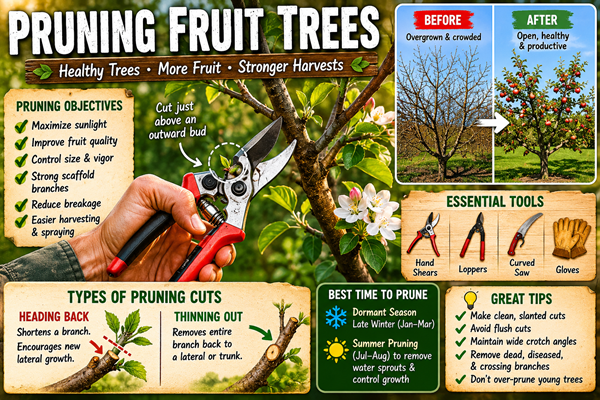
Pruning Fruit Trees is a practical guide published by the University of Nebraska Cooperative Extension that teaches homeowners and small orchard growers how to properly prune, train, maintain, and rejuvenate fruit trees. The guide focuses on improving fruit quality, increasing sunlight penetration, reducing limb breakage, controlling tree size, and maintaining productive fruiting wood.
The publication begins by explaining the primary objectives of pruning:
- Maximize sunlight exposure
- Improve fruit quality and size
- Maintain strong scaffold branches
- Control tree height and vigor
- Reduce branch breakage
- Improve fruit harvesting and spraying access
A major section explains when pruning should occur. Most pruning is performed during the dormant season, although summer pruning may be used to restrict growth, remove water sprouts, and eliminate damaged wood. The guide emphasizes avoiding pruning before January to reduce winter injury risk.
The handbook provides detailed explanations of:
- Tree anatomy
- Scaffold branches
- Leaders
- Spurs
- Flower buds
- Water sprouts
- Crotch angles
- Branch structure and strength
Several chapters focus on pruning techniques including:
- Heading-back cuts
- Thinning-out cuts
- Training young trees
- Maintaining mature trees
- Rejuvenating neglected trees
- Fruit thinning
- Branch spreading techniques
The guide strongly recommends the Modified Leader System, explaining year-by-year pruning instructions from planting through the fifth year of growth. Numerous diagrams illustrate how to establish strong scaffold branches and maintain a productive tree structure.
Specialized recommendations are also provided for:
- Apples
- Pears
- Peaches
- Tart cherries
- Plums
- Apricots
Each fruit species has unique growth habits and pruning requirements that are discussed separately.
One particularly useful section covers neglected trees, explaining how to safely reduce height, remove overcrowded branches, restore light penetration, and rejuvenate older fruit trees over several seasons.
© Prepping Communities. This content is for informational purposes only and not professional advice. Use at your own risk.
Terms | Privacy | Guidelines