

Have you looked at the price of cheese lately? It has become one of those grocery items where you pick up a block, look at the price and sometimes wonder if you really need it. Fresh mozzarella can be even worse, especially if you’re buying the better stuff. That alone makes learning how to make it at home worth considering.
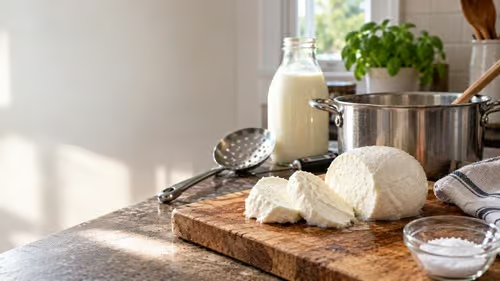
There’s also a pretty big difference between the various products we casually call mozzarella. Walk through a grocery store and you’ll see fresh mozzarella, blocks of low-moisture mozzarella, bags of shredded mozzarella and different processed cheese products. They’re not necessarily interchangeable. Some shredded cheeses contain starch, cellulose or other anti-caking ingredients that keep the pieces from sticking together in the bag. Fresh mozzarella contains much more moisture. Low-moisture mozzarella has less. All of this changes how the cheese behaves when you cook with it.
You can really see the difference when you melt them. Fresh mozzarella tends to become soft and creamy, while low-moisture mozzarella gives you more of that familiar browned, stretchy pizza cheese. Some pre-shredded products don’t melt quite as smoothly because they’re designed partly around convenience and shelf life. That doesn’t mean one is automatically good and another bad. They’re different products made for somewhat different purposes. But once you’ve made fresh mozzarella yourself and cooked with it, you start noticing those differences a lot more.
That’s also worth remembering when comparing prices. If you’re comparing homemade fresh mozzarella with the cheapest bag of shredded pizza cheese you can find, you’re not really comparing the same thing. Compare it with good fresh mozzarella and the numbers can look quite different.
There’s another reason to learn this. Milk doesn’t last very long, particularly if refrigeration becomes a problem. People were turning milk into cheese long before refrigerators existed because they needed ways to use what their animals produced before it spoiled. Cheesemaking was once an ordinary household and farm skill rather than something most people left entirely to a factory.
Fresh mozzarella won’t solve a long-term food-storage problem. It still needs refrigeration and should be eaten fairly quickly. But learning to process milk gives you somewhere to go next. Ricotta, yogurt, simple acid-set cheeses and eventually cheeses intended for longer storage all build on some of the same basic ideas. If you someday have access to milk from a nearby farm, keep dairy animals yourself or simply have milk that needs to be used, knowing a few of these skills gives you more choices.
And this is definitely something I’d rather figure out on a normal Saturday afternoon than when I actually needed it.
Making Your First Batch
You don’t need much to get started. For a basic batch you’ll need one gallon, or about 3.8 liters, of whole milk, about 1½ teaspoons of citric acid, cheesemaking rennet, non-iodized salt and a little non-chlorinated water. You’ll also want a large stainless-steel pot, thermometer, long knife, slotted spoon, colander and heatproof bowl. Food-safe heat-resistant gloves aren’t absolutely necessary, but they’re pretty handy once you start handling hot curds.
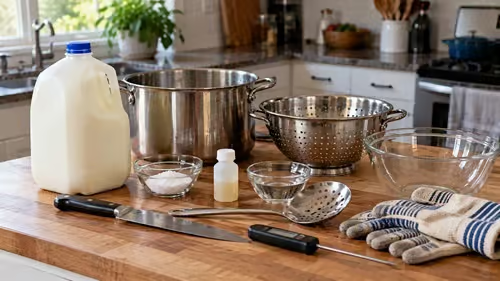
Regular pasteurized whole milk from the grocery store is fine. What you generally want to avoid is milk labelled ultra-pasteurized or UHT. The higher-temperature processing can alter the milk proteins enough to make curd formation unreliable. Don’t confuse ultra-pasteurized with homogenized either. Most grocery-store milk is homogenized and that alone doesn’t mean you can’t make cheese with it.
Rennet is usually the ingredient people haven’t heard of when they first try cheesemaking. Basically, it contains enzymes that help the proteins in milk come together and form a curd. Traditional animal rennet has been used for a very long time, but microbial and other non-animal varieties are available too. You can find cheesemaking rennet at cheesemaking and home-brewing stores, some farm-supply and specialty food stores, and from online cheesemaking suppliers. Major online retailers carry it as well. Search specifically for cheesemaking rennet and you’ll normally find both liquid and tablet versions.
Don’t assume every rennet is the same strength. This is one place where following the package really matters. Use whatever amount the manufacturer recommends for one gallon of milk rather than automatically copying a measurement from another recipe.
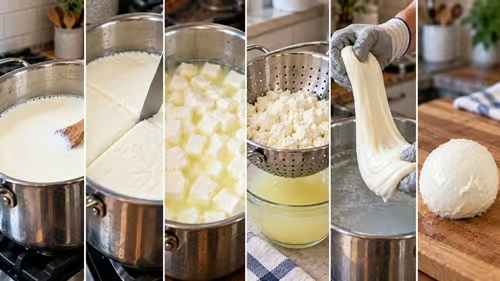
Once you have everything together, dissolve about 1½ teaspoons of citric acid in ¼ cup of cool, non-chlorinated water. Prepare your rennet separately in another small amount of cool water according to its directions. Pour the gallon of milk into your pot, stir in the citric acid mixture and slowly warm everything to about 90°F (32°C).
When the milk reaches temperature, gently stir in the diluted rennet for about 30 seconds. There’s no need to beat it or stir aggressively. Cover the pot and leave it alone for somewhere around five to ten minutes. When you come back, what was liquid milk should have started looking more like a soft custard. Put a knife into the curd and lift it slightly. If the curd separates reasonably cleanly rather than immediately running back together, you’re ready to continue. If it’s still very loose, give it a little more time.
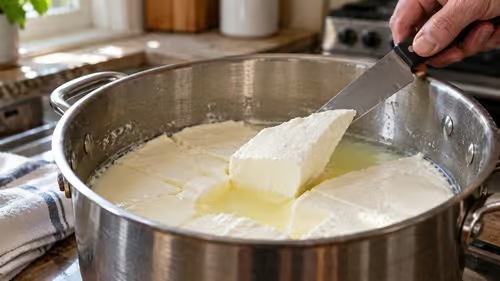
This is one of the parts I think makes mozzarella such a good first cheese. Reading about curds and whey is one thing. Seeing a pot of ordinary milk actually separate makes the whole process much easier to understand.
Cut the curd into pieces roughly an inch across. They don’t have to be pretty or perfectly even. Cut in one direction, then the other, and angle your knife so you’re cutting through the curd below the surface as well. There’s a reason for doing this. Cutting creates more surface area and helps whey escape, and the way curds are cut and heated affects the moisture and texture of the finished cheese.
Slowly warm the curds again, this time to about 105°F (40°C). Stir gently because the curds can still be fairly fragile. You’ll notice them getting firmer and you’ll see more yellowish whey separating around them. Once they’ve firmed up, scoop them into a colander and let the whey drain. You can press the curds together gently, but there’s no need to squeeze every bit of moisture out.
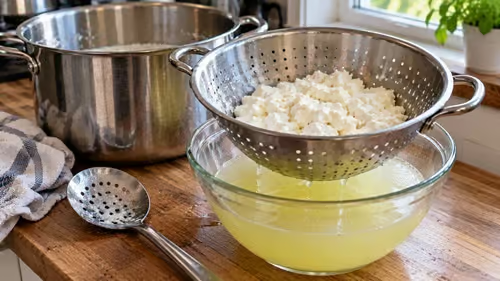
The amount of whey left over can be surprising the first time you make cheese. You start with this big pot full of milk and end up with a fairly modest amount of curd sitting in the colander. It gives you a different appreciation for why good cheese can cost what it does.
Before pouring all that whey down the drain, save some. It can be used in bread and other baking, soups or as part of the liquid for cooking grains. If cheesemaking turns into something you enjoy, there are other foods you can learn to make from whey too, including ricotta-style whey cheeses. Once you start finding uses for it, pouring a whole pot of whey down the drain seems a bit of a waste.
Now you need to get the curds hot enough to stretch. Heat water to around 170–180°F (77–82°C) and place the drained curds into it long enough for them to become hot and pliable. Be careful because you’re working with temperatures that can burn you. Food-safe heat-resistant gloves make this part a lot easier.
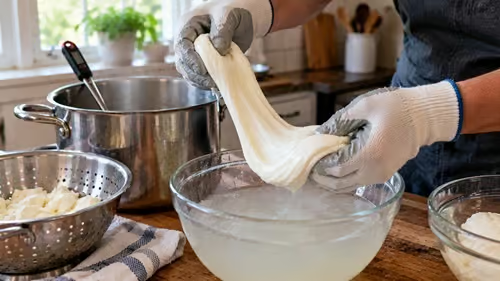
Once the curd has softened, start gently folding and stretching it. At first it may still look rough, but as it warms and stretches it should begin becoming smoother and more elastic. Work some non-iodized salt into it as you go.
There’s a tendency the first time you successfully get mozzarella to stretch to keep doing it because it’s actually kind of fun. Don’t overdo it. Too much stretching and too much heat can push out more moisture and turn your nice soft mozzarella into something much tougher. Once it becomes smooth, stretches nicely and has a slight shine to it, shape it into a ball or several smaller balls and cool them in cold or ice water.
Don’t worry if the first one looks a little strange. Homemade cheese doesn’t have to look like it came out of a machine. Pay attention to how the curd felt when it finally started stretching because that will probably help you more on your second batch than memorizing another set of instructions.
If your curd doesn’t stretch, try warming it again first. If it’s thoroughly heated and still breaks apart, the acidity may not be quite right. If the curd never formed properly at all, check the milk, rennet, temperatures and water you used. Writing down the brand of milk, amount of rennet and temperatures for your first few batches is worthwhile. Nothing complicated. Just enough information that when you finally make a batch you really like, you know what you did.
You may also come across recipes claiming you can make mozzarella using nothing more than milk and vinegar or lemon juice. Acid absolutely can separate milk into curds and whey, and simple acid-set cheeses are worth learning. But that doesn’t necessarily produce the same stretchy mozzarella you get using rennet and properly controlled acidity. I’d actually learn both. They’re fairly simple skills, and you may not always have rennet around.
What Does Homemade Mozzarella Really Cost?
Whether homemade mozzarella saves money depends quite a bit on where you live. Milk prices vary, cheese prices vary and even the amount of cheese you get from a gallon of milk can vary. It’s better to work it out using your own grocery prices rather than simply assuming homemade is cheaper.
As a rough example, if you pay $4 for a gallon of milk and allow another 50 cents for the small amount of rennet, citric acid and salt, you’ve spent about $4.50. If you get roughly a pound of mozzarella, you’re around $4.50 per pound.
If milk costs $6, you’re closer to $6.50 per pound. At $8 for the milk, you’re around $8.50 per pound, and if you’re using premium milk that costs $10, you’re already around $10.50 per pound before considering the small amount of energy used to heat everything.
Those examples also show why somebody living in one part of Canada or the United States might tell you homemade mozzarella saves them quite a bit while somebody somewhere else says it doesn’t save them anything. They’re both potentially right. Milk prices aren’t the same everywhere.
Yield matters too. If you spend $7 on ingredients but only get three-quarters of a pound of finished cheese, your cheese obviously didn’t cost $7 per pound. Weigh the finished mozzarella and divide your total ingredient cost by the amount you actually made.
For example, suppose your ingredients cost $7 and you end up with 450 grams, which is roughly a pound, of mozzarella. Your cost is about $1.56 per 100 grams. If comparable fresh mozzarella where you shop costs $2.50 per 100 grams, making it yourself saved you close to a dollar for every 100 grams.
But remember what you’re comparing it with. If you’re making fresh mozzarella, look at what fresh mozzarella costs where you live. Don’t automatically compare it with the least expensive bag of shredded low-moisture mozzarella. They’re different cheeses intended for somewhat different uses.
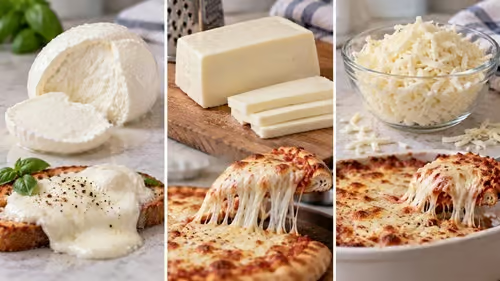
This is also where quality starts entering the calculation. Buy a ball of good fresh mozzarella and a bag of inexpensive pre-shredded mozzarella sometime and melt each on a small piece of bread or pizza. You’ll probably notice a difference. The moisture, texture and added ingredients can affect the way the cheese melts, browns and feels when you eat it.
Fresh mozzarella has much more moisture and tends to melt into soft, creamy areas. Low-moisture mozzarella usually gives you more browning and that familiar pizza-cheese stretch. Pre-shredded mozzarella may contain starch, cellulose or other anti-caking ingredients so the shreds remain separate in the package, and that can sometimes affect the way it melts.
So if you want real fresh mozzarella, compare the price of making it with the price of buying fresh mozzarella. If what you normally buy is inexpensive shredded mozzarella for pizza, that’s a different comparison.
Depending on where you live, homemade fresh mozzarella might save quite a bit compared with buying good fresh mozzarella. Somewhere else, the savings might be small. If milk is particularly expensive where you live, making it yourself could cost about the same or even a little more.
Even if you only break even, you still end up with fresh cheese and you’ve learned how to make it. For some households that’s worth the effort. For others it may be something they make occasionally rather than every week.
Questions People Usually Have
Where can I buy rennet?
Look at cheesemaking or home-brewing stores, farm-supply stores and some specialty food stores. Online cheesemaking suppliers are another good source, and major online retailers carry it too. Search for cheesemaking rennet. Liquid and tablet forms are both available.
What kind of rennet should I buy?
Basic rennet intended for home cheesemaking is all you need to get started. Animal rennet is traditional, while microbial and other non-animal options are also available. Liquid is easy to measure for small batches, but tablets work too. Pay more attention to the manufacturer’s strength and dosage instructions than to finding some supposedly perfect rennet.
Can I store rennet and citric acid for preparedness?
Yes. Citric acid is fairly easy to store when it’s kept sealed and dry. Rennet requires a little more attention because storage depends on the type. Some liquid rennets need refrigeration, while certain tablets may be more practical for longer storage. Follow the manufacturer’s storage directions and pay attention to the best-before date because rennet can lose strength over time.
If you’re planning to store these ingredients, make cheese with them first. You’ll find out how much you actually use, whether your rennet works well and how the milk you normally buy behaves. Then what you’re putting away is something you’ve already worked with rather than an ingredient you’ve never opened.
Can I use regular grocery-store milk?
Yes. Pasteurized whole milk is a good starting point. Avoid ultra-pasteurized or UHT milk because the high-temperature treatment can interfere with curd formation.
Can I use raw milk?
Raw milk can be used for cheesemaking where it is legally available, but it carries additional food-safety considerations. You don’t need raw milk to learn. Regular pasteurized whole milk works.
Do I really need a thermometer?
It’s worth having one. The difference between 90°F and 105°F isn’t something most people can reliably judge by touching the pot, and temperature matters when you’re trying to get consistent curds.
Why didn’t my curds form?
Check whether the milk was ultra-pasteurized first. Then look at your rennet, how much you used, whether it’s still active, your temperatures and the water you used to dilute it. Sometimes the curd simply needs a little more time too.
Why won’t my mozzarella stretch?
Try warming it again. If the curd is thoroughly heated and still breaks rather than stretches, acidity may be the problem. This is where notes from previous batches start becoming useful.
Why did my mozzarella turn rubbery?
It may have been heated or stretched too much. Once it becomes smooth and elastic, stop working it.
Can I make mozzarella without rennet?
You can make fresh acid-set cheeses with vinegar or lemon juice, but they won’t necessarily have the same structure and stretch as rennet-based mozzarella. They’re still worth learning because they’re another fairly easy way to process milk.
How much mozzarella will I get from a gallon of milk?
It varies with the milk and how much moisture remains in the finished cheese. Roughly a pound from a gallon is a useful general estimate, but don’t be surprised if your own result is somewhat different.
Can I use powdered milk from my emergency food storage?
Possibly, but test the actual product you store. Powdered milks are processed differently and won’t necessarily behave exactly like fresh whole milk. If it doesn’t work the way you expected, it’s much better to discover that now.
What can I do with leftover whey?
Use it in bread, other baking, soups or as part of the cooking liquid for grains. If you keep learning cheesemaking, you’ll probably find other uses for it too.
How long does homemade mozzarella last?
Fresh mozzarella is a high-moisture, perishable food. Keep it refrigerated and plan to use it fairly quickly. If you notice mold, unusual discoloration, an off smell or other signs of spoilage, throw it away.
Can I freeze it?
Yes, although freezing can change the texture. If you’re making mozzarella because you like that soft fresh texture, smaller batches that you eat fresh may make more sense.
Can I make mozzarella during a power outage?
Yes. You need controlled heat, but that doesn’t have to come from an electric stove. A propane stove or another safe backup cooking method can work. If that’s how you expect to cook during an outage, making a practice batch on it beforehand would tell you a lot about how easily you can control the temperature.
Is mozzarella really a preparedness food if it doesn’t store for very long?
Mozzarella won’t do much for long-term food storage by itself. What it does is give you some experience working with milk, controlling temperature, separating curds and whey and understanding how dairy can be processed. From there you can move into yogurt, ricotta, simple acid-set cheeses and eventually cheeses that are better suited to longer storage.
Is homemade mozzarella always better than store-bought mozzarella?
Not necessarily. It depends on what you’re comparing it with and what you’re using it for. Good commercial fresh mozzarella can be excellent, and low-moisture mozzarella may actually be a better choice for certain styles of pizza because it releases less water.
What homemade mozzarella gives you is control over the ingredients, the ability to use it extremely fresh and a chance to understand how the cheese was made. Once you’ve tried several different mozzarellas side by side, you’ll probably start choosing them based on what you’re cooking rather than assuming they’re all the same.
Why doesn’t some pre-shredded mozzarella melt the same way as fresh mozzarella?
Moisture is a big part of it. Fresh mozzarella contains considerably more water than low-moisture mozzarella. Some pre-shredded cheeses also contain anti-caking ingredients such as starch or cellulose to keep the shreds from sticking together in the package. Different moisture levels, fat levels and added ingredients can all change how cheese melts and browns.
Preparedness Action Plan
Start with the milk you already buy. Make one gallon into mozzarella and don’t worry too much about whether the first batch is beautiful. Pay attention to how the curd forms, what happens as the whey separates and what the cheese feels like when it finally reaches the point where it stretches.
Then make it again. Once you can get reasonably consistent results, try a simple acid-set cheese and find a use for some of the leftover whey. If powdered milk is part of your emergency food storage, experiment with the brand you actually store rather than assuming it will work.
From there, try another dairy skill. Ricotta, yogurt, cottage cheese or eventually an aged cheese would all be useful things to learn. You don’t have to become a cheesemaker. The idea is simply to become comfortable enough with milk that buying finished cheese isn’t the only thing you know how to do with it.
Disclaimer
This posting is intended for educational and preparedness purposes and is not a substitute for professional food-safety guidance. Cheesemaking involves perishable dairy products, temperature control and proper sanitation. Always use clean equipment, safe drinking water and milk from a safe, reliable source. Follow the storage and handling instructions for the specific rennet and other ingredients you use.
Raw milk carries additional food-safety risks and may also be subject to local laws and regulations. Fresh mozzarella is a high-moisture, perishable cheese and should be refrigerated promptly and handled accordingly. If a batch develops mold, unusual discoloration, an off smell or other signs of spoilage, discard it.
Ingredient prices, cheese yields, storage times and results can vary depending on the milk, ingredients, equipment and methods used. The cost examples in this posting are intended to show how to calculate your own cost and should not be taken as current grocery prices for every location.
© Prepping Communities. This content is for informational purposes only and not professional advice. Use at your own risk.
Terms | Privacy | Guidelines