
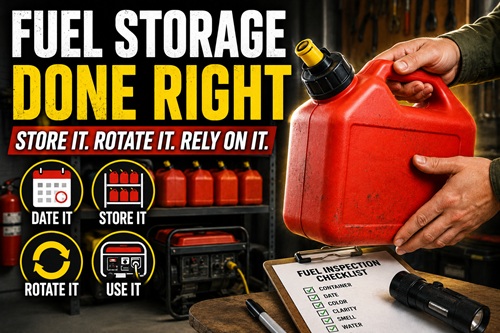
A Practical Guide to Inspecting, Refreshing, Rotating, and Safely Storing Fuel
Why This Matters
Gasoline is one of the most useful emergency supplies you can store. It powers vehicles, generators, chainsaws, water pumps, pressure washers, snow blowers, lawn equipment, and countless other tools that become especially valuable during emergencies.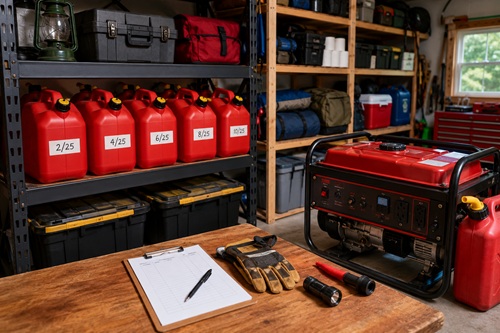
Unlike canned food or bottled water, however, gasoline has a limited shelf life. Over time it naturally changes. It can lose volatility, form deposits, absorb moisture (particularly ethanol-blended fuels), and eventually become unsuitable for many engines.
The good news is that fuel problems are usually preventable.
With proper storage, regular inspections, and a simple rotation system, you can maintain a dependable emergency fuel supply without wasting money or damaging expensive equipment.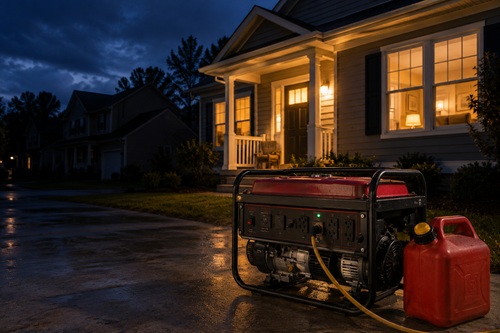
This guide teaches practical fuel management skills that every prepper, homeowner, and homesteader should know.
Understanding Why Gasoline Ages
Many people think gasoline suddenly “goes bad.”
In reality, gasoline slowly changes over time.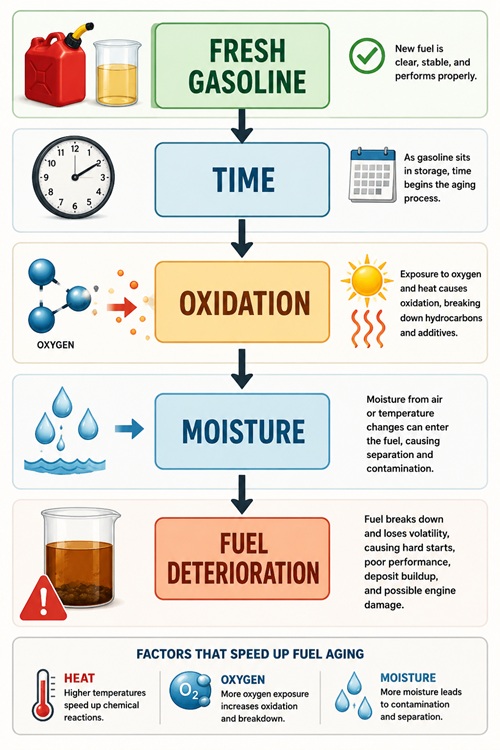
As it sits, lighter compounds gradually evaporate, reducing volatility and making engines harder to start. Oxygen reacts with the fuel, causing oxidation that produces sticky gums and varnish. If the fuel contains ethanol, it can also absorb moisture from the air. In severe cases, this moisture can separate from the gasoline, creating a condition known as phase separation.
Heat, sunlight, poorly sealed containers, and repeated temperature changes all accelerate this aging process.
Fortunately, these changes happen gradually.
That’s why regular inspections and proper storage are far more effective than trying to rescue badly deteriorated gasoline later.
Preparedness Perspective
The goal isn’t to make gasoline last forever.
The goal is to never allow it to become unusable in the first place.
Before You Continue
Now that you understand why gasoline changes over time, the next step is learning how long different types of fuel typically remain usable under proper storage conditions. Knowing these general timeframes helps you build a practical rotation schedule before problems ever develop.
How Long Does Gasoline Last?
One of the most common questions people ask is, “How long will gasoline last?”
The honest answer is that there isn’t a single number.
The life of stored gasoline depends on several factors, including the type of fuel, whether a fuel stabilizer was added before storage, the quality of the storage container, temperature fluctuations, and exposure to air and moisture.
While you’ll often hear specific timeframes quoted online, they should be viewed as general guidelines rather than guarantees. Properly stored gasoline may remain usable longer, while poorly stored fuel may deteriorate much sooner.
The best approach is to use shelf-life estimates to build a fuel rotation schedule rather than waiting until the fuel becomes questionable.
Typical Gasoline Shelf Life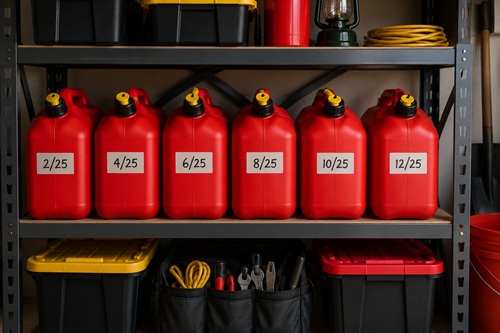
The following table summarizes the approximate storage life of gasoline under good storage conditions using approved fuel containers.
| Fuel Type | Typical Storage Life* | Best Practice |
|---|---|---|
| Regular gasoline | Approximately 3–6 months | Rotate regularly |
| Premium gasoline | Approximately 3–6 months | Rotate regularly |
| Ethanol-blended gasoline (E10) | Often 3–6 months | Rotate frequently |
| Non-ethanol gasoline | Often 6–12 months | Excellent for emergency storage |
| Gasoline treated with stabilizer | Often up to 12 months or longer, depending on the product and storage conditions | Follow the stabilizer manufacturer’s recommendations |
*Actual storage life depends on temperature, container quality, fuel composition, and storage conditions.
Ethanol Makes a Difference
Most gasoline sold today contains ethanol.
Although ethanol offers several benefits during normal vehicle operation, it creates additional challenges for long-term storage.
Ethanol naturally attracts moisture from the surrounding air. As moisture accumulates, the fuel becomes increasingly susceptible to phase separation, where water and ethanol settle out of the gasoline. Once this occurs, the fuel may no longer perform properly and can damage certain engines.
Because of this, ethanol-blended gasoline should generally be rotated more frequently than non-ethanol fuel.
If non-ethanol gasoline is available in your area and will be stored for emergency use, many experienced preppers prefer it for long-term storage.
Fuel Stabilizers Extend Storage—They Don’t Stop Aging
Fuel stabilizers are excellent preventative tools.
When added to fresh gasoline before storage, they slow many of the chemical reactions responsible for fuel degradation.
However, they don’t permanently preserve gasoline.
Even stabilized gasoline continues to age, just more slowly.
It’s also important to understand that fuel stabilizers are designed to protect fresh gasoline. They cannot restore gasoline that has already deteriorated significantly.
Think of a stabilizer as preventive maintenance rather than a repair product.
Storage Conditions Matter
Two identical containers filled on the same day may age very differently depending on where they’re stored.
Gasoline stored inside an approved container in a cool, dry building will generally remain usable much longer than gasoline stored outdoors where it’s exposed to direct sunlight and repeated heating and cooling.
Every temperature change causes the air inside the container to expand and contract slightly. Over time, this breathing effect introduces additional moisture into the container, especially when humidity is high.
Keeping fuel cool and protected from direct sunlight helps slow this process.
Don’t Depend on the Calendar Alone
Although shelf-life estimates are useful, they shouldn’t be your only guide.
Two containers filled on the same day may not age at the same rate.
That’s why experienced preppers inspect stored gasoline regularly instead of relying only on dates.
A container that’s six months old may still be perfectly usable, while another stored under poor conditions may already be deteriorating.
The fuel itself should always have the final say.
Prepper Tip
Write the purchase date directly on every gasoline container using a permanent marker or weather-resistant label. This simple habit eliminates guesswork and makes it much easier to rotate your fuel supply before quality begins to decline.
Common Beginner Mistakes
One of the most common mistakes is assuming that all gasoline lasts exactly the same amount of time. Different fuel blends and storage conditions can produce very different results.
Another mistake is believing that adding fuel stabilizer means the gasoline never needs attention again. Stabilizers slow fuel degradation, but they don’t eliminate it. Regular inspections and fuel rotation remain essential.
Finally, avoid storing gasoline without recording the purchase date. Once several identical containers are sitting in the garage, it’s surprisingly easy to lose track of which one is oldest.
Before You Continue
Knowing approximately how long gasoline can last is helpful, but it’s only part of the picture.
The next step is learning how to inspect stored gasoline. By recognizing changes in color, smell, clarity, and condition, you’ll be able to decide whether your fuel is still suitable for use, should be refreshed with new gasoline, or needs to be safely disposed of.
Inspecting Stored Gasoline
Before using gasoline that has been sitting in storage for several months, take a few minutes to inspect it carefully. This simple habit can prevent hard starting, poor engine performance, clogged carburetors, and expensive repairs.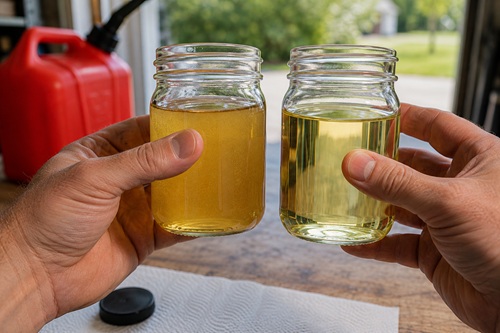
Fortunately, you don’t need specialized equipment to perform a basic inspection.
Your eyes, your sense of smell, and a little common sense will usually tell you whether the fuel still appears suitable for use.
Rather than asking, “How old is this gasoline?” a better question is, “What condition is it in today?”
Start with the Container
Before examining the gasoline itself, inspect the storage container.
Look for cracks, dents, corrosion, swelling, leaking caps, or signs that the container has been exposed to excessive heat or sunlight.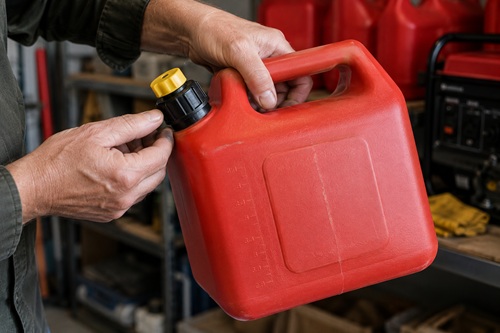
If the container has been damaged, the gasoline inside may have been exposed to additional air or moisture, accelerating deterioration.
Also check that the label showing the purchase date remains readable.
If you don’t know how old the gasoline is, now is an excellent time to begin keeping records.
A well-maintained container is the first step toward maintaining good fuel.
Examine the Color
Fresh gasoline is normally clear and ranges from nearly colorless to light yellow or slightly amber, depending on the fuel blend and additives.
As gasoline ages, it often becomes noticeably darker.
A slight darkening doesn’t automatically mean the fuel is unusable, but a deep amber, orange, or brown color usually indicates significant oxidation.
If the gasoline appears unusually dark compared to fresh fuel, inspect it even more carefully before deciding to use it.
Color alone doesn’t determine fuel quality, but it provides an important clue.
Check for Clarity
Healthy gasoline should appear clean and transparent.
Hold the container up to the light if possible.
The fuel should look clear rather than cloudy.
Cloudiness often indicates moisture contamination.
You should also look for sediment, floating particles, or layers within the fuel.
Gasoline that contains visible contamination or has separated into distinct layers should generally not be used in engines.
Clean fuel should look clean.
If it doesn’t, investigate further before using it.
Smell the Fuel
Gasoline has a distinctive odor that most people recognize immediately.
Fresh gasoline smells sharp but familiar.
As gasoline deteriorates, its odor often changes.
Old fuel may develop a sour smell or a strong varnish-like odor caused by oxidation.
If the smell seems dramatically different from fresh gasoline, treat the fuel with caution.
Your sense of smell can often detect deterioration long before performance problems appear.
Look for Water
Water contamination is one of the most common problems with stored gasoline, especially when ethanol-blended fuels are stored improperly.
Small amounts of water may appear as tiny bubbles or slight cloudiness.
Larger amounts may collect as a separate layer at the bottom of the container because water is heavier than gasoline.
If you observe obvious water separation, the fuel should not be poured directly into an engine.
Water contamination is far easier to prevent than to correct.
Consider the Storage History
The condition of the storage environment often provides valuable clues.
Ask yourself a few simple questions.
Has the container been stored indoors or outdoors?
Has it been exposed to direct sunlight?
Has it experienced repeated heating and cooling?
Was fuel stabilizer added before storage?
Has the container remained tightly sealed?
These answers help you judge whether the gasoline has likely aged under favorable or unfavorable conditions.
Good storage practices often matter just as much as the age of the fuel itself.
When the Fuel Looks Good
If the gasoline remains clear, has its normal color, smells normal, and has been stored properly in an approved container, it will often still be suitable for use even after several months.
That doesn’t necessarily mean you should continue storing it indefinitely.
Instead, consider rotating it into normal vehicle or equipment use and replacing it with fresh gasoline.
Rotation is always preferable to pushing fuel to the limits of its storage life.
When You Should Be Cautious
If the gasoline shows only minor signs of aging—perhaps a slight darkening or a mild change in odor—but remains clear and free of contamination, some people choose to dilute it with fresh gasoline for use in appropriate equipment.
This decision should be made carefully and only when the fuel otherwise appears clean and uncontaminated.
When in doubt, err on the side of caution.
Replacing a small quantity of questionable fuel is usually far less expensive than repairing a damaged engine.
When Not to Use the Fuel
Some gasoline simply shouldn’t be used.
Avoid using fuel that:
- Appears cloudy or milky.
- Contains visible sediment or floating debris.
- Has separated into distinct layers.
- Smells strongly of varnish or severe oxidation.
- Shows obvious signs of water contamination.
- Came from a damaged or leaking container.
Fuel in this condition should be handled according to your local hazardous waste disposal requirements rather than poured into vehicles, generators, or outdoor power equipment.
Fuel Inspection Checklist
Before using stored gasoline, take a minute to complete this quick inspection.
✓ Container is in good condition.
✓ Purchase date is known.
✓ Fuel is clear.
✓ Color appears normal.
✓ No sediment or floating particles.
✓ No visible water.
✓ Smell is normal.
✓ Container remained sealed.
✓ Storage conditions were appropriate.
If every item checks out, the gasoline is generally much more likely to be suitable for normal rotation.
Prepper Tip
Keep a small notebook or clipboard near your fuel storage area. Record inspection dates, observations, and when each container is rotated into use. Over time, these simple records help you identify storage patterns and prevent fuel from remaining forgotten for years.
Common Beginner Mistakes
One of the biggest mistakes is assuming gasoline is either “good” or “bad” based solely on its age. Fuel condition is influenced by many factors, including storage temperature, container quality, and exposure to air and moisture.
Another common mistake is ignoring small changes in color or odor. These early warning signs often indicate that the fuel is beginning to deteriorate and should be rotated soon.
Finally, don’t skip container inspections. Even excellent gasoline can be compromised if the container has been damaged or no longer seals properly.
Before You Continue
After inspecting your gasoline, you’ll be able to make a practical decision about what to do next. Some fuel is ready to use immediately, some may be suitable for refreshing with fresh gasoline, and some should be safely discarded.
The next chapter walks you through that decision process so you can confidently determine the best course of action for every container in your emergency fuel supply.
Refreshing Older Gasoline
Not all gasoline that has been sitting in storage needs to be discarded.
If the fuel has been stored properly, remains clear, has no visible contamination, and still smells reasonably normal, it may still be suitable for use. In some situations, slightly aged gasoline can be refreshed by mixing it with fresh gasoline before it is used.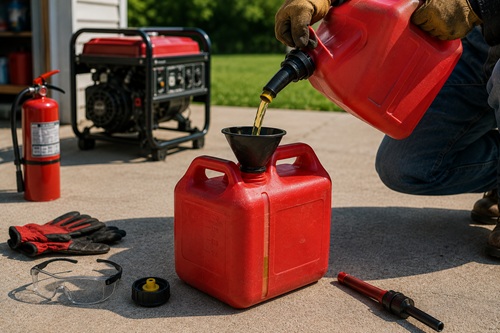
It’s important to understand what this process actually accomplishes.
Adding fresh gasoline does not reverse chemical aging or restore degraded fuel to its original condition. Instead, it dilutes some of the effects of aging and improves the overall quality of the fuel mixture.
Think of it as strengthening acceptable fuel rather than repairing damaged fuel.
When Refreshing May Be Appropriate
Refreshing gasoline should only be considered when the fuel has passed your inspection.
The gasoline should:
- Be clear and free of cloudiness.
- Show no signs of water contamination.
- Contain no visible sediment.
- Have only minor signs of aging.
- Come from a clean, properly sealed container.
If the fuel fails any of these basic inspections, refreshing it is generally not recommended.
Some gasoline simply reaches the point where replacement is the safer and more economical choice.
Mixing with Fresh Gasoline
A common practice is to dilute slightly aged gasoline by mixing it with fresh fuel before using it in appropriate equipment.
Many experienced equipment owners use approximately:
- One part older gasoline to three or four parts fresh gasoline.
This creates a fuel mixture that more closely resembles fresh gasoline while reducing the effects of normal aging.
The exact ratio isn’t critical.
The older the gasoline, the smaller its percentage should generally be in the final mixture.
Choose the Right Equipment
Even when older gasoline appears suitable after inspection, it’s wise to think carefully about where it will be used.
Modern vehicles and expensive power equipment often have sophisticated fuel systems that benefit from consistently fresh fuel.
If you decide to use refreshed gasoline, many people prefer to use it in equipment that is regularly maintained and not operating under heavy loads.
Whatever equipment you choose, always follow the manufacturer’s fuel recommendations.
Don’t Expect Instant Results
If slightly aged gasoline has been mixed with fresh fuel, the engine may not perform exactly as it would on completely fresh gasoline.
You may notice:
- Slightly longer starting times.
- Rougher idle for a short period.
- Reduced performance until fresh fuel fully circulates.
These minor differences are not unusual when older gasoline is present in the mixture.
However, if the engine runs poorly, stalls repeatedly, misfires, or produces unusual smoke, discontinue use and investigate further rather than assuming the problem will resolve itself.
What Fuel Additives Can—and Cannot—Do
Many products marketed as fuel treatments can be confusing.
Some additives are designed to stabilize fresh gasoline before storage.
Others help clean fuel systems by removing deposits.
Neither type should be viewed as a product that restores badly deteriorated gasoline.
If gasoline has already oxidized significantly or become contaminated with water, additives cannot reverse those changes.
Using additives correctly begins with understanding their intended purpose.
When Disposal Is the Better Choice
Sometimes the safest decision is simply not to use the fuel.
Gasoline that has become cloudy, contains water, has separated into layers, or produces a strong varnish odor has deteriorated beyond what simple dilution can reasonably address.
Using questionable fuel may save a few dollars today but can result in much more expensive engine repairs later.
When fuel clearly fails inspection, dispose of it according to local hazardous waste regulations.
Never pour gasoline onto the ground, into storm drains, household plumbing, or ordinary garbage containers.
Responsible disposal protects both your equipment and the environment.
Quick Decision Guide
When inspecting stored gasoline, ask yourself these questions.
Fuel looks clear and normal?
→ Continue using your normal fuel rotation.
Fuel is slightly aged but otherwise clean?
→ Consider mixing with fresh gasoline before use.
Fuel is cloudy, contaminated, or has separated?
→ Do not use it. Dispose of it properly.
Making these decisions consistently is one of the simplest ways to protect engines while maintaining an effective emergency fuel supply.
Prepper Tip
If you find yourself wondering whether gasoline is “probably okay,” it’s usually a sign that it has remained in storage too long. Developing a regular rotation schedule removes uncertainty and greatly reduces the need to make judgment calls about questionable fuel.
Common Beginner Mistakes
One of the most common mistakes is assuming fresh gasoline can “fix” severely deteriorated fuel. While dilution may improve slightly aged gasoline, it cannot reverse oxidation, water contamination, or phase separation.
Another mistake is adding fuel stabilizer after gasoline has already aged significantly. Stabilizers are designed to slow future deterioration, not repair existing damage.
Finally, avoid trying to save a few litres of questionable gasoline at the risk of damaging expensive engines. Replacing bad fuel is usually far less costly than repairing fuel system components.
Before You Continue
The easiest way to avoid dealing with questionable gasoline is to prevent it from becoming old in the first place.
The next chapter introduces one of the most valuable preparedness habits you can develop: fuel rotation. A simple First-In, First-Out (FIFO) system keeps your emergency fuel fresh, reduces waste, and eliminates most of the uncertainty surrounding long-term gasoline storage.
Building a Fuel Rotation System
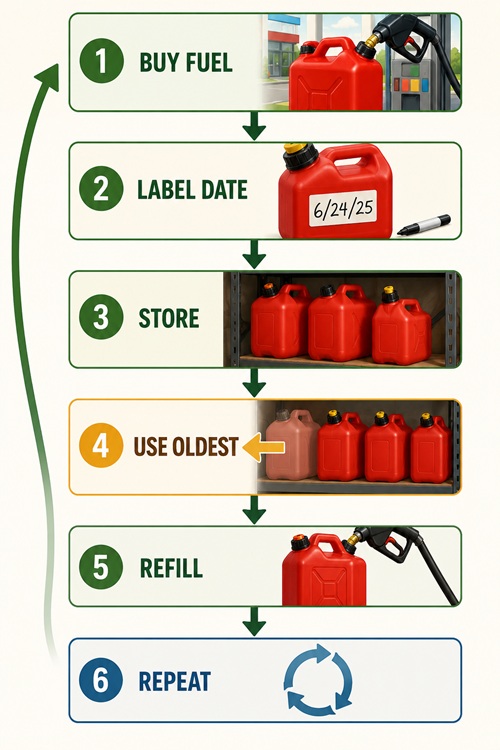
The simplest way to maintain a dependable emergency fuel supply is not by trying to restore old gasoline—it’s by preventing gasoline from becoming old in the first place.
A fuel rotation system ensures that stored gasoline is used regularly while fresh fuel continually replaces it. This approach keeps your emergency supply in good condition, reduces waste, and removes much of the uncertainty that comes with long-term fuel storage.
Many experienced preppers treat gasoline just like food storage.
The oldest supplies are used first.
New supplies replace what was used.
The cycle repeats continuously.
When fuel is managed this way, there is rarely a need to question whether it has become too old.
The First-In, First-Out Method
The easiest fuel rotation system follows a simple principle known as First-In, First-Out, often abbreviated as FIFO.
The first container placed into storage should also be the first one used.
Every time gasoline is purchased, the newest container is placed at the back of the storage area while the oldest container is moved to the front.
When it’s time to refill a vehicle, generator, lawn mower, or other gasoline-powered equipment, use the oldest container first.
Once it’s empty, refill it with fresh gasoline, label it with the new purchase date, and place it at the back of the rotation.
This simple routine keeps every container moving through the system on a regular basis.
Label Every Container
A rotation system only works if you know which fuel is oldest.
Immediately after filling a container, write the purchase date directly on the container using a permanent marker or attach a durable weather-resistant label.
Some people also record:
- Fuel type
- Octane rating
- Whether fuel stabilizer was added
- Container number
These extra details aren’t essential, but they make inspections much easier when managing several containers.
A clear label eliminates guessing months later.
Create a Simple Rotation Schedule
Fuel rotation doesn’t have to be complicated.
Many households simply rotate gasoline whenever they refill their vehicles.
Others perform a quick inspection every three or four months and replace the oldest container if it hasn’t already been used.
The important point isn’t following a rigid calendar.
It’s developing a routine that prevents gasoline from sitting untouched for long periods.
Consistency is far more important than perfection.
Match Storage to Your Needs
One of the biggest reasons gasoline becomes too old is storing more than you’ll realistically use.
Before buying additional fuel containers, think about how much gasoline your household actually consumes.
For example, someone who regularly uses gasoline for lawn equipment, generators, and recreational vehicles will naturally rotate fuel much faster than someone who rarely uses gasoline outside of their daily commute.
Your emergency fuel supply should reflect your normal usage habits.
Preparedness works best when emergency supplies become part of everyday life.
Rotate Through Everyday Equipment
One of the easiest ways to maintain fresh fuel is to simply use your stored gasoline during normal activities.
The oldest container can be emptied into your vehicle, lawn mower, chainsaw, snow blower, generator during routine testing, or other gasoline-powered equipment before being refilled with fresh fuel.
By incorporating stored gasoline into everyday use, the rotation process becomes almost automatic.
Instead of maintaining a separate “emergency” fuel supply that never gets touched, you create a constantly refreshed reserve that’s always ready when needed.
Keep a Fuel Log
Although it’s optional, a simple fuel log makes rotation even easier.
A notebook kept near the storage area can record:
| Date | Container | Action |
|---|---|---|
| March 12 | #1 | Filled |
| June 15 | #1 | Used in truck |
| June 15 | #1 | Refilled |
| September 20 | #2 | Inspected |
Over time, these records reveal whether your rotation schedule is working and help ensure that no container is forgotten.
Review Your Supply Regularly
Even with a good rotation system, inspect your fuel storage area several times each year.
Check:
- Container condition
- Labels
- Fuel dates
- Signs of leaks
- Ventilation
- Storage temperature
A five-minute inspection every few months is usually enough to identify small problems before they become larger ones.
Regular attention keeps your emergency fuel supply dependable.
Fuel Rotation Example
The following example illustrates how simple fuel rotation can be.
| Month | Action |
|---|---|
| January | Fill two approved gasoline containers and label each with the purchase date. |
| April | Use the oldest container in your vehicle or equipment. Refill it immediately and place it at the back of the storage area. |
| July | Repeat the process with the next oldest container. |
| October | Continue rotating the oldest container into everyday use and replace it with fresh gasoline. |
By repeating this cycle throughout the year, your emergency fuel supply remains fresh without requiring complicated maintenance.
Prepper Tip
Store only the amount of gasoline you can realistically rotate. A smaller supply that’s consistently fresh is far more valuable than a large supply that’s allowed to deteriorate.
Common Beginner Mistakes
One of the most common mistakes is filling several containers and forgetting about them for years. Fuel that’s never inspected or rotated eventually becomes difficult to evaluate and may no longer be suitable for use.
Another mistake is failing to label containers. Without dates, every inspection becomes guesswork, making it impossible to know which fuel should be used first.
Finally, avoid treating emergency fuel as something separate from your normal routine. The easiest rotation system is one that’s built into everyday life.
Before You Continue
With a reliable rotation system in place, the final piece of the puzzle is storing gasoline safely. Proper containers, appropriate storage locations, ventilation, and fire safety all play an important role in protecting both your fuel and your household.
The next chapter explains how to store gasoline correctly so it remains safe, stable, and ready whenever you need it.
Storing Gasoline Safely
Proper storage is just as important as choosing the right gasoline or maintaining a good rotation schedule. Even fresh fuel can deteriorate quickly if it is stored in poor conditions or in unsuitable containers.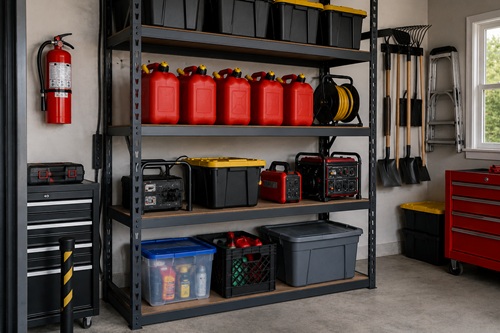
A good storage system protects the gasoline from unnecessary heat, moisture, and contamination while also reducing safety hazards around your home or workshop.
Fortunately, storing gasoline correctly doesn’t require expensive equipment. A few simple practices will greatly improve both fuel quality and safety.
Use Approved Fuel Containers
Always store gasoline in containers specifically designed and approved for fuel storage.
These containers are built to withstand pressure changes, reduce vapor loss, and seal properly to help prevent leaks and contamination.
Avoid storing gasoline in containers that were never intended for fuel, such as drink bottles, milk jugs, glass jars, or other household containers. Besides creating a serious safety hazard, these containers can deteriorate, leak, or be mistaken for something safe to drink.
Choose containers that are appropriate for the amount of fuel you plan to store and inspect them regularly for damage.
Store Fuel in a Cool Location
Heat is one of the biggest enemies of long-term gasoline storage.
Higher temperatures accelerate the chemical reactions that slowly degrade fuel while also increasing vapor pressure inside the container.
Whenever possible, store gasoline in a cool, dry location away from direct sunlight.
A detached garage, storage shed, or other well-ventilated outbuilding is generally a better choice than leaving fuel exposed to the weather or inside a vehicle for long periods.
Keeping fuel consistently cool helps slow natural aging.
Keep Containers Sealed
Every time gasoline is exposed to air, small amounts of volatile compounds can escape while moisture may enter the container.
For this reason, containers should remain tightly sealed whenever fuel is not being transferred.
Avoid opening containers unnecessarily.
A properly sealed container not only helps preserve fuel quality but also reduces vapor emissions and contamination.
Protect Fuel from Water
Water contamination is one of the leading causes of fuel problems.
Rainwater entering an improperly sealed container, condensation caused by repeated temperature changes, or storing containers directly on damp ground can all introduce unwanted moisture.
Keep containers elevated whenever practical and store them where they remain protected from rain, snow, and standing water.
Regular inspections help identify damaged seals before they become a problem.
Organize Your Fuel Storage Area
A clean, organized storage area makes fuel management much easier.
Arrange containers so the oldest fuel is always easiest to reach.
Keep labels facing outward where dates can be read without moving every container.
Leave enough space between containers to allow easy inspection for leaks or damage.
Good organization reduces mistakes and makes your fuel rotation system almost effortless.
Reduce Fire Hazards
Gasoline is highly flammable and should always be treated with respect.
Store fuel well away from:
- Open flames
- Sparks
- Pilot lights
- Space heaters
- Welding equipment
- Smoking areas
Keep the storage area clean and free of unnecessary combustible materials whenever possible.
Simple precautions greatly reduce unnecessary risk.
Avoid Overbuying
Many people assume that storing more gasoline automatically improves preparedness.
In reality, storing more fuel than you can realistically rotate often creates additional work while increasing the likelihood that some of the fuel will deteriorate before it’s ever used.
Instead, determine how much fuel your household normally consumes over several months and build your emergency reserve around that realistic usage pattern.
Preparedness is about maintaining dependable supplies—not accumulating supplies that become difficult to manage.
Seasonal Inspections
Make fuel storage part of your seasonal preparedness routine.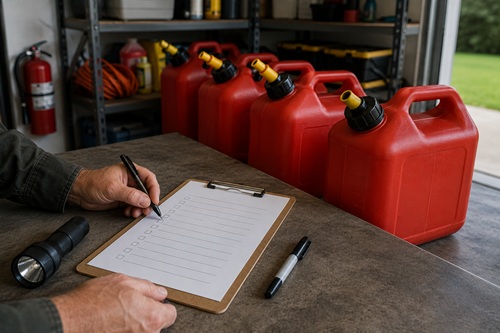
At least a few times each year:
- Inspect every container.
- Verify labels remain readable.
- Check for leaks.
- Confirm caps are sealing properly.
- Review purchase dates.
- Rotate older fuel if needed.
- Clean the storage area.
These inspections usually require only a few minutes but help ensure your emergency fuel remains ready whenever it’s needed.
Safe Fuel Storage Checklist
Before leaving your storage area, confirm:
✓ Approved fuel containers
✓ Containers tightly sealed
✓ Clearly labeled with purchase date
✓ Stored in a cool, dry location
✓ Protected from sunlight
✓ Away from ignition sources
✓ Organized for FIFO rotation
✓ No leaks or damage
✓ Inspection date recorded
A simple checklist helps make safe storage a habit rather than something that’s easy to overlook.
Prepper Tip
Instead of waiting until an emergency to discover your fuel supply has problems, choose one day each season to inspect, rotate, and organize your fuel storage. Linking this task to another seasonal chore—such as checking smoke detectors or servicing your generator—makes it much easier to remember.
Common Beginner Mistakes
One of the most common mistakes is storing gasoline wherever there happens to be extra space. Fuel should have a dedicated storage area where it can be inspected easily and protected from unnecessary heat and moisture.
Another mistake is neglecting the containers themselves. Even high-quality gasoline can become contaminated if a cap no longer seals properly or a container develops cracks or damage.
Finally, avoid expanding your fuel supply faster than you can manage it. A well-organized, regularly rotated fuel reserve is far more valuable than a large collection of forgotten containers.
Before You Continue
By now you’ve learned how gasoline ages, how long it typically lasts, how to inspect it, when it may be refreshed, how to rotate your supply, and how to store it safely.
The final chapters bring these ideas together by reviewing the most common mistakes, summarizing the key lessons, and providing a simple fuel management system that you can begin using immediately.
Common Fuel Storage Mistakes
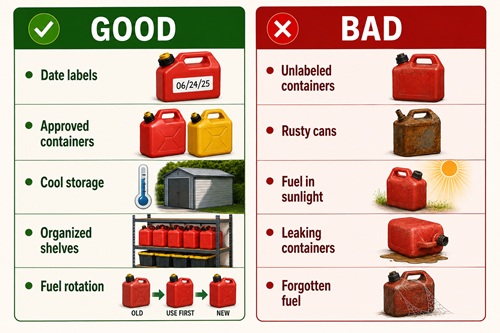
Most gasoline storage problems don’t happen because the fuel suddenly becomes unusable. They happen because of small mistakes that slowly reduce fuel quality over time.
The good news is that these mistakes are almost entirely preventable.
By understanding the most common errors people make when storing gasoline, you can avoid unnecessary waste, protect expensive equipment, and maintain a fuel supply that’s ready when you need it most.
Preparedness isn’t about doing complicated things.
It’s about consistently doing the simple things well.
Waiting Too Long to Rotate Fuel
The biggest mistake is assuming that gasoline can simply sit on a shelf indefinitely.
Many people fill several fuel containers, place them in the garage, and forget about them for years. When an emergency finally arrives, they discover that they no longer trust the fuel they’ve been storing.
A simple rotation system eliminates this problem entirely.
Using the oldest gasoline during normal vehicle or equipment operation and replacing it with fresh fuel keeps your emergency reserve dependable year after year.
Forgetting to Label Containers
It doesn’t take long for several identical gasoline containers to become impossible to distinguish.
Without a purchase date, you’ll never know which container is oldest.
Guessing defeats the purpose of a rotation system.
Every container should be labeled immediately after filling. A permanent marker or weather-resistant label is usually all that’s needed to record the purchase date.
This small habit prevents countless problems later.
Using the Wrong Containers
Gasoline should only be stored in containers designed and approved for fuel storage.
Improvised containers such as drink bottles, food containers, or glass jars can leak, deteriorate, or create serious safety hazards.
Besides increasing the risk of spills, improper containers may also allow additional air and moisture to enter, shortening the life of the fuel.
Using the correct container from the beginning is one of the simplest ways to protect both your gasoline and your family.
Storing Too Much Fuel
Preparedness isn’t measured by how many containers you own.
It’s measured by how well you manage them.
Many people buy far more gasoline than they realistically use. As a result, containers remain untouched for long periods and eventually become difficult to evaluate.
A smaller supply that is inspected and rotated regularly is usually far more valuable than a much larger supply that’s forgotten in the corner of the garage.
Build your emergency fuel supply around your actual needs.
Ignoring the Storage Area
The storage location matters just as much as the fuel itself.
Containers exposed to direct sunlight, excessive heat, standing water, or repeated temperature changes often experience faster fuel degradation.
An organized, cool, dry, well-ventilated storage area protects both the gasoline and the containers while making inspections much easier.
A little organization goes a long way.
Assuming Fuel Stabilizer Solves Everything
Fuel stabilizers are valuable tools, but they’re often misunderstood.
They help slow fuel degradation when added to fresh gasoline before storage.
They do not restore gasoline that has already deteriorated.
Some people assume that adding stabilizer means fuel never needs to be inspected or rotated again.
Unfortunately, that’s not how stabilizers work.
Even stabilized gasoline should be inspected regularly and incorporated into a rotation schedule.
Ignoring Warning Signs
Gasoline usually provides warning signs before serious problems develop.
Changes in color, cloudiness, sediment, unusual odors, or water contamination should never be ignored.
Continuing to use questionable fuel simply because “it’s probably okay” can create much more expensive problems later.
When in doubt, inspect carefully and choose the safer option.
Never Testing Equipment
Another common mistake isn’t the gasoline—it’s the equipment.
Generators, chainsaws, pumps, and other emergency equipment should be operated periodically throughout the year.
Regular testing confirms both the equipment and the stored fuel are functioning properly while naturally helping rotate your gasoline supply.
An emergency is the worst possible time to discover that either one isn’t working.
Prepper Tip
Schedule one “Fuel Day” each season.
On that day:
- Inspect every container.
- Check purchase dates.
- Rotate the oldest fuel.
- Refill empty containers.
- Test your generator or other gasoline-powered equipment.
- Update your fuel log.
Completing all of these tasks together usually takes less than an hour and keeps your entire fuel system ready for emergencies.
Quick Self-Assessment
Ask yourself these questions.
✓ Are all fuel containers labeled?
✓ Do I know which container is oldest?
✓ Have I inspected my gasoline this season?
✓ Have I rotated fuel recently?
✓ Have I tested my generator?
✓ Are my containers still in good condition?
✓ Is my storage area organized?
If you answered “no” to any of these questions, you’ve identified an opportunity to improve your preparedness.
Before You Continue
By avoiding these common mistakes, you’ve already solved most of the problems that affect long-term gasoline storage.
The final chapter brings everything together into a practical preparedness plan that will help you maintain a safe, dependable fuel supply for years to come.
Preparedness Applications
Emergency fuel is more than something you store for a disaster.
It’s part of a complete preparedness system.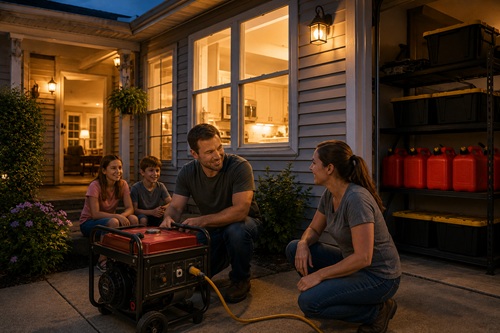
Gasoline powers many of the tools people depend on most during emergencies. Vehicles allow you to evacuate or transport supplies. Generators keep essential appliances running during power outages. Chainsaws help clear fallen trees after storms. Water pumps, pressure washers, snow blowers, and other equipment all become much more valuable when normal services are disrupted.
Unfortunately, stored fuel is only useful if it’s still in good condition when you need it.
That’s why preparedness isn’t simply about owning gasoline.
It’s about managing gasoline.
By inspecting, rotating, and storing your fuel properly, you build confidence that your equipment will be ready when it’s needed most.
Prevention Is Easier Than Restoration
Many people search for ways to “fix” old gasoline after it’s already deteriorated.
Experienced preppers take a different approach.
They build systems that prevent fuel from becoming old in the first place.
Regular inspections, proper storage, and consistent rotation eliminate most of the problems discussed throughout this handbook.
A few minutes of maintenance every few months is far easier than trying to decide whether years-old gasoline is still safe to use.
Preparedness rewards consistency.
Build Fuel Management into Your Routine
Fuel management shouldn’t be a special event.
It should become another routine household task.
Many people already check smoke detector batteries, inspect fire extinguishers, change furnace filters, or test backup generators throughout the year.
Fuel inspections fit naturally into these existing routines.
Choose one day each season to:
- Inspect fuel containers.
- Rotate the oldest gasoline.
- Refill empty containers.
- Check labels.
- Update your fuel log.
- Test gasoline-powered emergency equipment.
By linking fuel management to other seasonal preparedness tasks, it quickly becomes a habit rather than another chore to remember.
Keep Learning
Every household has different fuel needs.
Some people rely heavily on gasoline for generators and outdoor power equipment, while others primarily store fuel for their vehicles.
Over time, you’ll develop a better understanding of how much fuel your household actually uses, how often containers need rotating, and which storage methods work best in your climate.
Don’t be afraid to adjust your system.
Preparedness is built through observation and continuous improvement.
Key Takeaways
Throughout this handbook, you’ve learned that gasoline naturally changes over time, but proper management can greatly extend its useful life.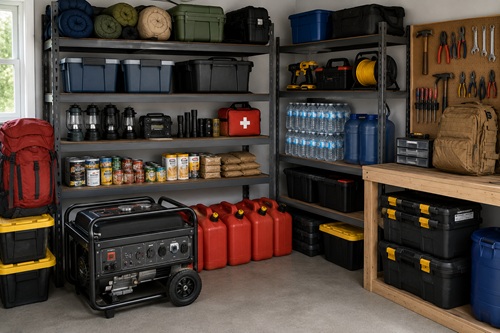
You’ve learned how to inspect stored gasoline, recognize warning signs of deterioration, understand when slightly aged fuel may be refreshed, and identify when gasoline should no longer be used.
Perhaps most importantly, you’ve learned that the best solution isn’t repairing old gasoline—it’s preventing gasoline from becoming old through proper storage and regular rotation.
Simple habits such as labeling containers, inspecting fuel seasonally, using approved containers, and following a First-In, First-Out rotation system help ensure your emergency fuel supply remains dependable year after year.
Preparedness isn’t about storing fuel and forgetting it.
It’s about maintaining a system that continues working long after the containers have been filled.
Your Next Steps
You don’t need to overhaul your entire fuel storage system today.
Start with a few simple improvements.
This week:
- Label every gasoline container with the purchase date.
- Inspect each container for damage or leaks.
- Check the condition of your stored fuel.
- Organize your storage area using a First-In, First-Out layout.
- Create a simple fuel inspection log.
- Plan your next fuel rotation.
Each of these tasks takes only a few minutes, yet together they dramatically improve the reliability of your emergency fuel supply.
Preparedness is built one small improvement at a time.
Final Thoughts
Gasoline is one of the most useful emergency resources you can store, but it’s also one of the easiest to neglect.
Unlike many other preparedness supplies, fuel changes continuously. Left unmanaged, it may no longer perform as expected when it’s needed most.
Fortunately, maintaining good fuel isn’t difficult.
By understanding how gasoline ages, inspecting it regularly, storing it correctly, and rotating it into everyday use, you can maintain a dependable emergency fuel supply with very little extra effort.
In the end, preparedness isn’t measured by how much gasoline you own.
It’s measured by your confidence that the fuel you’ve stored will be ready when you need it.
Knowledge keeps your equipment running.
Good habits keep your knowledge working.
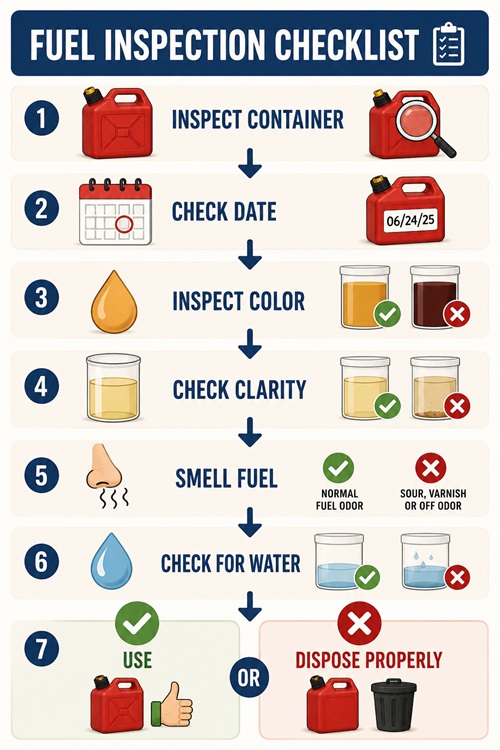
Appendix A — Gasoline Inspection Checklist
Use this checklist every time you inspect stored fuel.
| Inspection Item | Check |
|---|---|
| Container in good condition | ☐ |
| Purchase date visible | ☐ |
| Fuel is clear | ☐ |
| Normal color | ☐ |
| No sediment | ☐ |
| No water contamination | ☐ |
| Normal gasoline smell | ☐ |
| Container tightly sealed | ☐ |
| Storage area dry and cool | ☐ |
| Fuel log updated | ☐ |
Appendix B — Fuel Rotation Log
| Date | Container | Action | Notes |
|---|---|---|---|
| Filled | |||
| Inspected | |||
| Rotated | |||
| Refilled | |||
| Used |
Appendix C — Quick Decision Guide
| Condition | Recommended Action |
|---|---|
| Clear, normal appearance | Continue normal rotation and use |
| Slightly aged but otherwise clean | Consider mixing with fresh gasoline before use |
| Cloudy or milky | Do not use |
| Water contamination | Dispose of properly |
| Sediment or debris | Do not use |
| Strong varnish or sour odor | Dispose of properly |
| Unknown history and questionable condition | Err on the side of caution and dispose of properly |
Appendix D — Seasonal Fuel Maintenance Checklist
Spring
- Inspect all fuel containers.
- Rotate the oldest gasoline.
- Test your generator.
- Update your fuel log.
Summer
- Check for heat damage.
- Verify container seals.
- Review fuel inventory.
Fall
- Rotate gasoline before winter.
- Test snow-removal equipment.
- Refill emergency containers.
Winter
- Inspect storage area.
- Review emergency fuel needs.
- Plan next year’s rotation schedule.
© Prepping Communities. This content is for informational purposes only and not professional advice. Use at your own risk.
Terms | Privacy | Guidelines