
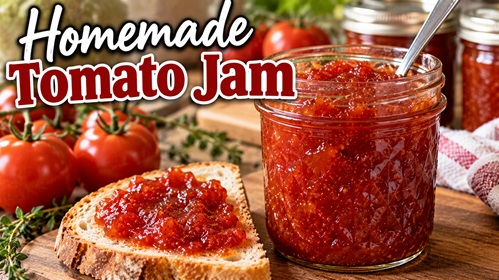
Another Way to Preserve the Harvest
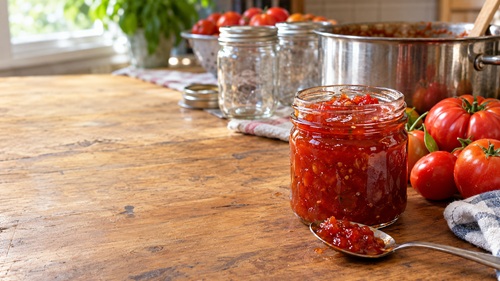
There always seems to be a point during tomato season when the garden goes from giving you a few tomatoes for dinner to giving you more than you know what to do with. At first that’s great. Then the kitchen counter starts filling up, another bowl appears on the table, and suddenly you’re trying to figure out what else you can possibly make with them.
Sauce, salsa and canned tomatoes are the obvious choices, and they’re useful ones. Tomato jam is a little different.
If you’ve never tried it, the name might sound strange. This isn’t really jam for your morning toast. It’s a thick, sweet and savoury tomato condiment that works really well on burgers, grilled cheese, sandwiches, crackers with cheese and roasted meats. The tomatoes are slowly cooked with sugar, citrus juice, salt and spices until much of their water is gone and the flavour becomes concentrated.
From a preparedness standpoint, I like the idea of having several ways to use the same crop. A garden doesn’t give you exactly six tomatoes every Tuesday because that’s what you need for dinner. Sometimes you get almost nothing, and then suddenly you have twenty pounds sitting on the counter.
Knowing several preservation methods gives you choices when that happens. Some tomatoes can become sauce, some salsa, some can be dehydrated or canned, and a smaller amount can become something like tomato jam.
It also adds something we don’t talk about enough with food storage: flavour. Rice, beans, bread, canned meat and other staples can keep people fed, but eating similar foods over and over gets old. A jar of something sweet, acidic and spicy can completely change an otherwise ordinary meal.
Choosing Tomatoes for Jam
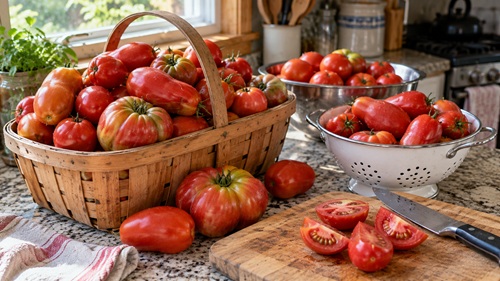
Good tomatoes make better jam. Since you’re cooking away a lot of the water, you’re also concentrating whatever flavour was in the tomatoes to begin with.
Paste tomatoes work particularly well because they’re generally fleshier and contain less water. Roma-type tomatoes and other paste varieties are good choices. Regular ripe garden tomatoes can work too, especially if they have good flavour, but juicier varieties may take longer to cook down and may give you less finished jam.
One thing I really like about this method is that you don’t have to peel and seed all those tomatoes first. Core them and chop them up. The skins and seeds stay in the batch.
Anyone who has stood in a kitchen peeling tomato after tomato during canning season will probably appreciate that.
The recipe below starts with six pounds of tomatoes and should produce somewhere around six half-pint jars, although tomatoes vary and your actual yield may be somewhat different.
Homemade Tomato Jam Recipe
Yield: Approximately 6 half-pint jars
Prep time: About 15 minutes
Cooking time: Approximately 2½–3 hours
Ingredients
- 6 pounds ripe tomatoes, cored and coarsely chopped
- 4 cups granulated sugar
- ½ cup bottled lemon juice or bottled lime juice
- 1 tablespoon freshly grated ginger, or ¼ teaspoon dried ground ginger
- 2–4 teaspoons red pepper flakes
- 2 teaspoons salt
- 1 teaspoon ground cinnamon
- ½ teaspoon ground cumin
Directions
1. Prepare the tomatoes.
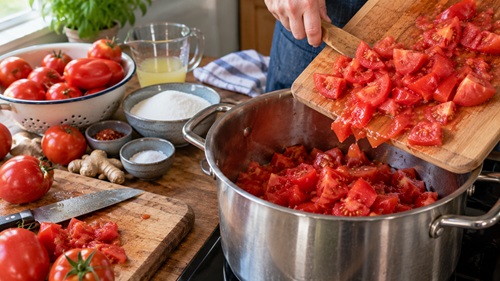
Wash the tomatoes, remove the cores and chop them into fairly coarse pieces. There’s no need to peel or seed them.
2. Combine everything in the pot.
Place the chopped tomatoes in a large, heavy-bottomed pot or Dutch oven. Add the sugar, bottled lemon or lime juice, ginger, red pepper flakes, salt, cinnamon and cumin. Stir everything together well.
3. Bring it to a boil.
Place the pot over medium-high heat and bring the mixture to a boil, stirring occasionally so the sugar dissolves and the spices are distributed throughout the tomatoes.
4. Reduce to a simmer.
Once it reaches a good boil, lower the heat and maintain a steady simmer. You’re trying to slowly remove water rather than violently boil the mixture.
5. Let it cook down.
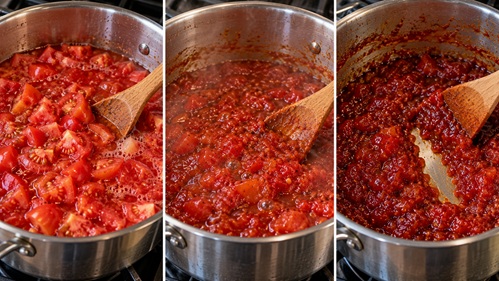
Continue simmering for approximately 2½–3 hours. Stir periodically and scrape the bottom and sides of the pot. As the jam becomes thicker, stir more frequently because the sugar and reduced tomato mixture can scorch.
6. Check the consistency.
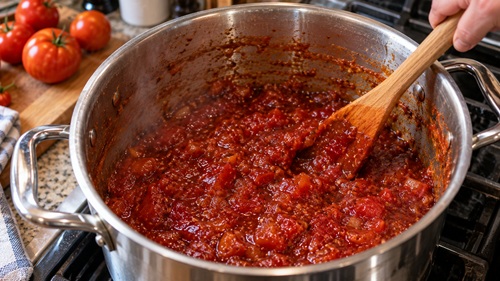
Drag a spoon or spatula through the mixture. When the jam is getting close, the path should stay open briefly before slowly filling back in. A spoonful should hold together rather than immediately running off like tomato sauce.
If it’s still watery, keep cooking. Juicier tomatoes can take longer.
7. For refrigerator or freezer storage.
Transfer the finished jam into clean containers. Refrigerate after cooling or package appropriately for freezing. The refrigerated version should be used within about a month, while frozen tomato jam can be kept for roughly six months for best quality.
8. For water-bath canning.
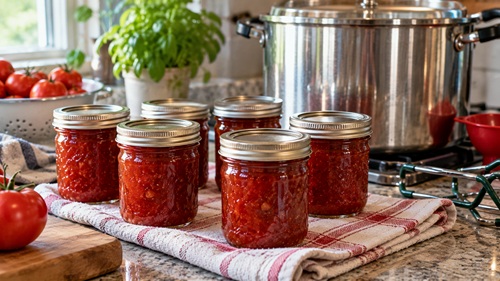
If you’re canning the jam, ladle the hot mixture into properly prepared half-pint canning jars, leaving ¼ inch headspace. Apply two-piece canning lids according to the manufacturer’s directions.
Process the jars in a boiling-water canner for 10 minutes, adjusting the processing time to 15 minutes at elevations above 6,000 feet.
Remove the jars according to proper canning procedure and allow them to cool undisturbed. Check the seals after cooling. Any jar that hasn’t sealed properly should be refrigerated rather than placed in pantry storage.
Properly processed and sealed jars should maintain their best quality for approximately 12–18 months. Refrigerate after opening.
A Few Things I’d Pay Attention To
Four cups of sugar sounds like a lot because it is. Tomato jam is a condiment, though, not something you’re going to eat by the bowlful. You’re using a spoonful on a burger, sandwich or grilled cheese.
The sugar also contributes to the consistency of this particular recipe. I wouldn’t simply cut the amount in half and expect the same jam.
The acidity is even more important if you’re canning it. Use the full amount of bottled lemon or lime juice. Bottled juice is preferable for canning because its acidity is standardized, while the acidity of freshly squeezed citrus can vary.
Don’t reduce the acid if you’re planning to store the jars at room temperature.
The spices are where there’s more room to decide what you enjoy. Two teaspoons of red pepper flakes gives you a milder jam than four. If heat isn’t your thing, you could explore a refrigerator or freezer version using something like smoked paprika for a different flavor.
When you’re experimenting substantially with a recipe, though, refrigeration or freezing is the safer route. Canning isn’t the place to casually change acidity or add a bunch of low-acid ingredients and assume the finished product remains safe for pantry storage.
Don’t Make a Giant Batch Just Because You Have a Giant Pile of Tomatoes
This is tempting during harvest season.
You need six pounds of tomatoes for the recipe, but there are twenty pounds sitting on the counter. It seems logical to find the biggest pot you own, triple everything and get the whole job done at once.
I wouldn’t.
Jam depends on evaporation. A much larger and deeper batch doesn’t necessarily reduce at the same rate, and you can end up cooking it forever while the mixture around the bottom and sides starts scorching.
This recipe can be halved if you want a smaller batch, but I wouldn’t double or triple it.
Make another batch instead.
It may feel slower, but ruining one enormous pot isn’t much of a time saver either.
Refrigerator, Freezer or Pantry?
You don’t have to can tomato jam at all.
If you’ve never made it before, I’d actually start with a refrigerator batch. Make it, put a jar in the fridge and see what happens.
Does everyone put it on burgers? Does it disappear on grilled cheese? Does somebody start eating it with crackers and cheese?
Great. Make more.
If the jar sits untouched for three weeks because everyone would rather have ketchup, you’ve learned something before filling an entire pantry shelf with it.
Freezing is another good option and doesn’t require learning water-bath canning.
Shelf storage is where things become more serious because now you’re asking a sealed jar of food to remain safe without refrigeration. That’s why tested recipes, proper acidity, correct headspace, processing time and altitude adjustments matter.
If you’re new to home canning, learn the complete boiling-water canning process from a current trusted canning authority before starting. Don’t rely on a short recipe alone to teach you everything about safe canning.
What Do You Actually Eat Tomato Jam With?
Burgers are probably the easiest place to start. Tomato jam works really well with beef and cheese because it adds sweetness, acidity and spice at the same time.
Grilled cheese is another good one. Spread a little inside before grilling and you’ve got something completely different from an ordinary sandwich.
It’s also good with crackers and cheese, roasted meats, sandwiches or baked brie. Spoon some over a block of cream cheese and you’ve got a pretty easy dip for crackers.
Once there’s an open jar in the refrigerator, you’ll probably find other things to put it on.
That’s actually part of why I like condiments in food storage. Imagine eating from your pantry for several weeks. There may be absolutely nothing wrong with the rice, bread, beans or canned meat you’re eating, but eventually meals can start tasting pretty similar.
A few jars of tomato jam, salsa, relish, chutney, mustard or other strongly flavoured foods give you ways to change those basic meals.
Food morale matters too. People don’t suddenly stop caring what dinner tastes like because they’re in an emergency.

Preserving the Same Harvest More Than One Way
If tomatoes are part of your garden plan, there’s another lesson here that’s probably more important than tomato jam itself.
Learn several ways to preserve them.
Tomato sauce gives you one option. Salsa gives you another. Whole or diced canned tomatoes can be used in all kinds of meals. Tomatoes can also be dehydrated. Tomato jam fills a much smaller role, but it gives you something completely different.
You don’t need fifty jars of every product.
Maybe you want twenty jars of sauce, twelve jars of salsa and only six little jars of tomato jam.
That’s fine.
Preparedness isn’t about turning every food into the largest stockpile possible. It’s about having enough knowledge and options that when food is abundant, you know what to do with it.
Twenty pounds of tomatoes preserved four or five different ways may also be a lot more enjoyable to eat over the winter than twenty pounds preserved exactly the same way.
Preparedness Action Plan
If you grow tomatoes, decide how you plan to use at least some of the harvest before everything ripens. Check your jars and lids, make sure you have freezer space if you’re using it, and keep some of the ingredients you’ll need for your favourite preservation recipes on hand.
Try one normal batch of tomato jam before deciding how much you want to store. Six pounds of tomatoes is enough to find out whether your household likes it without committing the entire garden to an experiment.
Then actually use it.
Put it on burgers. Try it with grilled cheese. Open a jar with crackers and cheese. Pay attention to whether it becomes something people ask for again.
If canning is going to be part of your preparedness plan, learn it while everything is normal. Know how your canner works, understand headspace and processing times, and know whether your elevation requires adjustments.
And don’t stop with tomato jam. Learn another way to preserve tomatoes too. The more ways you know how to handle a heavy harvest, the less likely good food is going to waste when the garden suddenly gives you more than you expected.
Key Takeaways
Tomato jam is a fairly simple way to turn ripe tomatoes into a sweet, savoury and spicy condiment. Paste tomatoes generally give a better yield because they contain less water, but other flavourful tomatoes can work too.
The process isn’t difficult, but it takes time. Most of that time is simply allowing the tomatoes to slowly reduce until the mixture becomes thick.
For refrigerator and freezer storage, you have more freedom to experiment. Canning is different. If the finished product is going onto a pantry shelf, acidity, ingredient proportions, headspace, processing method, processing time and altitude adjustments need to be taken seriously.
You don’t need dozens of jars of tomato jam for preparedness. A few jars give you another way to preserve a tomato harvest and something very different to add to otherwise ordinary stored meals.
And if everyone in the house starts asking when you’re making another batch, then you’ll know how many jars to make next year.
Food Safety Disclaimer
This posting is provided for preparedness education and general information. Home canning requires proper food-safety procedures. When preserving food for room-temperature storage, use a current tested recipe from a trusted canning authority and follow its ingredient proportions, acidity requirements, jar preparation, headspace, processing method, processing time and altitude adjustments.
Do not assume that reducing the acid, adding low-acid ingredients or substantially changing a canning recipe will produce a product that remains safe for pantry storage. If you’re uncertain about a modified recipe, refrigerate or freeze the finished food instead.
Inspect preserved foods before use. Jars that are unsealed, leaking, bulging, spurting liquid, moldy or otherwise suspicious should not be eaten. If the safety of a home-canned product is uncertain, don’t taste it to find out.
© Prepping Communities. This content is for informational purposes only and not professional advice. Use at your own risk.
Terms | Privacy | Guidelines