
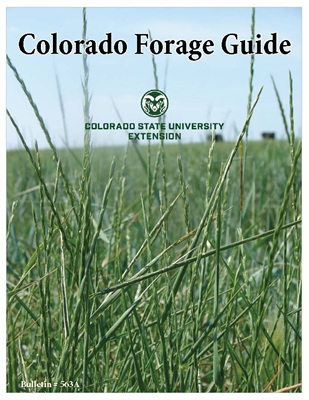
The Colorado Forage Guide is a practical, field-focused manual designed to help landowners, especially those managing small acreages, understand how to establish, manage, and sustain productive pastures. Produced by Colorado State University Extension in collaboration with agricultural and conservation agencies, it serves as both an introductory and intermediate guide to forage production, grazing systems, and land stewardship.
At its core, the publication explains how different forage plants—primarily grasses and legumes—function within a pasture system. It breaks down key differences such as cool-season vs. warm-season grasses, native vs. introduced species, and bunch grasses vs. sod-forming grasses. These distinctions matter because each plant type responds differently to climate, soil, and grazing pressure. The guide emphasizes selecting species based on site-specific conditions like soil type, moisture availability, and intended land use, whether for livestock grazing, hay production, or habitat.
A major focus of the guide is pasture establishment and renovation, walking readers through soil testing, seed selection, seedbed preparation, and planting methods. It highlights the importance of using “pure live seed” calculations to ensure proper seeding rates and explains how to design effective seed mixtures. The guide also stresses that establishing a healthy pasture takes time and proper planning, and that mistakes early on—such as poor site preparation or incorrect species selection—can lead to long-term productivity issues.
Equally important is its detailed coverage of grazing management, which is presented as the key factor in long-term pasture success. The guide explains how overgrazing damages plant health, reduces forage production, and leads to weed invasion. It introduces concepts like stocking rate, carrying capacity, and rotational grazing, helping landowners balance livestock needs with plant recovery. Practical guidance—such as maintaining proper stubble height and allowing adequate regrowth periods—makes it clear that good grazing management is both a science and an ongoing, hands-on process.
Overall, this publication is less about quick fixes and more about building a sustainable, long-term system. It teaches landowners how to work with their environment—soil, climate, and plant biology—to create resilient forage systems that support livestock while protecting the land.
Highly Recommended Reading!
Jennifer L. Cook
Joe E. Brummer
Paul J. Meiman
Thaddeus Gourd
Adapted from the Forage Guide for the Northern Colorado Front Range, by Ron Jepson, Colorado State University
Cooperative Extension, 1997
© Prepping Communities. This content is for informational purposes only and not professional advice. Use at your own risk.
Terms | Privacy | Guidelines