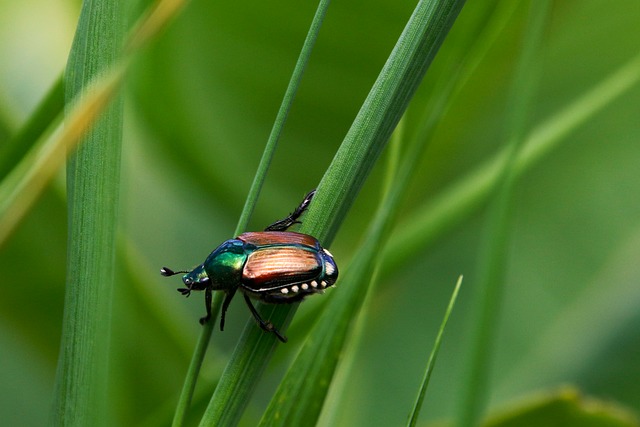
Japanese Beetle (Popillia japonica) is a fact sheet published by Virginia Cooperative Extension that provides an overview of the identification, life cycle, damage, and management of one of the most destructive landscape and garden pests in North America. The publication explains how Japanese beetles affect ornamental plants, fruit trees, grapes, vegetables, turfgrass, and agricultural crops, while also describing the grub stage that damages lawns and turf systems.
The guide begins by discussing the beetle’s distribution and host range. Originally discovered in New Jersey in 1916, the Japanese beetle has spread throughout much of the eastern United States and is now well established across Virginia. Adult beetles feed on hundreds of plant species and are particularly damaging to roses, grapes, fruit trees, and many ornamental plants. The document explains how adults skeletonize leaves by feeding between the veins, leaving behind a characteristic lace-like appearance.
The publication also covers the grub stage of the insect’s life cycle. White grubs develop underground where they feed on grass roots and other plant roots. Severe infestations can cause large brown patches in lawns that resemble drought damage. The guide explains the annual life cycle, including egg laying, larval development, overwintering behavior, pupation, and adult emergence. The photograph on page 1 shows the distinctive metallic green and copper-colored adult beetle, while the illustration on page 2 highlights the grub stage and life cycle.
The final section focuses on control strategies. Recommendations include cultural controls, biological controls such as beneficial nematodes, trapping, plant selection, physical exclusion using netting, hand-picking, and chemical control options for turf, fruit trees, and ornamental plants. The guide emphasizes timing treatments properly because different control methods target different stages of the beetle’s life cycle.