
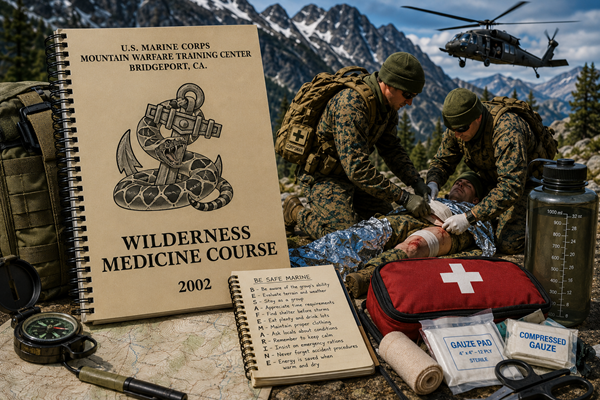
Wilderness Medicine Course (2002) is a comprehensive U.S. Marine Corps Mountain Warfare Training Center handbook that combines wilderness medicine, survival, mountain operations, search and rescue, preventive medicine, navigation, and casualty management into a single field reference. The course was designed to prepare personnel to operate safely and effectively in remote mountainous environments where medical evacuation may be delayed and environmental hazards pose significant risks.
The handbook covers a remarkably broad range of subjects. Medical topics include wilderness patient assessment, combat casualty care, burn management, hypothermia, rewarming techniques, cold injuries, heat-related illnesses, high-altitude illnesses, submersion incidents, orthopedic injuries, envenomation from reptiles and insects, triage, preventive medicine, and water purification. The manual emphasizes practical field treatment and decision-making in situations where advanced medical care may be hours or days away.
A major portion of the course focuses on mountain safety and survival. The opening chapter introduces the Marine Corps mountain safety acronym “BE SAFE MARINE”, which covers route planning, weather awareness, group management, emergency preparedness, shelter selection, hydration, equipment maintenance, accident prevention, and energy conservation. The handbook repeatedly emphasizes that environmental hazards often present a greater threat than hunger or isolation and that exposure-related injuries such as hypothermia can become life-threatening in a matter of hours.
The nutrition sections discuss operating in cold-weather and high-altitude environments, including caloric requirements, hydration, carbohydrate and fat utilization, cold tolerance, dehydration prevention, and field rations. The manual notes that personnel operating in mountainous environments may require approximately 4,500 calories per day and stresses the importance of maintaining adequate hydration even when cold temperatures reduce the sensation of thirst.
The survival appendices add substantial preparedness value by covering:
- Survival priorities
- Survival kits
- Signaling techniques
- Shelter construction
- Fire building
- Wilderness navigation
- Water procurement
- Foraging
- Traps and snares
- Mountain weather awareness
Additional appendices cover swift-water rescue, rope systems, mountain rescue techniques, casualty evacuation, rappelling, climbing equipment, and mountaineering operations.
Overall, this is one of the most comprehensive wilderness survival and wilderness medicine references encountered so far, combining medical preparedness, search and rescue, mountain operations, navigation, survival skills, and preventive medicine into a single field handbook.
© Prepping Communities. This content is for informational purposes only and not professional advice. Use at your own risk.
Terms | Privacy | Guidelines