
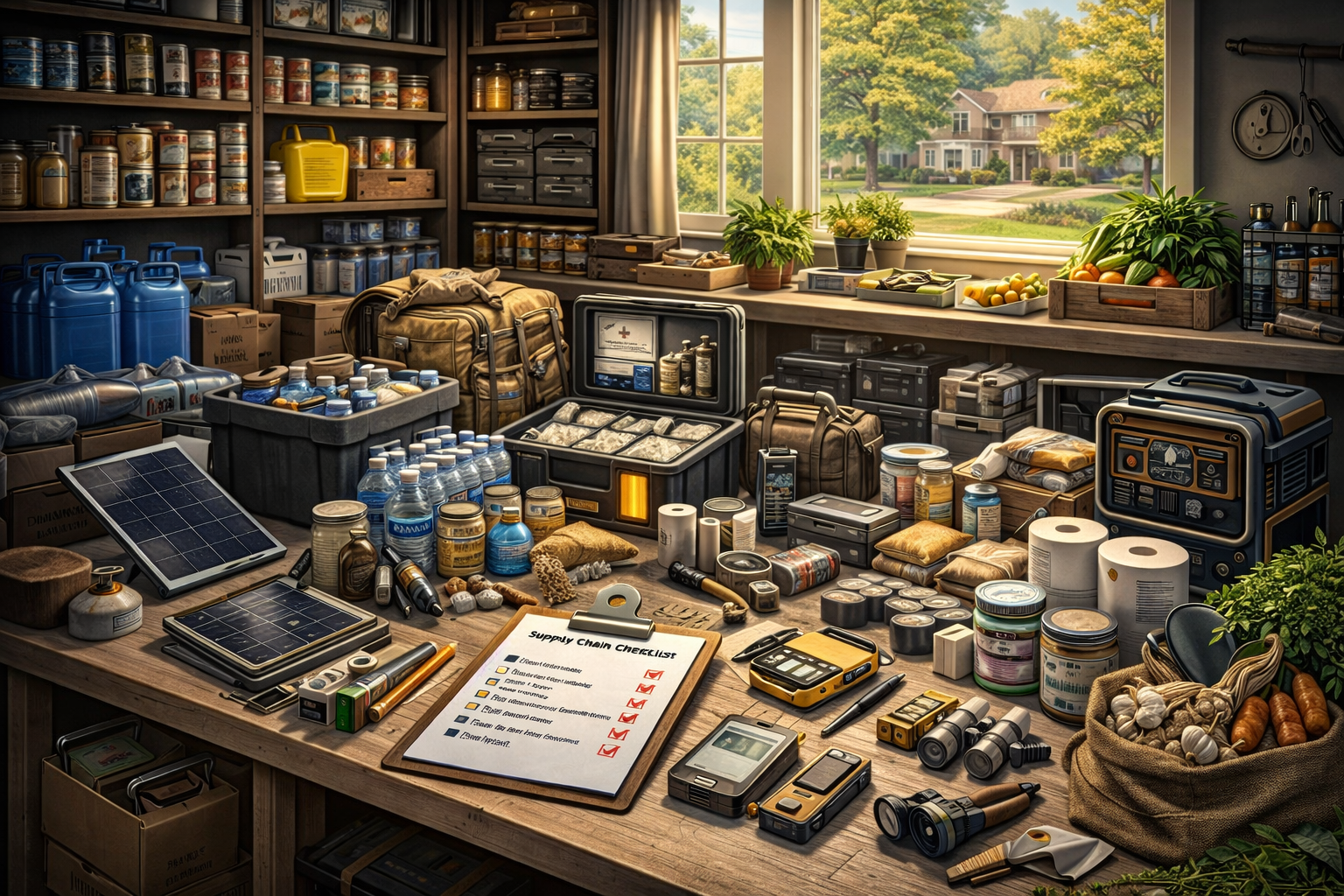
Most people assume:
- Stores will restock
- Deliveries will continue
- Shortages are temporary
Reality:
- Supply chains break in layers
- Once disruption starts, it compounds
- Recovery takes far longer than failure
If you rely on “just-in-time” systems, you are vulnerable.
CORE SUPPLY CHAIN PRINCIPLES
- Control what you can locally
- Reduce dependence on outside systems
- Build redundancy into everything
- Store what you use, use what you store
- Expect delays, shortages, and substitutions
COMPLETE SUPPLY CHAIN CHECKLIST
1. FOOD SUPPLY (PRIMARY PRIORITY)
Checklist:
- Minimum 30–90 days food stored (start here)
- Mix of:
- Dry goods (rice, beans, oats)
- Canned foods
- Freeze-dried or long-term storage
- Manual cooking methods (no grid reliance)
Advanced:
- Garden setup (even small scale)
- Seed storage (heirloom, repeatable)
- Food preservation skills (canning, dehydrating)
2. WATER SUPPLY (CRITICAL)
Checklist:
- Minimum 1 gallon per person per day (bare minimum)
- Storage containers (rotated regularly)
- Water filtration system
- Backup purification (boiling, tablets)
Advanced:
- Rain catchment
- Nearby natural water sources mapped
3. FUEL AND ENERGY SUPPLY
Checklist:
- Fuel storage (gas, propane, etc.)
- Backup power (solar, generator, battery bank)
- Manual alternatives (non-electric tools)
Reality:
Fuel shortages hit fast and last long
4. MEDICAL AND HYGIENE SUPPLY
Checklist:
- First aid kits (multiple locations)
- Prescription medications stocked
- Hygiene supplies (soap, sanitation, feminine products)
Advanced:
- Basic medical knowledge
- Backup treatment options
5. TRANSPORTATION AND MOBILITY SUPPLY
Checklist:
- Vehicle maintained and ready
- Fuel reserves
- Backup transport (bike, walking gear)
Supply Chain Tie-In:
If you can’t move, you can’t access resources
6. HOUSEHOLD ESSENTIALS
Checklist:
- Cleaning supplies
- Cooking essentials
- Batteries and lighting
- Tools and repair items
Focus:
Items people forget—but need daily
7. COMMUNICATION SUPPLY
Checklist:
- Radios (handheld or base)
- Backup power for communication devices
- Contact plans with family
8. BARTER AND TRADE ITEMS
Reality:
Cash may lose usefulness in certain scenarios
Checklist:
- Extra consumables (food, hygiene items)
- Tools and practical goods
- Skills you can trade
9. STORAGE AND ROTATION SYSTEM
Mistake:
Buying supplies and letting them expire
Fix:
- Label everything
- Rotate regularly
- Use FIFO (first in, first out)
10. SUPPLY CHAIN AWARENESS
Checklist:
- Watch for early signs of disruption:
- Empty shelves
- Price spikes
- Delayed shipments
- Adjust buying habits early
TOP SUPPLY CHAIN MISTAKES
- Waiting until shelves are empty
- Relying on one store or supplier
- Not storing enough water
- Ignoring fuel and energy needs
- No backup plan for cooking or transport
STEP-BY-STEP (NO FLUFF PLAN)
Step 1: Build a 30-Day Buffer
- Food, water, essentials
Step 2: Expand to 90 Days
- Add variety and depth
Step 3: Add Independence
- Gardening
- Water sourcing
- Energy backup
Step 4: Add Redundancy
- Multiple supply options
- Backup systems
Step 5: Maintain and Rotate
- Keep everything usable
ADVANCED PREPPER INSIGHT
Supply chain collapse doesn’t look like chaos at first—
it looks like:
- Missing items
- Higher prices
- Longer waits
By the time it becomes obvious, it’s too late.
FINAL TAKEAWAY
You don’t need to panic—you need to prepare early.
If you:
- Build reserves
- Reduce dependence
- Create redundancy
…you remove yourself from the weakest part of the system.