
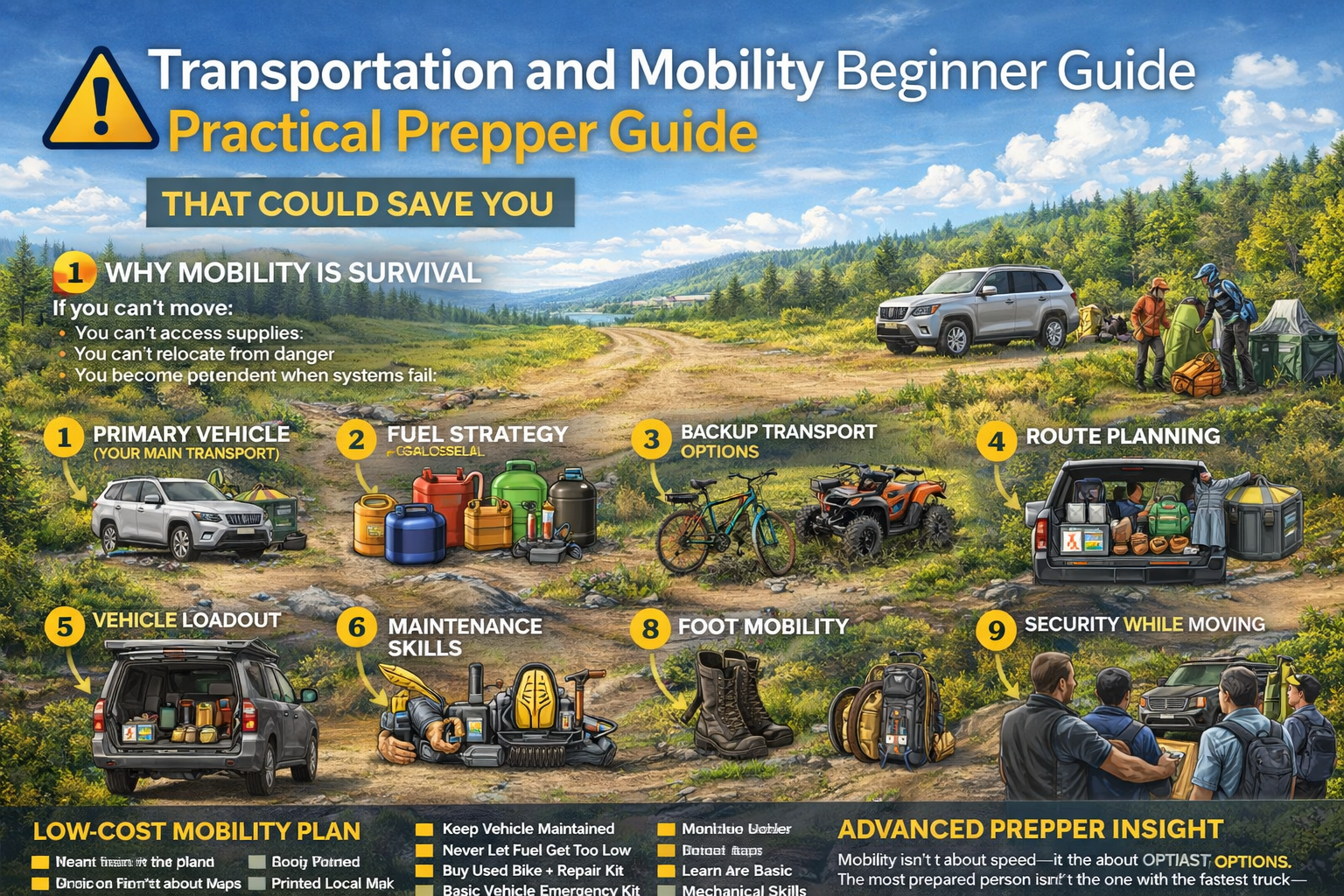
When systems break down, movement becomes power.
If you can’t move:
- You can’t access supplies
- You can’t relocate from danger
- You can’t support your family or community
- You become dependent on failing systems
Mobility is not just about vehicles—
it’s about having multiple ways to move under any condition.
CORE PREPPER MOBILITY PRINCIPLES
- Redundancy (multiple transport options)
- Simplicity (less tech = fewer failure points)
- Efficiency (fuel, energy, effort)
- Reliability (works when systems fail)
- Adaptability (urban, rural, off-road)
COMPLETE BEGINNER MOBILITY CHECKLIST
1. PRIMARY VEHICLE (YOUR MAIN TRANSPORT)
Must-Have Traits
- Reliable engine (proven platform > new tech)
- Easy to repair (parts availability matters)
- Good fuel efficiency
- Cargo capacity
Checklist
- Full maintenance done (fluids, belts, filters)
- Spare tire + repair kit
- Basic tool kit in vehicle
- Jumper cables or battery pack
- Extra fluids (oil, coolant, transmission fluid)
2. FUEL STRATEGY (CRITICAL)
Mistake Most Beginners Make:
Keeping the tank half full or less.
What To Do
- Always maintain minimum 50–75% fuel
- Store backup fuel safely (rotate regularly)
Fuel Types to Consider
- Gasoline (common but short shelf life)
- Diesel (better for storage and torque)
- Propane (long-term stable)
3. BACKUP TRANSPORT OPTIONS
If your vehicle fails, what’s next?
You need layers:
- Bicycle (silent, efficient, no fuel)
- Walking kit (boots, pack, endurance)
- ATV / dirt bike (off-road mobility)
Minimum Setup
- One bike per person if possible
- Repair kit for each transport type
4. ROUTE PLANNING (MOST OVERLOOKED)
Mistake:
Only knowing main roads.
What To Do
- Map at least 3 routes:
- Primary (fastest)
- Secondary (less traffic)
- Emergency (off-road / backroads)
Include
- Fuel stops
- Water sources
- Safe rest locations
Pro Tip
- Use paper maps—not just GPS
5. VEHICLE LOADOUT (MOBILE SURVIVAL KIT)
Your vehicle should act like a mini survival base.
Essentials
- Water (at least 24–72 hours)
- Food (non-perishable)
- First aid kit
- Flashlights and batteries
- Blankets / sleeping bags
Advanced Additions
- Portable stove
- Recovery gear (tow straps, shovel)
- Fire-starting kit
6. MAINTENANCE SKILLS (NON-NEGOTIABLE)
If you can’t fix it, you don’t own it—you borrow it.
Learn Basics
- Tire changes
- Battery replacement
- Oil changes
- Air filter replacement
Carry
- Wrenches
- Tire inflator
- Multitool
7. OFF-ROAD AND RURAL MOBILITY
In a real crisis, roads may not be usable.
Prepare For
- Dirt roads
- Mud
- Snow
- Blocked highways
Upgrade Options
- All-terrain tires
- Roof racks for gear
- Skid plates (if serious)
8. FOOT MOBILITY (LAST LINE BUT ESSENTIAL)
If everything fails—you walk.
Checklist
- Durable boots (broken in, not new)
- Backpack (bug-out ready)
- Weather-appropriate clothing
Train
- Walk long distances with weight
- Practice navigation without GPS
9. SECURITY WHILE MOVING
Movement makes you visible and vulnerable.
Key Points
- Avoid predictable routes
- Keep a low profile
- Don’t overload vehicle visibly
Situational Awareness
- Watch choke points
- Avoid crowded areas in crisis
10. COMMUNITY MOBILITY (FORCE MULTIPLIER)
Going alone limits your options.
Stronger Strategy
- Coordinate with others
- Share transport resources
- Plan group relocation routes
LOW-COST MOBILITY PLAN (START HERE)
Step-by-Step:
- Keep your current vehicle fully maintained
- Never let fuel drop below half tank
- Buy a used bicycle and repair kit
- Build a basic vehicle emergency kit
- Print local maps and mark routes
- Start learning basic mechanical skills
TOP BEGINNER MISTAKES
- Relying on one vehicle only
- Ignoring fuel storage
- No backup transport
- No route planning
- Overloading vehicle with unnecessary gear
- Never practicing mobility plans
ADVANCED PREPPER INSIGHT
Mobility isn’t about speed—it’s about options.
The most prepared person isn’t the one with the fastest truck—
it’s the one who can still move when:
- Fuel is gone
- Roads are blocked
- Systems are down
FINAL TAKEAWAY
Transportation and mobility can mean the difference between:
- Being stuck
- Or staying in control
You don’t need expensive gear—you need:
- A reliable system
- Backup options
- A clear plan
That’s what keeps you moving when it matters most.