
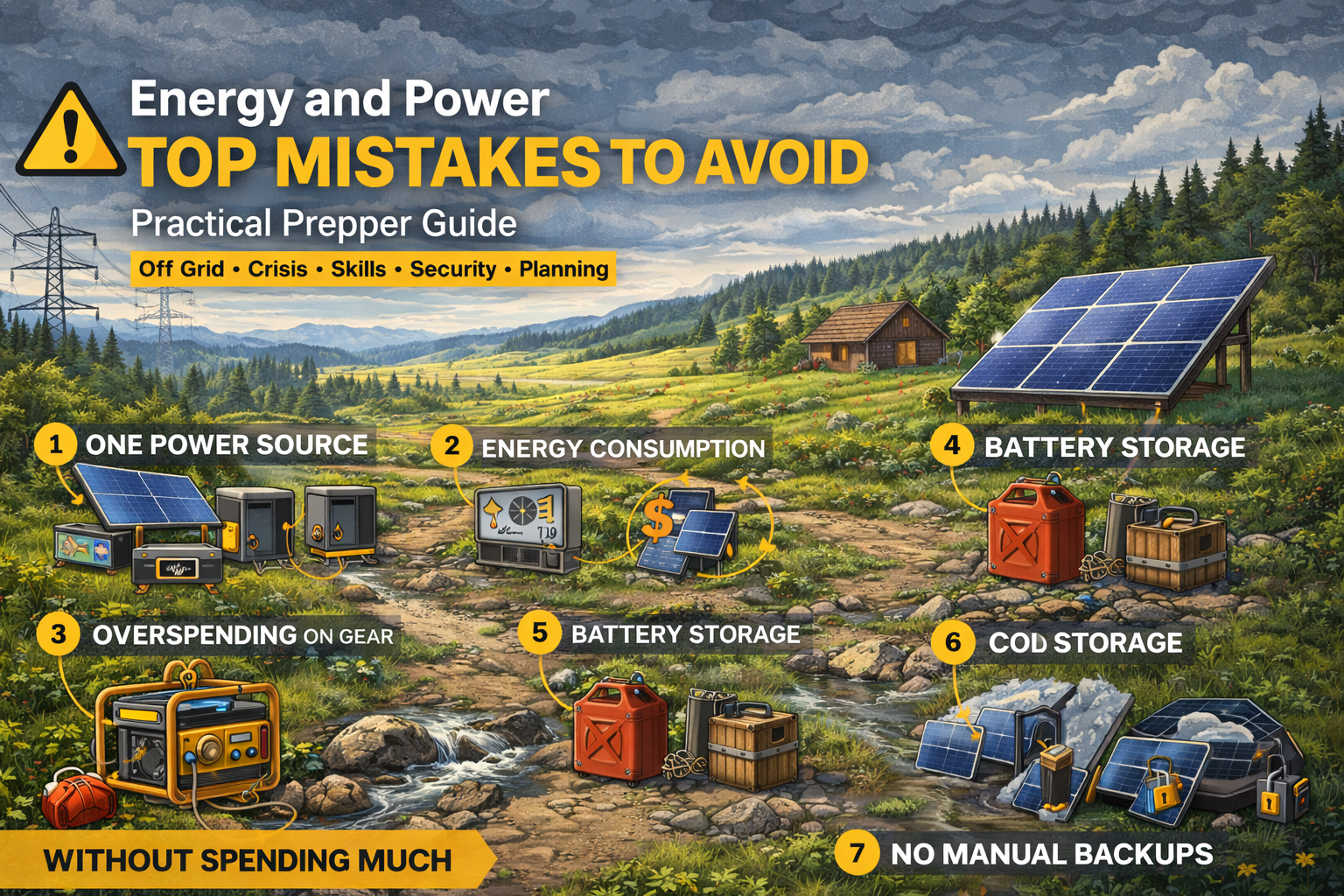
Energy is one of the first systems to fail in a crisis—and one of the hardest to rebuild quickly. Most people focus on buying gear instead of building a layered, redundant energy strategy.
This guide focuses on the biggest mistakes preppers make and how to avoid them without spending much money.
TOP MISTAKES TO AVOID (AND WHAT TO DO INSTEAD)
1. Relying on ONE Power Source
Mistake:
Depending entirely on solar, grid power, or a generator.
Why It Fails:
- Solar fails in prolonged cloud/snow
- Generators fail without fuel
- Grid fails during outages or restrictions
What To Do Instead:
Build layered redundancy:
- Primary: Solar system
- Secondary: Generator (fuel-based)
- Tertiary: Manual (hand crank, mechanical tools)
Minimum Setup:
- Small solar panel (100–400W)
- Backup generator OR battery bank
- Manual alternatives (non-electric tools)
2. Ignoring Energy Consumption (Load Planning)
Mistake:
Buying power systems without calculating usage.
Why It Fails:
You run out of power faster than expected.
What To Do Instead:
Calculate your daily load:
Basic Formula:
- Watts × Hours = Watt-hours per day
Example:
- Fridge (100W × 10h = 1000Wh)
- Lights (10W × 5h = 50Wh)
- Devices (50W × 3h = 150Wh)
Total = 1200Wh/day
Action:
- Track every device
- Cut unnecessary loads
- Prioritize survival gear only
3. Overspending on Gear Instead of Strategy
Mistake:
Buying expensive systems without a plan.
Why It Fails:
- Poor integration
- Missing components
- Wasted money
What To Do Instead:
Start with a phased build:
Phase 1: Essentials
- Lighting
- Communication devices
- Phone charging
Phase 2: Sustainability
- Refrigeration
- Water pumping
Phase 3: Comfort
- Heating supplements
- Tools and appliances
4. No Battery Storage Strategy
Mistake:
Running solar panels without sufficient battery storage.
Why It Fails:
No power at night or during low sunlight.
What To Do Instead:
- Prioritize battery storage FIRST
- Use deep-cycle batteries (AGM or LiFePO4)
Rule of Thumb:
- At least 2–3 days of stored energy
5. Poor Fuel Storage Practices
Mistake:
Storing little or no fuel—or storing it incorrectly.
Why It Fails:
- Fuel degrades
- Limited runtime
- Safety hazards
What To Do Instead:
- Rotate fuel every 6–12 months
- Use stabilizers
- Store safely in approved containers
Include:
- Gasoline
- Propane (long-term stable)
- Diesel (longer shelf life)
6. Ignoring Cold Weather Performance
Mistake:
Assuming systems work the same in winter.
Why It Fails:
- Batteries lose efficiency
- Solar output drops
- Fuel thickens (diesel gelling)
What To Do Instead:
- Insulate battery banks
- Angle solar panels for winter sun
- Keep backup heating options
7. No Manual Backup Options
Mistake:
Everything requires electricity.
Why It Fails:
Total dependency on power.
What To Do Instead:
- Manual water pumps
- Wood stoves
- Hand tools instead of electric
8. Poor System Integration
Mistake:
Random gear that doesn’t work together.
Why It Fails:
- Inefficiency
- Compatibility issues
- Increased failure points
What To Do Instead:
- Standardize voltage (12V, 24V, or 48V)
- Use compatible connectors
- Plan BEFORE buying
9. No Security for Energy Systems
Mistake:
Leaving solar panels, fuel, and generators exposed.
Why It Fails:
Energy = high-value target in crisis.
What To Do Instead:
- Conceal or camouflage systems
- Lock fuel storage
- Use noise discipline (generators)
10. Not Practicing or Testing the System
Mistake:
Waiting until an emergency to use your setup.
Why It Fails:
- Equipment failure
- User error
- Missing parts
What To Do Instead:
- Run monthly tests
- Simulate grid-down scenarios
- Track performance and adjust
LOW-COST ENERGY PREP STRATEGY (DO THIS FIRST)
Step-by-Step (Budget Friendly):
- Start with a portable power station OR DIY battery
- Add a 100–200W solar panel
- Switch to LED lighting only
- Use 12V devices where possible
- Build a fuel reserve slowly
- Add manual backups over time
ADVANCED PREPPER INSIGHT
Energy independence is not about having the most power—
it’s about having reliable, sustainable, and scalable power.
Key Principles:
- Reduce before you produce
- Store before you expand
- Redundancy beats capacity
- Simplicity beats complexity
FINAL TAKEAWAY
Most failures in prepping energy systems are not caused by lack of equipment—
they are caused by poor planning, lack of redundancy, and no real-world testing.
If you avoid these mistakes, you can build a highly resilient energy system
without spending a fortune.