
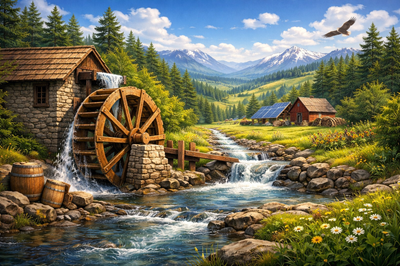
1 Why Water Wheels Still Matter Today
 Water wheels remain one of the most overlooked yet powerful tools in modern homesteading. In a world increasingly dependent on complex and fragile energy systems, water wheels offer something rare—simple, continuous, and reliable power. Unlike solar panels that depend on sunlight or wind turbines that require favorable conditions, water wheels can operate day and night as long as there is a steady flow of water.
Their importance goes beyond energy production. Water wheels represent a return to systems that are repairable, understandable, and independent of supply chains. There are no batteries to replace, no electronics required, and no reliance on fuel deliveries. For homesteaders and preppers, this makes them an ideal long-term solution for mechanical and even electrical power.
In practical terms, a properly built water wheel can run grain mills, pump water, power workshop tools, or generate electricity. It transforms a natural resource into usable energy with minimal ongoing input. In uncertain times, this level of self-reliance is not just valuable—it’s critical.
Water wheels are one of the oldest and most reliable forms of mechanical power. Long before electricity grids existed, they powered mills, saws, pumps, and entire communities. Today, they remain one of the most resilient, low-tech, and sustainable energy systems available to homesteaders.
Unlike solar or wind, water power can run 24/7, as long as flow is consistent. This makes it one of the few renewable energy systems capable of delivering steady, predictable output. For off-grid living, that reliability is a massive advantage.
For preppers and homesteaders, a water wheel represents something even more important: independence from fuel, batteries, and fragile systems.
2 Types of Water Wheels
Understanding the different types of water wheels is essential to building a system that actually works in your environment. Each type is designed to harness water energy in a different way, depending on the speed of flow and the available vertical drop (head). Choosing the wrong type is one of the fastest ways to end up with a system that underperforms or fails entirely.
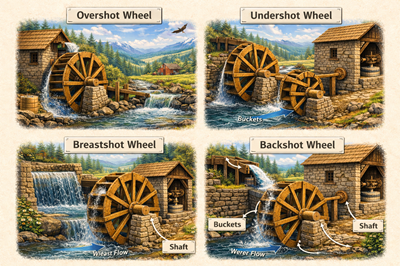
Overshot wheels are the most efficient, using the weight of water dropping from above to generate torque. These are ideal for locations where you have elevation or can create it with a small dam or flume. Undershot wheels, on the other hand, rely on the speed of flowing water and are best suited for flat areas with fast-moving streams. Breastshot wheels fall somewhere in between, offering a balance of efficiency and simpler construction.
The key takeaway is that there is no universal design. The best water wheel is the one that matches your specific site conditions. By aligning your design with your environment, you maximize efficiency and avoid unnecessary complexity.
2.0 Water Wheel Types Overview
Overshot Wheel
- Water flows over the top
- Uses gravity + weight
- Most efficient (60–80%)
Undershot Wheel
- Water flows under the wheel
- Uses current speed
- Least efficient but simplest
Breastshot Wheel
- Water hits near the middle
- Balanced efficiency and simplicity
Backshot Wheel
- Water enters behind the wheel
- Used in steeper terrain
Choosing the Right Type Depends On:
- Water flow speed
- Height (head)
- Terrain
| Wheel Type | Water Entry | Power Source | Efficiency | Best Conditions | Pros | Cons | Difficulty |
|---|---|---|---|---|---|---|---|
| Overshot | Over the top | Gravity + water weight | 60–80% | High elevation (head), slow flow | Highest efficiency, strong torque, works with low flow | Requires flume/dam, more complex | High |
| Undershot | Under the wheel | Water speed (current) | 20–40% | Flat terrain, fast streams | Simple, cheap, easy to build | Low efficiency, needs strong current | Low |
| Breastshot | Middle of wheel | Weight + flow | 50–70% | Moderate slope, steady flow | Balanced efficiency, less complex than overshot | Still needs water control | Medium |
| Backshot | Behind the top | Gravity (optimized entry) | 60–80% | Steep terrain, angled flow | High efficiency, smoother water entry | Complex alignment, less common | High |
2.1 Overshot Wheel (Highest Efficiency – Gravity Driven)
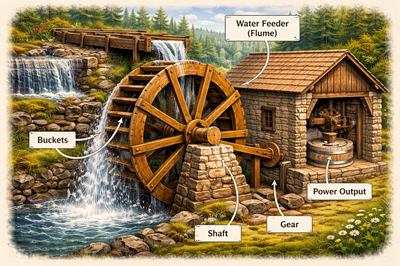 The overshot wheel is widely considered the gold standard of traditional water wheel design. Instead of relying on the speed of flowing water, it uses the weight of water itself to generate power. Water is delivered to the top of the wheel—typically via a flume, chute, or pipe—and fills a series of buckets attached around the rim. As these buckets fill, gravity pulls them downward, turning the wheel with significant torque.
What makes this design so powerful is that it captures both the potential energy (height/head) and the weight of the water. This allows overshot wheels to achieve efficiencies between 60% and 80%, far higher than other traditional designs. Even relatively small flows can produce meaningful output if sufficient head is available.
However, this efficiency comes at the cost of complexity. You must create or utilize a vertical drop (head), which often requires building a raised channel, small dam, or diversion system. Precision is critical water must enter at the correct angle and flow rate. Too fast, and it spills; too slow, and it doesn’t fill the buckets properly.
Best Use Case
- Hilly or mountainous terrain
- Properties with natural elevation changes
- Locations where water can be diverted and controlled
Key Advantages
- Highest efficiency of all traditional wheels
- Works well even with low flow if head is high
- Produces strong, steady torque (great for mechanical work)
Limitations
- Requires more engineering and setup
- Needs stable water delivery system
- More sensitive to poor alignment and design
2.2 Undershot Wheel (Simplest – Flow Driven)
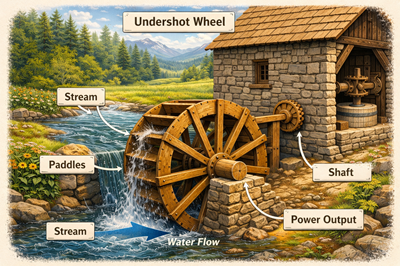 The undershot wheel is the simplest and most accessible design, making it the best starting point for beginners. Instead of using gravity and weight, it relies entirely on the horizontal movement (velocity) of water flowing beneath it. The current pushes against paddles mounted on the wheel, causing it to rotate.
Because it depends on water speed rather than height, undershot wheels are best suited for flat terrain with fast-moving streams or rivers. They are easy to install, often requiring little more than placing the wheel in the current and securing it in place.
However, this simplicity comes with lower efficiency—typically in the 20% to 40% range. Much of the water flows past the paddles without transferring its full energy, especially if the wheel is not properly sized or positioned.
Best Use Case
- Flat land with steady, fast-moving water
- Creeks, rivers, or irrigation channels
- Low-budget or experimental builds
Key Advantages
- Easiest and cheapest to build
- Minimal infrastructure required
- Works without modifying the landscape
Limitations
- Lowest efficiency
- Requires strong current to be effective
- Produces less torque than other designs
2.3 Breastshot Wheel (Balanced Performance)
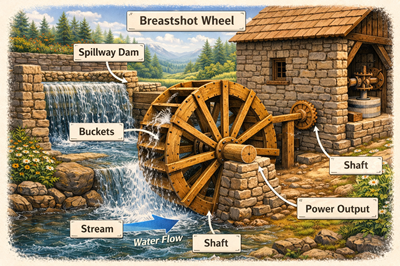 The breastshot wheel is a middle-ground design, combining aspects of both overshot and undershot wheels. Water strikes the wheel around the midpoint (or slightly above), applying force both through its weight and its momentum. This hybrid approach results in moderate efficiency, typically between 50% and 70%.
This design is particularly useful in areas where there is some elevation but not enough for a full overshot system. It allows you to capture more energy than an undershot wheel without requiring the full infrastructure of an overshot setup.
The key to a successful breastshot wheel is controlling the water flow so that it hits the wheel at the correct height and angle. Too low, and you lose the benefit of gravity; too high, and it behaves more like an inefficient overshot system.
Best Use Case
- Gentle slopes or moderate elevation
- Streams with consistent but not extreme flow
- Sites where partial water control is possible
Key Advantages
- Good balance of efficiency and simplicity
- Less infrastructure than overshot
- More power than undershot
Limitations
- Still requires some water control
- Less efficient than overshot
- More complex than undershot
2.4 Backshot Wheel (Specialized High-Head Design)
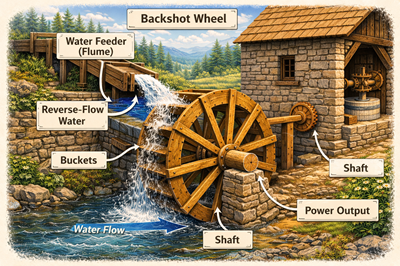 The backshot wheel is a less common but highly effective design used in steep terrain. It is similar to an overshot wheel but with a key difference: water is introduced slightly behind the top of the wheel, rather than directly over it. This allows for smoother filling of buckets and can improve performance in certain conditions.
Because of its design, the backshot wheel is particularly well-suited for locations where water can be delivered at a steep angle or where controlling the exact drop point is difficult. It can also reduce splashing and energy loss compared to poorly aligned overshot systems.
This design still relies heavily on head (height) and benefits from the same principles as overshot wheels, including high efficiency and strong torque output.
Best Use Case
- Steep slopes or mountainous terrain
- Systems with angled water delivery
- Advanced builds requiring fine-tuned performance
Key Advantages
- High efficiency similar to overshot
- Better control of water entry in some setups
- Smooth, consistent rotation
Limitations
- More complex to design and align
- Requires precise water delivery
- Less common, fewer examples to follow
3 Understanding Water Power (Key Concepts)
Water power is driven by two main factors: flow and head. Flow refers to how much water is moving, while head refers to the vertical drop of that water. Together, these determine how much usable energy you can extract from your system. Even a modest stream can produce meaningful power if either flow or head is sufficient.
Many beginners assume they need a large river or waterfall, but this is not always the case. A small stream with a consistent flow can be just as valuable if properly managed. Increasing head through a simple diversion or channel can significantly boost output without requiring more water.
Efficiency also plays a critical role. Not all the energy in the water will be converted into useful work—some is lost to friction, splashing, and imperfect design. Understanding these losses allows you to make smarter design decisions and get the most out of your system.
3.1 Core Concepts
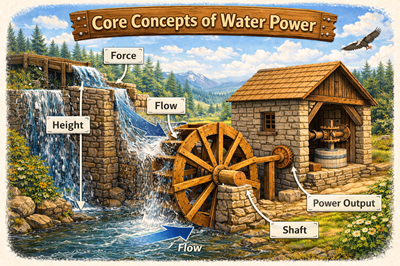 Understanding how a water wheel produces power comes down to a few fundamental principles. These concepts determine not only whether your system will work, but how much usable energy you can realistically expect from it. Many water wheel projects fail because these basics are misunderstood or overlooked.
At its core, water power is about capturing and converting the energy that already exists in moving water. That energy comes from two main sources: how much water is moving (flow) and how far it falls (head). When combined properly—and with an efficient design—these factors can produce surprisingly strong and consistent power, even on a small homestead.
3.2 Flow (Volume)
Flow refers to the quantity of water moving past a point over time, and it is typically measured in gallons per minute (GPM), liters per second, or cubic feet per second. This is the “fuel supply” for your water wheel. The more water you have moving through your system, the more energy is available to capture.
However, flow alone does not guarantee power. A large volume of slow-moving water may carry less usable energy than a smaller volume moving efficiently through a well-designed system. That’s why flow must always be considered alongside head.
Measuring flow doesn’t have to be complicated. Simple methods—such as timing how long it takes to fill a container or estimating stream width and speed—can give you a practical understanding of what you’re working with. The key is consistency. A steady, reliable flow is far more valuable than a large but unpredictable one.
3.3 Head (Height)
Head refers to the vertical distance that water falls before it reaches your wheel. This is where gravity comes into play. The greater the height, the more potential energy the water has before it is converted into motion.
Even a small increase in head can dramatically improve performance. A drop of just a few feet can multiply the power output compared to a flat, fast-moving stream. This is why overshot and backshot wheels—both of which rely on height—are typically much more efficient than undershot designs.
In many cases, natural head is limited. However, it can often be improved through simple modifications such as small dams, diversion channels, or raised flumes. Creating even a modest vertical drop can significantly increase the effectiveness of your system.
3.4 Power Formula (Simplified)
Power = Flow × Head × Efficiency
This simple formula explains everything.
- Flow = how much water you have
- Head = how much energy that water carries due to height
- Efficiency = how much of that energy your system actually captures
No system is 100% efficient. Some energy is always lost due to friction, turbulence, splashing, and imperfect design. That’s why efficiency plays such an important role—it determines how much of the available energy becomes usable power.
3.5 How It All Works Together
More flow and more height will always increase potential power—but most homesteads won’t have both in abundance. The key is learning how to maximize what you do have.
- Low flow + high head → still very effective (ideal for overshot)
- High flow + no head → workable (undershot)
- Moderate flow + moderate head → balanced performance (breastshot)
This is why even small streams can be useful. With proper design, water that seems insignificant can still generate meaningful power over time. Consistency is often more important than size.
You don’t need a large river or waterfall to build a functional system.
What you need is:
- Reliable flow
- Some level of head (or the ability to create it)
- A design that matches your conditions
When these three factors are aligned, even a modest water source can become a dependable source of energy for your homestead.
4 Site Selection (Where Most Projects Fail)
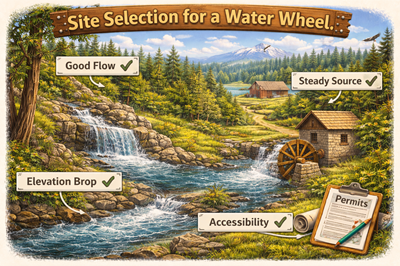 The success of a water wheel project is determined long before construction begins. Site selection is the single most important factor, yet it is often rushed or overlooked. A poorly chosen location can limit performance no matter how well the wheel is built.
A good site provides consistent water flow throughout the year, with minimal seasonal variation. It should also offer a stable foundation for construction and, ideally, some natural elevation to increase head. Accessibility is another important consideration, as you will need to maintain and possibly adjust the system over time.
Equally important is understanding what to avoid. Areas prone to flooding, heavy debris, or sediment buildup can damage your system and increase maintenance. Taking the time to carefully evaluate your site ensures that your effort and materials are invested in a location that will deliver long-term results.
What to Look For
- Consistent water flow
- Minimal seasonal drying
- Natural drop or slope
- Stable ground
Avoid
- Flood-prone zones
- Silty or debris-heavy streams
- Legal restrictions
5 Materials You Can Use
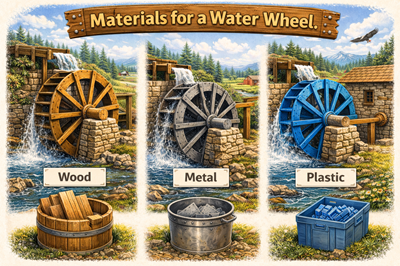 One of the advantages of water wheels is their adaptability. They can be built using a wide range of materials, from traditional wood to modern metals and plastics. The choice of materials affects not only the durability of the system but also the ease of construction and maintenance.
Wood is often the most accessible option and has been used for centuries. It is easy to work with and relatively inexpensive, making it ideal for beginner builds. However, it requires regular maintenance to prevent rot and wear. Metal components, particularly for the axle and fasteners, add strength and longevity but increase cost and complexity.
Modern materials like PVC and composite plastics offer a balance between durability and ease of use. These materials resist weathering and can reduce maintenance requirements. Ultimately, the best material choice depends on your budget, tools, and long-term goals.
Basic Options
- Wood (traditional, easy to work with)
- Steel (durable, long-lasting)
- PVC (lightweight, modern builds)
Key Components
- Wheel frame
- Buckets or paddles
- Axle (shaft)
- Bearings
- Support structure
Your Material Choice Affects
- Lifespan
- Maintenance
- Cost
6 Basic Water Wheel Design
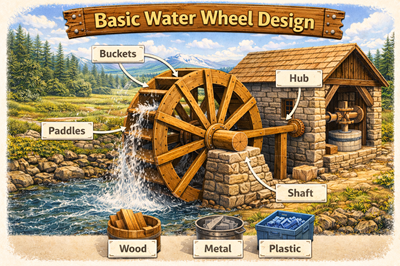 At its core, a water wheel is a simple machine—but small design details can have a big impact on performance. The diameter of the wheel determines how much torque it can generate, while the width affects how much water it can capture. These dimensions must be carefully balanced based on your water source.
The placement and angle of buckets or paddles also play a critical role. Poor alignment can cause water to spill without transferring its energy effectively. A well-designed wheel ensures that water is captured, held, and released in a way that maximizes rotation.
Simplicity is often the best approach, especially for first-time builders. A straightforward design with solid construction will outperform a complex system that is poorly executed. Focus on balance, alignment, and strength to create a reliable foundation.
A Simple Water Wheel Consists Of
- Circular frame
- Buckets or paddles
- Central axle
- Support structure
Key Design Factors
- Diameter (larger = more torque)
- Width (captures more water)
- Bucket angle (efficiency)
Overshot wheels benefit most from larger diameters.
7 Building a Simple Undershot Wheel (Beginner Build)
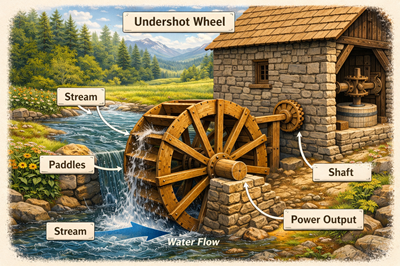 The undershot wheel is the ideal starting point for most builders. It requires minimal materials, no complex water delivery system, and can be installed directly in a flowing stream. This simplicity makes it an excellent learning tool and a practical solution for low-head environments.
The construction process focuses on creating a sturdy circular frame and attaching evenly spaced paddles. These paddles catch the flow of the water, converting its movement into rotation. Precision is less critical than with other designs, but balance remains important to ensure smooth operation.
While undershot wheels are less efficient than other types, their ease of construction and adaptability make them highly valuable. They provide a solid introduction to water power and can be upgraded or replaced as your system evolves.
Steps
- Build circular frame (wood or metal)
- Attach paddles evenly spaced
- Mount axle through center
- Place in flowing stream
- Secure structure
Tools Needed
- Saw
- Drill
- Fasteners
This design is ideal for learning and low-cost setups.
8 Building an Overshot Wheel (Advanced Build)
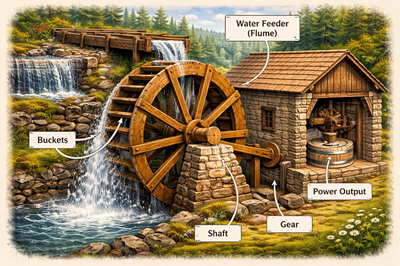 Overshot wheels represent a significant step up in both complexity and efficiency. Instead of relying on water speed, they use the weight of water dropping from above, which allows them to extract far more energy from the same volume of water. This makes them the preferred choice for high-efficiency systems.
However, this efficiency comes at the cost of more precise construction. The water must be delivered at the correct height and angle, and the buckets must be designed to hold and release water effectively. Even small misalignments can reduce performance.
Building an overshot wheel requires careful planning and execution, but the results are worth it. When done correctly, these wheels can provide consistent, high-output power with minimal water flow.
Steps
- Build strong frame
- Construct water channel (flume)
- Install buckets
- Align water drop precisely
- Secure support structure
Critical Detail
Water must enter at the top with controlled flow.
9 Creating a Water Delivery System
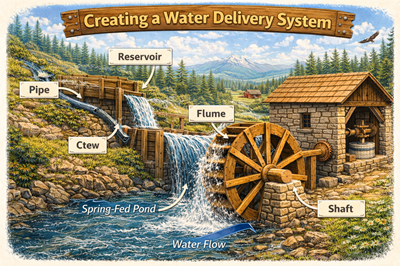 A water wheel is only as effective as the system that feeds it. Controlling the flow of water is essential for maximizing efficiency and maintaining consistent operation. This is where flumes, channels, and simple dams come into play.
A flume directs water from its source to the wheel, allowing you to control both the speed and direction of flow. By adjusting the height and angle, you can increase the energy delivered to the wheel without increasing the volume of water.
This section emphasizes that water control is power control. A well-designed delivery system can dramatically improve performance and make the difference between a weak output and a highly efficient system.
Water Delivery Components
Flumes
- Channels water to the wheel
Penstocks
- Pipes for pressurized flow
Dams (Small Scale)
- Increase head height
10 Converting Motion into Power
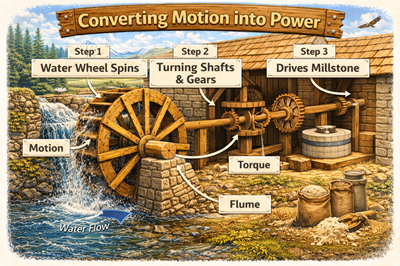 The spinning motion of a water wheel is only useful if it can be applied to real-world tasks. This section focuses on converting rotational energy into practical applications. Mechanical uses are the simplest and most reliable, requiring minimal additional components.
By connecting the wheel to belts, gears, or direct shafts, you can power tools such as grinders, saws, or pumps. These systems are highly efficient and do not require electricity, making them ideal for off-grid setups.
The key is to match the speed and torque of the wheel to the task. Some applications require slow, powerful rotation, while others need higher speeds. Understanding this relationship allows you to make the most of your system.
Mechanical Power Uses
- Grinding grain
- Pumping water
- Running tools
Electrical Power
- Connect to generator
- Use belt or gear system
11 Generators & Electrical Systems
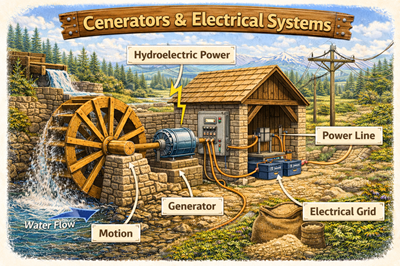 For those looking to produce electricity, a water wheel can be connected to a generator. This adds complexity but opens up new possibilities for powering lights, charging batteries, and running small appliances.
The process involves transferring rotational energy from the wheel to a generator using belts or gears. Proper alignment and speed matching are critical to ensure efficient energy conversion. Batteries and charge controllers are often used to store and regulate the output.
While electrical systems require more components, they can significantly enhance the functionality of your homestead. With a steady water source, they provide a reliable supplement to solar or other energy systems.
To Produce Electricity
Basic Setup
- Wheel → Shaft → Pulley → Generator
Generator Options
- DC motor (simple setups)
- Alternator (more power)
Storage
- Batteries
- Charge controllers
12 Water Wheel Efficiency
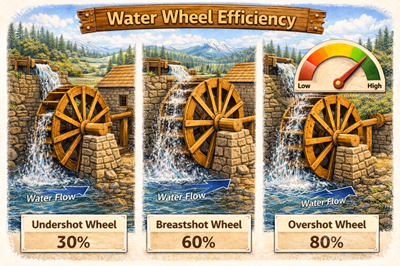 Efficiency determines how much of the water’s energy is actually converted into useful work. Even a well-built wheel will lose some energy due to friction, splashing, and imperfect design. Understanding these losses helps you improve performance.
Different wheel types have different efficiency ranges, with overshot wheels leading the way. However, even a less efficient design can perform well if it is properly matched to the site conditions.
Improving efficiency often comes down to small adjustments—better alignment, smoother bearings, or improved water flow. These incremental improvements can significantly increase output over time.
Efficiency Depends On
- Wheel type
- Water flow
- Design accuracy
Typical Efficiency
- Overshot: 60–80%
- Breastshot: 50–70%
- Undershot: 20–40%
13 Maintenance & Longevity
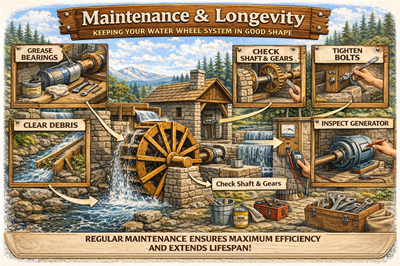 A well-built water wheel can last for decades, but only if it is properly maintained. While these systems are relatively simple, they are constantly exposed to water, debris, and environmental stress. Over time, this wear can reduce efficiency or cause structural damage if left unchecked.
Routine maintenance should include checking for debris buildup, especially after storms or seasonal runoff. Leaves, sticks, and sediment can interfere with rotation or damage paddles and buckets. Bearings and the axle should also be inspected regularly, as friction in these areas can reduce performance and increase wear.
Preventative maintenance is far easier than repairs. By addressing small issues early, you extend the lifespan of your system and maintain consistent performance. A water wheel is not a “set it and forget it” system—but with minimal attention, it can remain highly reliable.
Regular Checks
- Debris buildup
- Bearing wear
- Structural integrity
Seasonal Maintenance
- Ice damage (winter)
- Flood damage (spring)
14 Cold Climate Considerations
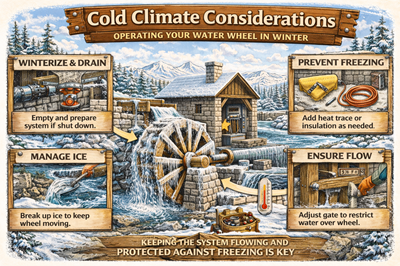 Cold climates introduce unique challenges that must be addressed during both design and operation. Freezing temperatures can stop water flow entirely, damage components, and create dangerous ice buildup.
One of the biggest risks is ice forming on the wheel itself or in the water delivery system. This can cause imbalance, reduce efficiency, or even break structural components. Designing with drainage in mind—allowing water to flow out of the system when not in use—can help reduce this risk.
Some homesteaders choose to operate their systems seasonally, shutting them down during the coldest months. Others build partial enclosures or use insulated channels to extend operation. The key is to plan for winter from the start rather than trying to adapt later.
Cold Climate Challenges
- Freezing water
- Ice buildup
- Reduced flow
Solutions
- Partial enclosures
- Drain systems
- Winter shutdown option
15 Legal Considerations
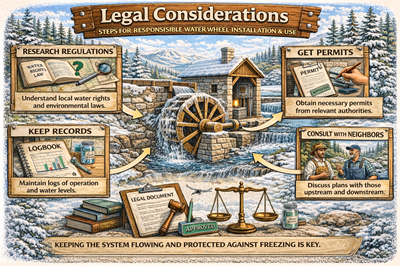 Water is often regulated more strictly than other natural resources, and understanding local laws is essential before starting your project. Regulations may govern how much water you can divert, whether you need permits, and how your system impacts the surrounding environment.
Ignoring these requirements can lead to fines, forced removal of your system, or conflicts with neighboring landowners. Even small-scale projects may fall under local water rights laws, especially if they alter the natural flow of a stream.
Taking the time to research and comply with regulations ensures that your system remains both legal and sustainable. It also helps protect the long-term viability of your water source and surrounding ecosystem.
You May Need
- Permits for water diversion
- Environmental approval
16 Safety Considerations
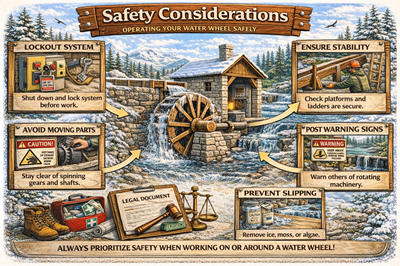 Water wheels may seem simple, but they involve moving parts, flowing water, and structural loads that can pose real risks. Safety should be considered at every stage of the build, from design to operation.
Moving components such as the wheel and axle can cause injury if not properly guarded. Slippery surfaces around water sources increase the risk of falls, especially during maintenance. Structural failure is another concern if the system is not built or secured properly.
Simple precautions—such as adding guards, ensuring stable footing, and using strong materials—can significantly reduce these risks. A safe system not only protects you but also ensures that the wheel can be operated confidently and consistently.
Risks
- Drowning
- Structural failure
- Moving parts
Safety Measures
- Guards on moving parts
- Stable footing
- Secure construction
17 Scaling Your System
Most successful water wheel projects do not start large—they start simple and grow over time. Scaling allows you to learn from your initial build, identify improvements, and expand your system without unnecessary risk.
Increasing the diameter of the wheel, improving water delivery, or adding additional wheels are all ways to scale up. Each upgrade should be based on real-world performance rather than assumptions. This approach ensures that your system evolves in a practical and efficient way.
Scaling also allows you to match your system to your needs. As your homestead grows, your energy requirements may increase. A flexible, scalable design ensures that your water wheel can grow with you.
Start Small
- Basic wheel
Then Expand
- Larger diameter
- Better flow control
- Add generator
18 Common Mistakes
Many water wheel projects fail due to avoidable mistakes rather than fundamental flaws in the concept. One of the most common issues is poor site selection, where the water source is inconsistent or insufficient. Even the best-built wheel cannot compensate for a weak or unreliable flow.
Another frequent mistake is improper sizing. A wheel that is too small may not capture enough energy, while one that is too large can become inefficient or difficult to maintain. Poor water control is another major issue, as uncontrolled flow reduces efficiency and can damage the system.
Understanding these common pitfalls allows you to avoid them from the start. A successful build is not about perfection—it’s about making informed decisions and learning from others’ mistakes.
Common Issues
- Poor site selection
- Undersized wheel
- Bad water control
- Ignoring maintenance
19 Water Wheels vs Modern Systems
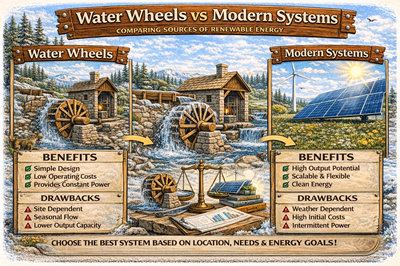 Modern renewable energy systems like solar and wind have become popular, but they each come with limitations. Solar panels depend on sunlight and require battery storage for nighttime use. Wind turbines rely on unpredictable conditions and can vary widely in output.
Water wheels offer a different advantage: consistency. As long as water is flowing, they can provide steady power without the need for complex electronics or storage systems. This makes them particularly valuable in off-grid environments where reliability is critical.
That said, water wheels are not a replacement for all other systems. They are best used as part of a diversified energy strategy, complementing solar or other sources. Together, these systems create a more resilient and balanced approach to energy production.
Water Wheel
- Reliable
- Low-tech
- Continuous
Solar
- Intermittent
- Weather dependent
Wind
- Inconsistent
19.1 Why Most Modern Systems Don’t Use Traditional Water Wheels
While traditional water wheels are reliable, simple, and proven over centuries, most modern small-scale hydro systems have shifted toward turbine-based designs. This change isn’t because water wheels don’t work—it’s because turbines are generally more compact, more efficient for electricity generation, and easier to integrate with modern systems.
Water wheels excel at producing slow, high-torque mechanical power, which is ideal for grinding grain, pumping water, or running tools directly. However, when the goal is generating electricity, turbines are typically more effective because they spin at much higher speeds, making it easier to drive generators without complex gearing systems.
Modern turbines are designed to extract energy from water more efficiently across a wider range of conditions. They can handle different combinations of flow and head, allowing homesteaders to match a turbine type precisely to their water source. This flexibility is one of the main reasons turbines have become the standard in modern micro-hydro setups.
That said, water wheels still have a place. They are often preferred in low-tech, off-grid, or preparedness-focused systems where simplicity, repairability, and durability are more important than maximum electrical efficiency.
19.1.1 Pelton Turbines (High Head, Low Flow)
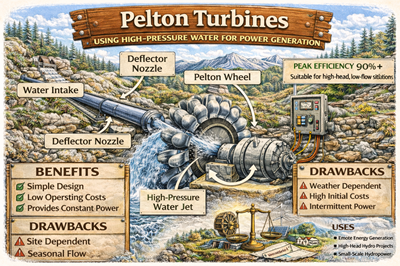 Pelton turbines are one of the most common and efficient turbine types for small-scale hydro systems. They are designed for high head (large vertical drop) and relatively low water flow. Instead of allowing water to simply fall onto a wheel, Pelton systems use high-pressure jets of water directed at specially shaped buckets mounted on a fast-spinning wheel.
These buckets split the water jet and reverse its direction, extracting as much energy as possible from the moving water. Because of this design, Pelton turbines can achieve very high efficiencies, often exceeding 80% under ideal conditions.
Pelton systems require a penstock (pressurized pipe) to deliver water from a higher elevation to the turbine. This setup allows even a small stream to produce significant power if enough head is available.
Best Use Case
- Steep terrain
- Mountainous properties
- Small streams with strong elevation drop
Key Advantages
- Very high efficiency
- Works well with low flow if head is high
- Compact and powerful
Limitations
- Requires significant elevation
- Needs pressurized water delivery
- More complex setup than basic wheels
19.1.2 Turgo Turbines (Medium Head, Medium Flow)
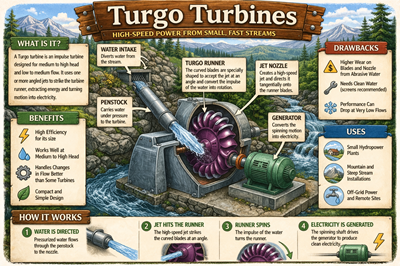 Turgo turbines are similar to Pelton turbines but are designed to handle a wider range of flow conditions. Instead of striking the buckets head-on, the water jet hits them at an angle and passes through, allowing the turbine to operate efficiently with higher flow rates than a Pelton system.
This angled design allows for faster rotation and greater flexibility, making Turgo turbines a strong option when you have moderate head and moderate flow. They are often used in situations where a Pelton turbine would be too restrictive or where flow is too high for optimal Pelton performance.
Turgos are also somewhat simpler to construct and can handle variations in water supply better than some other turbine types.
Best Use Case
- Moderate elevation
- Consistent but not extreme flow
- Sites with variable water supply
Key Advantages
- Handles higher flow than Pelton
- Good efficiency across a range of conditions
- More forgiving in real-world setups
Limitations
- Slightly less efficient than Pelton in ideal conditions
- Still requires some head
- Requires proper nozzle alignment
19.1.3 Crossflow Turbines (Low Head, High Flow)
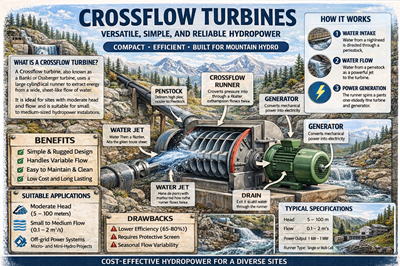 Crossflow turbines (also known as Banki or Ossberger turbines) are designed for low head and high flow environments, making them one of the most practical options for many homesteads. Instead of using a single impact point, water flows through a cylindrical runner and passes across the blades twice, extracting energy on both entry and exit.
This dual-pass design makes crossflow turbines efficient even when water pressure is relatively low. They are also known for being durable, simple to maintain, and tolerant of debris, which makes them well-suited for real-world conditions where water is not perfectly clean.
Because they can operate effectively without large elevation drops, crossflow turbines are often the best choice for creeks, irrigation channels, and flatter terrain.
Best Use Case
- Low head (small vertical drop)
- High flow (large volume of water)
- Streams with debris or variable conditions
Key Advantages
- Works well with minimal elevation
- Handles debris better than most turbines
- Simple, rugged design
Limitations
- Lower peak efficiency than Pelton
- Larger physical size for same output
- Requires consistent flow to perform well
Modern hydro systems have shifted toward turbines because they are:
- More efficient for electricity
- Easier to integrate with generators
- More adaptable to different water conditions
However, the choice between a turbine and a traditional water wheel comes down to your goals:
Water Wheel
- Simple
- Durable
- Best for mechanical power
- Easier to repair
Turbine
- Compact
- Higher electrical efficiency
- Better for powering modern systems
19.2 Comparing Water Wheels to Turbines
| Category | Water Wheels | Turbines |
|---|---|---|
| Primary Use | Mechanical power (mills, pumps, tools) | Electricity generation |
| Efficiency | 20–80% (depends on type) | 60–90% (generally higher) |
| Speed (RPM) | Low (high torque) | High (ideal for generators) |
| Complexity | Simple, easy to understand | More complex systems |
| Cost | Low to moderate (DIY friendly) | Moderate to high |
| Maintenance | Low, easy to repair | Moderate, more specialized parts |
| Durability | Very durable, long lifespan | Durable but more sensitive components |
| Debris Handling | Handles debris well | Sensitive to debris |
| Water Requirements | Works with low-tech setups | Requires controlled flow (often pressurized) |
| Best Terrain | Flexible (flat to steep depending on type) | Matched to specific head/flow conditions |
| Off-Grid Suitability | Excellent (low-tech, repairable) | Excellent (higher power output) |
| Installation | Easier, less precise | Requires more precision |
| Scalability | Limited without major rebuild | Highly scalable |
| Best For | Preppers, homesteaders, mechanical systems | Power generation, modern off-grid systems |
19.3 Water Wheel Manufacturers (Traditional + Custom Builds)
🇬🇧 Freeflow69
- Custom-built overshot, breastshot, and modern water wheels
- Offers design → manufacturing → installation
- Stainless steel wheels and full systems available
- Can supply complete water wheel packages or components
One of the few companies still actively building true water wheels (not just turbines)
🇬🇧 Smith Engineering
- Specializes in high-efficiency overshot water wheels
- Designed for electricity generation + mechanical use
- Systems optimized for specific flow/head conditions
Their systems can achieve ~75% efficiency with proper design
Micro Hydro Generator & Component Suppliers
- One of the top micro-hydro companies in North America
- Sells:
- Generators
- Turbine wheels
- Complete hydro systems
- Known for off-grid reliability and durability
Long-standing manufacturer (since 1980) focused on small-scale systems
- Custom hydro systems from 1 kW to large installations
- Includes:
- Turbines
- Generators
- Control systems
- Strong option for custom or higher-output builds
🇳🇿 PowerSpout
- Small-scale DIY-friendly hydro generator kits
- Designed for:
- Off-grid homes
- Homesteads
- Modular systems (expandable)
Offers kits starting small and scaling up
Industrial / Budget Suppliers (Components & Generators)
- Wide range of:
- Water wheel generators
- Pelton / Turgo / Francis turbines
- 500W → 1MW+ systems
- Lower cost, but requires:
- Vetting suppliers
- Import considerations
Useful for sourcing components or bulk systems
19.4 How to Choose the Right Type of Supplier
If you want a REAL water wheel (traditional style):
- Freeflow69
- Smith Engineering
If you want electricity generation (most practical):
- Energy Systems & Design
- PowerSpout
- Dependable Turbines
If you want DIY / budget / parts:
- Alibaba suppliers
- Mix with local fabrication
20. Best Strategy for Homesteaders
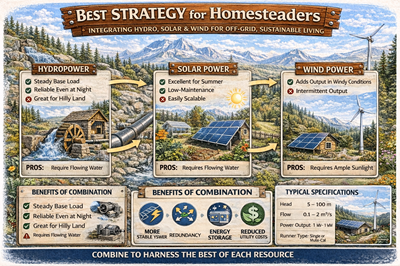 If you’re building for true resilience and long-term self-sufficiency, the most effective approach is not choosing between water wheels and turbines, it’s using both together.
- Use a turbine for electricity
- Keep a water wheel for mechanical backup
This combination gives you something most systems don’t: redundancy across different types of power. One system supports modern needs, while the other ensures you’re never fully dependent on technology.
20.1 Using a Turbine for Electricity
Modern homesteads still rely heavily on electricity—lighting, communications, refrigeration, tools, and charging systems all depend on it. This is where turbines shine. They are designed to produce higher-speed rotational energy, which makes them ideal for driving generators and producing usable electrical power efficiently.
A properly installed turbine system can provide continuous, steady power, unlike solar or wind, which are intermittent. As long as your water source is consistent, your turbine can operate around the clock, supplying energy to batteries and powering essential systems.
From a practical standpoint, turbines allow you to maintain a level of modern convenience and functionality that would otherwise be difficult to sustain off-grid. They integrate well with battery banks, inverters, and hybrid systems, making them a key component of a modern self-sufficient setup.
Summary:
Turbines give you efficient, reliable electricity—the backbone of a modern off-grid homestead.
20.2 Keeping a Water Wheel for Mechanical Backup
While turbines are excellent for electricity, they introduce a level of complexity that can become a weakness over time. Generators, electronics, and specialized components can fail, wear out, or become difficult to replace—especially in long-term or grid-down scenarios.
This is where the water wheel becomes critical. A traditional water wheel provides low-speed, high-torque mechanical power that can be used directly, without relying on electrical systems. It can grind grain, pump water, run simple machinery, or drive tools using belts and gears.
More importantly, water wheels are simple, durable, and repairable. They can be built and maintained with basic tools and materials, making them ideal for long-term resilience. Even if your electrical system fails completely, a water wheel ensures you still have access to usable power.
Summary:
Water wheels give you reliable, low-tech mechanical power that works when everything else doesn’t.
20.3 Long-Term Strategy: Building a Resilient System
The real strength of this approach comes from how these systems work together over time. Instead of relying on a single solution, you’re building a layered energy system that can adapt to changing conditions, failures, and long-term challenges.
In the short term, the turbine carries most of the workload. It provides electricity for daily use, keeps batteries charged, and supports modern tools and systems. This allows you to operate efficiently and comfortably while reducing reliance on external power sources.
At the same time, the water wheel operates as a parallel system—either actively supporting mechanical tasks or remaining ready as a backup. It doesn’t need to run constantly to be valuable. Its role is to ensure that if your electrical system fails, you still have a functional and dependable source of power.
Over the long term, this dual-system approach becomes even more important. Electrical components wear out. Batteries degrade. Replacement parts may become expensive or unavailable. When that happens, systems that rely entirely on modern technology become vulnerable.
A water wheel, by contrast, can be maintained indefinitely with basic materials and skills. It represents a form of energy independence that is not tied to supply chains or advanced manufacturing.
Strategic Advantages of a Hybrid System
- Redundancy: If one system fails, the other continues
- Flexibility: Mechanical + electrical power options
- Resilience: Less dependence on fragile components
- Scalability: Expand one or both systems over time
- Sustainability: Long-term operation with minimal external input
How This Plays Out in a Real Scenario
- Normal conditions:
Turbine powers your home, charges batteries, runs modern systems - Partial failure (generator/battery issue):
Water wheel takes over mechanical tasks (water pumping, food processing) - Long-term disruption (no parts, no replacements):
Water wheel becomes your primary power system, keeping essential functions running
Final Takeaway
Most people build for efficiency.
Very few build for failure.
The homesteaders who last long-term are the ones who plan for both.
By combining:
- Turbines (modern efficiency)
- Water wheels (old-world reliability)
You create a system that is not just powerful—but adaptable, durable, and truly self-sufficient.