
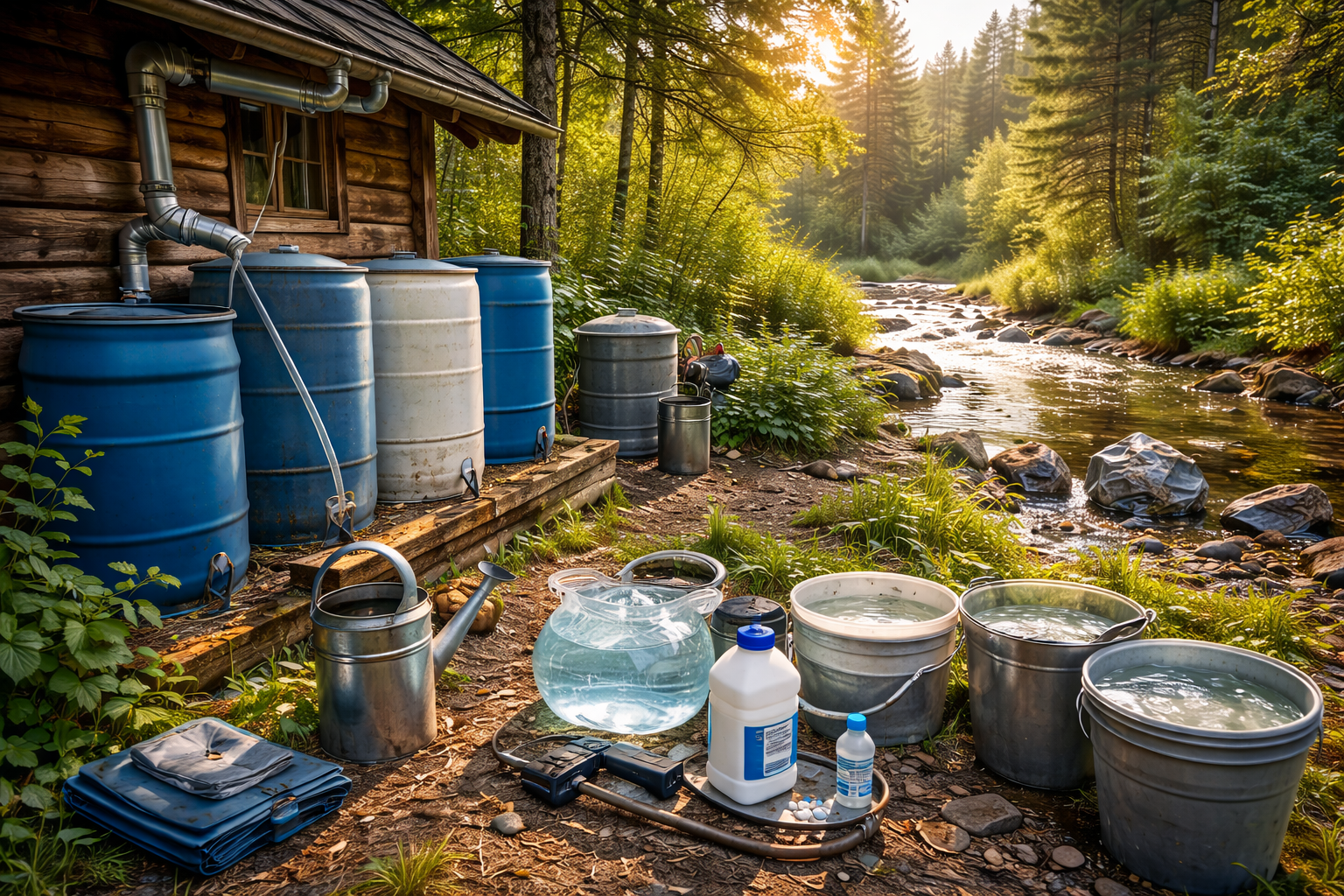
Practical Prepper Guide That Holds Up in Real Life
Most people think water prep = buying a few cases of bottled water.
That’s not a system.
That’s a short delay before a bigger problem.
Real preparedness means you can:
- Store water safely
- Find new water sources
- Make unsafe water drinkable
- Sustain it long-term
This guide walks through exactly how to build a real-world water system that actually holds up.
Step 1: Understand the Goal (This Changes Everything)
You are not preparing to “have water.”
You are preparing to:
Maintain access to safe water indefinitely
That requires 3 things:
- Storage
- Collection
- purification
Miss one, and your system fails.
Step 2: Build Your Water Storage (Your Time Buffer)
Storage gives you breathing room.
Minimum Target:
2–3 gallons per person per day
Realistic Goal:
14–30 days supply
Storage Options (Best → Better → Basic)
Best:
-55-gallon food-grade barrels
IBC totes (275+ gallons)
Better:
-Stackable water containers (5–7 gallons)
Basic:
-Bottled water (short-term only)
Storage Rules (Most People Miss These)
- Keep out of sunlight (prevents algae growth)
- Use food-grade containers ONLY
- Add stabilizer if storing long-term
- Rotate every 6–12 months
Don’t store water where you can’t access it quickly
Step 3: Water Collection (Your Long-Term Supply)
Once storage runs out, this is everything.
Primary Collection Methods:
Rainwater Harvesting:
Roof → gutters → barrels
Use first-flush system to remove debris
Surface Water:
- Rivers
- Lakes
- Streams
- Snow (Cold Climates):
- Melt and purify before use
Critical Mistake:
Assuming collected water is safe.
It’s not.
Every source must be treated.
Step 4: Filtration vs Purification (Know the Difference)
This is where most people get it wrong.
Filtration Removes:
- Dirt
- Bacteria
- Parasites
- Purification Handles:
- Viruses
- Some chemicals (depending on method)
You Need BOTH Layers
Step 5: Build a Multi-Layer Filtration System
Do NOT rely on one method.
Layer 1: Pre-Filter (Extend Life of Main Filters)
- Cloth
- Coffee filters
- Sediment filters
- Removes debris before it clogs your system
Layer 2: Primary Filter
Options:
- Gravity-fed systems
- Pump filters
- Inline filters
Removes:
- Bacteria
Protozoa
Layer 3: Purification
Choose at least one:
Boiling:
- 1–3 minutes rolling boil
- Reliable but fuel-dependent
Chemical:
- Unscented bleach (tiny amounts)
- Water purification tablets
- UV (Advanced):
- Battery-powered UV purifiers
Best practice: Filter + Purify
Step 6: Chemical Contamination (The Hidden Threat)
Most filters do NOT remove:
- Fuel contamination
Industrial chemicals
Heavy metals
Solutions
- Activated carbon filters
- Avoid questionable sources
- Use multiple filtration stages
If water smells like fuel or chemicals—avoid it
Step 7: Water Transport (The Overlooked Problem)
Water is heavy and hard to move.
Reality:
5 gallons = ~40 lbs
Solutions:
- Carry multiple smaller containers
- Use carts / wagons
- Pre-stage containers at key locations
Plan BEFORE you need to move it
Step 8: Storage + Filtration Integration
This is where your system becomes real.
Working Flow:
Source → Collection → Pre-filter → Filter → Purify → Store → Use
Setup Tip:
Keep:
Dirty water containers
Clean water containers
Never mix the two
Step 9: Redundancy (Where Preppers Win)
Single systems fail.
Always have backups.
Minimum Setup:
- Stored water
- Primary filter
- Backup purification method
Ideal Setup:
- Stored water (30 days)
- Rain collection system
- Gravity filter
- Backup chemical + boiling
Redundancy = reliability
Step 10: Test Your System (Most Important Step)
Don’t assume it works.
Do This
- Turn off your water for 48–72 hours
- Use only your system
- Track:Usage
- Weak points
- Time required
This is where real gaps show up
Real-World Scenario (What Happens)
Day 1–3:
You use stored water
Day 4–10:
You begin collecting and filtering
Day 10+:
Your system efficiency determines survival
Most people fail here—not because they don’t have water…
But because they can’t sustain it
What You Can Do Today
Today:
Store 3–7 days of water
Buy a basic filter
Identify 1 nearby water source
This Week:
Set up rain collection
Practice filtering water
Separate clean vs dirty containers
This Month:
Expand storage
Add backup purification
Run a full system test
Final Thought
Water preparedness isn’t about stockpiling.
It’s about building a system that:
- Works under stress
- Lasts over time
- Adapts to conditions
Because when the system fails…
The people with a plan don’t panic.
They filter, store, and keep going.