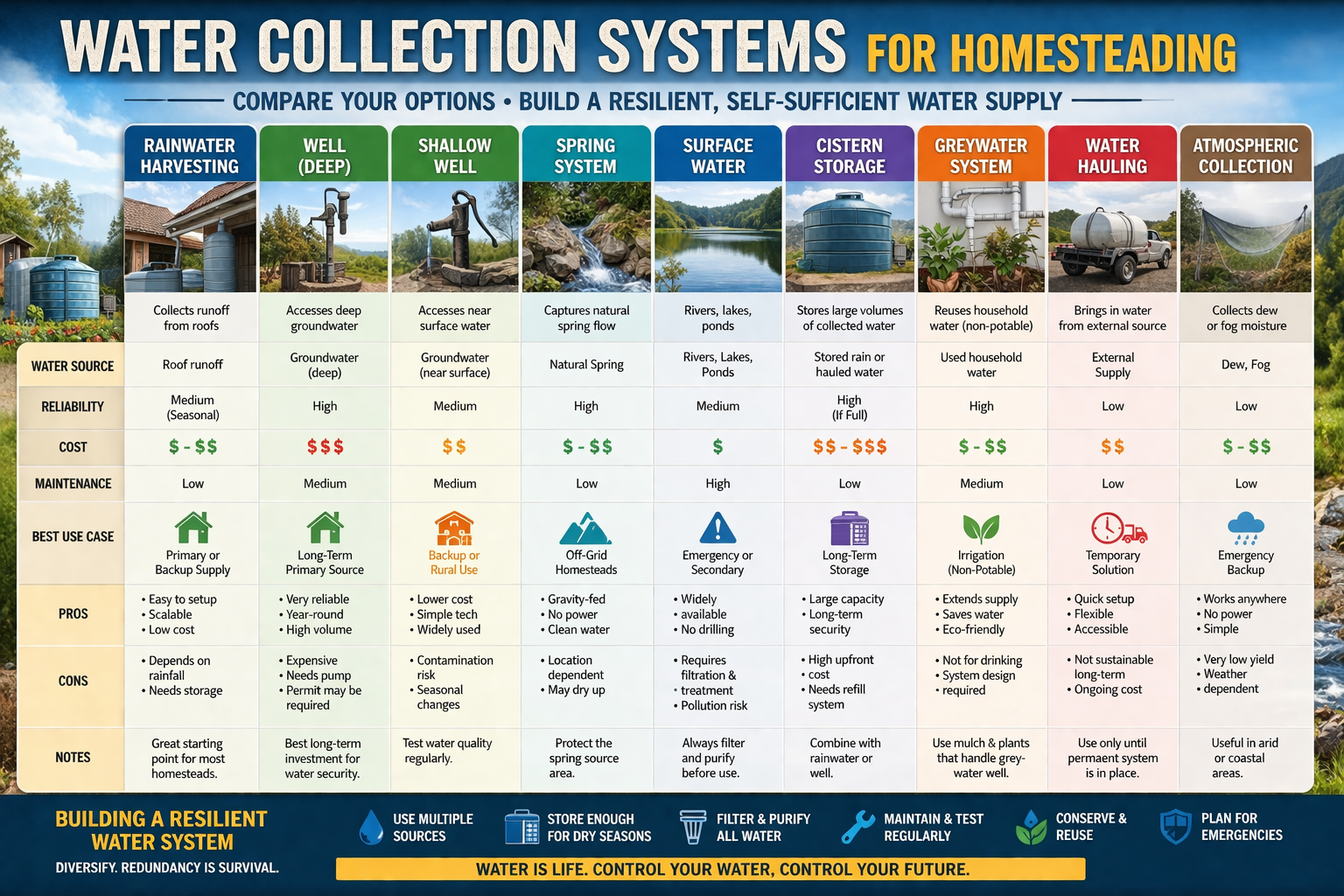
Comparison of Homestead Water Systems
| System Type | Water Source | Reliability | Cost | Maintenance | Best Use Case | Pros | Cons |
|---|---|---|---|---|---|---|---|
| Rainwater Harvesting | Roof runoff | Medium (seasonal) | Low–Medium | Low | Primary or backup supply | Easy setup, scalable, low cost | Dependent on rainfall |
| Well (Deep) | Groundwater | High | High | Medium | Long-term primary source | Consistent supply, year-round | Expensive, requires pump |
| Shallow Well | Groundwater (near surface) | Medium | Medium | Medium | Backup or rural use | Lower cost than deep well | Contamination risk |
| Spring System | Natural spring | High | Low–Medium | Low | Off-grid homesteads | Gravity-fed, no power needed | Location dependent |
| Surface Water | Rivers, lakes, ponds | Medium | Low | High | Emergency or secondary | Widely available | Requires filtration & purification |
| Cistern Storage | Stored rain or hauled water | High (if full) | Medium–High | Low | Long-term storage | Large capacity | Needs refill system |
| Greywater System | Used household water | High | Low–Medium | Medium | Irrigation | Extends water supply | Limited to non-drinking use |
| Water Hauling | External supply | Low | Medium | Low | Temporary solution | Quick setup | Not sustainable long-term |
| Atmospheric Collection | Dew, fog | Low | Low–Medium | Low | Emergency/backup | Works anywhere | Very low yield |
1: Why Water Collection Is the Foundation of Homesteading
Water is the backbone of every successful homestead, yet it is often the most overlooked system until it fails. Unlike food production, which can be supplemented or rationed over time, water is an immediate and constant need. Without reliable access, even the most well-prepared homestead will quickly become unsustainable. Every aspect of daily life—drinking, cooking, cleaning, growing food, and caring for animals—depends on a steady supply.
Modern infrastructure has distanced most people from understanding how water actually reaches their homes. This disconnect creates a dangerous dependency on systems that can fail due to weather events, power outages, or supply disruptions. Homesteaders who invest in independent water systems are not just preparing for emergencies—they are building resilience and long-term stability.
A homesteader who controls their own water supply is no longer dependent on those systems. This section sets the stage for understanding why water collection is not optional—it is the core of self-reliance.
2: Understanding Your Water Needs
Accurately estimating water needs is one of the most critical steps in designing a collection system. Many beginners’ underestimate consumption, focusing only on drinking water while overlooking the significant demands of hygiene, cooking, gardening, and livestock. This often leads to undersized systems that fail during peak usage periods.
Water demand is not static—it changes with the seasons, weather patterns, and the growth of your homestead. Summer months, for example, can dramatically increase water use due to irrigation and higher personal consumption. Planning must account for these fluctuations, ensuring that your system can handle both everyday needs and periods of increased demand without running dry.
Before collecting water, you need to understand how much you actually need. Most people underestimate this dramatically.
A basic breakdown:
- Drinking: 1–2 gallons per person/day
- Cooking: 0.5–1 gallon/day
- Hygiene: 2–5 gallons/day
- Gardening: highly variable
- Livestock: significant additional demand
A small homestead can easily require:
20–100+ gallons per day
Seasonal variation matters:
- Summer = peak demand (gardens + heat)
- Winter = storage and freezing challenges
Planning without accurate demand estimates leads to failure. Water systems must be built around real usage, not assumptions.
3: Types of Water Sources
A strong homestead water system is built on diversity. Relying on a single source introduces risk, while combining multiple sources creates redundancy and flexibility. Rainwater, groundwater, and surface water each offer unique advantages, and understanding how they complement one another is key to building a resilient system.
Each source also comes with its own challenges. Rainwater is seasonal, surface water requires treatment, and wells can be costly to establish. The goal is not to find a perfect source, but to create a balanced system where the strengths of one source compensate for the weaknesses of another.
A resilient homestead uses multiple water sources, not just one.
Rainwater
- Most accessible and scalable
- Clean when collected properly
Surface Water
- Rivers, lakes, ponds
- Requires filtration and treatment
Groundwater
- Wells, springs
- Most reliable long-term source
Atmospheric Water
- Dew collection
- Fog harvesting (advanced setups)
Each source has strengths and weaknesses. The goal is redundancy, not dependence.
4: Rainwater Harvesting Systems
Rainwater harvesting is one of the simplest and most effective ways to collect water on a homestead. With the right setup, even modest rainfall can generate significant volumes of usable water. Roof-based collection systems are especially efficient, turning existing structures into reliable catchment areas.
The effectiveness of a rainwater system depends heavily on design and maintenance. Clean surfaces, proper filtration, and well-planned storage are essential to ensure water quality. When done correctly, rainwater harvesting can provide a dependable supply for both household use and irrigation.
Rainwater harvesting is the backbone of most homestead water systems.
Basic System Components
- Roof catchment surface
- Gutters and downspouts
- First-flush diverter
- Storage tanks
Key Design Factors
- Roof material (metal is best)
- Clean collection surfaces
- Proper drainage flow
Collection Potential
Formula:
Roof Area × Rainfall = Collection Volume
Even small roofs can collect thousands of gallons annually.
5: Storage Systems (Where Most People Fail)
Water storage is often underestimated, yet it determines how useful your collection system truly is. Without adequate storage, excess water during rainy periods is wasted, and shortages during dry periods become inevitable. A well-designed storage system bridges this gap, allowing you to capture and preserve water for future use.
The type of storage you choose should reflect your climate, space, and long-term goals. Protection from sunlight, contamination, and temperature extremes is essential. Whether using simple barrels or large underground cisterns, storage must be treated as a central component—not an afterthought.
Collecting water is easy. Storing it properly is where most systems break down.
Storage Options
- Barrels (55-gallon)
- IBC totes (275–330 gallon)
- Cisterns (large-scale)
Critical Considerations
- UV protection (prevent algae)
- Sealed systems (prevent contamination)
- Overflow management
Above Ground vs Underground
- Above: easy, cheaper, freeze risk
- Underground: stable temp, expensive
Storage determines whether your system is short-term or long-term viable.
6: Water Filtration & Purification
Collecting water is only the first step—ensuring it is safe to use is equally important. Even clean-looking water can contain harmful microorganisms or contaminants. Filtration removes visible debris and sediment, while purification targets bacteria, viruses, and other invisible threats.
A layered approach to water treatment provides the highest level of safety. By combining filtration and purification methods, homesteaders can confidently use collected water for drinking, cooking, and hygiene. This process is essential for both everyday use and emergency preparedness.
Collected water is not automatically safe.
Filtration Removes:
- Sediment
- Debris
- Some bacteria
Purification Removes:
- Bacteria
- Viruses
- Parasites
Methods
- Gravity filters (Berkey-style)
- Boiling
- Chemical treatment
- UV purification
Rule:
Filter first, purify second
7: Groundwater Systems (Wells & Springs)
Groundwater systems offer one of the most reliable sources of water for long-term homesteading. Deep wells tap into stable underground reserves, providing consistent access regardless of weather conditions. Springs, when available, offer a natural and often gravity-fed solution that requires minimal infrastructure.
However, these systems require careful planning and investment. Drilling a well can be expensive, and ongoing maintenance is necessary to ensure water quality. Despite these challenges, groundwater remains one of the most dependable foundations for a self-sufficient homestead.
Groundwater is the most reliable long-term solution.
Wells
- Deep wells = stable supply
- Require pumps (manual backup recommended)
Springs
- Natural flow systems
- Can be gravity-fed
Challenges
- Cost of drilling
- Legal restrictions
- Maintenance
A well + rain system = ideal redundancy setup
8: Water Distribution on the Homestead
Once water is collected and stored, it must be distributed efficiently throughout the homestead. Poor distribution systems can lead to wasted time, energy, and water. Whether using gravity-fed systems or pumps, the goal is to move water where it is needed with minimal effort.
Well-designed distribution systems improve both convenience and sustainability. By reducing manual labor and ensuring consistent flow, they allow homesteaders to focus on other critical tasks. Efficient distribution is what turns a collection system into a fully functional water network.
Collecting water is only half the system—you need to move it efficiently.
Gravity Systems
- Tanks placed uphill
- No power required
Pump Systems
- Electric pumps
- Solar pumps
- Manual pumps
Pressure Systems
- Pressure tanks
- Controlled flow to home and garden
Good distribution = less effort, more reliability
9: Drought Planning & Water Conservation
Drought is an inevitable challenge that every homesteader must prepare for. Even regions with regular rainfall can experience extended dry periods, making conservation strategies essential. Reducing water usage and increasing storage capacity are key to surviving these conditions.
Conservation is not about limiting productivity—it’s about using water more intelligently. Techniques like mulching, drip irrigation, and greywater reuse can dramatically reduce consumption while maintaining healthy gardens and livestock. Planning for drought ensures long-term stability.
Water collection must be paired with conservation.
Reduce Usage
- Mulching gardens
- Drip irrigation
- Greywater reuse
Storage Expansion
- Increase tank capacity
- Store excess during rainy seasons
Backup Planning
- Emergency reserves
- Secondary sources
Drought is not a possibility—it is a certainty over time.
10: Greywater Systems
Greywater systems provide an effective way to extend your water supply by reusing water that would otherwise be wasted. This includes water from sinks, showers, and laundry, which can be safely redirected for irrigation and other non-potable uses.
Implementing a greywater system requires an understanding of safe practices to prevent contamination. When done correctly, it reduces overall water demand and increases efficiency. For many homesteads, greywater is a simple upgrade that delivers significant benefits.
Greywater = reused water from sinks, showers, laundry.
Uses
- Irrigation
- Tree watering
Do NOT Use For
- Drinking
- Edible plant leaves
Benefits
- Reduces total water demand
- Extends system lifespan
Greywater is one of the easiest ways to double your efficiency.
11: Water for Gardening & Food Production
Gardening is one of the most water-intensive activities on a homestead. Without efficient watering methods, even a well-designed system can struggle to keep up with demand. This makes water management a critical part of food production.
Improving soil quality, selecting appropriate crops, and using efficient irrigation systems all contribute to reduced water usage. By aligning gardening practices with available resources, homesteaders can produce more food with less water.
Gardens are your biggest water consumer.
Efficient Methods
- Drip irrigation
- Soaker hoses
- Watering at dawn/dusk
Soil Improvement
- Compost increases water retention
- Healthy soil reduces watering needs
Crop Selection
- Drought-resistant plants
- Local climate adaptation
Smart gardening reduces water use by 50% or more.
12: Livestock Water Systems
Livestock require consistent access to clean water to remain healthy and productive. Unlike plants, animals cannot tolerate interruptions in water supply, making reliability essential. Even small-scale operations must account for daily and seasonal variations in water needs.
Designing systems that minimize labor while ensuring consistent delivery is key. Automatic waterers, gravity-fed systems, and proper storage all contribute to efficient livestock management. A reliable water system protects both animals and the investment they represent.
Animals require consistent, clean water.
Approximate Needs
- Chickens: small but constant
- Goats/sheep: moderate
- Cattle: very high
Systems
- Gravity-fed troughs
- Automatic waterers
- Heated systems (cold climates)
Animals without water = rapid loss of livestock.
13: Seasonal Challenges
Each season presents unique challenges that can impact water collection and storage. Winter brings freezing temperatures that can damage pipes and tanks, while summer increases demand and evaporation rates. Understanding these patterns allows for better preparation.
Systems must be designed to handle extremes, not just average conditions. Insulation, proper placement, and seasonal adjustments ensure that water remains accessible year-round. Planning for seasonal variation is essential for long-term success.
Winter
- Frozen pipes
- Tank freezing
- Reduced collection
Summer
- Evaporation loss
- High demand
- Drought stress
Design systems for worst-case season, not average conditions.
14: Water Quality Monitoring
Maintaining water quality is an ongoing responsibility. Even well-designed systems can become contaminated over time due to environmental factors or system failures. Regular monitoring helps identify problems early before they become serious health risks.
Simple observation combined with periodic testing provides a reliable approach to water safety. By staying vigilant, homesteaders can ensure that their water supply remains clean and safe for all uses.
Even clean-looking water can be unsafe.
Watch For
- Odor
- Color changes
- Sediment
Testing
- Basic kits
- Lab testing (if possible)
Water systems must be monitored continuously, not assumed safe.
15: Legal & Regulatory Considerations
Water collection and usage are often subject to local regulations, which can vary widely depending on location. Some areas restrict rainwater harvesting or require permits for wells and storage systems. Understanding these rules is essential to avoid legal complications.
Researching local laws and planning accordingly ensures that your system remains compliant. While regulations may seem restrictive, they are an important part of responsible resource management.
Depending on location:
- Rainwater collection may be restricted
- Well permits may be required
Always check:
- Local bylaws
- Water rights laws
16: Off-Grid & Collapse Scenarios
In off-grid or collapse scenarios, water systems must function without external support. This means no reliance on electricity, municipal treatment, or external supply chains. Systems must be simple, durable, and repairable using available resources.
Redundancy becomes critical in these situations. Multiple water sources and backup systems ensure that failure in one area does not compromise the entire setup. Preparing for worst-case scenarios builds true independence.
When systems fail:
- No treatment plants
- No power
- No municipal backup
Your system must:
- Be manual-capable
- Be redundant
- Be repairable
17: Emergency Water Collection Methods
When primary systems fail, emergency collection methods become essential. These techniques rely on improvisation and adaptability, using available materials to gather water from the environment. While not ideal, they can provide critical short-term solutions.
Understanding these methods before they are needed ensures that you can act quickly under pressure. Emergency collection is not a replacement for a proper system, but it is a vital backup.
When everything fails:
- Tarps for rain catchment
- Snow melting
- Stream collection
- Improvised containers
Emergency collection = last line of survival
18: Scaling Your System
Water systems should grow alongside your homestead. Starting small allows you to learn and refine your setup, while scaling ensures that your system continues to meet increasing demands. Expansion should be planned, not reactive.
Adding storage, integrating new sources, and improving efficiency over time creates a system that evolves with your needs. A scalable approach ensures long-term sustainability.
Start small:
- Barrels
Then grow:
- Larger tanks
- Multiple sources
End goal:
Full independence
19: Common Mistakes to Avoid
Many water system failures come down to simple mistakes. Underestimating demand, neglecting maintenance, and relying on a single source are among the most common issues. These mistakes can quickly turn a functional system into a liability.
Learning from these pitfalls allows homesteaders to build stronger, more reliable systems. Avoiding common errors is often the difference between success and failure.
- Underestimating water needs
- No backup systems
- Poor storage design
- Ignoring filtration
- Overcomplicating setup
20: Conclusion
Water collection is not just a technical skill—it is a mindset. It requires planning, adaptability, and a willingness to take control of a critical resource. Those who invest the time to build reliable systems gain independence and resilience.
In the end, water is more than a necessity—it is the foundation of self-sufficiency. A well-designed water system supports every other aspect of homesteading, making it one of the most important investments you can make.
Water is not just a resource—it is control.
If you control your water:
- You control your food
- You control your hygiene
- You control your survival
Most people rely on systems they don’t understand.
A homesteader builds systems they own and trust.
Full Size Image