
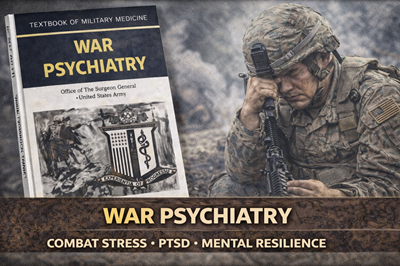
Textbook of Military Medicine Published by Office of The Surgeon General United States of America
War Psychiatry is a deep, comprehensive volume from the U.S. Army’s Textbook of Military Medicine series that explores the psychological realities of warfare and their impact on soldiers. Unlike traditional medical manuals focused on physical injuries, this publication examines the mental and emotional toll of combat—highlighting how stress, fear, fatigue, and trauma can shape performance, decision-making, and long-term health outcomes . It reinforces a critical truth: survival in conflict is not just physical—it is deeply psychological.
At its core, the publication analyzes combat stress reactions and psychiatric casualties, drawing from historical conflicts and modern military operations. As outlined in the table of contents and early chapters, it covers topics such as combat stress, post-traumatic stress disorder (PTSD), the psychological effects of isolation and fear, and the mental impact of nuclear, biological, and chemical warfare . These insights show that psychological breakdown is not weakness, but a natural response to extreme conditions—and one that can be predicted, managed, and often reversed with the right approach.
A major theme throughout the book is the importance of early intervention and leadership in maintaining mental resilience. The foreword and preface emphasize principles like proximity, immediacy, and expectancy (PIE), which focus on treating stress casualties close to the battlefield, as quickly as possible, and with the expectation of recovery . These principles dramatically improve the likelihood that individuals can return to duty and remain functional within their unit, reinforcing both individual recovery and group cohesion.
Beyond military applications, War Psychiatry offers powerful lessons for preppers, emergency responders, and anyone preparing for high-stress or disaster scenarios. It provides insight into how humans react under extreme pressure, how group dynamics influence survival, and how mental resilience can be strengthened before a crisis occurs. In any prolonged emergency, understanding stress, fear, and psychological endurance may be just as important as food, water, or medical supplies—making this publication a critical resource for true preparedness.