
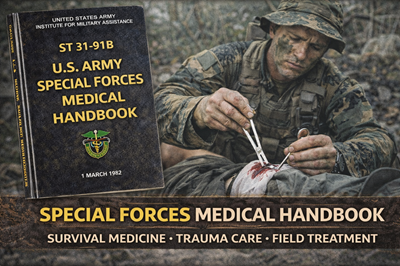
The U.S. Army Special Forces Medical Handbook (ST 31-91B) is a battlefield-proven, no-nonsense medical reference designed for extreme environments where professional care is limited or nonexistent. Developed for Special Forces medics operating deep in remote and hostile areas, this handbook is built around one reality: you may be the only medical help available. It serves as both a training guide and a field reference, giving users the ability to assess, treat, and manage a wide range of medical situations under pressure .
What makes this manual stand out is its breadth and practicality. As shown in the contents (page ii), it covers everything from body systems and infectious diseases to trauma care, pediatrics, toxicology, environmental injuries, and even nuclear, biological, and chemical (NBC) threats. It doesn’t just focus on emergencies—it teaches how to manage ongoing care, perform clinical assessments, and adapt treatment methods using limited resources. This makes it far more than a first aid guide—it’s a complete field medicine system .
The handbook is designed for speed and usability in high-stress situations. As noted in the preface (page iii), it prioritizes concise explanations and practical application over theory, allowing medics to quickly reference critical information when time matters most. It includes clear descriptions of symptoms, diagnosis methods, and treatment protocols for a wide range of conditions—from skin infections and respiratory issues to trauma and surgical-level interventions. The structured format ensures that even complex topics can be understood and applied in the field.
While originally intended for Special Forces, this manual is incredibly valuable for preppers, homesteaders, survivalists, and anyone preparing for off-grid or collapse scenarios. It provides the kind of medical knowledge that bridges the gap between basic first aid and advanced care—exactly what is needed when hospitals are inaccessible. In a true emergency, this handbook equips individuals to move beyond simple response and into real medical capability, decision-making, and long-term care management.