
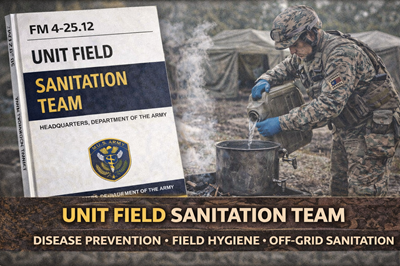
FM 4-25.12 (FM 21-10-1) UNIT FIELD SANITATION TEAM HEADQUARTERS, DEPARTMENT OF THE ARMY DISTRIBUTION RESTRICTION: Approved for public release; distribution is unlimited.
The Unit Field Sanitation Team (FM 4-25.12) is a foundational field manual focused on one of the most critical—but often underestimated—factors in survival and operational success: sanitation and disease prevention. Developed by the U.S. Army, this publication provides doctrine, training, and practical procedures for establishing and operating field sanitation teams (FSTs), whose primary mission is to protect the health of personnel in austere and high-risk environments .
At its core, the manual emphasizes a powerful reality: disease and nonbattle injury (DNBI) have historically caused more casualties than combat itself. As outlined in the early chapters, factors such as contaminated water, poor food handling, improper waste disposal, and insect-borne diseases can quickly degrade an entire unit’s effectiveness if not properly controlled . The publication makes it clear that sanitation is not just a support function—it is a frontline defense that directly impacts survival, readiness, and mission success.
The handbook provides detailed, practical guidance on managing real-world health threats in the field, including water purification, food service sanitation, waste disposal systems, pest and rodent control, and personal hygiene. It also addresses environmental hazards such as heat and cold injuries, toxic industrial chemicals, and noise exposure. The structured training program and lesson plans ensure that small units can implement these measures consistently, even under difficult conditions .
Beyond military use, this manual is extremely valuable for preppers, homesteaders, and anyone preparing for off-grid or disaster scenarios. It teaches how to build and maintain systems that prevent illness before it starts—something that becomes absolutely critical when medical care is limited or unavailable. In any long-term crisis, sanitation and hygiene are not optional—they are the difference between maintaining strength or watching a group slowly degrade. This publication provides a clear, disciplined blueprint for staying healthy when everything else breaks down.